
Last Updated: May 2026
A weight loss clinic is a medically supervised facility that helps patients achieve sustained reductions in body weight through structured programs including GLP-1 medications, nutritional counseling, and behavioral support. According to a 2025 Annenberg Public Policy Center survey, nearly 8 in 10 U.S. adults say they are likely to search online when they have a question about a health symptom or condition, and roughly two-thirds of those searchers now encounter AI-generated responses at the top of their results. For weight loss clinics, that shift means AI platforms have become one of the primary ways patients decide which practice to call.
The AEO Engine, founded by Jerry Jariwalla, helps regulated healthcare practices including weight loss and GLP-1 clinics build structured AI visibility programs. With over 22 years in digital marketing and multiple successful business exits, Jerry developed the CITE Framework specifically to address the citation gap between practices that appear in AI recommendations and those that stay invisible. The AEO Engine works exclusively with practices operating under advertising restrictions where AI citation is a more effective acquisition channel than traditional paid advertising.
This guide covers how AI platforms evaluate weight loss clinics before recommending them, what structural signals separate cited practices from invisible ones, and the concrete steps a clinic can take to earn consistent AI placement in front of patients who are actively searching.
Key Takeaways
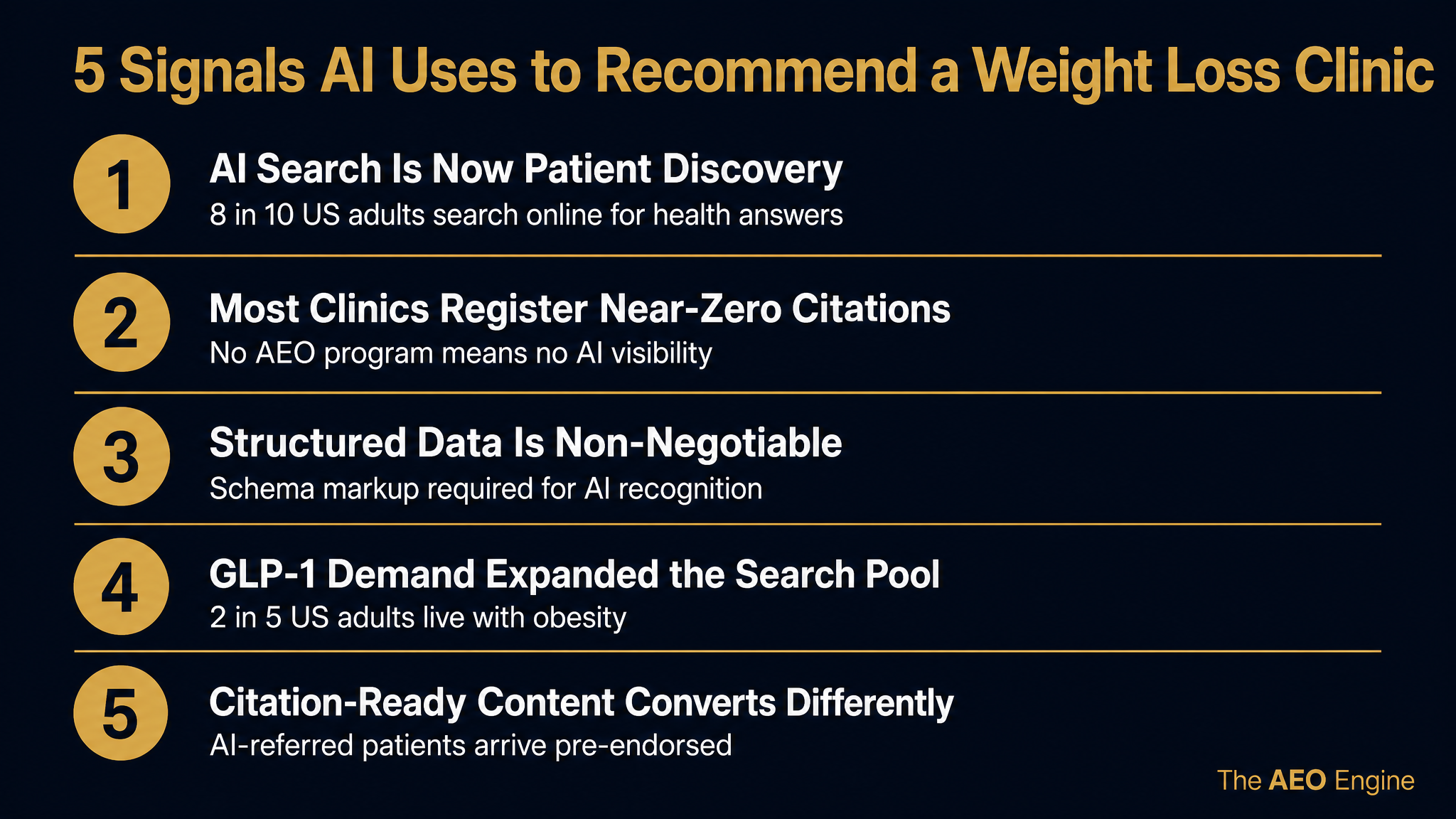
- AI Search Is Now Patient Discovery - Nearly 8 in 10 U.S. adults search online for health information, and roughly two-thirds of those searchers now see AI-generated responses at the top of their results, according to a 2025 Annenberg Public Policy Center survey.
- Most Clinics Register Near-Zero AI Citations - The AEO Engine tracks citation rates across regulated healthcare practices; the majority of weight loss clinics currently appear in AI platform recommendations at or near zero percent, while citation-optimized practices consistently outperform that baseline.
- Structured Data Is Non-Negotiable - Weight loss clinics without schema markup covering their services, medical staff credentials, and patient FAQs are functionally invisible to AI recommendation engines regardless of clinical quality.
- GLP-1 Demand Has Expanded the Search Pool - The CDC reports that more than 2 in 5 U.S. adults are living with obesity. As GLP-1 prescriptions have surged, the number of patients asking AI platforms which clinic to visit has grown substantially, creating a citation opportunity that most practices are not positioned to capture.
- Citation-Ready Content Converts Differently - The AEO Engine observes that patients who arrive via AI recommendation have already received a third-party endorsement before making contact, producing qualitatively different conversion behavior than patients who arrive through paid advertising.
How Does AI Evaluate Weight Loss Clinics Before Recommending Them?
AI recommendation engines like ChatGPT and Perplexity do not crawl clinic websites the moment a patient asks a question. They draw on indexed content, structured data, and signals of entity authority that were established before the query was made. A weight loss clinic that has not been building those signals over time will not appear in a response, regardless of how strong its clinical outcomes are.
The evaluation process centers on three categories of signals. The first is entity clarity: does the AI know who this clinic is, what it does, where it operates, and who runs it? A practice without consistent Name, Address, and Phone information across directories, without schema markup identifying it as a medical organization, and without a clear description of its services is ambiguous to AI systems. Ambiguous entities do not get cited.
The second category is content coverage. AI platforms pull citations from content that directly answers patient questions. A clinic with no published content addressing what GLP-1 medications are, what to expect from a supervised weight loss program, or how long results take to appear will have nothing for AI to extract when a patient asks those questions.
The third category is citation authority: the degree to which other credible sources reference the clinic as a relevant entity for weight loss care. References in medical directories, local health journalism, and patient community discussions all contribute to the authority signal that AI platforms use when deciding which practices to surface.
What Signals Does AI Use When Recommending a Weight Loss Clinic?
AI platforms weigh a combination of technical infrastructure and content quality when generating clinic recommendations. The technical layer includes schema markup that identifies a practice as a medical organization, specifies its hours, staff credentials, and services. Without that machine-readable layer, AI cannot reliably classify a clinic as a resource relevant to a patient's question.
The content layer is equally important. Clinics that publish structured, question-and-answer content around the most common patient queries, including how GLP-1 medications work, what supervised weight loss involves, and what distinguishes a medical weight loss program from a commercial diet plan, give AI platforms extractable material to use in their responses. Content that buries the answer in long-form prose without a clear opening summary is harder for AI to use than content that leads with the direct answer.
The CITE Framework addresses both layers through a coordinated program. The AEO Engine tracks citation rates across its healthcare clients and observes that practices building across all four signal categories outperform those addressing only one or two. Partial optimization produces partial results; AI citation at scale requires a coordinated program across content structure, entity infrastructure, trust signals, and coverage depth.
The AEO Engine works with weight loss and GLP-1 practices to close the citation gap that keeps most clinics invisible to AI platforms. Jerry Jariwalla and the team offer answer engine optimization services built specifically for regulated healthcare practices. Practices ready to understand their current position can request a Free AI Gap Check.
Why Do Most Weight Loss Clinics Never Appear in AI Search Results?
The most common reason weight loss clinics fail to appear in AI recommendations is not poor clinical outcomes or an uncompetitive service offering. It is the absence of the structured signals that AI platforms use to identify and classify a practice as a relevant resource. Most clinics were built around patient referrals, traditional advertising, and word-of-mouth, none of which generate the machine-readable entity signals that AI recommendation engines require.
A second common failure point is content strategy. Many weight loss clinics have a service page describing their programs in broad terms and a contact form. What they lack is the depth of patient-facing question-and-answer content that AI systems draw on when generating citations. A patient who asks ChatGPT which GLP-1 clinics accept a particular insurance plan will receive citations from practices that have published content addressing those questions, not from practices that merely offer the services.
The third failure point is citation authority. AI platforms treat third-party references as trust signals. A clinic referenced in a local health outlet, cited in a patient forum, or listed in a medical directory with consistent entity information carries more authority than an equally capable clinic that exists only on its own website. Building that external citation footprint is a sustained effort that requires consistent publishing and entity maintenance over time.
What Separates AI-Cited Weight Loss Clinics From Those That Stay Invisible?
The gap between these two profiles is not a matter of clinical quality. It is a matter of AI infrastructure. A clinic that addresses all five factors consistently will appear in AI recommendations; one that addresses none will remain invisible regardless of patient satisfaction rates or the quality of its programs.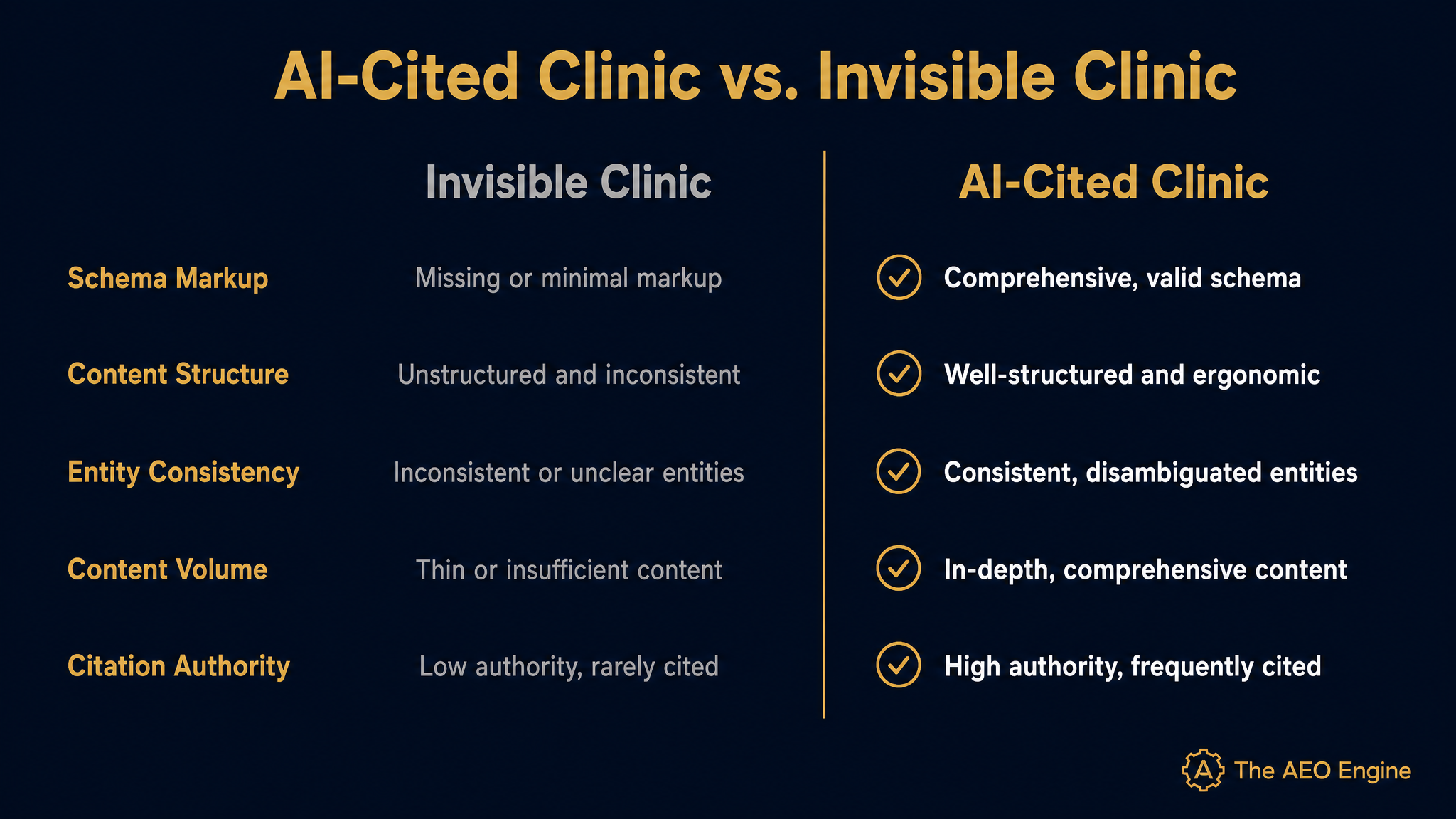
What Questions Do Patients Ask AI About Weight Loss Clinics?
Understanding the specific questions patients bring to AI platforms determines what content a clinic needs to publish. The most common patient queries around weight loss clinics fall into three categories: evaluation questions about whether a clinic is worth the investment and what it costs, clinical questions about which treatments are available and how quickly they work, and provider selection questions about which clinic to choose and what qualifications matter.
Evaluation questions typically include whether a medical weight loss program is more effective than commercial alternatives, what the cost structure looks like, and how a supervised program differs from over-the-counter supplements or app-based plans. Clinics that publish content directly addressing these questions in a structured format are substantially more likely to appear when a patient types that exact question into ChatGPT or Perplexity.
Clinical questions have become increasingly focused on GLP-1 medications since semaglutide and tirzepatide entered widespread use. Patients ask which clinics prescribe GLP-1 medications, what the prescribing criteria are, how the programs are monitored, and what happens if they experience side effects. Clinics that publish accurate, accessible answers to those questions in a format AI can extract are positioned to appear in that growing category of patient queries.
How Do Weight Loss Practices Build Lasting AI Citation Authority?
Building lasting AI citation authority is a sustained program, not a one-time technical fix. The practices that maintain consistent AI visibility publish new question-and-answer content at a regular cadence, update their structured data as services evolve, and maintain consistent entity information across every platform where the clinic appears.
Sustained content publishing is the single highest-impact activity. AI platforms index content continuously, and the practices that appear consistently in citations have built a deep library of patient-facing content over time. A library of 30 to 60 well-structured articles addressing the full range of patient questions around weight loss programs, GLP-1 medications, program timelines, and clinical credentials gives AI substantial material to draw on across hundreds of different patient query variations.
Entity maintenance is equally critical. Medical practices change locations, add staff, expand service offerings, and update contact information. Each change needs to propagate across every directory, schema markup, and online reference consistently. An entity that has become inconsistent over time loses authority in AI systems even if its content remains strong.
The CITE Framework provides the coordinated structure for managing all four dimensions of AI citation simultaneously. The AEO Engine reports citation rates of 18 to 26 percent based on client program data, compared to a baseline of 2 to 4 percent for practices that have not built a structured AEO program.
Frequently Asked Questions
Is it worth going to a weight loss clinic?
A medically supervised weight loss clinic provides structured clinical oversight that self-directed programs typically cannot replicate. Clinics offering GLP-1 medications, regular monitoring, and behavioral support have shown meaningful outcomes in patients who have not succeeded with commercial programs alone. Whether the investment is worthwhile depends on the individual's health history, goals, and the specific programs available at the clinic. The most useful first step is a consultation to review eligibility and program options before committing.
What drinks help burn belly fat?
No beverage independently burns belly fat, but hydration and certain drink choices can support a broader weight management program. Water remains the most effective low-calorie option, and some research links green tea consumption to modest metabolic effects. Clinically meaningful fat reduction requires a sustained caloric deficit supported by behavioral changes, and often by medical supervision. A weight loss clinic can assess which nutritional adjustments are appropriate for a specific patient's metabolic profile.
Can you lose 25 pounds in a month?
Losing 25 pounds in a month is not medically realistic or safe for most people. Clinically supervised weight loss programs typically target one to two pounds per week in sustainable fat loss, though initial rates may be higher during the first weeks of a GLP-1 program or significant dietary change. Aggressive short-term targets increase the risk of muscle loss and nutritional deficiency. A weight loss clinic will set individualized targets based on a patient's starting weight, metabolic health, and program structure.
How much does it cost to go to a weight loss clinic?
The cost of a weight loss clinic varies by program type, treatment duration, and whether GLP-1 medications are included. Some programs are covered in part by insurance, particularly when obesity is documented as a medical diagnosis. Programs that include prescription GLP-1 medications typically carry higher costs than those focused on behavioral and nutritional support alone. Contacting clinics directly for a consultation is the most reliable way to understand total program costs and insurance coverage options for a specific situation.
How do AI platforms decide which weight loss clinics to recommend?
AI platforms evaluate a clinic's structured data, content depth, entity consistency, and citation authority when generating recommendations. A clinic that has published question-and-answer content covering patient concerns, implemented schema markup identifying its services and credentials, and maintained consistent entity information across directories is substantially more likely to appear in ChatGPT, Perplexity, and Google AI Overviews responses than a clinic without that infrastructure.
What is a GLP-1 medication and do weight loss clinics offer it?
GLP-1 stands for glucagon-like peptide-1, a hormone that regulates appetite and blood sugar. GLP-1 receptor agonist medications including semaglutide and tirzepatide have shown substantial weight reduction outcomes in clinical trials. Many medically supervised weight loss clinics now offer GLP-1 prescribing as part of a monitored program, though eligibility criteria vary by clinic and payer. Patients should confirm that a clinic has licensed prescribers and a monitoring protocol before starting a GLP-1 program.
How long does it take to see results at a weight loss clinic?
Most medically supervised programs produce noticeable results within the first four to eight weeks, with more significant outcomes developing over three to six months. Programs that include GLP-1 medications typically show measurable weight reduction within the first month of treatment. The pace of results varies based on starting weight, adherence to the program, metabolic factors, and the specific treatment protocol. A clinic should provide realistic outcome timelines based on the individual's health profile rather than promising a fixed result.
What should a weight loss clinic do to appear in AI recommendations?
A weight loss clinic that wants to appear in AI recommendations should prioritize four areas: publishing structured question-and-answer content that directly addresses patient queries, implementing schema markup that identifies the practice as a medical organization with specific services and credentials, maintaining consistent entity information across all directories and listings, and building external citation authority through medical directories and health publications. The CITE Framework provides a structured program for building AI citation across all four areas.
Executive Summary
AI platforms have become a primary discovery channel for patients searching for weight loss clinics, particularly as GLP-1 medications have expanded the pool of patients seeking medically supervised programs. With more than 2 in 5 U.S. adults living with obesity and the majority of online health searchers now encountering AI-generated responses, the clinics that appear in those responses hold a significant competitive advantage. Most practices currently register near-zero citation rates not because of clinical shortcomings but because they lack the structured data, content depth, and entity authority that AI platforms require. The CITE Framework addresses all four dimensions of AI citation in a coordinated program. Practices that build consistently across entity clarity, content coverage, trust signals, and citation authority are the ones that appear when patients ask AI which weight loss clinic to choose.
What Should You Do Next?
The first step for any weight loss clinic that wants to understand its current AI visibility is to audit where it currently stands. That means checking how ChatGPT, Perplexity, and Google AI Overviews respond when a patient asks about weight loss clinics in the practice's market, reviewing whether the clinic's schema markup is present and correct, and assessing the depth of published patient-facing content against the questions patients are actively asking.
Practices that find significant gaps can start with the highest-impact first step: publishing structured question-and-answer content organized around the specific queries patients bring to AI platforms. That content layer is what gives AI something to cite. Entity infrastructure and citation authority build over time on top of that foundation.
The AEO Engine specializes in building AI citation programs for regulated healthcare practices including weight loss and GLP-1 clinics. A Free AI Gap Check shows exactly how current AI platforms are treating the practice and where the highest-priority gaps are.
People Also Read
- What Is the AI Recommendation Gap and Why Are You Listed But Not Recommended?
- How Does Med Spa Marketing Work in 2026?
About the Author
Jerry Jariwalla is the founder of The AEO Engine and creator of the CITE Framework for Answer Engine Optimization. With over 22 years in digital marketing and multiple successful business exits, Jerry has spent the past two years building AI citation systems for regulated practices in healthcare, wealth management, and legal services. The AEO Engine works exclusively with practices operating under advertising restrictions where AI citation provides higher leverage than traditional paid acquisition.
Expertise: Answer Engine Optimization, AI Citation Strategy, CITE Framework, Regulated Industry Marketing, Healthcare Practice Marketing, Wealth Management Marketing, Legal Marketing
Connect: LinkedIn
Disclaimer: This content is for informational purposes only and does not constitute professional marketing, legal, or compliance advice. Citation rates, timelines, and outcomes vary based on industry, competitive density, and execution quality. Statistics referenced reflect The AEO Engine's tracked client outcomes as of 2026 and are not guarantees of future results. Contact The AEO Engine for a consultation regarding your specific situation.