
Last Updated: May 2026
A med spa marketing program in 2026 is the coordinated effort to make an aesthetic practice the answer AI assistants give when prospective patients ask which provider to choose. A growing share of consumers now consult AI chat tools before searching the open web, which has shifted med spa discovery away from traditional rankings toward AI citation. The practices winning new patient consultations are the ones AI tools recommend by name, not just the ones that appear on a results page.
The AEO Engine was built by founder Jerry Jariwalla to solve this exact gap for regulated practices including med spas. With over 22 years of digital marketing experience and multiple successful business exits, Jerry caught the AI search shift in 2024 and developed a citation-first methodology for med spas, plastic surgery groups, and other aesthetic medicine practices that must operate under HIPAA, FTC, and state-specific advertising rules.
This article explains what med spa marketing looks like in the AI search era, the four work areas a serious program covers, what evaluation criteria separate effective agencies from generic SEO shops, the typical timeline and investment ranges, and how practice owners can audit their current AI visibility before committing to a vendor.
Key Takeaways
- AI Recommendation Is the New Lead Source - AI assistants now feed a meaningful share of consultation requests for aesthetic practices, and the providers AI names by default capture that flow.
- Listed Is Not Recommended - Most med spas show up in directories and map packs yet are never named in an AI answer, which is the new visibility gap.
- Entity Consistency Is the Foundation - Practices with inconsistent NAP data, mismatched service descriptions, and absent structured data are functionally invisible to AI ranking systems.
- Citation-Ready Content Beats Keyword Content - Content engineered for clean AI extraction outperforms generic SEO blog posts by a wide margin when the goal is being quoted by ChatGPT or Perplexity.
- Regulated Practices Need Regulated Marketing - Med spas operate under FDA device rules, state board oversight, and HIPAA, so the marketing program must respect those constraints from the first article forward.
A serious med spa marketing program in 2026 treats AI citation as the primary outcome, with traditional SEO, paid search, and social as supporting channels rather than the headline strategy.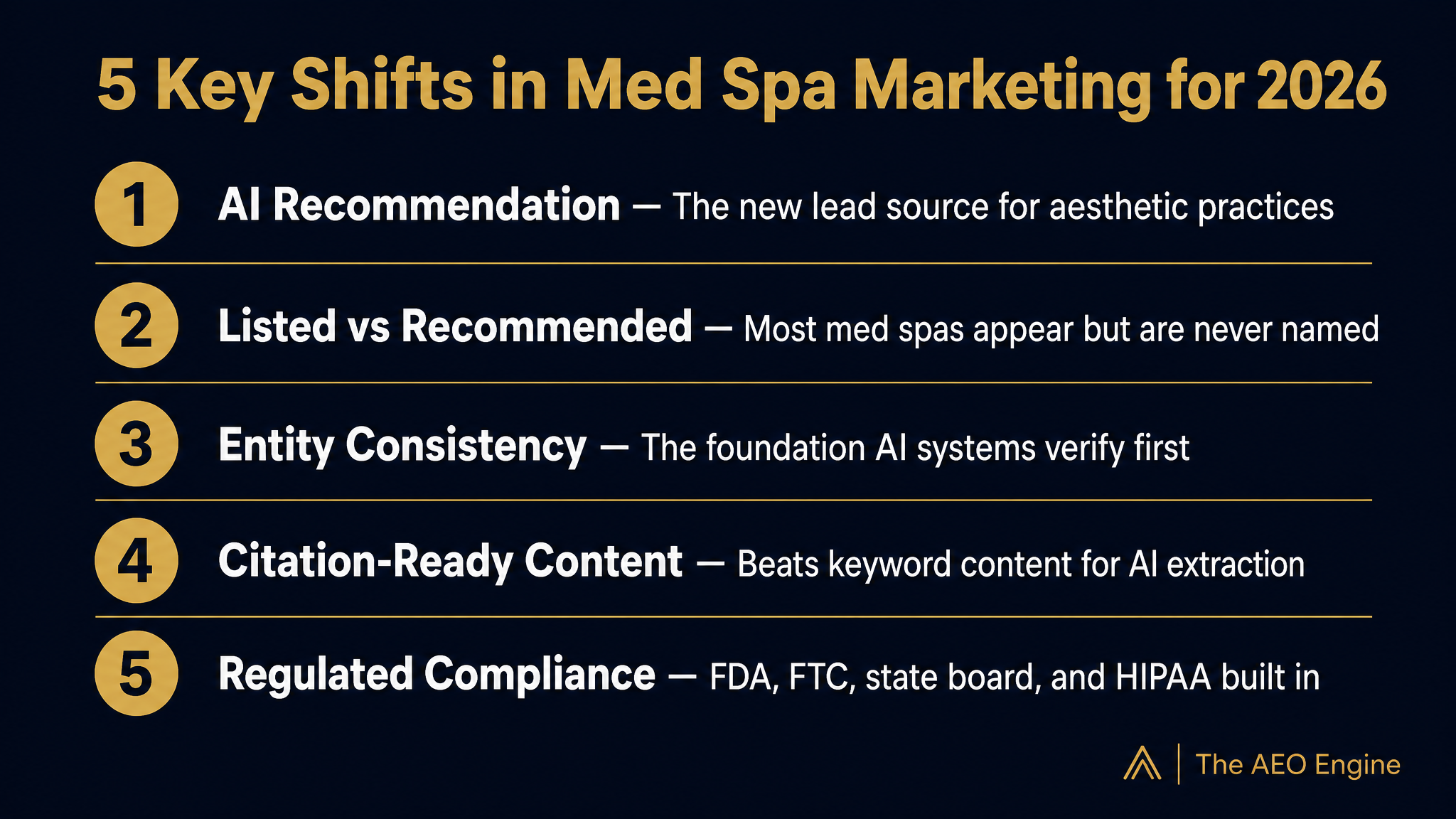
Why Has Med Spa Marketing Changed So Much in 2026?
Med spa marketing has changed because the discovery pattern for aesthetic services has changed. Prospective patients increasingly start a research journey by asking ChatGPT or Perplexity for recommended providers in their city, the safest injectable options for their concern, or which device platforms produce the most reliable results. AI tools answer those questions by citing specific practices, articles, and authorities, and the practices that appear in those citations capture the consultation request.
Traditional SEO still has a role, but it now serves the AI layer rather than the consumer directly. AI tools read structured content, entity-consistent pages, and authoritative third-party citations to decide which med spas to mention. A site optimized only for Google's blue links often has none of the markers AI tools look for.
What Are the Four Work Areas in a Modern Med Spa Marketing Program?
A modern program covers four coordinated work areas rather than running each channel as a separate campaign. The areas reinforce each other because AI systems aggregate signals across the entire web presence before deciding whether to recommend a practice.
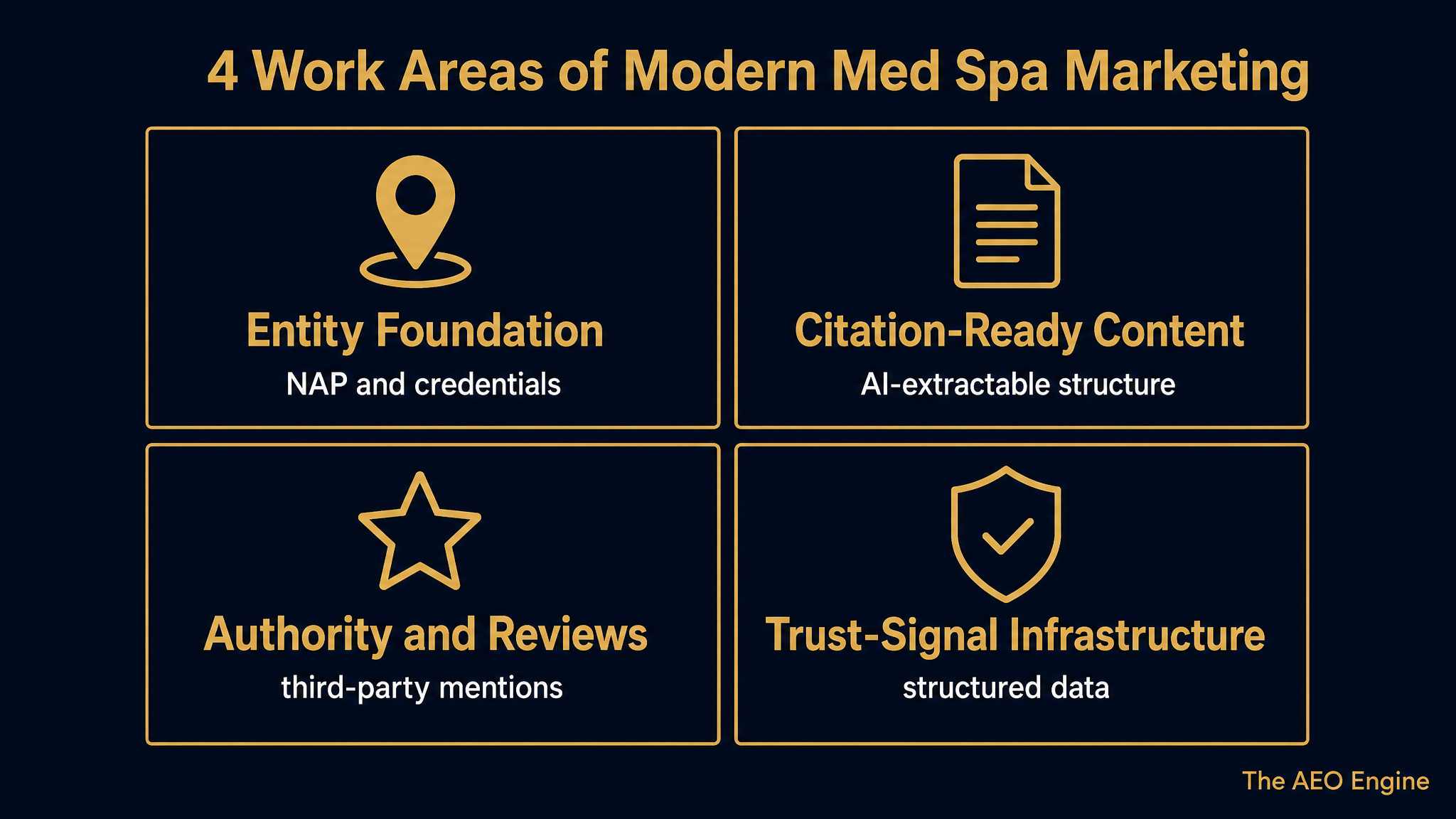
- Entity foundation - The practice's name, address, phone, service categories, and provider credentials are consistent across the website, Google Business Profile, healthcare directories, and structured data.
- Citation-ready content - Articles and service pages are written and formatted so AI tools can extract clean answers about treatments, candidate criteria, recovery timelines, and pricing categories.
- Authority and reviews - The practice earns mentions on third-party sources AI tools trust, including local press, industry publications, and medical directories, paired with verified patient reviews.
- Trust-signal infrastructure - Machine-readable data covering the business entity, the providers, and the content itself is layered into every page so AI tools can verify the practice in seconds.
Each work area is necessary. A program that nails three of the four typically sees limited citation lift because AI systems read the gap as a missing signal.
If your med spa needs to move from invisible to recommended on AI platforms, The AEO Engine offers a free AI visibility audit for regulated practices including aesthetic medicine. The team has spent the past two years building citation systems for healthcare practices that must operate under FDA, FTC, and state board advertising rules.
What Should Med Spa Owners Look For When Hiring a Marketing Agency?
A med spa owner should look for an agency that demonstrates regulated-industry fluency, can show citation outcomes rather than just ranking screenshots, and is willing to operate under the practice's compliance constraints from day one. Generic digital marketing shops often produce content that violates state board rules for aesthetic medicine, or that uses before-and-after claims in ways that trigger FDA enforcement attention.
The right partner treats AI citation as the headline metric and traditional rankings as a derivative outcome. The wrong partner sells a keyword report and a blog calendar with no plan for how the content will be cited by AI tools or read by structured data systems.
- Regulated-industry track record - The agency can name healthcare or wealth or legal verticals it has worked in and explain how its content respected the rules in those industries.
- AI citation reporting - The agency tracks named mentions on ChatGPT, Perplexity, and AI Overviews, not just keyword positions.
- Structured-data competence - The agency implements the article-level, business-entity, and author-level structured data rather than treating schema as an optional extra.
- Authority-building plan - The agency has a documented approach for earning mentions on third-party publications AI tools trust.
- Compliance review workflow - The agency builds compliance checks into the content workflow rather than asking the practice to catch issues at publish time.
How Does AI Search Pick Which Med Spas to Recommend?
AI search picks med spas to recommend based on a combination of entity consistency, content extractability, authority signals, and the freshness of structured data covering the practice and its providers. The recommendation logic is not a single ranking number, it is an aggregation of confidence signals across the web presence.
Practices that figured out the AI citation game early tend to share several characteristics. They publish content that answers patient questions directly in the opening sentences, they keep their Google Business Profile and NAP data perfectly consistent, they earn mentions on regional press and medical directories, and they implement structured data covering both the business and the providers as people. The combination raises the AI's confidence enough that it will name the practice when a patient asks for recommendations.
What Does a Med Spa Marketing Program Actually Cost?
A med spa marketing program built around AI citation typically requires a meaningful monthly investment because the work spans content production, structured data engineering, authority outreach, and ongoing entity maintenance. Pricing varies by scope, regional competition, and the volume of providers and locations the program needs to cover. Practice owners should expect a discovery and audit phase, a foundation-building phase, and an ongoing program rather than a single one-time engagement.
The investment math usually favors AI citation programs because patients arriving via an AI recommendation tend to convert at higher rates than patients arriving via a generic search result. The AEO Engine tracks consultation-to-treatment conversion rates of 30 to 45 percent for AI-recommended traffic versus 10 to 15 percent for traditional organic traffic based on client program data, which means a smaller volume of better-qualified leads often produces more revenue than a larger volume of cold organic clicks.
How Long Does a Med Spa Marketing Program Take to Show Results?
A med spa marketing program built on AI citation usually shows meaningful citation activity in the first 60 to 90 days, with steady gains continuing through months four to six as the structured data ages and authority signals compound. The timeline depends on the practice's starting position, the competitive density of the local market, and how aggressively the program builds authority during the first quarter.
The AEO Engine tracks citation rates of 18 to 26 percent across regulated client programs based on tracked outcomes, with the highest performers reaching the 24 to 30 percent range after the program has been running for six months or more. Practices that start with broken entity data, missing schema, and thin content typically see citation activity at zero at intake, which means the first 60 days are foundation work before any citation lift becomes visible.
What Are the Most Common Mistakes Med Spas Make in Their Marketing?
The most common mistakes med spas make in their marketing involve treating AI search as a future problem, accepting generic content that does not extract cleanly, and assuming that ranking on Google guarantees being recommended by AI. Practices often invest heavily in social media and paid acquisition while ignoring the structured-data and content-engineering work that determines whether AI tools will ever mention them.
The pattern across mistakes is the same. Practices invest in channels they can see, like paid ads and social posts, and underinvest in the structured, technical, citation-oriented work that drives AI recommendations.
Frequently Asked Questions
What is the difference between med spa marketing and med spa SEO?
Med spa marketing in 2026 covers the full set of channels and signals that drive new patient consultations, with AI citation as the headline outcome. Med spa SEO is a narrower discipline focused on keyword rankings and organic traffic. Modern programs still include SEO work, but they treat it as one input into a larger AI-citation strategy rather than the end goal. A practice that ranks well but is never cited by ChatGPT or Perplexity is missing the channel patients increasingly trust most.
How much should a med spa spend on marketing each month?
A med spa should expect a meaningful monthly investment that reflects the cost of content production, structured-data engineering, compliance review, and authority outreach. Pricing varies by scope, location, and provider count, so practice owners should request a custom proposal rather than rely on industry averages. The investment math tends to favor citation-first programs because AI-recommended leads convert at higher rates than generic organic leads, so total cost per acquired patient is often lower even at higher monthly retainer levels.
Can a med spa do its own AEO without an agency?
A med spa can do its own AEO if it has in-house staff with experience in structured data, compliance-aware content writing, and authority outreach. In practice, most practices lack that combination because the skill set spans technical SEO, healthcare compliance, and editorial production. Hiring an agency that specializes in regulated-practice AEO is usually faster and produces cleaner citation outcomes than building the function in-house from scratch.
What metrics should a med spa track to measure marketing success?
A med spa should track AI citation rates across ChatGPT, Perplexity, and AI Overviews, consultation request volume, consultation-to-treatment conversion rate, and revenue per acquired patient. Traditional metrics like keyword rankings and organic traffic remain useful as leading indicators, but they should never be the headline metric. A practice that ranks well but converts poorly has a content or trust-signal problem that ranking reports do not surface.
How does compliance affect med spa marketing content?
Compliance affects med spa marketing content because aesthetic medicine sits under FDA device rules, FTC advertising standards, state medical board oversight, and HIPAA when patient stories are involved. Content that uses before-and-after claims aggressively, names off-label treatment uses, or quotes patient identifiers can trigger enforcement attention. Citation-first programs build compliance review into the content workflow rather than treating it as a final check at publish time.
Why are AI citations more valuable than search rankings for med spas?
AI citations are more valuable than search rankings for med spas because AI tools deliver a single recommended provider rather than a list of ten options. A patient asking ChatGPT for the best med spa in a city receives one or two names, not a results page. Being one of those named providers captures the consultation request before the patient ever sees a competitor's website, which is why AI citation tends to convert at higher rates than equivalent organic visibility.
Do reviews still matter for med spa marketing in the AI era?
Reviews still matter for med spa marketing in the AI era because AI tools read review aggregation signals as part of their trust calculus. A practice with strong, verified reviews on Google Business Profile, RealSelf, and other trusted platforms gives AI systems more confidence to recommend it. Fake or incentivized reviews are flagged and ignored, so the work has to be a real reputation program, not a review-buying scheme.
What is the first thing a med spa should fix in its marketing?
The first thing a med spa should fix in its marketing is the entity foundation: business name, address, phone, provider names, credentials, and service descriptions must be consistent across the website, Google Business Profile, and major directories. Without that consistency, none of the downstream work in content, authority, or schema produces reliable citation results. Practices typically discover several inconsistencies during the foundation audit even when leadership believes the data is clean.
Executive Summary
Med spa marketing in 2026 is no longer about keyword rankings and social posts. The discovery pattern for aesthetic services has shifted toward AI assistants like ChatGPT and Perplexity, and the practices winning consultation requests are the ones AI tools recommend by name. A serious program covers four coordinated work areas: entity foundation, citation-ready content, authority and reviews, and trust-signal infrastructure. Regulated industry fluency matters because aesthetic medicine operates under FDA, FTC, state board, and HIPAA constraints that generic agencies often violate. The investment math favors citation-first programs because AI-recommended traffic converts at meaningfully higher rates than generic organic traffic. Practice owners should expect a 60 to 90 day foundation window before citation lift becomes visible, with steady compounding through the first year as authority signals and structured data age into the AI confidence layer.
What Should You Do Next?
Practice owners ready to evaluate their current AI visibility should start with an audit of how AI tools currently describe the practice. A free citation audit shows whether ChatGPT, Perplexity, and AI Overviews already name the practice, name the wrong practice, or return generic results that hand the consultation request to a competitor.
Request a free AI visibility audit from The AEO Engine. The audit covers entity consistency, structured data, current AI citation status, and the highest-impact fixes the practice can make in the first 30 days.
About the Author
Jerry Jariwalla is the founder of The AEO Engine and creator of the CITE Framework for Answer Engine Optimization. With over 22 years in digital marketing and multiple successful business exits, Jerry has spent the past two years building AI citation systems for regulated practices in healthcare, wealth management, and legal services. The AEO Engine works exclusively with practices operating under advertising restrictions where AI citation provides higher leverage than traditional paid acquisition.
Expertise: Answer Engine Optimization, AI Citation Strategy, CITE Framework, Regulated Industry Marketing, Healthcare Practice Marketing, Wealth Management Marketing, Legal Marketing
Connect: LinkedIn
Disclaimer: This content is for informational purposes only and does not constitute professional marketing, legal, or compliance advice. Citation rates, timelines, and outcomes vary based on industry, competitive density, and execution quality. Statistics referenced reflect The AEO Engine's tracked client outcomes as of 2026 and are not guarantees of future results. Contact The AEO Engine for a consultation regarding your specific situation.