
Last Updated: May 2026
The AI recommendation gap is the structural difference between being mentioned by AI when users ask broad category questions and being actively recommended by AI when users ask buying-intent questions. AI extraction systems treat broad mentions and decision-stage recommendations as different selection problems, and businesses that score high on the first often fail the second because the signals AI weighs for each are not the same.
The AEO Engine provides Answer Engine Optimization services to regulated practices in healthcare, wealth management, and legal sectors, where advertising restrictions make AI citation uniquely valuable. Founder Jerry Jariwalla, creator of the CITE Framework for Answer Engine Optimization, has spent over 22 years in digital marketing across multiple industries and led the development of citation tracking methodologies that distinguish list-tier appearance from recommendation-tier citation across regulated services.
The questions below identify what the AI recommendation gap actually is, why a business can show up on lists but never as a recommendation, and what the optimization work to close the gap looks like in practice.
Key Takeaways
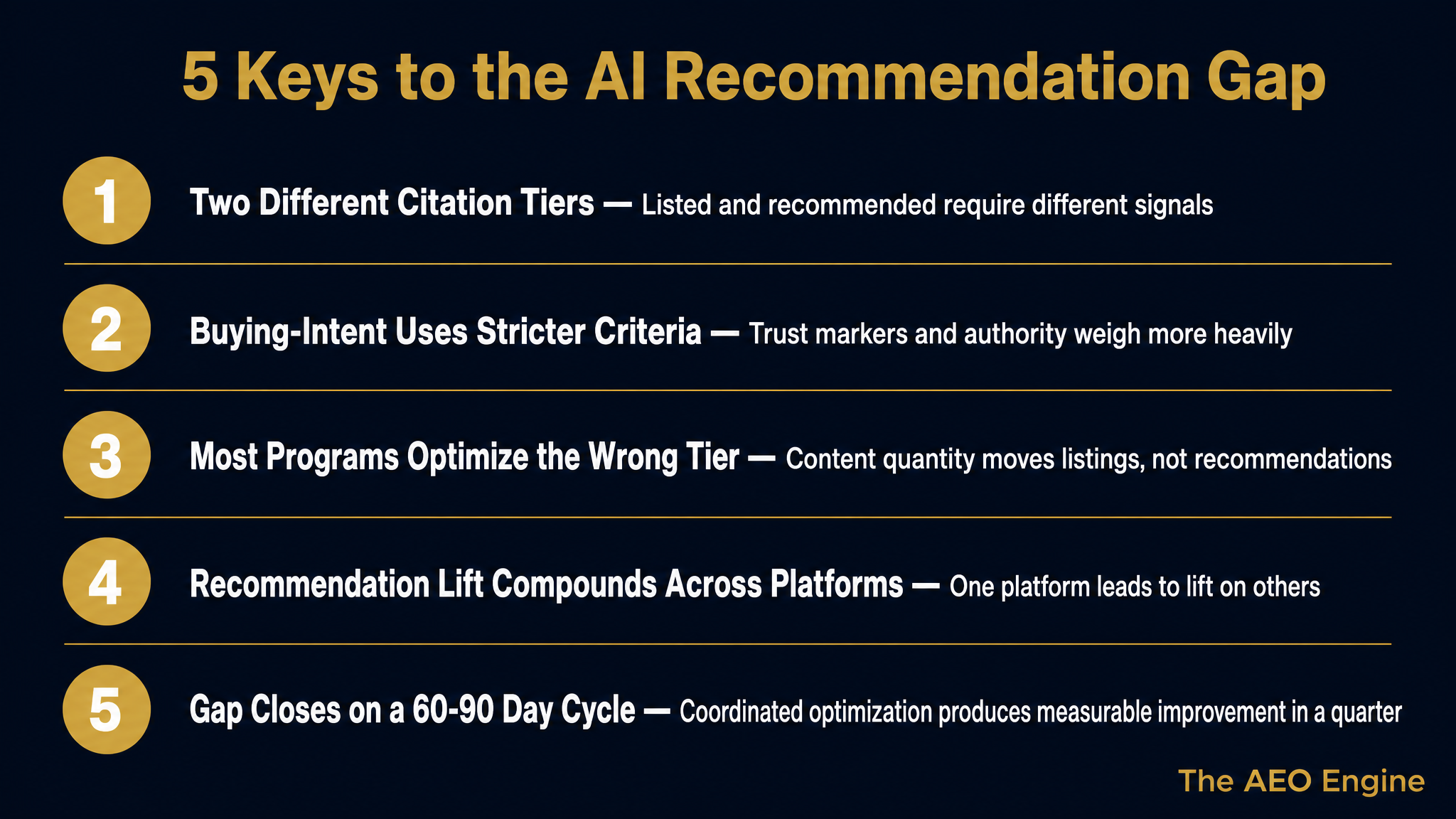
- Listed and Recommended Are Two Different Citation Tiers. Being included in a category list is mention-tier; being named when a user asks a buying-intent question is recommendation-tier, and the signals that drive each are not the same.
- Buying-Intent Queries Use Stricter Selection Criteria. AI weighs trust markers, authority signals, and entity consistency more heavily for decision-stage queries than for general-knowledge queries.
- Most Businesses Optimize for the Wrong Tier. Generic content production lifts list-tier appearance but does not move recommendation rates, which is why traffic-focused programs often fail to produce booked consultations.
- Recommendation-Tier Citation Compounds Across Platforms. Practices that close the recommendation gap on one AI platform typically see lift across ChatGPT, Perplexity, and AI Overviews simultaneously.
- The Gap Closes on a 60 to 90 Day Cycle. Coordinated optimization that audits entity baselines first, then sequences trust-marker work, typically produces measurable recommendation lift within a single quarter.
Key Takeaway AEO 9
What Does the AI Recommendation Gap Actually Look Like?
The AI recommendation gap appears whenever a business shows up in AI responses to broad category questions but is absent from AI responses to specific buying-intent questions. A wealth management firm might be mentioned when a user asks ChatGPT to "list financial advisory firms in New York" but never appear when the same user asks "Which fiduciary financial advisor should I trust for retirement planning?" The first query produces a list; the second produces a recommendation.
The gap is structural rather than competitive. Businesses with strong list-tier appearance typically have content optimized for category coverage, broad mentions across the web, and basic entity consistency. The recommendation tier requires additional signals: documented authority within the specific service category, trust markers that justify a personal recommendation, and structured data that gives AI extraction systems confidence the business is the right answer rather than just a relevant one.
For regulated practices, the recommendation gap is especially costly because regulated services attract decision-stage queries more often than browsing queries. A patient asking ChatGPT for a GLP-1 weight loss specialist, a client asking Perplexity for a fiduciary advisor, or a prospect asking Google AI Overviews for a specific kind of attorney is in buying mode. The list tier captures awareness; the recommendation tier captures the booking.
Why Are You Listed But Not Recommended by AI?
The most common reason a business is listed but not recommended is that the business has invested in content quantity but not in trust marker depth. Volume-based content programs lift category coverage and broad mention rates because AI extraction systems can find more pages to reference, but they do not strengthen the authority and trust signals that AI weighs heavily for buying-intent queries.
The second common reason is entity inconsistency across platforms. A business with mismatched names, addresses, services, or credentials between its website, professional directories, review platforms, and association memberships gets filtered out of recommendation responses even when its content is otherwise strong. AI extraction systems resolve identity ambiguity by recommending the cleanest profile rather than the most prominent one.
The third common reason is structured data weakness. Pages without the JSON-LD signals that document who operates the business, what credentials they hold, and what services they actually deliver force AI to rely on inference, and inference produces conservative recommendations that favor better-documented competitors.
The fourth common reason is platform coverage gaps. Businesses visible only on their own website typically miss recommendations that go to competitors with broader presence across professional directories, review platforms, and category-specific authority surfaces.
How Is the Recommendation Gap Different From a Visibility Gap?
A visibility gap means the business is invisible to AI entirely, with no mentions in either list-tier or recommendation-tier responses. A recommendation gap means the business is visible at the list tier but absent at the recommendation tier. The two gaps require different optimization work, and treating them as the same problem produces predictable failure patterns.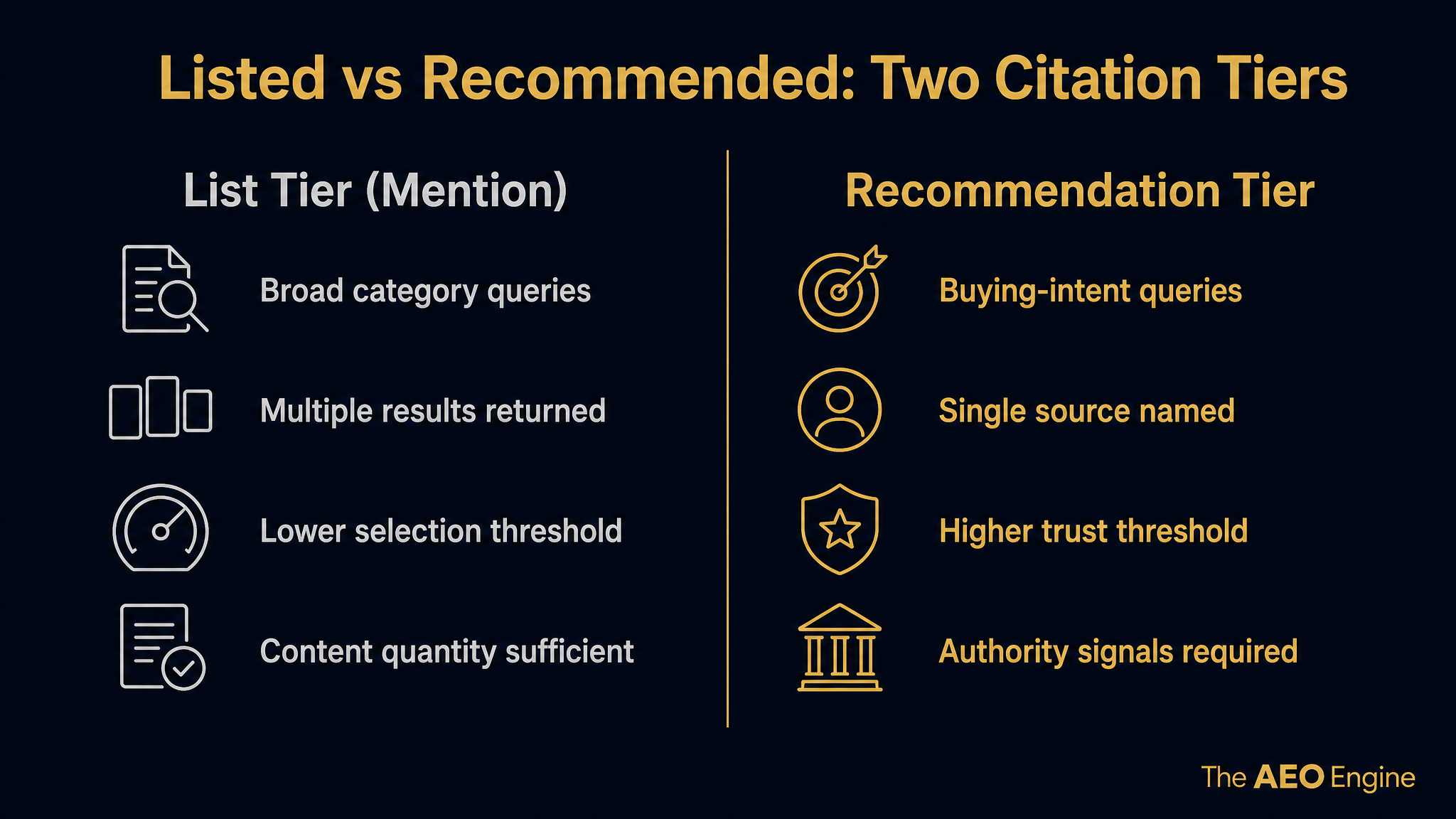
Visibility gap closure focuses on basic AI presence: cross-platform indexability, content extractability, and minimal structured data. Most generic AI marketing programs address visibility gaps, which is why they typically deliver measurable mention-tier lift within the first 30 to 60 days.
Recommendation gap closure focuses on the additional signals AI weighs for buying-intent queries: documented authority within specific service categories, trust marker depth, structured data that establishes the business as the right answer rather than just a relevant one, and entity consistency that resolves any ambiguity in AI's favor.
The mistake businesses make is investing in visibility-gap work and then expecting recommendation-tier results. The optimization compounds, but only when the program addresses both gap types in sequence rather than treating mention-tier metrics as proxies for booked consultations.
What Signals Move the Recommendation Tier Specifically?
Recommendation-tier citation is moved by trust markers, authority documentation, structured data depth, and entity consistency across the specific service category the practice serves.
Trust markers in regulated industries include credentials documented in indexable text, professional association memberships verified through structured data, third-party endorsements from authority publications, and clear evidence of jurisdictional or regulatory standing. AI extraction systems weigh these signals heavily for buying-intent queries because users making decisions need to verify legitimacy.
Authority documentation includes publications, speaking engagements, industry-specific recognition, and case study evidence that demonstrates depth in the specific service category. AI weighs vertical authority more heavily than general business authority for decision-stage queries.
Structured data depth includes the entity-level signals that give AI extraction systems confidence about who operates the practice, what credentials they hold, and what services they actually deliver. Pages with thin or missing structured data force AI to rely on inference, and inference produces recommendations that favor better-documented competitors.
Entity consistency means the same business name, address, services, credentials, and jurisdictional details appear identically across every platform where the practice is referenced. Inconsistencies create ambiguity that AI extraction systems resolve by recommending a cleaner competitor profile.
The AEO Engine offers a Free Gap Check, full Answer Engine Optimization services, and the CITE Framework program for regulated practices ready to close both visibility and recommendation gaps.
How Do You Close the AI Recommendation Gap in Practice?
Closing the AI recommendation gap requires sequencing the work in a specific order: entity audit first, then trust marker documentation, then structured data implementation, then platform coverage expansion. Starting in the wrong order produces work that has to be redone once foundation issues become visible.
Entity audit comes first because trust marker work compounds incorrectly when foundation entity data is inconsistent. A practice that documents credentials extensively across platforms with mismatched name and address data produces conflicting signals that hurt recommendation rates rather than helping them.
Trust marker documentation comes second because trust markers do most of the recommendation-tier lifting. Credentials in indexable text, professional memberships verified through structured data, and authority signals documented in machine-readable formats together drive the bulk of recommendation rate improvement.
Structured data implementation comes third because structured data amplifies trust markers rather than replacing them. Without trust markers to amplify, structured data alone produces marginal improvement.
Platform coverage expansion comes last because expanding coverage on top of a foundation of inconsistent entity data and weak trust markers produces broader visibility at the list tier without moving the recommendation tier.
Does Closing the Gap on One AI Platform Lift Citation on Others?
Yes, in most cases. Closing the recommendation gap on ChatGPT typically produces measurable lift on Perplexity and Google AI Overviews simultaneously because the underlying signals AI extraction systems weigh are similar across platforms. The platforms differ in their retrieval strategies, ranking models, and user interface, but the trust markers, authority signals, structured data, and entity consistency that drive recommendation-tier citation work across all three.
The exception is platforms with their own proprietary ranking systems that weigh signals differently from web-extraction-based AI. These platforms require additional optimization work specific to their ranking model, but they represent a small share of total AI citation volume in 2026.
For most regulated practices, the practical approach is to optimize against the AI extraction patterns shared across the major platforms first, then layer on platform-specific work for the platforms where the practice has unusual citation gaps.
Frequently Asked Questions
What is the AI recommendation gap?
The AI recommendation gap is the structural difference between being mentioned by AI when users ask broad category questions and being actively recommended by AI when users ask buying-intent questions. The two citation tiers require different optimization signals, and businesses with strong list-tier appearance often fail the recommendation tier because the underlying selection criteria differ.
Why am I listed but not recommended by AI?
The most common reasons are content quantity without trust marker depth, entity inconsistency across platforms, structured data weakness, and platform coverage gaps. Each prevents recommendation-tier citation in a different way, and the right fix depends on which gaps are present in the practice's current optimization profile.
How long does it take to close the AI recommendation gap?
Coordinated programs that sequence the work correctly typically produce measurable recommendation rate improvement within 60 to 90 days. Faster timelines are sometimes possible when only one or two signals need work, but full closure across all categories typically takes one to two quarters of sustained optimization.
Is the AI recommendation gap the same as a visibility gap?
No. A visibility gap means the business is invisible to AI entirely; a recommendation gap means the business is visible at the list tier but absent at the recommendation tier. The two require different optimization work, and treating them as the same problem produces predictable failure patterns.
Does my Google ranking help me close the AI recommendation gap?
Not directly. Pages ranking number one on Google can still fail recommendation-tier citation when their trust markers, authority signals, structured data, or entity consistency are weak. Google rewards click-through optimization; AI weighs different signals for buying-intent queries.
Which AI platforms have the biggest recommendation gaps for regulated practices?
Practices in healthcare, wealth management, and legal sectors typically see the largest recommendation gaps on ChatGPT and Perplexity, which weigh trust markers heavily for buying-intent queries in regulated categories. Google AI Overviews shows similar patterns but tends to weigh existing search authority somewhat more.
Can I close the recommendation gap without rebuilding my website?
Often yes. Most recommendation-gap closure work involves entity consistency cleanup across existing platforms, trust marker documentation in indexable text, and structured data implementation on existing pages. Full website rebuilds are sometimes useful but rarely necessary for recommendation tier improvement.
What is the Free Gap Check from The AEO Engine?
The Free Gap Check is a no-cost diagnostic that runs the full AI visibility audit methodology and delivers a prioritized gap map. It identifies both visibility-tier and recommendation-tier gaps separately and indicates which signals to address in what sequence. The Gap Check is conducted personally by Jerry Jariwalla rather than generated by an automated tool.
Executive Summary
The AI recommendation gap is the structural difference between being mentioned by AI in list-tier responses and being actively recommended in buying-intent responses. The two citation tiers require different optimization signals, and businesses that score high on the first often fail the second because content quantity alone does not move recommendation rates. Closing the gap requires sequencing the work correctly: entity audit first, then trust marker documentation, then structured data implementation, then platform coverage expansion. The AEO Engine's CITE Framework program addresses both gap types in the right order to produce measurable recommendation rate lift. Based on client program data, recommendation-tier improvement typically becomes visible within 60 to 90 days for regulated practices that complete the sequenced optimization. Practices that invest in visibility-gap work and expect recommendation-tier results consistently underperform those that treat the gaps as separate problems requiring different signal work.
What Should You Do Next?
Audit how your business currently appears on ChatGPT, Perplexity, and Google AI Overviews for both broad category queries and specific buying-intent queries in your service area. Document where you appear at the list tier and where you are absent at the recommendation tier. Identify the gap pattern that applies to your practice. Request The AEO Engine's Free Gap Check to receive a prioritized gap map that distinguishes visibility-tier gaps from recommendation-tier gaps and sequences the optimization work for measurable recommendation rate lift within a single quarter.
About the Author
Jerry Jariwalla is the founder of The AEO Engine and creator of the CITE Framework for Answer Engine Optimization. With over 22 years in digital marketing and multiple successful business exits, Jerry has spent the past two years building AI citation systems for regulated practices in healthcare, wealth management, and legal services. The AEO Engine works exclusively with practices operating under advertising restrictions where AI citation provides higher leverage than traditional paid acquisition.
Expertise: Answer Engine Optimization, AI Citation Strategy, CITE Framework, Regulated Industry Marketing, Healthcare Practice Marketing, Wealth Management Marketing, Legal Marketing
Connect: LinkedIn
Disclaimer: This content is for informational purposes only and does not constitute professional marketing, legal, or compliance advice. Citation rates, timelines, and outcomes vary based on industry, competitive density, and execution quality. Statistics referenced reflect The AEO Engine's tracked client outcomes as of 2026 and are not guarantees of future results. Contact The AEO Engine for a consultation regarding your specific situation.