
Last Updated: June 2026
A wealth management service is a professional service that manages investments, planning, and financial decisions for clients. AI tools now name specific firms when someone asks for one. Harvard researchers note that AI tools are reshaping how people get financial guidance. When a buyer asks ChatGPT or Perplexity for a wealth manager, the answer names a few firms. The firms it names are rarely the biggest. They are the ones with the clearest trust data.
The AEO Engine is a citation program that helps regulated practices move from listed to cited by AI. Its founder, Jerry Jariwalla, brings over 22 years in digital marketing and created the CITE Framework after 18 months of testing across regulated industries. The AEO Engine works with wealth, healthcare, and legal practices. It tracks citation rates across client programs and closes the gaps that keep firms out of AI answers.
This guide covers the signals AI uses to pick wealth management firms, why most are missing from these answers, and what a structured citation program does differently.
Key Takeaways
- AI Treats Wealth Management as a High-Trust Category - Wealth questions involve money and risk, so AI applies stricter trust filters before naming any firm.
- Entity Clarity Decides Citations More Than Brand Size - AI checks how clearly a firm is described across sources. A big brand name does not guarantee citation without consistent data.
- Most Wealth Firms Are Invisible to AI - A capable firm with strong clients can be absent from AI answers because its digital entity signals are thin.
- The CITE Framework Closes the Citation Gap - It builds the structured signals AI needs to name a firm with confidence in a regulated category.
- Citation Rates on Structured Programs Run 18 to 26 Percent - The AEO Engine tracks this range across client programs based on its own program data.
Each of these points separates firms that AI names from those it skips.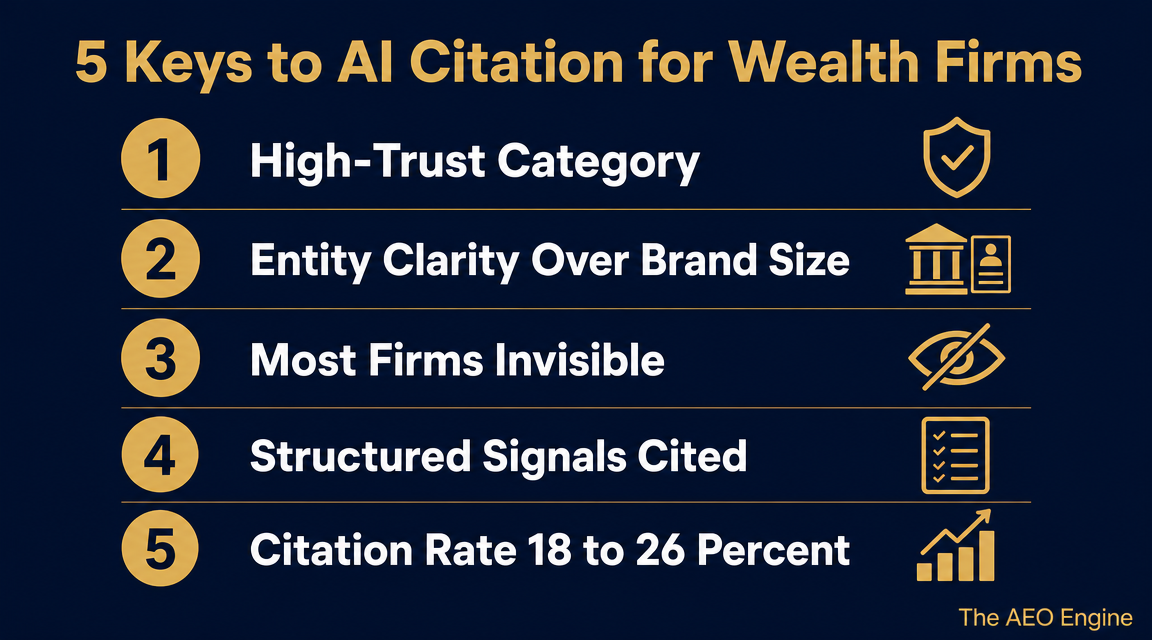
Why Does AI Treat Wealth Management as a High-Trust Category?
AI applies stricter filters to money, health, and legal topics. A wrong answer here can cause real harm. Google calls this YMYL, short for "your money or your life." ChatGPT and Perplexity apply the same caution.
AI will not name a wealth management firm without strong trust signals. One website is not enough. One brand mention is not enough. AI looks for the same firm across regulatory databases, directories, and media. The name, credential, and specialty must match.
Wealth firms have one edge. Their registrations are verifiable. The SEC's investor tools let anyone check a firm's standing. AI can read those same public records. A clean record gets a firm into the pool AI considers. It does not decide who AI names.
What Signals Does AI Use to Pick a Wealth Management Firm?
AI checks four signal types. Most firms are strong in one and weak in the rest.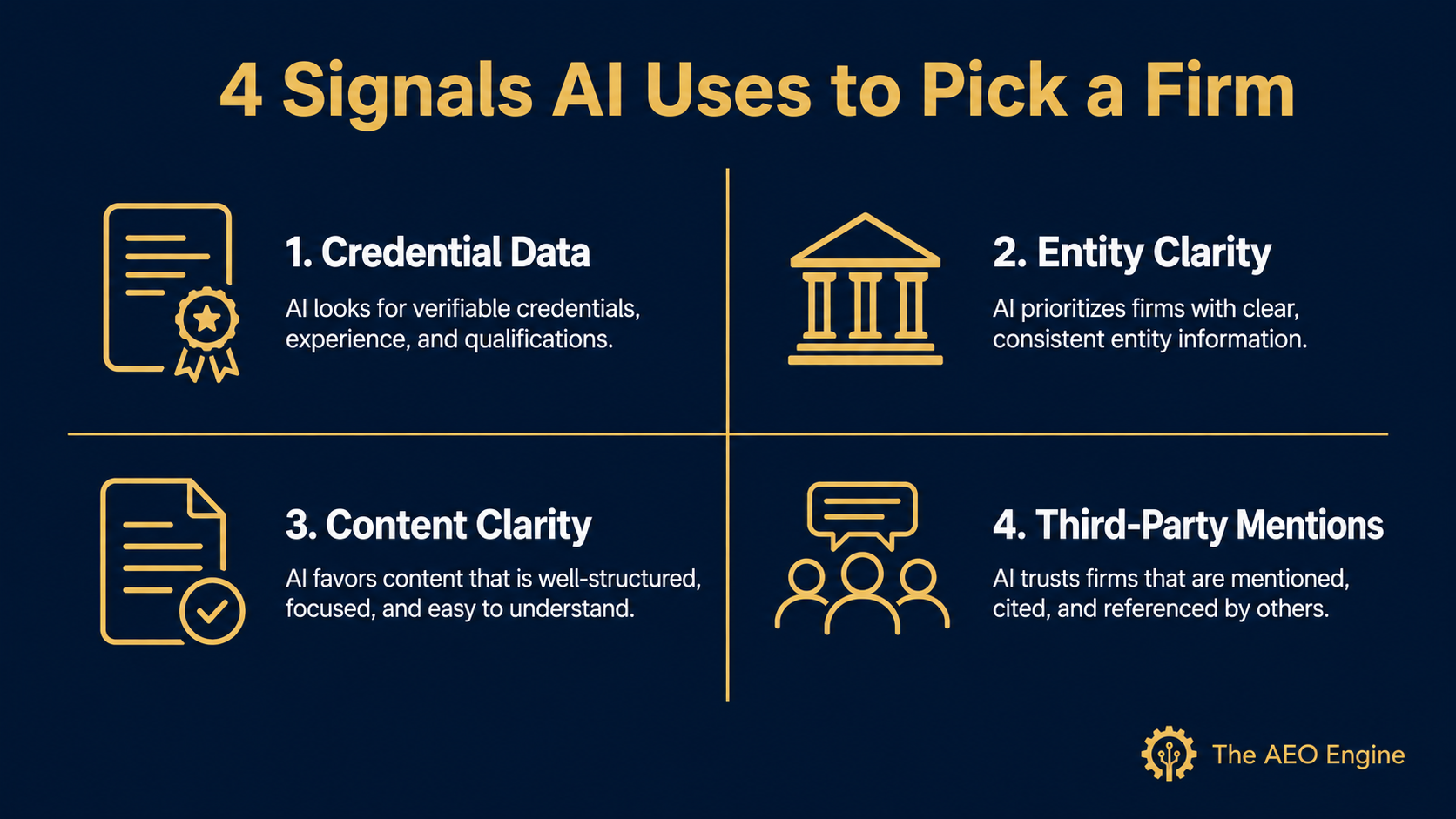
- Credential data - AI reads public regulatory records. A current, complete registration signals a legitimate firm.
- Entity clarity - The firm's name, credential, and location must match across the website, directories, and listings.
- Content clarity - AI favors firms that publish clear answers on fees, services, and planning.
- Third-party mentions - AI weighs mentions in directories and media that confirm the firm is trusted.
A firm strong across all four is a candidate for citation. A firm strong in only one is usually skipped, even a large one.
What Separates Firms AI Cites From Those It Ignores?
The gap is not brand size. Many large firms with strong reputations do not appear in AI answers for specific queries. The gap is structured digital entity data.
AI cannot evaluate what it cannot read. A firm with billions under management but a thin, inconsistent website is hard for AI to cite. Citations can go to smaller firms with clearer signals.
A large firm with messy entity data competes against a focused firm with clean data and verified credentials. For a specific query, AI may name the second firm. The first still has its brand. Its AI inquiry channel stays weak. That is the cost of the gap.
Why Are Most Wealth Management Firms Missing From AI Answers?
Most firms built their presence for brand marketing and basic search. They ran ads, built a brand site, and ranked for their own name. None of that produces what AI reads for category queries.
AI does not rank a list of links. It names a few firms it trusts for a question. That trust comes from consistent entity data, clear content, and verifiable credentials. Most firms have never managed those signals as a system.
HubSpot's research on answer engine work confirms that AI favors sources with clear, consistent signals. A firm that has never built those signals is absent from AI answers for category queries, regardless of its size or brand.
The AEO Engine runs AI citation audits for wealth management firms. The audit covers every signal type and delivers a ranked action plan. Book a free Gap Check to see where your firm stands.
How Does a Structured Citation Program Help a Wealth Firm?
A structured citation program treats AI visibility as a system. It starts with an audit of the firm's current signals. It finds where the entity data is thin, inconsistent, or missing.
From there, it builds what AI needs. It aligns the firm's name, credential, and location across sources. It structures content so AI can read and cite it. It builds the third-party signals that confirm the firm is trusted.
The CITE Framework is the method behind this work. The AEO Engine tracks citation rates of 18 to 26 percent across client programs based on its own program data. That compares with near-zero rates for firms that have not addressed their entity signals.
Frequently Asked Questions
What is a wealth management service?
A wealth management service is a professional service that manages a client's investments, financial planning, and related decisions. It often combines investment management, tax planning, estate planning, and retirement planning under one relationship. Wealth management usually serves clients with larger or more complex finances. The service aims to grow and protect wealth over time while coordinating the many parts of a client's financial life through a single advisor or firm.
What is the average fee for wealth management?
Wealth management fees commonly run around 1 percent of assets managed per year, though the rate often drops as account size rises. Some firms charge flat or tiered fees instead. Fee-only firms avoid commission conflicts. The exact fee depends on the firm, the services included, and the size of the account. Always ask for the full fee schedule in writing and confirm whether any commissions or extra costs apply before signing on.
What is the average cost for wealth management?
The total cost of wealth management includes the management fee plus any underlying fund or product costs. The headline fee is often about 1 percent of assets per year, but fund expenses and trading costs can add to that. Larger accounts usually pay a lower percentage. Some firms bundle planning into the fee, while others charge separately. Ask for a full breakdown of all costs, not just the headline rate, so you can compare firms fairly.
Can a financial advisor help with crypto?
Some financial advisors now help with cryptocurrency, but not all do. Those who do may advise on how crypto fits a broader portfolio, the risks involved, and tax treatment. Many traditional firms remain cautious due to volatility and regulatory uncertainty. If crypto matters to you, ask an advisor directly about their experience and approach before engaging. AI tools that recommend advisors may not surface crypto specialists unless those firms have clear, structured content on the topic.
How does AI decide which wealth management firm to recommend?
AI checks four signal types: credential data, entity clarity, content clarity, and third-party mentions. It looks for a firm whose name, credential, and location match across trusted sources. A clean regulatory record gets a firm into the running. Clear entity data and well-structured content decide which firm AI names. Brand size alone does not drive AI citations. Consistent, verifiable digital signals do.
Why is my wealth management firm not showing up in ChatGPT?
The most common reason is thin or mismatched entity data. If your firm's name, credential, and location do not match across your website, directories, and listings, AI cannot read your firm as one trusted entity. Many firms also lack content that answers category questions. The fix is to build consistent entity signals and clear content that AI can cite, which is the focus of a structured citation program.
How long does it take to get cited by AI?
Most structured programs see citation changes within the first quarter. The exact timeline depends on the firm's starting point, the category, and how complete the build is. Firms with strong credentials but thin digital signals often move faster. The trust already exists. It just needs to be made readable to AI. Building a durable citation pattern is ongoing work, not a one-time setup.
Can a smaller wealth firm compete with large firms in AI answers?
Yes. AI does not simply name the biggest firms. It names the firms with the clearest, most consistent signals. A smaller firm with clean entity data, verified credentials, and well-structured content can be cited ahead of a large firm with messy or thin signals. This is one advantage of AI citation over brand-driven marketing. Signal clarity matters more than brand size, which puts a well-prepared smaller firm on competitive footing.
Executive Summary
AI now names specific wealth management firms when people ask for help. The choice comes from four signal types: credential data, entity clarity, content clarity, and third-party mentions. A verifiable regulatory record gets a firm into the pool AI considers, but it does not decide who gets named. Most wealth firms are missing from AI answers, not because of weak service, but because their digital entity signals are thin or inconsistent. The firms AI names have clear, consistent, verifiable data across many sources. A structured citation program using the CITE Framework builds those signals and closes the gap. The AEO Engine tracks citation rates of 18 to 26 percent across client programs based on its own program data, compared with near-zero rates for firms that have not addressed entity signals.
What Should You Do Next?
Three steps help a wealth management firm understand and close its AI citation gap.
First, ask ChatGPT and Perplexity to recommend a wealth management firm for a situation like your clients'. Note whether your firm appears. If it does not, the entity signal gap is active.
Second, check your firm's data for consistency. Confirm your name, credential, and location match across your website, directories, and listings.
Third, book a free Gap Check with The AEO Engine. The session maps your credential and entity gaps and delivers a ranked fix plan.
People Also Read
- How Do AI Marketing Services Move You From Listed to Recommended?
- How Does AI Decide Which Online TRT Clinics to Recommend?
About the Author
Jerry Jariwalla is the founder of The AEO Engine and creator of the CITE Framework for Answer Engine Optimization. With over 22 years in digital marketing and multiple successful business exits, Jerry has spent the past two years building AI citation systems for regulated practices in healthcare, wealth management, and legal services. The AEO Engine works exclusively with practices operating under advertising restrictions where AI citation provides higher leverage than traditional paid acquisition.
Expertise: Answer Engine Optimization, AI Citation Strategy, CITE Framework, Regulated Industry Marketing, Healthcare Practice Marketing, Wealth Management Marketing, Legal Marketing
Connect: LinkedIn
Disclaimer: This content is for informational purposes only and does not constitute professional marketing, legal, or compliance advice. Citation rates, timelines, and outcomes vary based on industry, competitive density, and execution quality. Statistics referenced reflect The AEO Engine's tracked client outcomes as of 2026 and are not guarantees of future results. Contact The AEO Engine for a consultation regarding your specific situation.