
Last Updated: May 2026
An AI marketing service is a managed program that uses AI tools and signal optimization to grow a business's visibility, leads, and reputation across digital channels, with the most advanced category targeting AI citation rate rather than traffic volume. According to Search Engine Land's 2024 reporting on AI search, 60 percent of B2B buyer journeys now include at least one query to an AI platform like ChatGPT, Perplexity, or Google AI Overviews, which means visibility in those AI responses has become a primary acquisition channel. The factor that determines whether AI marketing services move a business from being listed to being actively recommended is whether the program optimizes for citation rate or for traffic volume.
The AEO Engine provides AI marketing services to regulated practices in healthcare, wealth management, and legal sectors, where advertising restrictions make AI citation uniquely valuable as a visibility channel. Founder Jerry Jariwalla, creator of the CITE Framework for Answer Engine Optimization, has spent over 22 years in digital marketing across multiple industries and led the development of citation tracking methodologies adopted by service businesses operating under FDA, SEC, and bar association compliance constraints. The questions below identify the seven AI marketing service categories, the deliverables that move practices from listed to recommended, and the evaluation criteria that separate citation-driving programs from generic AI content production.
The decisions that follow are not theoretical service category descriptions. They represent the specific deliverables, the measurement frameworks, and the cost ranges that produce 18 to 26 percent citation rates for actively-AEO-optimized regulated practices within 60 to 90 days of program launch. Each takeaway names a specific service category, a specific cost benchmark, or a specific evaluation criterion that a practice can apply within the next 30 days.
Key Takeaways
- Listed and Recommended Are Different AI Outcomes - Being listed means appearing in a generic directory or aggregator that an AI platform pulls from. Being recommended means an AI platform names the business directly in its response to a relevant question. Citation rate, the percentage of relevant queries in which the business is named, is the metric that distinguishes the two outcomes.
- AI Marketing Services Cover Seven Categories - AI content production, AI-driven SEO, AI advertising management, AI-powered email automation, AI customer service tools, AI marketing analytics, and Answer Engine Optimization (AEO). The categories overlap, but only AEO directly targets citation rate as the success metric.
- Regulated Practices See Highest Returns From AEO Services - Practices operating under FDA, SEC, or bar association advertising restrictions generate the largest return from AEO services because earned AI citation replaces advertising channels they cannot use. Healthcare, wealth management, and legal practices typically see citation rates of 18 to 26 percent within 12 months.
- Service Costs Range From $500 to $10,000 Monthly - AI marketing services pricing varies widely by category. Tool subscriptions vary by platform and feature tier. Managed AEO services for regulated practices are priced by content scope and platform coverage. Full-service AI marketing programs for mid-market businesses range from $5,000 to $10,000 monthly.
- Citation Rate Replaces Traffic as the Primary Success Metric - Traditional AI marketing services measure traffic, leads, and ranking position. The category shift toward AEO measures citation rate across ChatGPT, Perplexity, Claude, and Google AI Overviews. Practices selecting services on traffic metrics alone consistently miss the visibility shift happening in AI search.
Each of these five outcomes is measurable before any service retainer is signed. The practices that treat AI marketing services as a citation-rate procurement decision rather than a content-volume purchase consistently avoid the two failure modes that derail AI marketing programs: buying AI tools without integration into a measurement framework, and measuring traffic instead of citation rate when AI search is the primary visibility channel.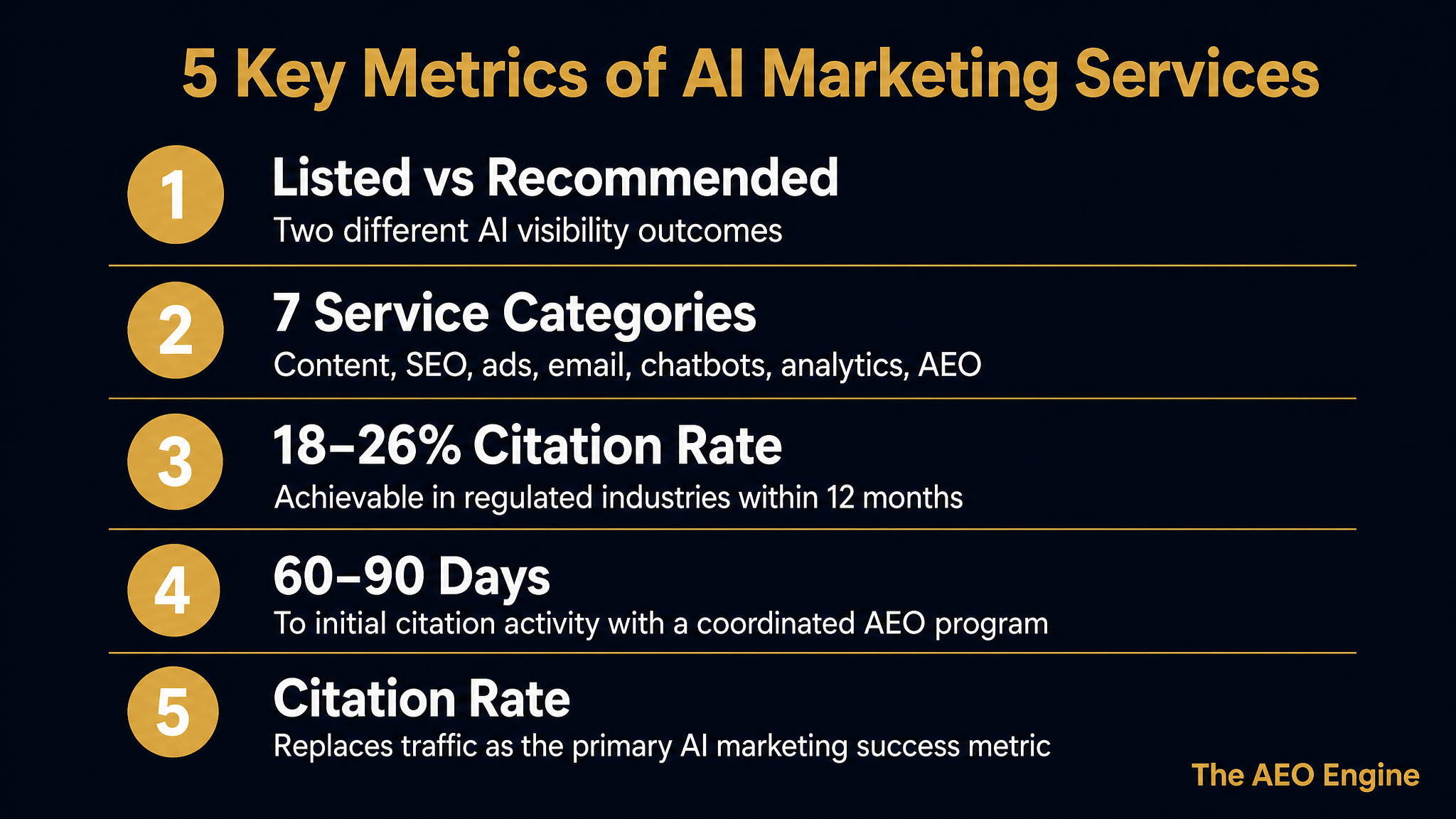
What Are AI Marketing Services?
AI marketing services are managed programs that combine AI-powered tools with strategic signal optimization to grow a business's digital visibility, leads, and reputation. The category includes content production, search optimization, paid advertising, email automation, customer service, analytics, and Answer Engine Optimization. Most services use AI tools like Jasper, Claude, or ChatGPT for content production while applying human strategy and review on top of AI outputs.
The category divides cleanly into two strategic orientations. The first orientation uses AI tools to produce traditional marketing outputs faster and cheaper, including content for SEO, ad copy, email sequences, and customer service responses. The second orientation targets AI itself as a marketing channel, optimizing for citation in AI-generated answers rather than producing content for human readers alone. Most established AI marketing services blend both orientations, but the specific weighting determines whether the program produces citation rate gains or traffic volume only.
The strategic question for a practice evaluating AI marketing services is whether the program treats AI primarily as a production tool or as a visibility channel. Programs treating AI as a production tool produce content faster but rarely move citation rate. Programs treating AI as a visibility channel produce citation rate gains but require entity audits, schema implementation, and multi-platform tracking that traditional services typically skip.
What's the Difference Between Being Listed and Being Recommended by AI?
Being listed by AI means appearing in a generic source that AI platforms pull from for general directory information, including Google Business Profile, Yelp, BBB, or industry-specific aggregator sites. Being recommended by AI means a platform names the business directly in its response to a relevant question, distinguishing the practice from generic alternatives based on entity signals, trust markers, and content authority.
The shift from listed to recommended is driven by four signal categories that AI platforms weigh:
- Coverage - Strategic presence across the platforms AI pulls from for authority validation, including industry-specific directories, professional association sites, review platforms, knowledge bases, and editorial publications.
- Indexability - Content structural readiness for AI extraction, supported by structured data and clean HTML formatting.
- Trust Signals - Specific credentials, certifications, reviews, awards, and authority markers documented in the practice's content and structured data.
- Entity Clarity - Identity consistency across every place the business appears, with the same legal name, address, services, and credentials.
Practices appearing only on generic listings without strong signals across all four categories are listed but not recommended. AI platforms encounter the business in directories but do not have enough authority signal evidence to name the business directly in a response.
How Do AI Marketing Services Differ From Traditional Digital Marketing?
The fundamental difference is the role AI plays in the service delivery. Traditional digital marketing services use AI as a productivity tool to write faster, target ads more efficiently, and analyze data at scale. AI marketing services position AI as both a production tool and a visibility channel, with citation rate across AI platforms emerging as a primary success metric.
The strategic implication for service businesses is that AI marketing services without an AEO component produce content faster but rarely shift visibility in AI search. Practices that need to be recommended by AI rather than just appearing in directories typically need either dedicated AEO services or AI marketing services with AEO as a defined deliverable.
If your practice needs a structured approach to AI citation strategy, The AEO Engine offers Answer Engine Optimization services for regulated practices building their first AI citation program. The team has tracked citation rates across healthcare practices and wealth management firms operating under regulatory constraints since 2024.
What AI Marketing Services Drive Citations Versus Traffic?
Five service deliverables specifically drive AI citation rate rather than traffic alone: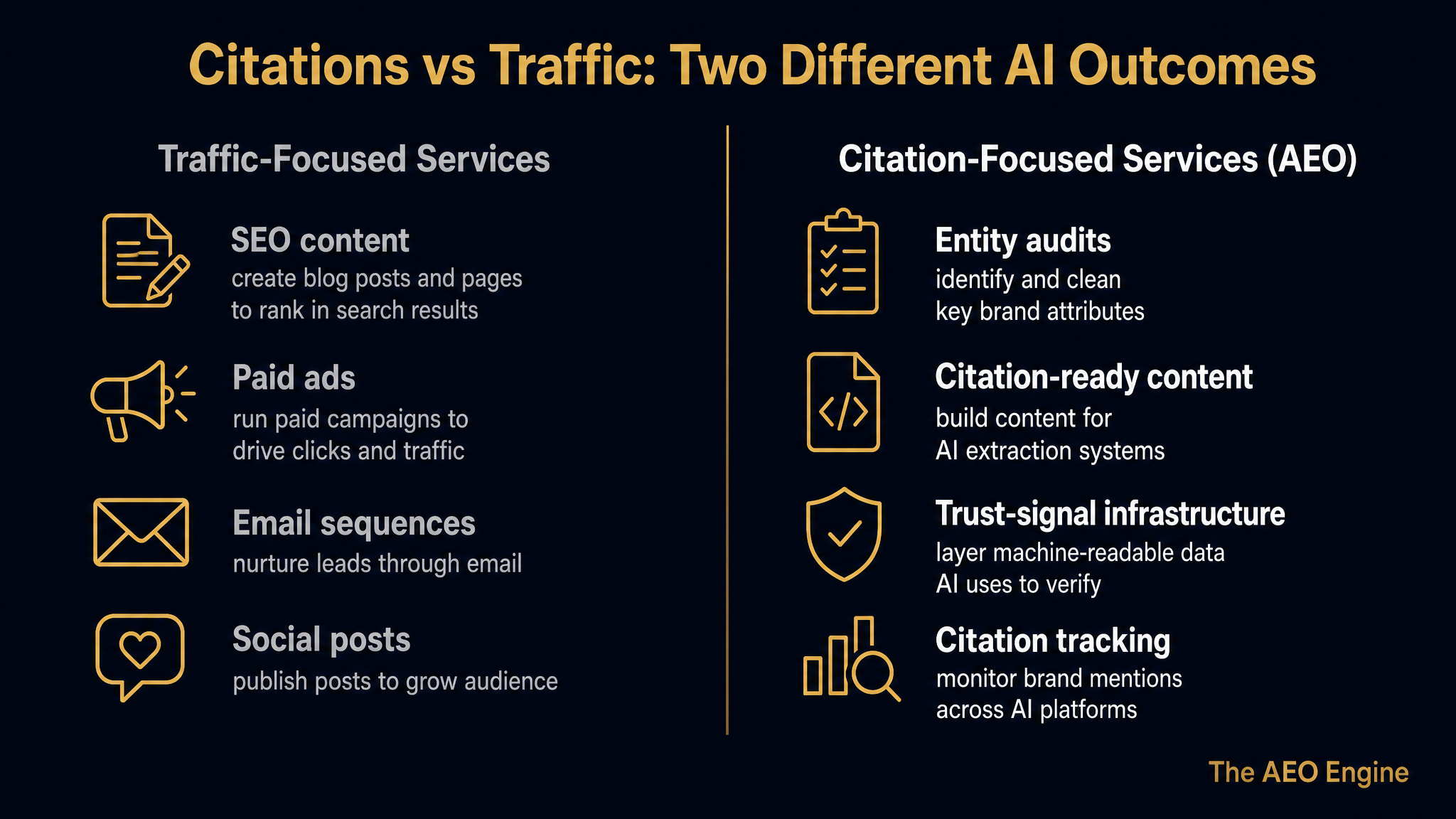
- Entity Consistency Audits - Cross-platform reviews that identify inconsistencies in business name, address, services, and credentials across the practice's website, professional directories, review platforms, and association profiles. AI platforms cross-reference these data points and reduce citation confidence when entity signals diverge.
JSON-LD Schema Implementation - Structured data markup for Organization, Person, FAQ, Article, and Service entities. Schema is the language AI platforms use to identify and categorize businesses; absence of structured data severely limits citation potential regardless of content quality.
- Citation-Ready Content Production - Content built for AI extraction, paired with comprehensive FAQ coverage and prose-style answers that crawlers can lift cleanly into responses.
- Authority Signal Documentation - Credential, certification, and association membership documentation surfaced in HTML body content and structured data rather than buried on credentials pages or in PDF documents AI crawlers cannot process.
- Multi-Platform Citation Tracking - Continuous measurement of business citations across ChatGPT, Perplexity, Claude, and Google AI Overviews. Tools such as Otterly.AI automate this tracking; manual sampling is feasible at lower query volumes.
Traditional AI marketing services often include some of these deliverables incidentally but rarely as primary focus areas. AEO services include all five as foundational deliverables and measure citation rate as the primary success metric.
How Should Regulated Practices Choose AI Marketing Services?
Regulated practices in healthcare, wealth management, and legal services should evaluate AI marketing services against three criteria specific to compliance-constrained verticals:
- Regulatory Familiarity - The provider must demonstrate experience with FDA marketing rules, SEC compliance requirements, or bar association advertising rules depending on the practice's vertical. Providers without regulated-industry experience often produce content that requires extensive compliance rework before publication, eroding the time savings the engagement was meant to provide.
- Authority Signal Documentation - Regulated practices typically have stronger credential foundations than unregulated industries (board certifications, peer-reviewed publications, association memberships, years of practice). The AI marketing service must surface these signals in structured data, content, and cross-platform listings rather than treating them as supplementary information.
- Compliance Review as a Standard Step - The service workflow must include compliance review before content publication, with clear processes for handling performance claims, treatment outcomes, and legal advice statements that intersect with regulatory standards.
For regulated practices, AI marketing services without AEO orientation typically produce traffic gains but limited citation rate gains, leaving the practice listed but not recommended in AI search. Services with AEO orientation tend to produce stronger results because the credential and authority signals regulated practices already have align directly with AI citation criteria.
What's the Typical Cost and Timeline for AI Marketing Services?
Costs vary significantly by service category and deliverable scope. Tool subscriptions for self-managed AI content production vary by platform across tools like Jasper, Claude Pro, or ChatGPT Team. Managed AI marketing services for small businesses typically range from $1,000 to $3,000 monthly. Managed AEO services for regulated practices vary by content scope and platform coverage. Full-service AI marketing programs for mid-market businesses range from $5,000 to $10,000 monthly.
Setup fees are common at engagement start for managed services, covering entity audits, schema implementation, baseline measurement, and content workflow setup. Practices skipping setup work to avoid the fee typically see slower results because the foundation that makes ongoing work compound is missing.
Timeline expectations differ by service category. AI content production gains are visible within 30 days as content volume increases. SEO gains from AI-augmented optimization typically take several months. AEO citation rate gains begin within 60 to 90 days for regulated practices following coordinated programs.
What Red Flags Signal a Poor AI Marketing Services Fit?
Five patterns signal that an AI marketing services provider is unlikely to produce citation rate gains for regulated practices:
- No Citation Rate Methodology - The provider cannot describe in writing how citation rates are measured, or describes a methodology that includes traffic and ranking metrics as primary success measures. Citation rate is the metric that distinguishes AEO from traditional AI marketing.
- Generic Content Production With No Entity Audit - The first deliverable is content production rather than a cross-platform entity audit. Providers that skip the audit cannot diagnose why content is or is not driving citation rate gains.
- Single AI Tool Specialization - The provider specializes in one AI content tool (Jasper-only, ChatGPT-only, Claude-only) rather than the broader signal management work that drives citation rate. Tool specialization rarely produces visibility shifts in AI search.
- No Regulatory Familiarity - The provider has no documented experience with FDA, SEC, or bar association content rules despite the practice's regulated status. Compliance rework typically erodes the productivity gains AI marketing was meant to provide.
- Promises Citation Activity Within 30 Days - Citation rate compounding typically requires entity baseline establishment and content production volume that produces no measurable activity in the first 30 days for regulated practices. Providers promising 30-day citation results are misrepresenting the timeline.
Frequently Asked Questions
What are AI marketing services?
AI marketing services are managed programs that combine AI-powered tools with strategic signal optimization to grow a business's digital visibility, leads, and reputation. The category includes content production, search optimization, paid advertising, email automation, customer service, analytics, and Answer Engine Optimization. The most advanced category targets AI citation rate as the primary success metric rather than traffic volume.
What's the difference between AI marketing tools and AI marketing services?
AI marketing tools are software products like Jasper, Claude, or ChatGPT that businesses use directly to produce marketing outputs. AI marketing services are managed programs delivered by agencies or consultants who use AI tools alongside human strategy, review, and signal optimization to produce results. Tools require in-house capability to use effectively; services produce outcomes for businesses without that internal capability.
Are there free AI marketing tools that work?
Free AI marketing tools include the free tiers of ChatGPT, Claude, and Google Gemini, which can produce content drafts and basic analysis. Free tools work for content drafting but lack the integration, workflow, and measurement features that paid tools and managed services provide. Practices using only free tools typically produce inconsistent outputs because the workflow that ensures quality and brand voice consistency is missing.
What's the difference between an AI marketing agency and a traditional digital marketing agency?
AI marketing agencies position AI as both a production tool and a visibility channel, often including Answer Engine Optimization as a defined deliverable. Traditional digital marketing agencies use AI as a productivity tool but focus measurement on traditional metrics like Google rankings and paid ROAS. The two service categories are converging as traditional agencies add AI services and AI agencies expand into broader digital marketing.
How much do AI marketing services cost?
AI marketing services pricing ranges widely. Tool subscriptions vary by platform and feature tier. Managed services for small businesses are priced by service scope. AEO services for regulated practices vary by content scope and platform coverage. Full-service AI marketing programs for mid-market businesses range from $5,000 to $10,000 monthly. Setup fees of $500 to $3,000 are common for managed engagements.
Do AI marketing services work for regulated industries?
AI marketing services produce strong returns for regulated industries when the provider has documented experience with FDA, SEC, or bar association content rules. Practices in healthcare, wealth management, and legal services typically have credential foundations that align directly with AI citation criteria, making AEO-oriented AI marketing services particularly effective. Compliance review must be a standard workflow step rather than an afterthought.
What's the difference between AI marketing services and AEO services?
AI marketing services is the broader category covering all AI-augmented marketing work including content, ads, email, and analytics. AEO services is a specific subcategory within AI marketing that targets citation rate across AI platforms as the primary deliverable. AEO services include entity audits, schema markup, structured content production, and multi-platform citation tracking that traditional AI marketing services typically do not include.
What is the AI Gap Check?
The AI Gap Check is a free 15 minute audit run by The AEO Engine that executes 25 AI queries specific to the practice's specialty and city, then compares the citation rate to the practice's top three competitors. The output is a written assessment of where the practice appears, where it does not, and which signal categories are blocking citation. The Gap Check is available at The AEO Engine, with five sessions per week and no sales call requirement.
Executive Summary
AI marketing services are managed programs combining AI tools with strategic signal optimization to grow business visibility, leads, and reputation. The category divides into seven service types: AI content production, AI-driven SEO, AI advertising management, AI-powered email automation, AI customer service tools, AI marketing analytics, and Answer Engine Optimization. AEO is the only category that directly targets citation rate as the primary success metric, distinguishing being listed by AI from being actively recommended. Regulated practices in healthcare, wealth management, and legal services see the highest returns from AEO-oriented AI marketing services because the credential foundations these practices already have align directly with AI citation criteria. Service costs range from $500 to $10,000 monthly depending on category and scope, with citation rate gains typically appearing within 60 to 90 days of program launch.
What Should You Do Next?
Before evaluating any AI marketing services provider, run 25 representative queries in ChatGPT today and document the citation rate. List the queries potential customers would ask, then count how often the practice is named directly in AI responses rather than only appearing in generic listings. The baseline citation rate becomes the measurement starting point that distinguishes practices that are listed by AI from practices that are recommended by AI.
The AEO Engine offers a free AI Gap Check that runs 25 queries specific to your specialty and city, then compares the citation rate to the practice's top three competitors. The Gap Check identifies which signal categories are blocking citation before any AI marketing services engagement begins, providing the diagnostic baseline that informs service selection.
About the Author
Jerry Jariwalla is the founder of The AEO Engine and creator of the CITE Framework for Answer Engine Optimization. With over 22 years in digital marketing and multiple successful business exits, Jerry has spent the past two years building AI citation systems for regulated practices in healthcare, wealth management, and legal services. The AEO Engine works exclusively with practices operating under advertising restrictions where AI citation provides higher leverage than traditional paid acquisition.
Expertise: Answer Engine Optimization, AI Citation Strategy, CITE Framework, Regulated Industry Marketing, Healthcare Practice Marketing, Wealth Management Marketing, Legal Marketing
Connect: LinkedIn
Disclaimer: This content is for informational purposes only and does not constitute professional marketing, legal, or compliance advice. Citation rates, timelines, and outcomes vary based on industry, competitive density, and execution quality. Statistics referenced reflect The AEO Engine's tracked client outcomes as of 2026 and are not guarantees of future results. Contact The AEO Engine for a consultation regarding your specific situation.