
Last Updated: May 2026
Online TRT clinics are testosterone replacement therapy providers that deliver care entirely or primarily through telemedicine, prescribing testosterone and related medications based on virtual consultations and remote lab review. The category has grown substantially since telemedicine infrastructure expanded, with patients in most US states now able to access TRT services without an in-person physician visit. According to Pew Research, 72 percent of internet users have searched for health information online, and three-quarters of those searches begin at a search engine, making the way online TRT clinics appear in AI-generated results a direct driver of patient acquisition. When patients query ChatGPT, Perplexity, or Google AI Overviews asking which online TRT clinic to use, the answer they receive is shaped by a set of signals that are meaningfully different from the local search factors most clinics have historically optimized for.
The AEO Engine helps regulated healthcare practices, including online TRT clinics and telemedicine providers, become visible in AI-generated recommendations. With over 22 years in digital marketing and multiple successful business exits, founder Jerry Jariwalla created the CITE Framework to help healthcare practices operating under advertising restrictions reach patients through AI citation rather than traditional paid acquisition. This article explains how AI recommendation systems evaluate online TRT clinics, what signals drive citation, and what patients should look for when an AI platform surfaces a telehealth TRT provider as a recommendation.
Understanding how AI selects online TRT clinics matters equally for patients evaluating their options and for clinic operators who want to appear consistently in the AI-generated results their prospective patients are increasingly relying on to make care decisions.
Key Takeaways
- Online TRT clinics are evaluated by AI on physician identity and clinical transparency, not location signals: unlike local clinic recommendations driven by address consistency and Google Business Profile, AI recommendations for national telehealth TRT providers rely on named physician credentials, published monitoring protocols, and review content that corroborates clinical claims
- Legal online TRT requires a licensed physician and valid prescription in the patient's state: testosterone is a Schedule III controlled substance under federal law, and any legitimate online TRT clinic must employ or contract licensed physicians who are authorized to prescribe in the states they serve
- The Endocrine Society's monitoring requirements apply equally to online and in-person TRT: baseline lab confirmation of low testosterone, cardiovascular risk evaluation, and regular monitoring of hematocrit, PSA, and serum testosterone are required standards regardless of whether care is delivered via telehealth
- Review specificity on telehealth-accessible platforms is the primary corroborating signal for online clinics: Trustpilot, Google, and specialized health review platforms surface reviews that name specific delivery methods, monitoring experiences, and outcome changes, and AI systems weight these reviews more heavily than generic star ratings
- AI platforms penalize inconsistency in physician identification across national directories: online TRT clinics that list vague provider language rather than named, licensed physicians lose citation probability to competitors whose physician roster is fully identified and verifiable
Each of these five signals reflects how AI recommendation systems have adapted to the specific challenges of evaluating healthcare providers who operate without a physical location footprint that traditional local search signals can anchor to.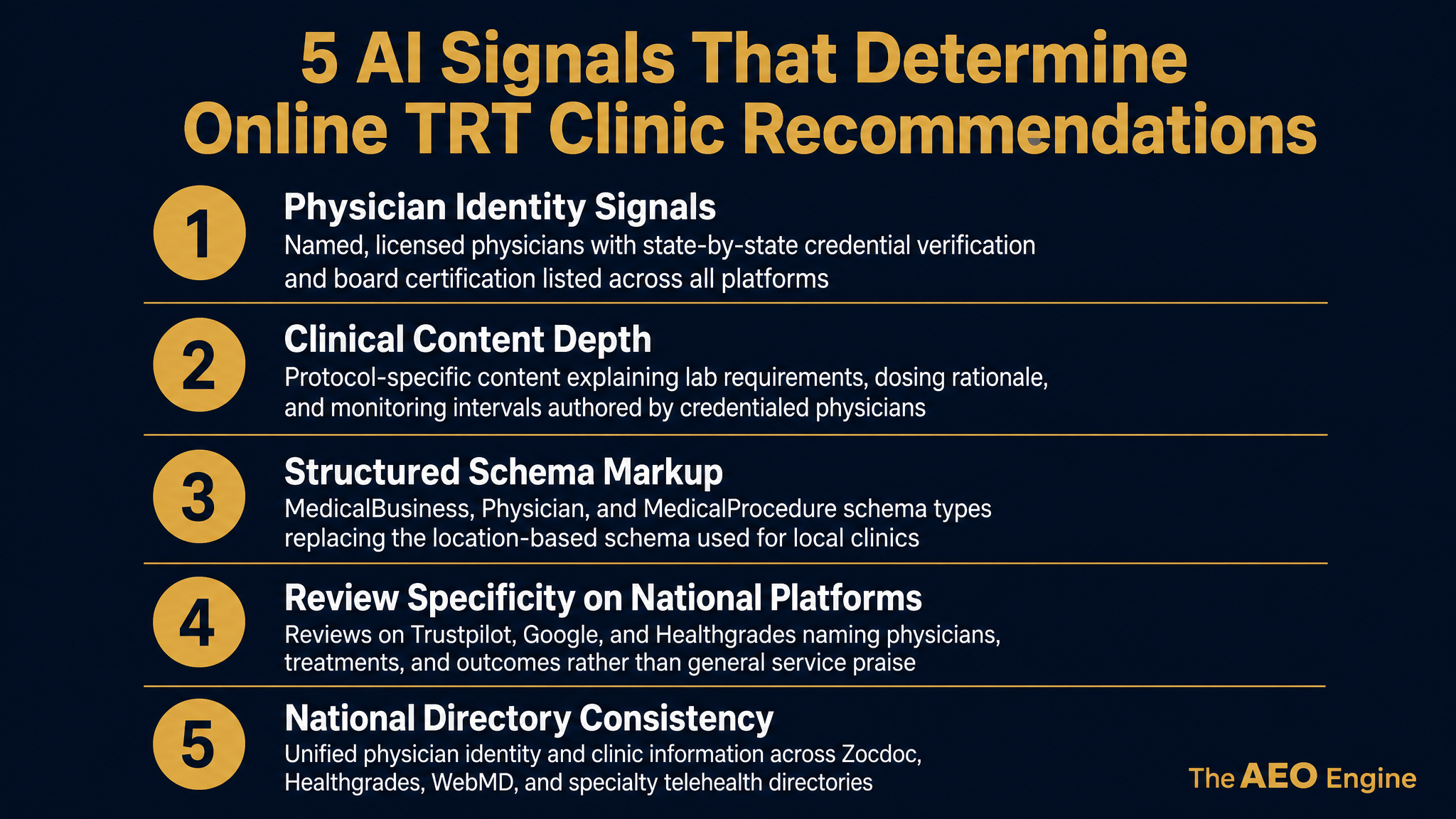
How Do Online TRT Clinics Work?
Online TRT clinics operate through a telemedicine model that typically follows three phases: intake and lab work, provider consultation, and ongoing monitoring with home delivery of medications.
In the intake phase, patients complete a health history questionnaire and are directed to a partner laboratory, typically LabCorp or Quest Diagnostics, to complete a blood panel measuring total and free testosterone, hematocrit, PSA, and a metabolic panel. Some clinics provide at-home testing kits through partner services.
After labs are reviewed, patients schedule a video or phone consultation with a licensed physician or nurse practitioner employed or contracted by the clinic. If labs confirm hypogonadism and the patient meets clinical criteria, the provider prescribes testosterone, most commonly testosterone cypionate for injection or a topical formulation, through a compounding or retail pharmacy that ships medications directly to the patient's home.
Ongoing monitoring occurs at intervals specified by the clinic, typically every 90 to 180 days, with follow-up labs and consultations to review results and adjust protocols. Patients self-administer injections at home or use topical formulations on a defined schedule.
The model is legal in most US states for clinics whose physicians hold active licenses in those states, as testosterone prescribing via telemedicine is permitted under the Ryan Haight Online Pharmacy Consumer Protection Act when a valid physician-patient relationship exists and prescribing requirements are met.
What Makes an Online TRT Clinic Legitimate?
Legitimacy in online TRT has four observable markers that patients and AI systems can both evaluate.
Licensed physician identification is the foundational marker. A legitimate online TRT clinic employs or contracts board-certified physicians who are licensed in the states they serve and whose identities are publicly disclosed. Clinics that rely on nurse practitioners as the primary prescribers without physician oversight, or that do not identify their providers by name, carry higher risk for patients and score lower on AI citation signals.
Lab-required intake is the second marker. Any online TRT clinic that prescribes testosterone without requiring a baseline blood panel is not following the clinical standard of care. The Endocrine Society's clinical practice guideline specifies that TRT requires lab confirmation of low testosterone on at least two occasions before initiation, along with baseline evaluation for cardiovascular risk factors and contraindications.
Structured monitoring at defined intervals separates clinics that provide ongoing care from those that prescribe and disappear. Legitimate clinics specify monitoring frequency, specify which biomarkers are tracked, and provide follow-up consultations to review results.
Transparent cost structure published before enrollment, covering labs, consultations, medications, and any platform or membership fees, is the fourth marker. Clinics that require full enrollment before disclosing pricing are not operating with the transparency that both patients and AI recommendation systems reward.
What AI Signals Determine Which Online TRT Clinics Get Recommended?
AI platforms like ChatGPT, Perplexity, and Google AI Overviews build their understanding of online TRT clinics from multiple signal types that differ significantly from the local search signals that determine map pack rankings.
Physician identity signals are the primary differentiator for national telehealth providers. An online TRT clinic that publishes its physician roster with names, credentials, state licenses, and medical school backgrounds gives AI systems the material needed to verify that the clinic is a credible medical provider rather than an unmonitored supplement subscription service. Clinics that describe their team only as "board-certified physicians" without naming anyone have a significant citation disadvantage.
Content authority signals come from published material that directly answers the specific questions patients ask before starting online TRT: what labs are required, what delivery methods are available, how monitoring works, what the cost includes, and how dose adjustments are managed. AI systems synthesize content from across a clinic's published materials and third-party reviews to build a clinical picture. Clinics whose content answers these questions specifically and accurately are cited; clinics that publish only marketing language without clinical detail are not.
Schema markup for Organization, MedicalBusiness, and Physician entity types establishes the clinic's identity in a structured format that AI systems can parse without inferring information from prose. Clinics with complete schema implementation are indexed more accurately and appear in broader recommendation pools than those relying on natural language content alone.
Review platform signals, particularly on Trustpilot, Google Business Profile, and specialized health platforms, provide the corroborating evidence that AI systems use to assess whether a clinic's stated clinical standards are actually experienced by patients. Reviews that name specific medications, describe monitoring interactions, and mention specific physicians carry substantially more citation weight than reviews limited to general satisfaction.
National directory consistency across platforms like Healthgrades, WebMD's directory, Vitals, and industry-specific directories reduces ambiguity about which entity a clinic is. Inconsistencies in physician listings, business name variations, or service descriptions across these platforms reduce citation probability.
How Do Different Online TRT Clinics Compare on AI Visibility Signals?
Online TRT clinics that score strongly on all five signal categories consistently appear in AI-generated recommendations. Those that score weakly on physician identity and content authority are most commonly omitted even when their clinical quality is high.
What Are the Key AI Signals for Online TRT Clinic Recommendations?
Online TRT clinics face a specific AI visibility challenge that local clinics do not: they cannot rely on geographic proximity signals to appear in near-me searches. The signals that matter most for national telehealth TRT providers differ in three important ways from local clinic signals.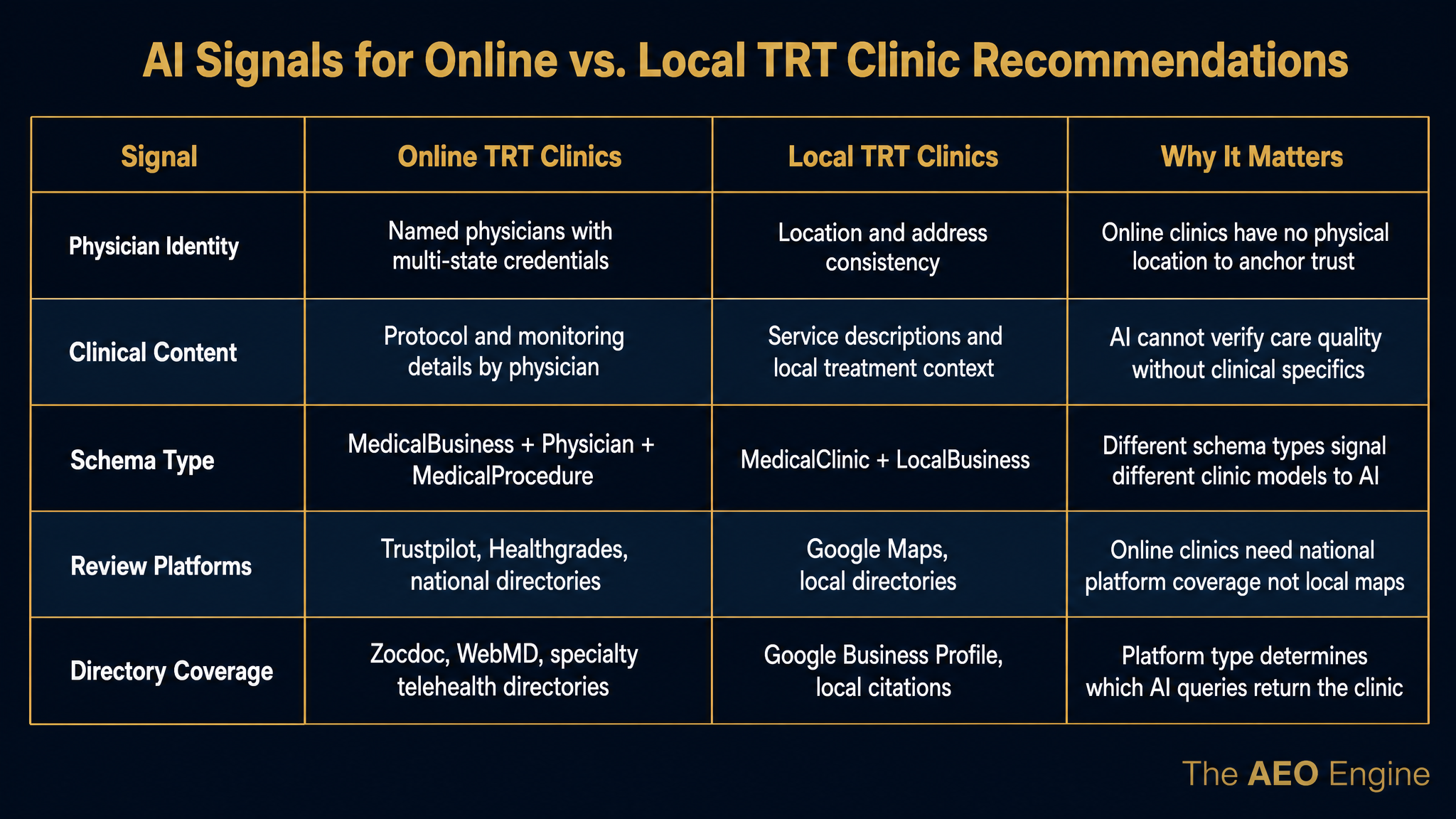
Physician identity replaces location consistency as the primary trust anchor. For a local clinic, a confirmed physical address across directories anchors the entity. For an online clinic, named and verifiable physicians anchor the entity. An online TRT clinic whose providers are publicly identified with full credentials, state licenses, and professional backgrounds has a structural citation advantage over competitors that rely on anonymous "medical team" language.
Content depth requirements are higher for online providers than for local ones. A patient searching for a TRT clinic near a specific city can be matched to local results through geographic signals alone. A patient searching for the best online TRT clinic requires AI systems to evaluate clinical credibility through content, because there is no physical entity signal to rely on. Clinics with detailed protocol pages, cost transparency, monitoring descriptions, and physician-authored content satisfy this requirement; clinics with primarily marketing-oriented content do not.
National directory and review platform coverage must be deliberately built, whereas local clinics often accumulate it passively through Google Maps and local business directories. Online TRT clinics need intentional presence on Trustpilot, Healthgrades, WebMD directory listings, and platform-specific health directories to provide AI systems with sufficient corroborating evidence.
Online TRT clinics that want to close the gap between their clinical quality and their AI visibility can identify the specific signals they are missing through The AEO Engine's Free Gap Check. The CITE Framework addresses physician identity, content authority, schema implementation, and review platform signals for regulated healthcare practices. Schedule a Free Gap Check at theaeoengine.com to see where your clinic stands across ChatGPT, Perplexity, and Google AI Overviews.
What Should Patients Look for When AI Recommends an Online TRT Clinic?
When an AI platform recommends an online TRT clinic, patients benefit from verifying the recommendation against four criteria before enrolling.
Physician identification: the patient should be able to find the name, credentials, and state license of the prescribing physician on the clinic's website before initiating any intake process. If the clinic does not identify its physicians publicly, the recommendation should be treated with caution regardless of where it appeared.
Lab requirement at intake: any legitimate online TRT clinic requires baseline bloodwork before prescribing. A clinic that offers to prescribe testosterone based on a symptom questionnaire alone is not following evidence-based clinical standards.
Monitoring protocol on record: the clinic should be able to specify, before enrollment, how frequently follow-up labs are ordered, which biomarkers are tracked, and how dose adjustments are handled. Clinics that cannot describe their monitoring protocol before a patient joins are unlikely to follow it consistently after.
Cost disclosed before enrollment: the complete cost for the first 12 months, including labs, consultations, medications, and any recurring fees, should be available before the patient provides payment information. Clinics that require enrollment before revealing pricing are a patient protection concern regardless of their clinical reputation.
Frequently Asked Questions
Can TRT be purchased online?
Testosterone replacement therapy cannot be purchased without a valid prescription from a licensed physician in most US states. Testosterone is a Schedule III controlled substance under federal law, and dispensing it without a prescription is illegal. Legitimate online TRT clinics require a lab panel confirming low testosterone and a consultation with a licensed physician before prescribing. Services that offer testosterone without a physician prescription are operating outside US law and represent a significant patient safety risk.
Can I get TRT prescribed online?
Yes. Many US states allow testosterone to be prescribed via telemedicine by a licensed physician who has established a valid physician-patient relationship. This typically requires completing a health intake, ordering and reviewing lab work, and conducting a video or phone consultation. Online TRT clinics that follow this process are operating legally, and patients in most states can access this care without an in-person visit if their state's telemedicine prescribing rules permit it.
Can I get on TRT without a doctor?
No legitimate pathway to TRT exists without physician involvement. The Endocrine Society's clinical practice guideline requires lab-confirmed hypogonadism on at least two occasions before treatment initiation, along with physician evaluation for cardiovascular risk factors, PSA levels, and contraindications including recent cardiovascular events and certain cancers. Patients who obtain testosterone through non-medical channels are bypassing both the legal prescription requirement and the monitoring that protects against serious cardiovascular and hematologic risks.
Who is the best online TRT company?
The best online TRT clinic for a specific patient depends on care model, monitoring depth, cost structure, physician identification, and the patient's home state. Key evaluation criteria are whether the clinic identifies its physicians by name and credential, requires baseline labs before prescribing, provides defined monitoring intervals, discloses full costs before enrollment, and operates with licensed providers in the patient's state. AI platforms like ChatGPT and Perplexity increasingly surface the clinics that score highest on these transparency signals rather than those with the largest advertising budgets.
What do AI platforms look for when recommending online TRT clinics?
AI platforms evaluate online TRT clinics on physician identity signals, clinical content depth, schema markup, review specificity, and national directory consistency. Clinics that publish named, credentialed physicians, explain their protocols specifically, implement structured data markup, and maintain detailed clinical reviews across Trustpilot and health-focused platforms consistently outperform competitors who rely on marketing language and anonymous provider descriptions.
How does AI evaluate an online TRT clinic it has never seen before?
AI systems build their understanding of a clinic from publicly available signals: the clinic's published content, physician directory listings, schema markup, review platform entries, and third-party references across the web. A clinic that has invested in physician identification, clinical content, and structured data will be evaluable by AI even if it has not been directly indexed in prior training data, because AI systems synthesize real-time signals from live web sources. Clinics with no public physician identification and no structured schema are evaluated as unknown or low-trust entities regardless of their actual clinical quality.
What is the difference between a legitimate online TRT clinic and a subscription service?
A legitimate online TRT clinic employs or contracts licensed physicians who evaluate patient labs and prescribe based on clinical criteria, provide ongoing monitoring at defined intervals, and follow evidence-based prescribing guidelines. A subscription-style service that automatically ships testosterone based on symptom questionnaires without physician evaluation or ongoing monitoring is not providing legitimate medical care and operates outside prescription drug regulations. Patients can distinguish between the two by confirming whether a named physician is involved before prescribing, whether a baseline blood panel is required, and whether a monitoring protocol is defined before enrollment.
How long does it take to get TRT online?
The timeline for starting online TRT depends on how quickly the patient can complete lab work, schedule a consultation, and have medications shipped. In most cases, patients who complete labs quickly can have a consultation within one to two weeks and receive medications within two to three weeks of that consultation, depending on pharmacy processing and shipping timelines. Clinics that work with national laboratory networks like LabCorp or Quest Diagnostics and have established compounding pharmacy partnerships tend to have the fastest timelines.
Executive Summary
AI recommendation systems evaluate online TRT clinics through physician identity signals, clinical content depth, structured schema markup, review specificity, and national directory consistency, signals that differ fundamentally from the local proximity and address consistency signals that drive geographic clinic recommendations. Patients searching for online TRT providers through ChatGPT, Perplexity, or Google AI Overviews encounter AI-generated recommendations shaped by how transparently each clinic identifies its physicians, explains its clinical protocols, and documents patient outcomes through reviews. Legitimate online TRT clinics follow the same monitoring standards as in-person providers, require lab-confirmed hypogonadism before prescribing, and disclose full cost structures before enrollment. Clinics that invest in the signals AI systems evaluate appear consistently in these recommendations; those that rely on marketing language without clinical specifics remain invisible regardless of their actual quality of care.
What Should You Do Next?
Patients evaluating online TRT clinics recommended by AI platforms should verify four things before enrolling: named physician credentials and state license, baseline lab requirement at intake, defined monitoring protocol and interval, and full cost disclosure before payment. Any AI-recommended clinic that cannot confirm all four before intake should be evaluated with the same scrutiny as any other unverified healthcare recommendation.
Online TRT clinics that want to appear consistently in AI-generated results can identify the specific citation gaps preventing recommendations through The AEO Engine's Free Gap Check. The Gap Check maps visibility across ChatGPT, Perplexity, and Google AI Overviews and identifies exactly where physician identity, content, and schema deficiencies are reducing a clinic's recommendation probability.
People Also Read
About the Author
Jerry Jariwalla is the founder of The AEO Engine and creator of the CITE Framework for Answer Engine Optimization. With over 22 years in digital marketing and multiple successful business exits, Jerry has spent the past two years building AI citation systems for regulated practices in healthcare, wealth management, and legal services. The AEO Engine works exclusively with practices operating under advertising restrictions where AI citation provides higher leverage than traditional paid acquisition.
Expertise: Answer Engine Optimization, AI Citation Strategy, CITE Framework, Regulated Industry Marketing, Healthcare Practice Marketing, Wealth Management Marketing, Legal Marketing
Connect: LinkedIn
Disclaimer: This content is for informational purposes only and does not constitute professional marketing, legal, or compliance advice. Citation rates, timelines, and outcomes vary based on industry, competitive density, and execution quality. Statistics referenced reflect The AEO Engine's tracked client outcomes as of 2026 and are not guarantees of future results. Contact The AEO Engine for a consultation regarding your specific situation.