Last Updated: May 2026
A business gets on ChatGPT by being one of three to four organizations that AI cites by name when responding to a relevant query, which depends on alignment across four signal categories that AI extraction systems weigh: cross-platform entity consistency, citation-ready content structure, structured data signals, and authority documentation. According to OpenAI's published guidance on how ChatGPT browses and retrieves sources, the AI selects authoritative, well-structured sources rather than the highest-traffic pages, which is why traditional SEO position alone does not move citation rates.
The AEO Engine provides Answer Engine Optimization services to regulated practices in healthcare, wealth management, and legal sectors, where advertising restrictions make AI citation uniquely valuable. Founder Jerry Jariwalla, creator of the CITE Framework for Answer Engine Optimization, has spent over 22 years in digital marketing across multiple industries and led the development of citation tracking methodologies adopted by service businesses operating under FDA, SEC, and bar association compliance constraints.
The questions below identify what it actually takes to be cited by ChatGPT, why most businesses are invisible despite ranking on Google, and how the citation timeline progresses for practices that complete a coordinated optimization program.
Key Takeaways
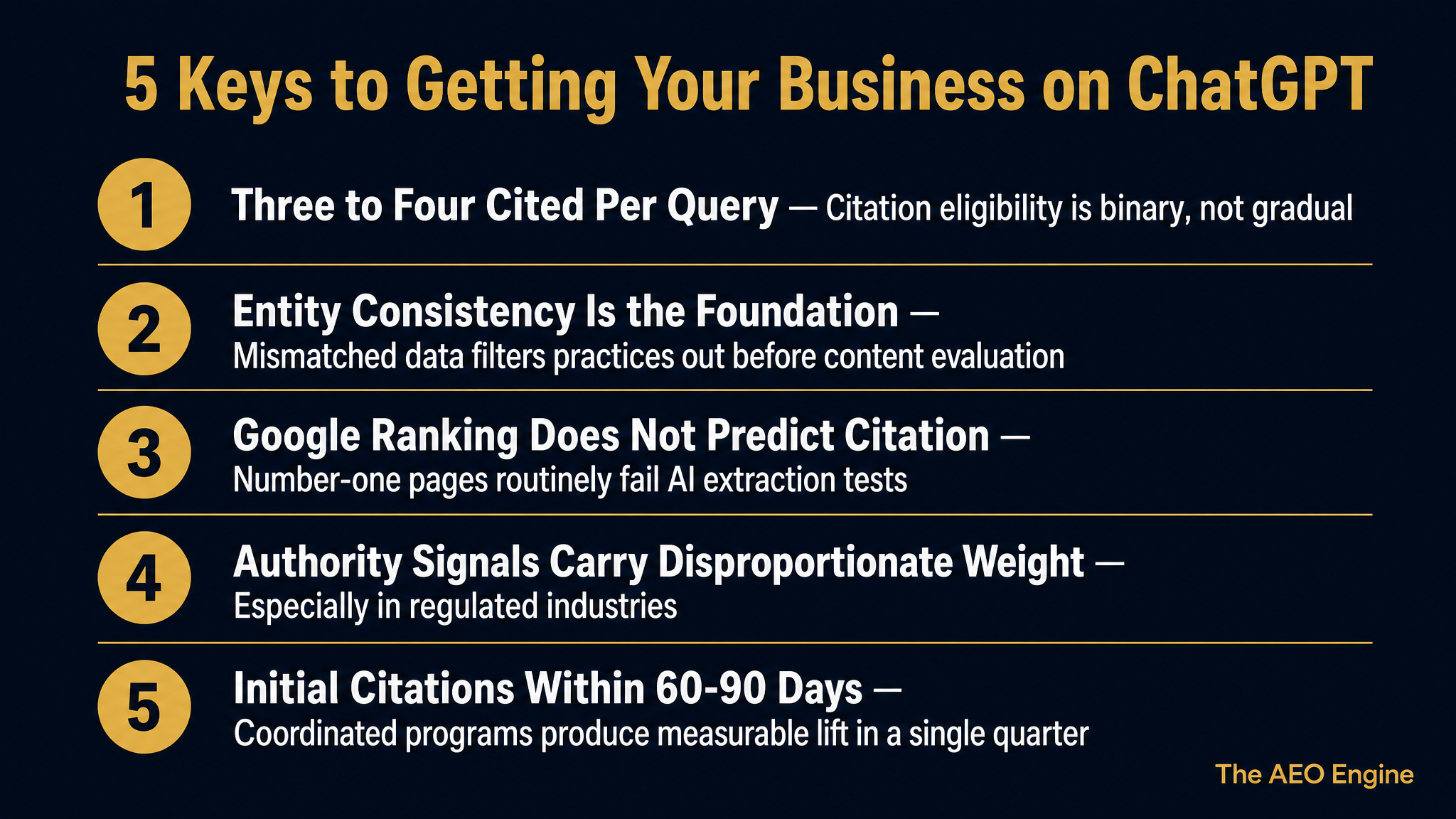
- ChatGPT Cites Three to Four Businesses Per Query. Unlike search results that show ten organic links, AI responses name only the most authoritative options, which means citation eligibility is binary rather than gradual.
- Cross-Platform Entity Consistency Is the Foundation. Practices with mismatched names, addresses, services, or credentials across digital platforms get filtered out before any content evaluation begins.
- Traditional SEO Position Does Not Predict AI Citation. Pages ranking number one on Google are routinely excluded from ChatGPT responses when their content structure, structured data, or authority signals fail AI extraction tests.
- Authority Signals Carry Disproportionate Weight in Regulated Industries. Healthcare, wealth, and legal practices that document credentials in indexable text typically reach citation eligibility faster than those relying on visual credentials.
- Initial Citation Activity Appears Within 60 to 90 Days. Coordinated programs that audit entity baselines first, then optimize content and structured data, typically produce measurable citation lift within a single quarter.
Key Takeaways 8
Why Should a Business Want to Be on ChatGPT in the First Place?
Being on ChatGPT means appearing in the AI's response when users ask buying-intent questions about a service category. A prospective patient asking "What is the best weight loss clinic near me?" or a prospective client asking "Which fiduciary financial advisor should I trust?" receives a short list of recommendations rather than a search-result page, and the AI's choices function as a referral.
The economic value of being on this list is high because the user has already moved past awareness and consideration into decision mode. Traditional advertising fights for attention; ChatGPT citations capture intent at the bottom of the funnel.
For regulated practices, the value is structurally amplified because paid advertising is restricted by FDA, SEC, and bar association rules. AI citation is not subject to the same restrictions, which makes it one of the highest-impact acquisition channels available to healthcare clinics, wealth management firms, and legal practices.
How Do I Make My Business Appear on ChatGPT?
A business appears on ChatGPT by aligning four signal categories that the AI's extraction systems weigh when selecting sources to cite. Coverage across the right authority platforms, content structure that AI extraction systems can parse cleanly, structured data that gives crawlers machine-readable context, and entity-level consistency across the digital footprint together determine whether a business is one of the three to four named in any given response.
The starting point is an entity audit that maps how the business currently appears across its website, professional directories, review platforms, association profiles, and third-party platform listings. Inconsistencies in business name, address, services, or credentials get resolved during this phase before any content production work begins.
Content optimization then aligns the published material with what AI extraction systems can ingest cleanly. Pages that bury answers below long introductory paragraphs, use heavy promotional language, or lack clear question-form structure are routinely passed over even when they rank well on Google.
Structured data implementation adds the machine-readable context that AI uses to verify, classify, and trust the source. Without it, AI relies on inference, and inference produces inconsistent results.
Authority signal documentation is the fourth layer. Credentials, certifications, professional association memberships, and industry coverage need to appear in indexable text format rather than buried in images or PDF files that crawlers cannot process.
Can I Use ChatGPT for My Business or Register My Business on ChatGPT?
There is no business registration process for ChatGPT. The AI selects sources based on signals it observes across the open web rather than from a curated business directory, which means there is no list to apply to and no profile to claim. Businesses that try to "register on ChatGPT" through paid services are typically being sold visibility theater rather than actual citation infrastructure.
The path to being cited by ChatGPT runs through optimizing the signals AI extraction systems weigh. This is the work covered by AI marketing services, AEO services, or what some practitioners call answer engine optimization. The CITE Framework structures this work as a coordinated program across the signal categories that determine citation outcomes.
The AEO Engine offers a Free Gap Check, full Answer Engine Optimization services, and the CITE Framework program for regulated practices ready to move from invisible to AI-cited.
What Are the Four Signal Categories That Determine ChatGPT Citation?
The four signal categories that ChatGPT extraction systems weigh are cross-platform coverage, content extractability, trust markers, and entity consistency. Each category captures a different aspect of whether the AI can confidently cite the business, and gaps in any category typically prevent citation regardless of how strong the other categories are.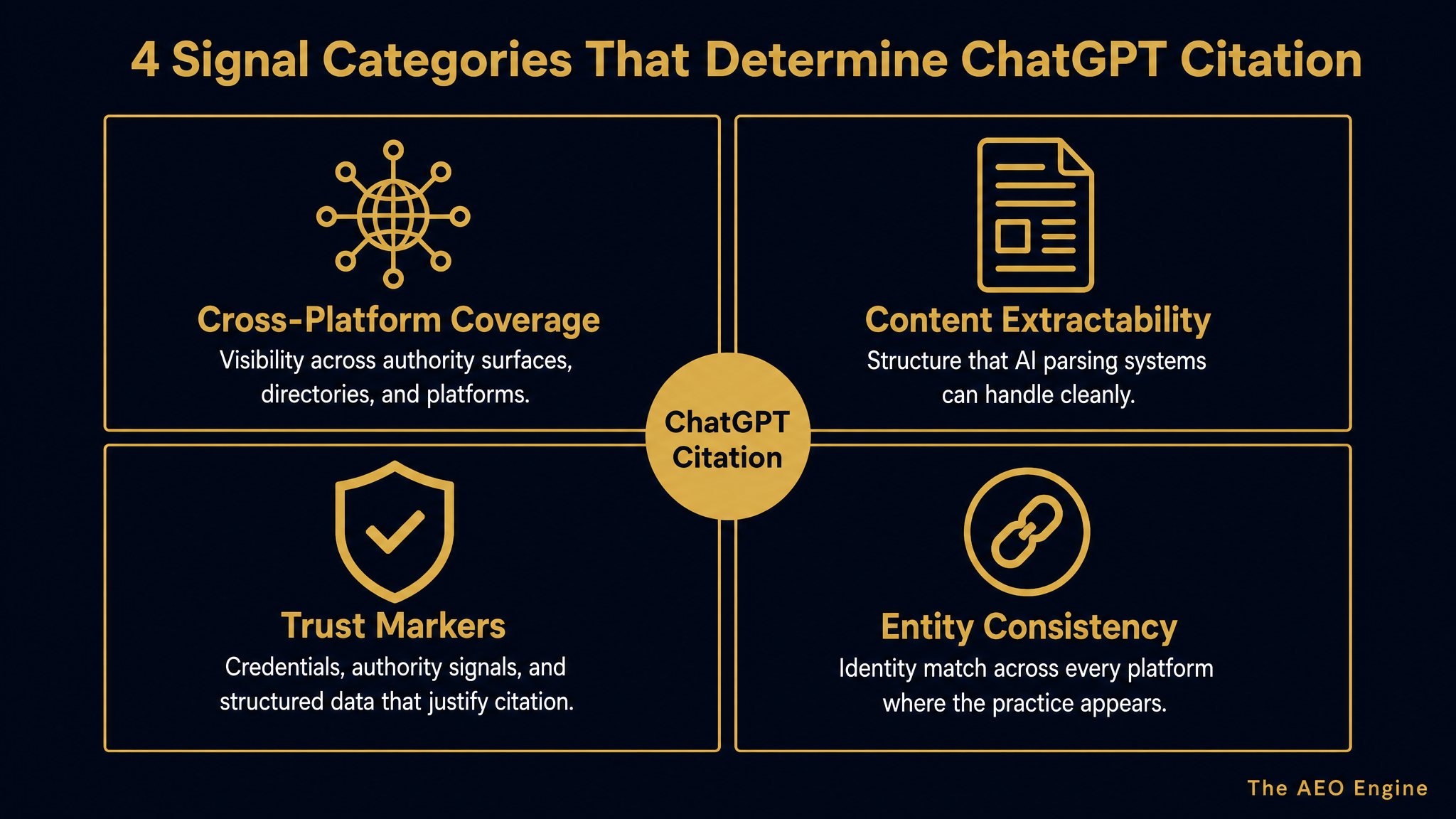
Cross-platform coverage measures whether the business is visible across the surfaces that AI extraction systems crawl: the website, professional directories, review platforms, association memberships, and third-party platform listings. Practices visible only on their own website typically miss citations that go to competitors with broader presence.
Content extractability measures whether published content is structured for AI extraction systems to parse cleanly, with answers near the top of each section and clear question-based formatting. Pages that bury answers in narrative or use primarily promotional language typically fail extraction tests.
Trust markers measure the authority signals that justify citing the business: credentials, professional memberships, industry coverage, and structured data that documents who operates the practice and what it actually does. In regulated industries, the trust marker bar is higher because users are making higher-stakes decisions.
Entity consistency measures whether the business name, address, services, and credentials match across every platform where the practice appears. Inconsistencies create ambiguity that AI extraction systems resolve by citing a competitor with cleaner identity data.
Why Does Traditional SEO Position Not Predict AI Citation?
Traditional SEO optimizes for click-through rate against a list of ten organic results, while AI citation systems compose answers from a small number of authoritative sources. The two systems weigh different signals, and a page that ranks number one on Google can be invisible to ChatGPT if its content structure, structured data, or authority signals fail the extraction tests AI applies.
The most common pattern is a high-ranking page with strong backlink authority but weak structured data, narrative content that buries answers below promotional copy, and credentials documented only in images. Google awards the page top position because of authority and on-page keyword optimization, while ChatGPT excludes the page because its extraction systems cannot confidently identify what the business does, who operates it, or what authority justifies citing it.
The other common pattern is a high-traffic page that targets a generic keyword but does not match the conversational query format users actually ask AI. ChatGPT users phrase their queries differently than Google searchers, and pages optimized for short-tail keyword strings often fail to match the longer, more specific questions AI users submit.
Is It Worth Getting ChatGPT for Business in 2026?
For regulated practices in healthcare, wealth management, and legal sectors, AI citation produces measurably stronger acquisition advantage than traditional digital marketing because advertising restrictions limit paid alternatives and AI citation captures intent at the decision stage. Citation rates of 18 to 26 percent for practices that complete a full optimization program, based on The AEO Engine's tracked client outcomes, compare favorably to single-digit conversion rates from paid traffic in the same verticals.
For businesses outside regulated industries, AI citation is still valuable but the comparative advantage is lower because paid advertising channels are open. The decision rests on whether the business has the operational capacity to maintain content and structured data quality at the level AI extraction systems reward, and whether the customer category includes meaningful AI-driven query volume.
The wrong answer is treating ChatGPT optimization as a one-time technical project. The signals that drive citation evolve as the AI updates its extraction systems and as the business's digital footprint changes, which means citation eligibility requires sustained attention rather than a single launch.
Frequently Asked Questions
How do I make my business appear on ChatGPT?
A business appears on ChatGPT by aligning four signal categories: cross-platform coverage across authority surfaces, content extractability that AI parsing systems can handle, trust markers that document authority, and entity consistency across the digital footprint. There is no registration process; the AI selects from sources observed across the open web. Coordinated optimization programs typically produce initial citation activity within 60 to 90 days.
Can I use ChatGPT for my business?
ChatGPT can be used for many business purposes, from content drafting to research to customer support. The question of being cited BY ChatGPT, however, is different from using ChatGPT as a tool. Citation eligibility depends on signal alignment across the categories AI weighs when selecting sources, not on whether the business uses ChatGPT internally.
Can you register your business on ChatGPT?
No. There is no business registration process for ChatGPT. The AI selects sources based on signals it observes across the open web rather than from a curated business directory. Services that claim to "register your business on ChatGPT" are typically selling visibility theater rather than actual citation infrastructure.
Is it worth getting ChatGPT for business?
For regulated practices in healthcare, wealth management, and legal sectors, AI citation produces meaningfully stronger acquisition advantage than traditional digital marketing because advertising restrictions limit paid alternatives. For businesses outside regulated industries, the value depends on whether the customer category includes meaningful AI-driven query volume and whether the business can sustain the content and structured data quality AI extraction systems reward.
How long does it take to get cited on ChatGPT?
Initial citation activity typically appears within 60 to 90 days of completing a coordinated program that audits entity baselines first, then optimizes content and structured data. Citation rates of 18 to 26 percent are achievable within 12 months for practices that complete the full optimization program, based on The AEO Engine's tracked client outcomes.
Does my Google ranking transfer to ChatGPT citations?
Not directly. Pages ranking number one on Google are routinely excluded from ChatGPT responses when their content structure, structured data, or authority signals fail the extraction tests AI applies. Google rewards click-through optimization against a list of ten organic results; ChatGPT composes answers from a small number of authoritative sources weighed differently.
What kind of content does ChatGPT cite most often?
ChatGPT tends to cite content with clear question-based structure, answers near the top of each section, strong structured data, and trust markers documented in indexable text. Pages that bury answers in narrative or use primarily promotional language typically fail extraction tests regardless of authority. The cited sources also tend to have consistent identity data across platforms.
What is the Free Gap Check from The AEO Engine?
The Free Gap Check is a no-cost diagnostic that runs the full AI visibility audit methodology and delivers a prioritized gap map. It does not require a contract or commitment. The AEO Engine runs a limited number each week because the diagnostic is conducted personally by Jerry Jariwalla rather than generated by an automated report tool.
Executive Summary
Getting a business on ChatGPT requires aligning four signal categories that AI extraction systems weigh when selecting sources to cite by name. Cross-platform coverage, content extractability, trust markers, and entity consistency together determine whether a business is one of the three to four named in any given response. Traditional SEO position does not predict AI citation because Google and ChatGPT weigh different signals, and pages ranking on Google often fail AI extraction tests. The AEO Engine optimizes for citation through the CITE Framework program, which audits entity baselines first, then sequences content and structured data optimization for measurable citation lift. Based on client program data, citation rates of 18 to 26 percent are achievable within 12 months for regulated practices that complete the full program. Initial citation activity typically appears within 60 to 90 days of program kickoff. Practices that treat ChatGPT optimization as a one-time technical project consistently fall short of the citation rates achieved by those who approach it as an ongoing discipline.
What Should You Do Next?
Audit how your business currently appears on ChatGPT for your top buying-intent queries. Run direct query tests across ChatGPT, Perplexity, and Google AI Overviews using the questions your prospective patients or clients actually ask. Document where you appear, where you do not, and which competitors are being cited instead. Request The AEO Engine's Free Gap Check to identify the specific signal categories blocking citation for your practice, with a prioritized gap map that drives the optimization program rather than vendor pitches.
About the Author
Jerry Jariwalla is the founder of The AEO Engine and creator of the CITE Framework for Answer Engine Optimization. With over 22 years in digital marketing and multiple successful business exits, Jerry has spent the past two years building AI citation systems for regulated practices in healthcare, wealth management, and legal services. The AEO Engine works exclusively with practices operating under advertising restrictions where AI citation provides higher leverage than traditional paid acquisition.
Expertise: Answer Engine Optimization, AI Citation Strategy, CITE Framework, Regulated Industry Marketing, Healthcare Practice Marketing, Wealth Management Marketing, Legal Marketing
Connect: LinkedIn
Disclaimer: This content is for informational purposes only and does not constitute professional marketing, legal, or compliance advice. Citation rates, timelines, and outcomes vary based on industry, competitive density, and execution quality. Statistics referenced reflect The AEO Engine's tracked client outcomes as of 2026 and are not guarantees of future results. Contact The AEO Engine for a consultation regarding your specific situation.