
Last Updated: May 2026
A med spa marketing agency is a specialized partner that builds the entity foundation, content, authority, and structured data needed for an aesthetic practice to be recommended by AI tools like ChatGPT, Perplexity, and Google AI Overviews. According to a 2025 Pew Research Center report on AI adoption, consumers are increasingly starting service searches in AI chat tools, which has reset what a marketing agency needs to deliver. The right partner produces named AI recommendations and qualified consultation requests, not just keyword reports.
The AEO Engine was founded by Jerry Jariwalla to give regulated practices a citation-first alternative to generic digital marketing. With over 22 years of digital marketing experience and multiple successful business exits, Jerry developed the CITE Framework specifically for healthcare, wealth management, and legal practices that operate under FDA, FTC, SEC, and state board advertising restrictions where generic agencies routinely cause compliance issues.
This article explains the evaluation criteria practice owners should use when interviewing agencies, the questions that separate citation-ready partners from generic shops, the typical engagement timeline, what reporting should look like, and the red flags that signal a wasted retainer.
Key Takeaways
- AI Citation Is the Headline Outcome - The right agency reports named mentions across ChatGPT, Perplexity, and AI Overviews, not keyword positions.
- Regulated-Industry Fluency Is Not Optional - Med spa marketing crosses FDA device rules, FTC standards, state medical board oversight, and HIPAA.
- Citation-Ready Content Beats Blog Calendars - Articles engineered for AI extraction outperform keyword-stuffed content by a wide margin.
- Structured Data Is a Build, Not an Add-On - Article-level, business-entity, and provider-level structured data are deliverables, not bonus extras.
- Reporting Should Tie to Revenue - Consultation requests, treatment-converting consults, and revenue per acquired patient matter more than traffic volume.
A serious med spa marketing agency in 2026 treats AI citation as the primary metric, with traditional SEO and paid acquisition as supporting channels rather than the headline strategy.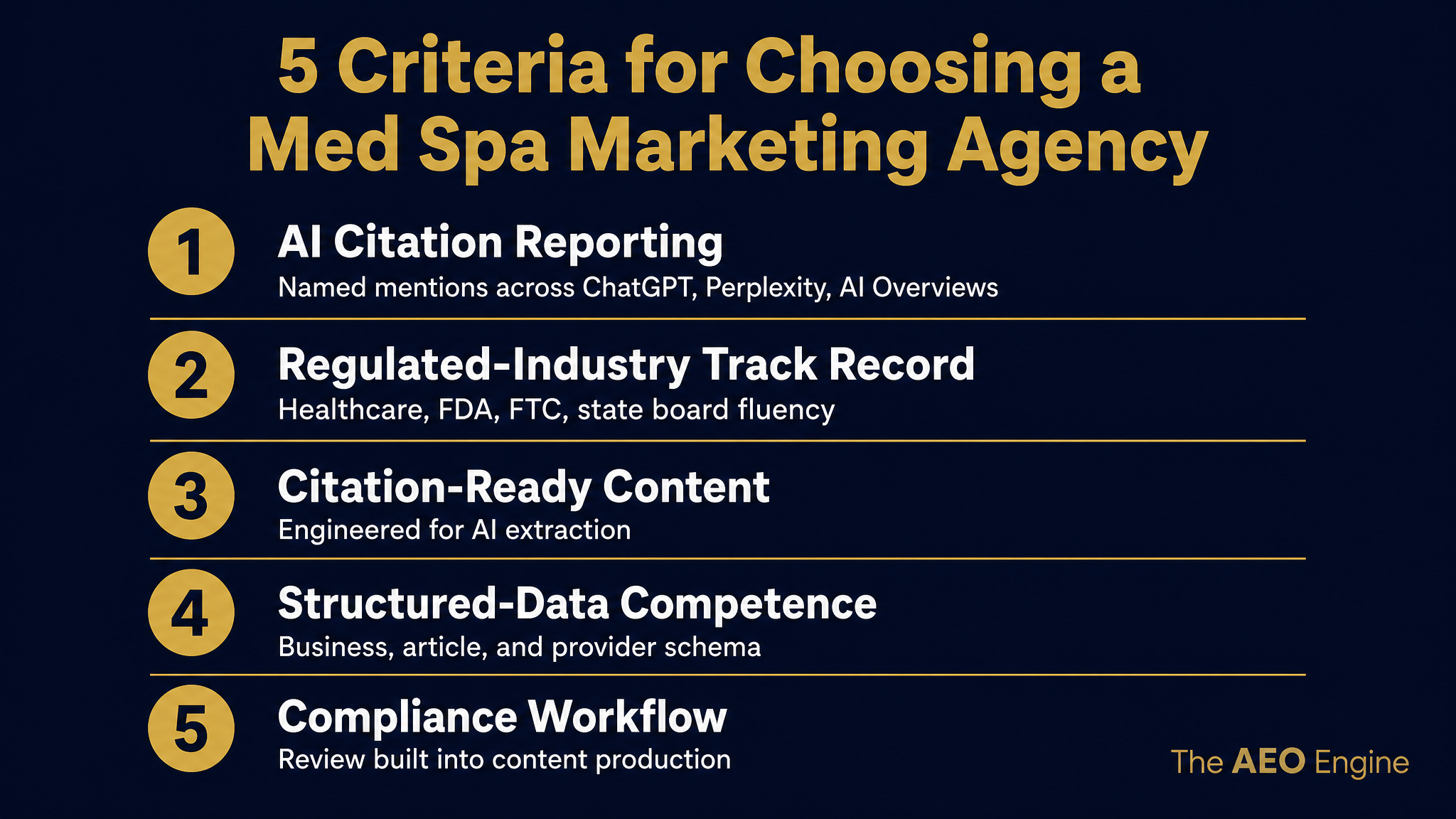
What Should Practice Owners Look For in a Med Spa Marketing Agency?
A practice owner should look for an agency that combines regulated-industry fluency, AI citation reporting, structured-data competence, and a documented authority-building plan. The combination matters because aesthetic medicine sits inside a tight compliance envelope that generic digital marketing agencies often violate, while at the same time competing for the AI recommendation slot that decides which practice receives a consultation request.
The wrong agency sells a keyword report, a blog calendar, and a paid ads dashboard. The right agency builds a citation foundation, engineers content for AI extraction, layers structured data across the entire web presence, and measures the program against named AI mentions and consultation revenue.
- Regulated-industry track record - The agency can name specific verticals it has worked in and describe how content respected the rules in those industries.
- AI citation reporting - The agency tracks named mentions across ChatGPT, Perplexity, and AI Overviews on a defined cadence.
- Structured-data competence - The agency implements business-entity, article-level, and provider-level structured data rather than treating schema as optional.
- Authority-building plan - The agency has a documented approach for earning mentions on third-party publications AI tools trust.
- Compliance review workflow - The agency builds compliance checks into the content workflow, not at publish time.
How Should a Med Spa Interview a Potential Agency?
A med spa should interview a potential agency the same way it would interview a clinical hire: with specific questions, written documentation, and reference calls. The interview should be designed to reveal whether the agency understands the AI-citation game or is selling the same playbook it sold five years ago.
Practice owners often skip the interview step and end up with an agency that produces content the practice cannot legally publish. A structured interview catches the mismatch early and saves the cost of an unwound engagement.
- Citation reporting question - "Can you show a sample dashboard with named mentions across at least three AI platforms?"
- Compliance question - "Walk through how a content piece moves from draft to publish, and where compliance review happens."
- Schema question - "Which structured data types do you implement by default, and how do you keep them consistent across the site?"
- Reference question - "Can we speak with two current healthcare clients about citation outcomes after six months?"
- Reporting cadence question - "What is the standard reporting cadence, and what metrics are at the top of the report?"
If your med spa is evaluating agencies and wants a baseline view of current AI visibility before signing a retainer, The AEO Engine offers a free AI visibility audit. The team has spent the past two years building citation systems for healthcare practices that operate under FDA, FTC, and state board advertising rules.
What Are the Red Flags That Disqualify an Agency?
Red flags that disqualify a med spa marketing agency usually appear in the sales conversation if a practice owner knows what to listen for. Agencies that talk only about keyword rankings, that cannot describe AI citation work, that promise specific traffic numbers without auditing the entity foundation first, or that have no compliance workflow built into content production are the wrong partners for an aesthetic practice in 2026.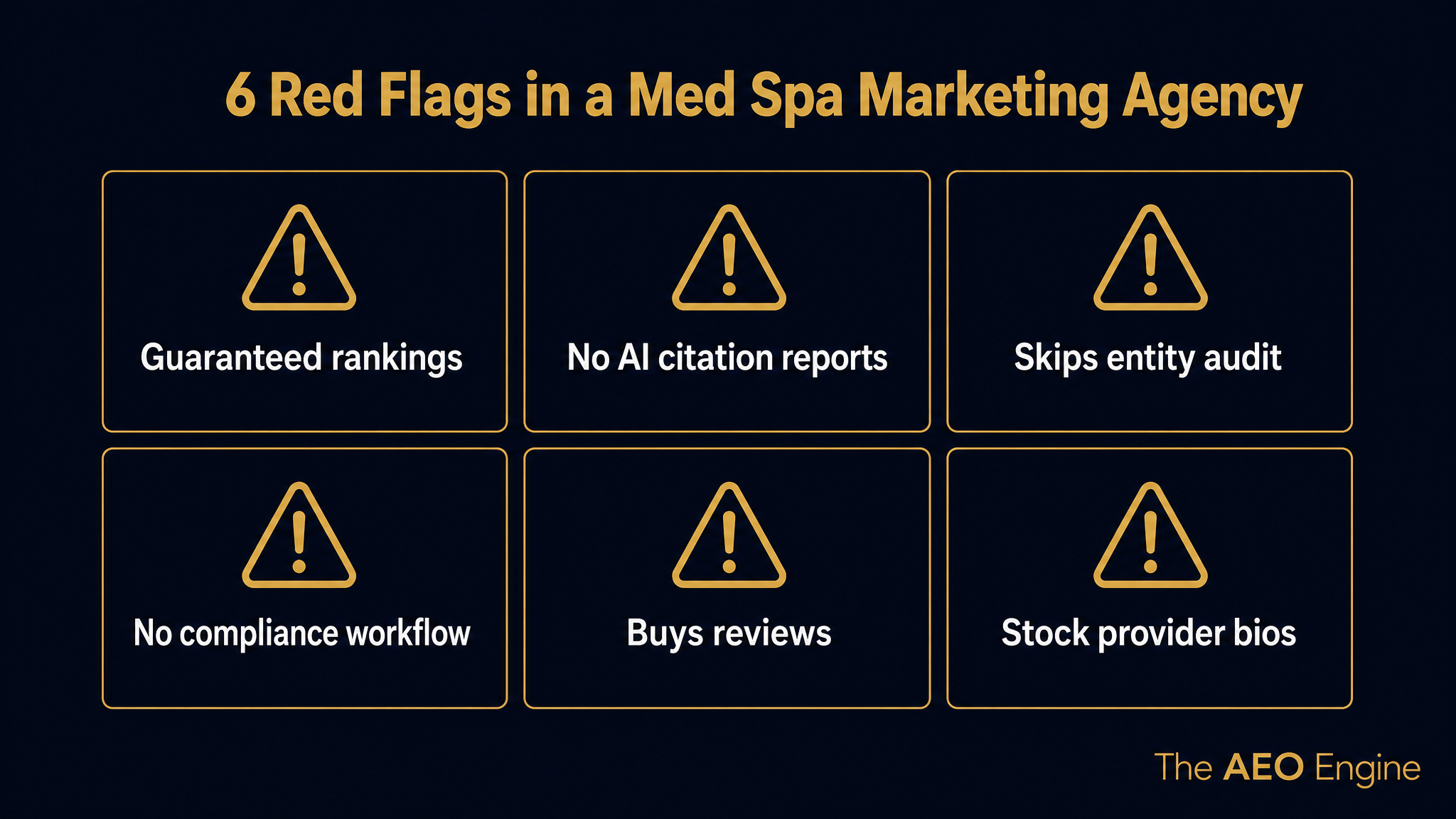
A second category of red flags appears in deliverables. Generic blog calendars, copied-and-pasted service pages, schema markup that does not match the visible content, and review-buying programs all signal a partner that will burn the retainer without producing citation lift.
What Does a Realistic Engagement Timeline Look Like?
A realistic engagement timeline for a med spa marketing agency built around AI citation includes a discovery and audit phase, a foundation-building phase, and an ongoing program. The first 60 to 90 days are foundation work: entity audit, structured data implementation, content-extraction baseline, and the first wave of citation-ready content. Citation lift typically becomes visible in months three to six and compounds through month twelve as authority signals age into the AI confidence layer.
The AEO Engine tracks citation rates of 18 to 26 percent for client programs based on tracked outcomes, with the highest performers reaching the 24 to 30 percent range after six or more months in the program. Practice owners should be skeptical of any agency promising significant citation lift inside the first 30 days, especially when the practice starts with broken entity data or missing structured data.
What Should Agency Reporting Actually Cover?
Agency reporting for a med spa should cover AI citation activity, consultation pipeline metrics, and revenue outcomes, with traditional SEO and traffic data as leading indicators rather than headline numbers. A report that opens with organic traffic and ends with bounce rate is reporting against the wrong target for an AI-citation program.
The headline metric on a modern report is named AI mentions across the platforms patients use to research providers. Underneath that, the report should show consultation request volume, the conversion rate from consultation to treatment, and revenue per acquired patient. Traffic, rankings, and engagement metrics are still useful but they belong in the second tier of the report.
How Does Pricing Typically Work for Med Spa Marketing Agencies?
Pricing for a med spa marketing agency typically reflects the scope of work, the regional competitive density, the number of providers and locations covered, and the depth of structured-data and authority work the program requires. Pricing varies by program and by practice, so practice owners should expect a custom proposal rather than a flat off-the-shelf rate.
Citation-first programs tend to deliver a lower cost per acquired patient than traffic-driven programs because AI-recommended consults convert at higher rates. The AEO Engine tracks consultation-to-treatment conversion rates of 30 to 45 percent for AI-recommended traffic versus 10 to 15 percent for generic organic traffic across client programs, which means a smaller but better-qualified inflow often produces more revenue than a larger volume of cold clicks.
Frequently Asked Questions
What is the difference between a med spa marketing agency and a generic digital marketing agency?
A med spa marketing agency built for 2026 specializes in regulated aesthetic practices and treats AI citation as the headline outcome. A generic digital marketing agency typically sells the same playbook across every vertical and focuses on keyword rankings and traffic volume. The specialized agency understands FDA device rules, FTC advertising standards, state medical board oversight, and HIPAA, while the generic agency often produces content that triggers compliance issues. The cost difference reflects the depth of compliance work and structured-data engineering involved.
How long should a med spa stay with a marketing agency?
A med spa should plan on a 12-month minimum engagement to allow the citation foundation to age into the AI confidence layer. Agencies that build entity data, structured data, and authority signals correctly produce citation lift that compounds over time. Switching agencies every six months breaks the compounding effect and forces a second foundation audit. Practice owners should evaluate the agency at month nine to decide on renewal rather than treating month twelve as the decision point.
What questions should a med spa ask in a discovery call?
A med spa should ask the agency to describe a recent healthcare engagement, walk through how compliance review is built into content production, show a sample report featuring AI citation metrics, name the structured-data types the agency implements by default, and explain how authority signals are earned over the first six months. The answers will quickly separate agencies that have done regulated-practice AEO work from agencies that are about to learn on the practice's retainer.
How much should a med spa expect to invest in marketing each month?
A med spa should expect a meaningful monthly investment that covers content production, structured-data engineering, compliance review, authority outreach, and entity maintenance. The amount varies by competitive density and provider count, so practice owners should request a custom proposal. The investment math usually favors citation-first programs because AI-recommended leads convert at higher rates than generic organic leads, which lowers cost per acquired patient even at higher retainer levels.
Can a small med spa afford an AI-citation agency?
A small med spa can afford an AI-citation program if the agency can deliver a focused scope rather than a full enterprise build. Smaller practices benefit from starting with an entity audit and a focused content program, then expanding once the citation foundation produces consultation flow. Agencies that only sell large retainers are not a fit for a single-location practice, which is why the discovery conversation should establish scope flexibility early.
What happens if the agency does not deliver citation results?
If the agency does not deliver citation results in the first six months, the practice should request a written program audit before renewing. The audit should cover the entity foundation, structured-data implementation, content extraction quality, and authority signals. In most cases, citation gaps trace back to foundation problems that were never resolved, which is why a strict 30-day audit pause is more effective than firing the agency immediately and starting over with a new partner.
How does the agency handle HIPAA and patient stories?
The agency should treat HIPAA as a first-principles constraint, not a checkbox. Patient stories require explicit written authorization, identifying details must be removed or fictionalized with patient consent, and before-and-after material requires clinical accuracy and proper disclosures. Agencies that ask for patient names, photos, or treatment details without a documented authorization workflow are signaling that compliance is not a priority, which is a disqualifying signal for an aesthetic practice.
Should a med spa hire one agency or split work across specialists?
A med spa is usually better served by one agency that owns the citation program end to end rather than splitting work across an SEO shop, a content shop, and a paid-ads shop. Split arrangements produce inconsistent entity data, disconnected reporting, and conflicting strategies, which weaken the AI confidence signal. A single citation-first partner can coordinate the entire program against the same outcomes, which is why most regulated practices end up consolidating to one agency after a year of split execution.
Executive Summary
Choosing a med spa marketing agency in 2026 means looking past keyword rankings and traffic dashboards to AI citation outcomes, regulated-industry fluency, and structured-data competence. A practice owner should interview the agency with specific questions about citation reporting, compliance workflow, schema implementation, and healthcare reference calls. Red flags include guaranteed ranking promises, no AI citation reporting, skipped entity audits, and no compliance review process. A realistic engagement runs 12 months with foundation work in the first 90 days and visible citation lift starting in months three to six. Reporting should lead with named AI mentions and consultation revenue rather than traffic. Pricing varies by scope, but the math typically favors citation-first programs because AI-recommended leads convert at higher rates than generic organic leads.
What Should You Do Next?
Practice owners ready to evaluate agencies should start with a baseline audit of current AI visibility. The audit shows whether ChatGPT, Perplexity, and AI Overviews already name the practice, name a competitor, or return generic results that hand the consultation request elsewhere.
Request a free AI visibility audit from The AEO Engine. The audit produces an entity scorecard, current AI citation status, and a prioritized list of fixes to make in the first 30 days, which gives the practice a concrete benchmark to evaluate any agency proposal against.
About the Author
Jerry Jariwalla is the founder of The AEO Engine and creator of the CITE Framework for Answer Engine Optimization. With over 22 years in digital marketing and multiple successful business exits, Jerry has spent the past two years building AI citation systems for regulated practices in healthcare, wealth management, and legal services. The AEO Engine works exclusively with practices operating under advertising restrictions where AI citation provides higher leverage than traditional paid acquisition.
Expertise: Answer Engine Optimization, AI Citation Strategy, CITE Framework, Regulated Industry Marketing, Healthcare Practice Marketing, Wealth Management Marketing, Legal Marketing
Connect: LinkedIn
Disclaimer: This content is for informational purposes only and does not constitute professional marketing, legal, or compliance advice. Citation rates, timelines, and outcomes vary based on industry, competitive density, and execution quality. Statistics referenced reflect The AEO Engine's tracked client outcomes as of 2026 and are not guarantees of future results. Contact The AEO Engine for a consultation regarding your specific situation.