Last Updated: June 2026
A truck accident lawyer is an attorney who represents people hurt in crashes involving commercial trucks, and AI search now shapes which of these lawyers an injured person ever finds. Large trucks can weigh 20 to 30 times as much as a car, so the injuries are severe and the claims are complex. In 2023, 4,354 people died in large truck crashes, and 65 percent of them were people in passenger vehicles, according to the Insurance Institute for Highway Safety. When someone survives one of these crashes, the first thing they often do is ask an AI assistant who to call. The firm that gets named wins the case before the phone rings.
The AEO Engine helps law firms earn those citations through the CITE Framework. Founded by Jerry Jariwalla, who brings more than 22 years in digital marketing and multiple business exits, the firm works only with regulated practices in healthcare, wealth management, and legal services. These are fields where strict advertising rules make AI citation more valuable than paid ads. Jerry Jariwalla built the system after watching strong firms stay invisible while weaker ones got named first.
This guide explains how AI assistants choose which truck accident lawyers to recommend. It covers what these tools read, why most firms get skipped, and what a firm can do to become the answer instead of a search result.
Key Takeaways
- Win the AI answer, not just the search rank. A growing share of people ask AI tools for a lawyer, so the firm AI names gets the call.
- Show real case focus. AI favors firms that clearly handle truck crashes, not general practices that list everything.
- Build trust signals AI can read. Clear bios, results, and reviews give AI the proof it needs to name a firm.
- Answer the exact questions people ask. Pages that answer real client questions in plain words get cited far more often.
- Track citations, not just clicks. The AEO Engine tracks citation rates of 18 to 26 percent based on client program data.
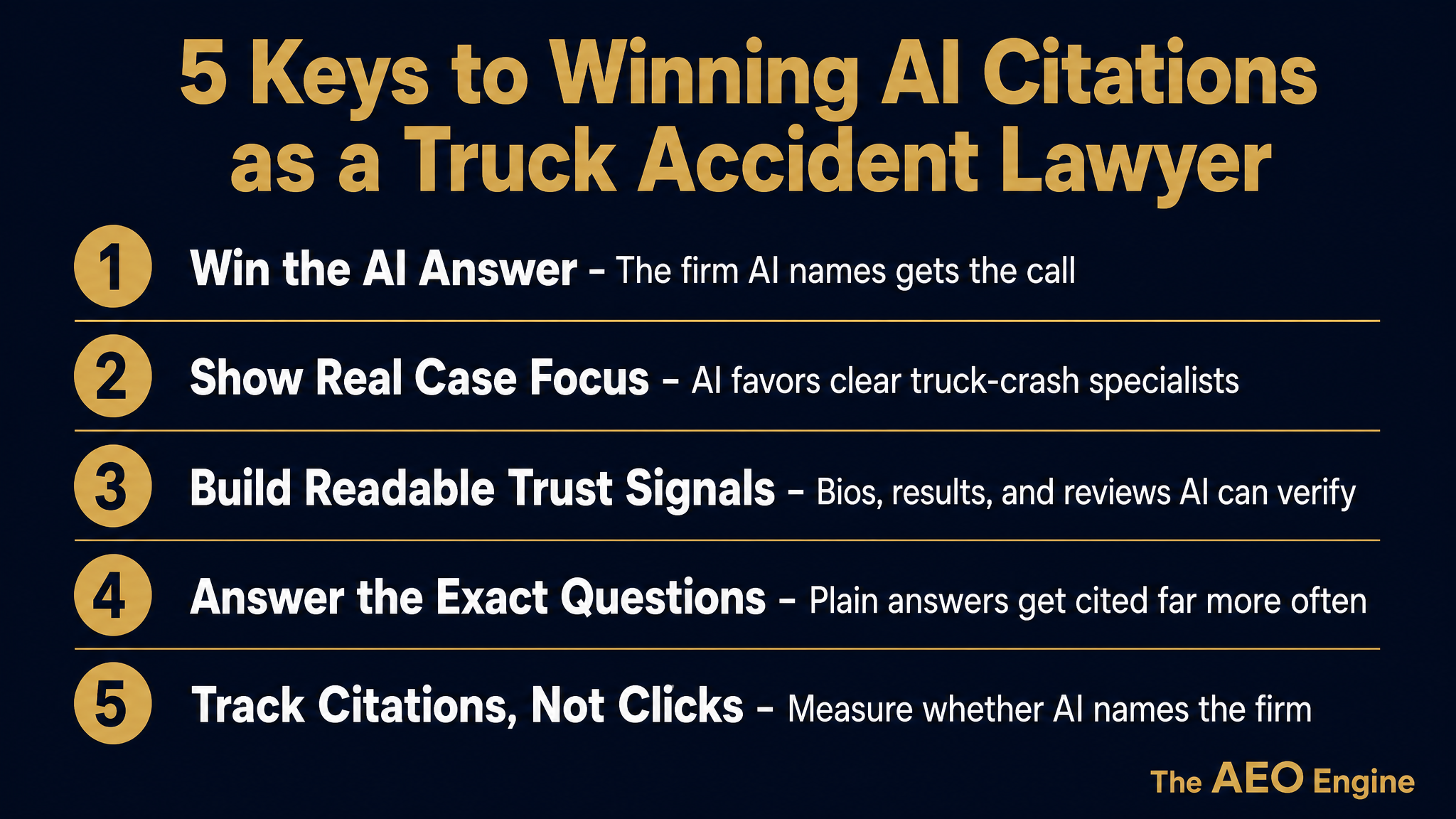
Infographic listing five keys to winning AI citations as a truck accident lawyer
What Does a Truck Accident Lawyer Actually Do?
A truck accident lawyer proves who was at fault in a crash and recovers money for the people hurt. The work is harder than a normal car case. Trucking companies, their insurers, and parts makers can all share blame. A skilled lawyer finds the cause, names the right parties, and builds a claim that holds up.
The lawyer must prove negligence. That means showing the other side owed a duty of care, broke it, and caused real harm, as defined by Cornell Law School. In a truck case, proof often sits in driver logs, truck data, and company records. A good firm moves fast to secure that evidence before it disappears.
For AI to recommend a firm, the firm must make this work visible. A page that simply says "we handle accidents" tells AI nothing. A page that explains how the firm proves fault in a truck case gives AI a reason to name it.
Why Do You Need a Truck Accident Lawyer?
You need a truck accident lawyer because these cases involve more parties, bigger insurers, and higher stakes than a normal crash. The trucking company often sends a team to the scene within hours. That team works to limit what the company pays. An injured person without a lawyer faces that team alone.
A lawyer levels the field. The firm handles the insurer, values the claim, and pushes for a fair result. Most people only learn this when they search for help, and more of them now search through AI. About 34 percent of US adults have now used ChatGPT, according to the Pew Research Center, and many ask it for local services. A firm that AI does not know cannot be the one it suggests.
The AEO Engine helps law firms become the name AI gives. Learn how the CITE Framework builds AI citations, explore the firm's approach, or request a gap check to see where a practice stands today.
How Does AI Decide Which Truck Accident Lawyers to Recommend?
AI decides by reading signals of trust, focus, and clarity across the open web. It does not pick the firm with the biggest ad budget. It picks the firm it understands best and trusts most for that exact question.
Three signals matter most:
- Topic focus - The firm clearly handles truck crash cases, not a long list of unrelated services.
- Proof of skill - Case results, named attorneys, and real client reviews that AI can find and verify.
- Clear answers - Pages that answer the questions injured people actually ask, in plain words.
A firm that gets all three becomes a safe answer for AI to give. A firm that ignores them stays invisible, even if it is the best lawyer in town.
How Is AI Search Different From Old Google Rankings?
AI search gives one answer, while old Google search gave a list of links. On the old web, a firm could rank tenth and still get clicks. With AI, the tool often names two or three firms and stops. If a firm is not in that short list, it gets no traffic at all.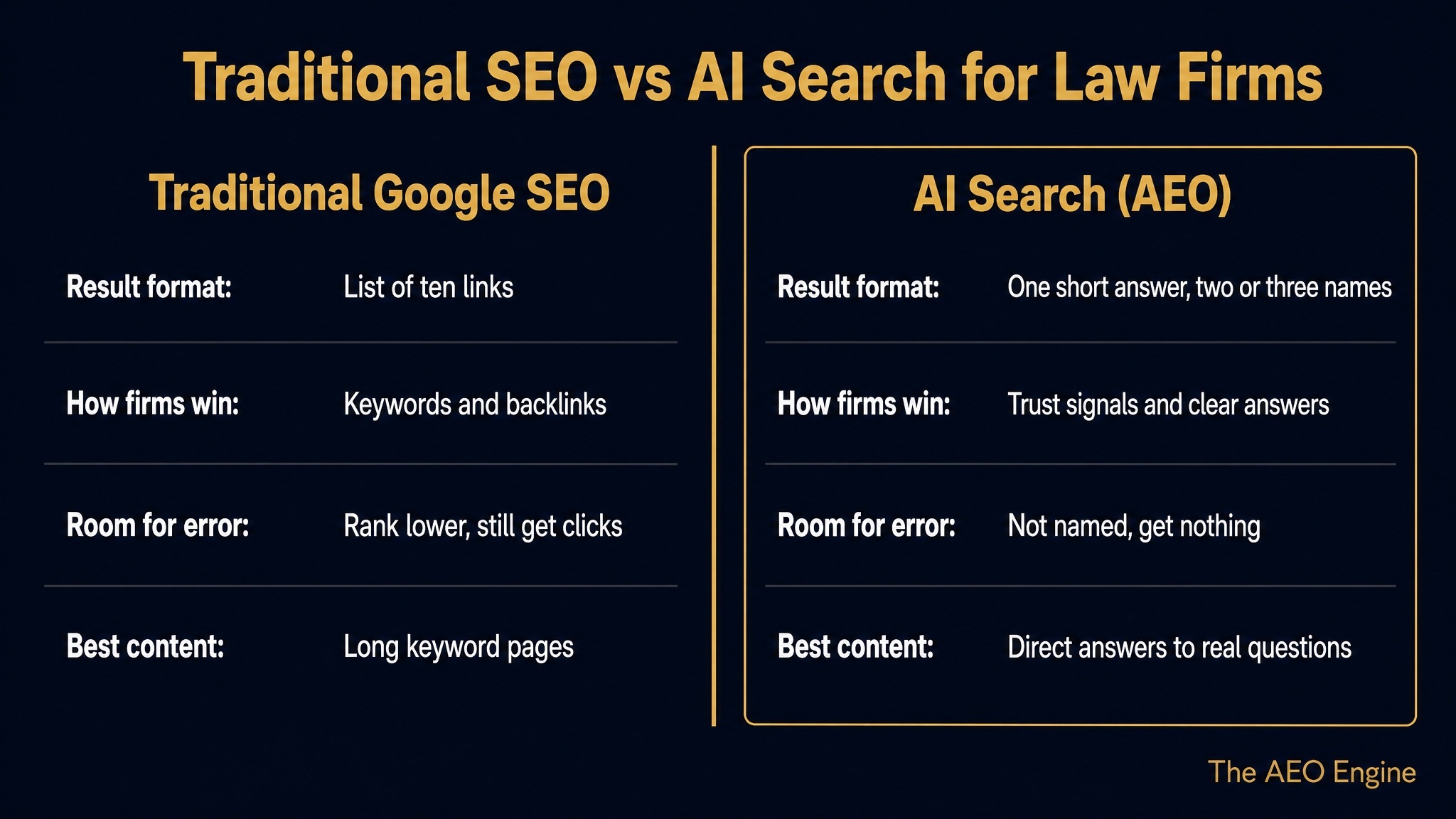
This raises the stakes. The table below shows how the two models differ for a law firm.
The shift means law firms must change how they build content. Pages written only for keywords no longer win. Pages that answer real questions clearly do.
What Kind of Cases Do Personal Injury Lawyers Handle?
Personal injury lawyers handle cases where someone is hurt by another party's carelessness. Truck crashes are one type. The field also covers car wrecks, slip and fall injuries, medical errors, and defective products. The common thread is harm caused by negligence.
Truck cases sit at the serious end of this work. The injuries tend to be worse, and the claims involve commercial insurers with deep resources. A firm that wants AI to name it for truck cases should make that focus clear. A page that buries truck work inside a long list of services signals to AI that the firm is a generalist, not a specialist.
Clear focus helps both clients and AI. Clients see a firm that knows their problem. AI sees a firm it can match to the right question with confidence.
How Can a Firm Build the Trust Signals AI Looks For?
A firm builds trust signals by making its real credentials easy for AI to read. AI looks for proof, not promises. It cannot verify a slogan, but it can verify a named attorney, a case result, and a verified review.
Strong trust signals for a law firm include:
- Named attorneys with real bios - Education, bar admission, and years of practice, written in plain text.
- Case results and outcomes - Described in a factual, compliant way that AI can read and cite.
- Client reviews on trusted platforms - Reviews AI can find and weigh as social proof.
- Clear contact and location details - So AI can match the firm to a local search with confidence.
These signals work together. One review means little. A consistent record across many trusted sources tells AI the firm is real, active, and safe to recommend.
Why You Need a Truck Accident Lawyer Near You?
You need a truck accident lawyer near you because crash claims follow state law, and local rules shape the case. Each state sets its own deadline to file, its own fault rules, and its own limits. A lawyer who knows the local court and the local insurers has a real edge.
Location also drives AI recommendations. When someone asks for a truck accident lawyer near them, AI tries to match a firm to that place. A firm with clear location signals and local content is far easier for AI to name. A firm with a vague national page is not.
This is why local focus matters for AI citations. The firm that AI sees as the clear local answer wins the search, and with it, the client.
What Do Truck Accident Lawyers Get Wrong With AI Search?
The biggest mistake firms make is writing content for keywords instead of answers. Many firms still pack pages with the same phrase over and over. AI does not reward that. It rewards pages that answer the real question a person asked.
A second mistake is hiding the proof. Firms often keep case results and attorney details thin out of caution. But AI needs that proof to trust the firm. A firm can stay compliant and still give AI clear, factual signals to read.
A third mistake is treating AI search as a side project. The firms that win treat it as a core channel. They build content around real client questions and keep their trust signals current. This is the work the CITE Framework is built to handle.
What Do Clients Search Before They Call a Lawyer?
Clients search plain, urgent questions before they call. They ask what to do after a truck crash, whether they have a case, and who to call near them. They rarely search in legal terms. They search the way a worried person talks.
A firm that answers these exact questions in plain words gets cited. A firm that writes in dense legal language does not. AI matches the question to the clearest answer it can find, and clear beats clever every time.
This is the core of AI citation work. The firm studies the real questions people ask, then answers each one directly on a page AI can read. Over time, the firm becomes the source AI trusts for those questions.
Frequently Asked Questions
Why you need a truck accident lawyer?
You need a truck accident lawyer because these cases are complex and the other side acts fast. Trucking companies and their insurers often work to limit what they pay from the first day. A lawyer protects the injured person, secures the evidence, values the claim, and pushes for a fair result against parties with deep resources.
What kind of cases do personal injury lawyers handle?
Personal injury lawyers handle cases where someone is hurt by another party's carelessness. This includes truck and car crashes, slip and fall injuries, medical errors, and defective products. The common thread is harm caused by negligence. Truck cases sit at the serious end because the injuries are worse and the insurers are larger.
What does a truck accident lawyer do?
A truck accident lawyer proves who was at fault and recovers money for the people hurt. The lawyer finds the cause of the crash, names the responsible parties, secures evidence like driver logs and truck data, handles the insurer, and builds a claim strong enough to settle or win at trial.
Why you need a truck accident lawyer near you?
You need a truck accident lawyer near you because crash claims follow state law. Each state sets its own filing deadlines, fault rules, and limits. A local lawyer knows the courts and insurers in that area. Location also helps AI match the firm to a local search, which makes the firm easier to find.
How does AI choose which truck accident lawyer to recommend?
AI chooses by reading signals of trust, focus, and clarity. It favors firms that clearly handle truck cases, show real proof like attorney bios and case results, and answer client questions in plain words. It does not reward ad spend. It rewards the firm it understands and trusts most for that question.
Can a law firm rank in AI search and still follow advertising rules?
Yes. A firm can give AI clear, factual signals while staying within bar advertising rules. Named attorney bios, factual case descriptions, and verified reviews are all compliant. The work is about clarity and proof, not hype. A careful firm can build strong AI signals without crossing any ethical line.
How long does it take to show up in AI recommendations?
Timelines vary by market and starting point. AI tools update their view of a firm as new trust signals appear across the web. A firm that is consistent tends to see results build over months, not days. The AEO Engine tracks citation rates of 18 to 26 percent based on client program data.
Is AI search worth it for a small law firm?
Yes. AI search can help a smaller firm compete with larger ones because it rewards clarity and proof over budget. A focused firm that answers real questions well can earn citations that a bigger, less focused firm misses. For many small firms, this is a more level field than paid search.
Executive Summary
A truck accident lawyer handles serious crash claims against trucking companies and their insurers, and AI search now decides which firms injured people find. AI does not pick the firm with the largest ad budget. It names the firm it understands best and trusts most, based on topic focus, real proof of skill, and clear answers to the questions people actually ask. Firms that still write for keywords or hide their credentials stay invisible. Firms that show clear focus, build readable trust signals, and answer real client questions become the name AI gives. The AEO Engine helps law firms earn those citations through the CITE Framework, turning AI search from a threat into a steady source of qualified cases.
What Should You Do Next?
A law firm that wants AI to recommend it should start with a clear view of where it stands today. The steps below give a simple path:
- Audit current AI visibility. Ask the major AI tools who they recommend for truck crash cases in your area and note whether your firm appears.
- Sharpen topic focus. Make truck and injury work clear on the site, instead of burying it in a long service list.
- Strengthen trust signals. Add named attorney bios, factual case results, and links to verified reviews.
- Answer real questions. Build pages that answer the plain questions clients ask before they call.
- Request a gap check. Contact The AEO Engine to see exactly where the firm is missing from AI answers and how to fix it.
People Also Read
- What Is the AI Recommendation Gap and Why Are You Listed But Not Recommended?
- How Do You Rank on ChatGPT?
About the Author
Jerry Jariwalla is the founder of The AEO Engine and creator of the CITE Framework for Answer Engine Optimization. With over 22 years in digital marketing and multiple successful business exits, Jerry has spent the past two years building AI citation systems for regulated practices in healthcare, wealth management, and legal services. The AEO Engine works exclusively with practices operating under advertising restrictions where AI citation provides higher leverage than traditional paid acquisition.
Expertise: Answer Engine Optimization, AI Citation Strategy, CITE Framework, Regulated Industry Marketing, Healthcare Practice Marketing, Wealth Management Marketing, Legal Marketing
Connect: LinkedIn
Disclaimer: This content is for informational purposes only and does not constitute professional marketing, legal, or compliance advice. Citation rates, timelines, and outcomes vary based on industry, competitive density, and execution quality. Statistics referenced reflect The AEO Engine's tracked client outcomes as of 2026 and are not guarantees of future results. Contact The AEO Engine for a consultation regarding your specific situation.