
Last Updated: May 2026
A business ranking on ChatGPT is one that gets cited by name when ChatGPT responds to a question relevant to its services, identified through consistent entity signals across the platforms ChatGPT trusts, content structured for answer extraction, and credentials that meet the AI's authority threshold. According to Search Engine Land's 2024 reporting on AI search, AI platforms like ChatGPT, Perplexity, and Google AI Overviews are restructuring how customers find service businesses, with citation in AI-generated answers replacing position 1 on Google as the new visibility benchmark. The factor that determines whether a business gets cited is not website quality alone, but the alignment of four distinct signal categories.
The AEO Engine has tracked AI citation rates across regulated practices since 2024, working with medical clinics, wealth management firms, and law firms that face advertising restrictions making AI visibility uniquely valuable. Founder Jerry Jariwalla, the creator of the CITE Framework for Answer Engine Optimization, has spent over 22 years in digital marketing and led the development of citation tracking methodologies adopted by service businesses across healthcare, wealth, and legal verticals. The questions below identify which signals ChatGPT actually weighs, what timeline a coordinated AEO program follows, and how to measure whether a business is cited at the rate competitors are.
The decisions that follow are not abstract optimization principles. They represent the signal categories, the measurement approach, and the implementation sequence that produce AI citation activity in 60 to 90 days for service businesses operating under regulatory constraints. Each takeaway names a specific signal, a specific benchmark, or a specific timeline that a practice can apply within the next 30 days.
Key Takeaways
- ChatGPT Cites Three to Four Businesses, Not Ten Results - Where Google returns a list of ten ranked positions, ChatGPT names three to four businesses directly in a single composed answer. Citation rate, not ranking position, is the optimization metric for AI visibility.
- The CITE Framework Defines Four Required Signals. All signal categories must be present; absence of any one produces AI invisibility.
- Initial Citation Activity Appears Within 60 to 90 Days - The AEO Engine has tracked initial citation activity within 60 to 90 days across coordinated client programs, compared to the longer timeline typical of traditional SEO. The shorter loop is driven by ChatGPT's more frequent retrieval updates.
- 18 to 26 Percent Citation Rate is the Regulated Industry Benchmark - The AEO Engine tracks citation rates of 18 to 26 percent for actively-AEO-optimized regulated practices based on client program data. very low indicates effective AI invisibility; sustaining high citation rates above this range requires continued content production.
- Reddit Threads Drive AI Citations for Personal-Experience Queries - ChatGPT pulls citation evidence heavily from Reddit threads in subject-specific subreddits, particularly for "best of" and personal-recommendation queries. Practices not mentioned positively in those threads forfeit the citation surface to competitors who are.
Each of these five signals is measurable before any content production begins. The practices that treat ChatGPT visibility as a citation-rate problem rather than a content-volume problem consistently avoid the two failure modes that derail AEO programs: optimizing for keyword density rather than answer extraction, and producing content faster than entity signals can be reconciled across platforms.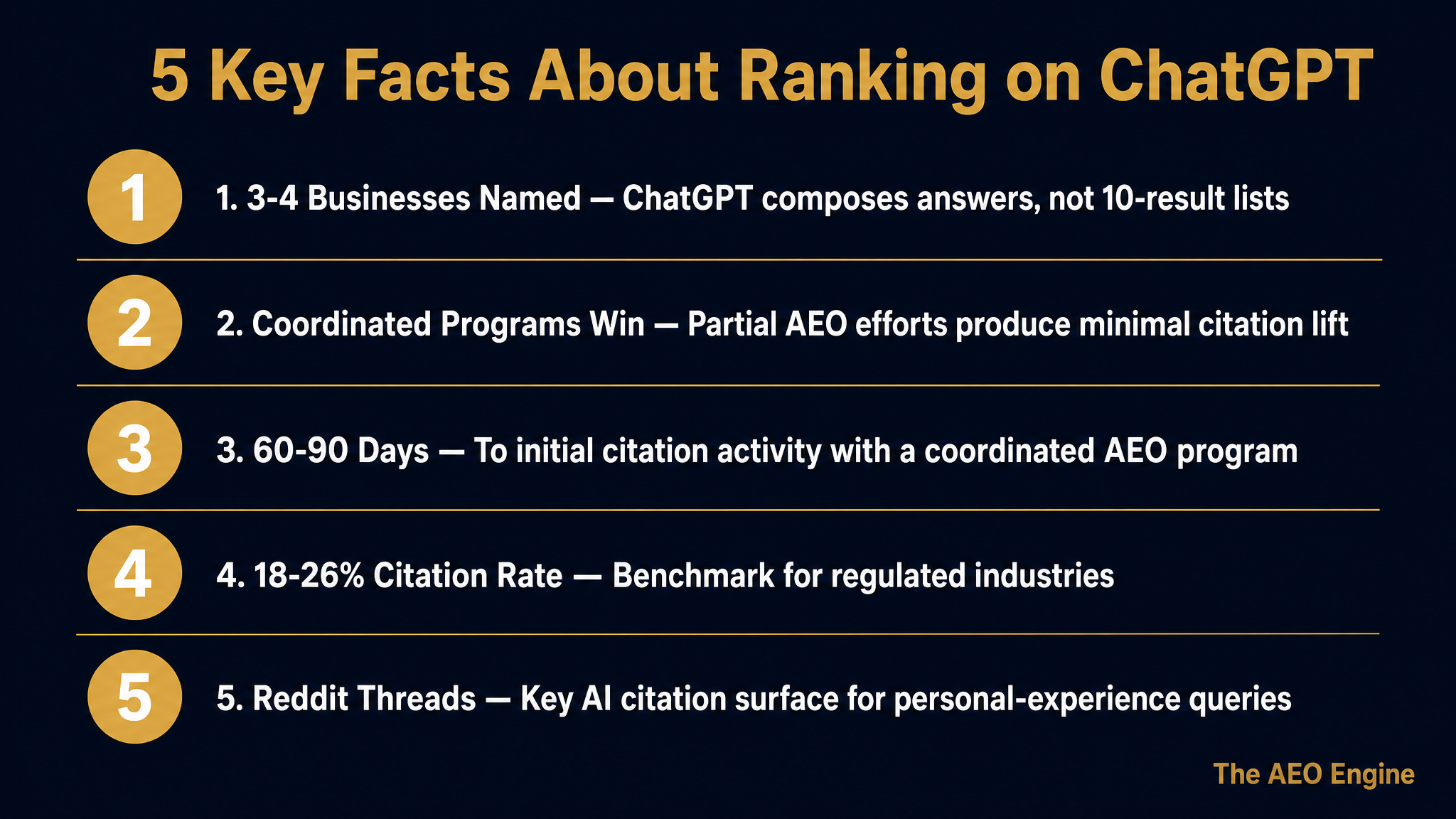
What Does It Mean to Rank on ChatGPT?
Ranking on ChatGPT means appearing as one of three to four businesses cited by name in a composed answer when a user asks ChatGPT a question relevant to the practice's services. ChatGPT does not return ranked search results in the way Google does, with ten positions on a results page. It produces a single answer naming a small number of businesses, then offers a brief explanation of each. Citation in that answer is the only visible position; there is no second page on ChatGPT.
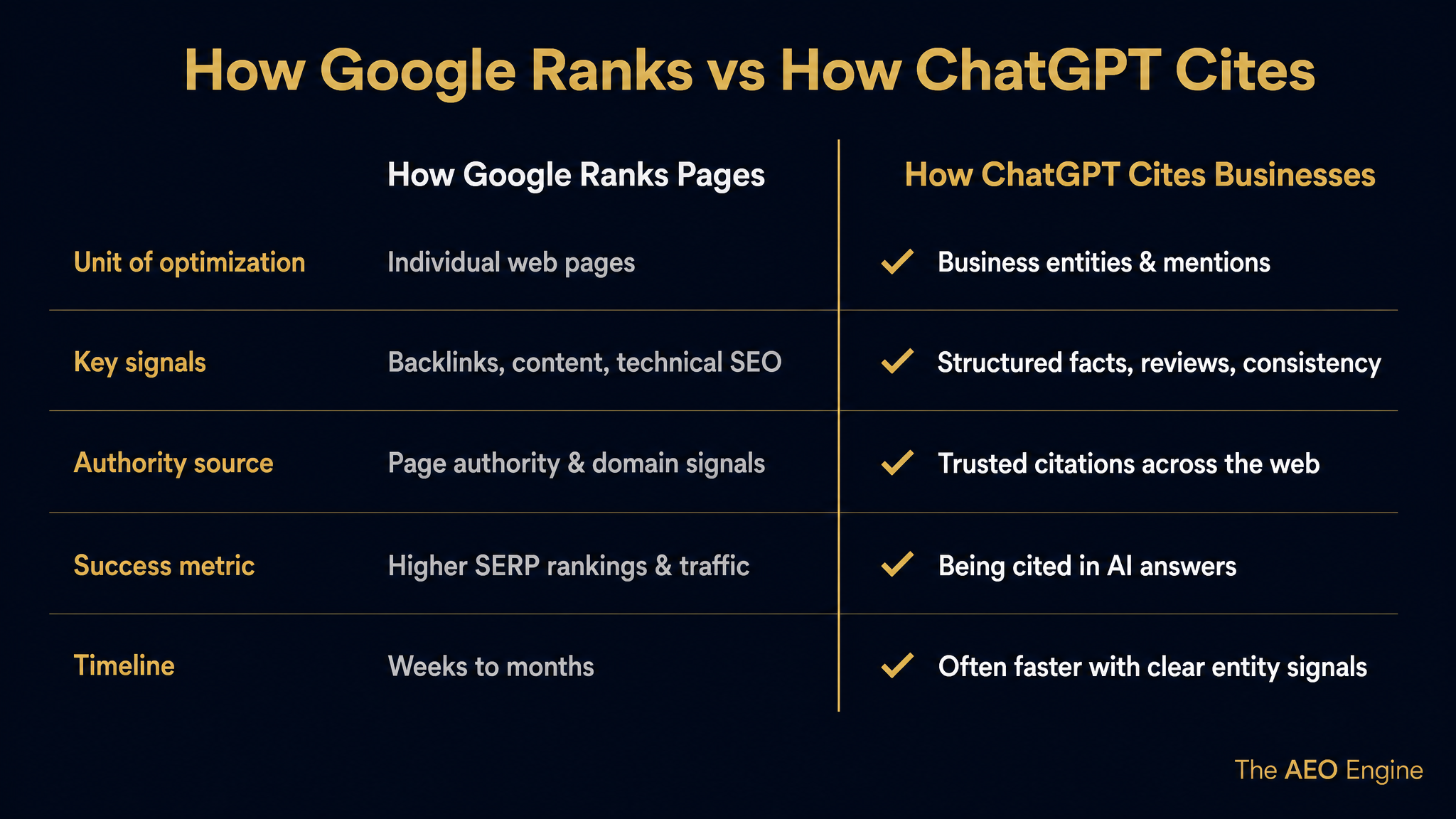
This changes the optimization target fundamentally. Traditional SEO measures success by ranking position for a target keyword. AI citation measures success by inclusion in the answer set. A practice that occupies position one on Google for a query can still be invisible on ChatGPT, and a practice that has never ranked on Google can still be cited regularly by AI when its entity signals are stronger than competitors. The two visibility systems operate on different signal weightings and reward different content structures.
Why Is Ranking on ChatGPT Different From Google SEO?
Google ranks pages by evaluating individual URLs against keyword relevance, backlink authority, and on-page optimization signals. ChatGPT cites entities by evaluating the business across multiple platforms simultaneously, looking for consistency in name, services, location, credentials, and reputation. The unit of optimization shifts from the page to the entity.
This entity-level evaluation explains why a website ranking well on Google can fail to be cited by ChatGPT. ChatGPT cross-references information across the practice's website, professional directories, review platforms, association sites, and news mentions. When that information is inconsistent, with different business names, different addresses, or conflicting service descriptions, ChatGPT's confidence in citing the practice drops and it selects a competitor instead.
Most regulated practices that fall behind on AI citation have not made an SEO mistake. They have an entity consistency problem that traditional SEO does not address, since traditional SEO does not require the cross-platform identity reconciliation that AI citation does.
What Signals Does ChatGPT Use to Recommend a Business?
The CITE Framework identifies the signal categories that determine AI citation:
- Platform presence - The practice must appear consistently across the sites ChatGPT pulls from for authority validation, including industry-specific directories, professional association sites, review platforms, knowledge bases, and editorial publications. Without consistent platform presence, a practice is invisible to AI regardless of website quality.
- Answer-extractable content structure - Content must be formatted in ways AI extraction systems can parse cleanly, supported by structured data and clean HTML body content. AI crawlers parse these structural signals to identify the response candidates worth citing.
- Credentials and authority markers - Specific certifications, reviews, awards, and practice qualifications distinguish a practice from generic alternatives. Specificity is required: "board-certified plastic surgeon, 15 years of practice, ASPS member, 500 documented procedures" produces stronger AI citation signals than "experienced cosmetic surgeon."
- Consistent identity across platforms - The same legal name, address format, service descriptions, and primary credentials must appear everywhere the business is referenced. ChatGPT cross-references this data and lowers citation confidence when identity signals diverge across sources.
These signal categories are mutually reinforcing rather than independent. A practice with strong credentials but insufficient platform presence remains invisible because ChatGPT does not encounter the authority markers during retrieval. A practice with wide platform presence but inconsistent identity signals gets demoted because ChatGPT cannot confidently identify the entity to cite.
How Long Does It Take to Rank on ChatGPT?
Most regulated practices following a coordinated AEO program reach initial citation activity within 60 to 90 days. This is faster than the six to twelve month timeline typical of traditional SEO, primarily because ChatGPT updates its retrieval and citation behavior more frequently than Google updates its core ranking algorithm. New authoritative content is incorporated into ChatGPT's citation surface within weeks rather than months.
The 60 to 90 day timeline assumes the program is sustained throughout the period. Practices that publish two to three articles and stop do not see compounding citation gains. The programs achieving strong citation rate benchmarks in regulated industries are typically publishing substantially more structured content of structured content monthly while maintaining cross-platform entity consistency throughout.
Practices that begin AEO without a written entity consistency baseline often see no early citation activity because their entity signals remain inconsistent regardless of how much content is produced. Establishing entity baseline before content production reduces the time to first citation.
If your practice needs a structured approach to AI citation strategy, The AEO Engine offers Answer Engine Optimization services for service businesses building their first AI citation program. The team has tracked citation rates across healthcare practices and wealth management firms operating under regulatory constraints since 2024.
What Kinds of Content Does ChatGPT Cite?
ChatGPT pulls citation evidence from a hierarchy of sources, weighted by perceived authority and topical specificity:
Reddit appears in ChatGPT's citation pool more frequently than most regulated practices realize. Threads in subject-specific subreddits such as r/EstatePlanning, r/financialplanning, and r/medspa are surfaced because they contain real customer language and named recommendations from peers. Practices not mentioned positively in those threads forfeit the citation surface to competitors who are.
The cited content tends to deliver a clear response near the top of each section, followed by supporting context. Content that buries the answer below background paragraphs or uses primarily promotional language does not extract cleanly and is cited less often regardless of website authority.
Can You Measure if Your Business Ranks on ChatGPT?
Citation rate is the measurement that quantifies AI visibility, calculated as the percentage of relevant queries in which ChatGPT names the business directly. Running 25 representative queries that potential customers would ask, then counting the number of times the business is cited by name, produces a citation rate that benchmarks against the regulated-industry standard of 18 to 26 percent.
The methodology works at three measurement points: a baseline run before any AEO work begins, a 30 day check to identify early citation activity, and a 90 day measurement to confirm whether the program is moving toward the target citation rate. Practices that complete the baseline measurement before content production begins are able to attribute citation gains to specific AEO interventions, while practices that skip the baseline have no comparison point.
Tools such as Otterly.AI automate citation tracking across ChatGPT, Perplexity, Claude, and Google AI Overviews on a continuous basis. Manual measurement is sufficient for a practice running a modest set of queries quarterly, but becomes impractical at higher query volumes or across multiple AI platforms simultaneously.
How Do Practices in Regulated Industries Rank on ChatGPT?
Regulated industries face advertising constraints that make earned AI citation uniquely valuable as a visibility channel. Plastic surgeons cannot run aggressive Google Ads in many cases due to FDA marketing restrictions. Wealth managers face SEC rules limiting performance claims. Law firms operate under bar association advertising rules. These constraints push regulated practices toward content and credential-based visibility, which is exactly the signal mix that ChatGPT weights heavily.
The signals that ChatGPT favors are signals regulated practices already have. Board certifications, peer-reviewed publications, association memberships, and documented years of practice are the credentials that AI extracts as Trust Signals when they appear in structured data. A board-certified surgeon with 500 documented procedures and ASPS membership produces stronger AI ranking signals than a competitor with a more visually polished website but weaker credentials.
The implementation challenge for regulated practices is making credentials visible to AI rather than burying them on a credentials page that crawlers do not process effectively. Credentials must appear in indexable HTML body content, in the page's structured data, and consistently across the practice's About page, professional association profiles, and third-party platform listings.
What Mistakes Keep Most Businesses Invisible to ChatGPT?
Five patterns account for the majority of AI invisibility cases observed across regulated practices:
- Optimizing Only for Google - Content built for keyword density is often unreadable by AI extraction systems. ChatGPT prefers content built for direct AI extraction over keyword-stuffed copy, regardless of how well the content ranks on Google.
- Burying Credentials in PDFs and Images - AI crawlers do not process most PDF content reliably. Credentials, certifications, case studies, and authority markers must live in HTML body content with proper schema markup to be extracted.
- Inconsistent Entity Data Across Platforms - Different business names on Google Business Profile, Yelp, and the practice's own website. Different addresses or service descriptions across sources. AI cross-references these data points and reduces citation confidence when they diverge.
- Missing Structured Data - Absent JSON-LD schema for Organization, Person, FAQ, and Article markup makes structured information extraction unreliable. The schema is the language AI uses to identify entities and categorize content.
- Treating AEO as One-Time Work - Citation rates require continuous content production at the volume necessary to maintain authority signals. Practices that publish two articles and stop do not see sustained citation gains, regardless of how well the initial articles were optimized.
The pattern most regulated practices fall into is the first. Their existing SEO program is still optimizing for Google ranking position, while ChatGPT is selecting from a different signal set entirely. The SEO work is not wrong; it is incomplete for the AI visibility goal.
Frequently Asked Questions
How do I rank on ChatGPT?
A business ranks on ChatGPT by establishing consistent entity signals across the platforms ChatGPT trusts, structuring content for answer extraction with valid schema markup, and earning coverage on authoritative third-party sites. The CITE Framework defines the signal categories AI weighs. Each reinforces the others. Practices reaching reasonable citation rates within 60 to 90 days are typically publishing 20 to 30 pieces of structured content monthly while maintaining cross-platform entity consistency.
How fast can you rank on ChatGPT?
Citation activity typically appears within 60 to 90 days of a coordinated AEO program. ChatGPT updates its retrieval more frequently than Google updates its ranking algorithm, which makes the feedback loop shorter. The 60 to 90 day timeline assumes the program is sustained; practices that publish a few pieces and stop do not see compounding results. Businesses hitting 18 to 26 percent citation rates are publishing consistently and reinforcing entity signals across platforms throughout the period.
Is SEO dead or evolving in 2026?
SEO is not dead, but its strategic importance is shifting. Traditional SEO continues to drive traffic from Google search. AEO drives citations from AI platforms including ChatGPT, Perplexity, and Google AI Overviews. For regulated practices, the better question is which channel delivers more revenue per dollar invested. AI-cited businesses report higher conversion on inbound calls because patients arriving via ChatGPT recommendation already trust the recommendation, while patients from Google searches are typically comparison-shopping.
Can I do AEO myself?
The structural work, including entity consistency audits, schema markup, and content restructuring, is doable in-house if the practice has technical capability. The harder part is sustained content production at the volume needed to drive citation rate gains. Most practices outsource content production while keeping entity audits and credential signal management in-house, since the credential management benefits from internal knowledge of the practice's actual qualifications.
Does ChatGPT use Google search results?
ChatGPT's web search feature pulls from Google-indexed pages, but its citation behavior also draws on training data, third-party data partnerships, and direct retrieval from sites in its trusted source set. Google ranking matters but is not sufficient for AI citation. A site ranking well on Google can still fail to be cited by ChatGPT if its information is inconsistent across the broader platform set or if its structured data is missing.
How is ranking on ChatGPT measured?
Citation rate, the percentage of relevant queries in which ChatGPT mentions the business by name, is the standard measurement. The benchmark for actively-optimized regulated practices is 18 to 26 percent. very low indicates effective AI invisibility; sustaining high citation rates above this range requires continued content production. Tools such as Otterly.AI automate citation tracking across ChatGPT, Perplexity, Claude, and Google AI Overviews. Manual sampling of 25 representative queries quarterly is sufficient for most regulated practices.
Should I optimize differently for ChatGPT versus Perplexity versus Google AI Overviews?
The fundamentals overlap across all three platforms, but each has distinct quirks. ChatGPT relies on training data plus retrieval. Perplexity prioritizes recency and aggressive web search. Google AI Overviews uses Google's search index directly. A well-built AEO program lifts citation rates across all three, but optimization for any one platform involves attention to its specific source preferences. Coverage on Reddit affects ChatGPT more than Google AI Overviews; recency affects Perplexity more than ChatGPT.
What is the AI Gap Check?
The AI Gap Check is a free 15 minute audit run by The AEO Engine that executes 25 AI queries specific to the practice's specialty and city, then compares the citation rate to the practice's top three competitors. The output is a written assessment of where the practice appears, where it does not, and what specific signal categories are blocking citation. The Gap Check is available at The AEO Engine, with five sessions per week and no sales call requirement.
Executive Summary
A practice ranks on ChatGPT by being one of three to four businesses cited by name when AI responds to a relevant query, identified through alignment of the CITE Framework signal categories. Coordinated AEO programs reach initial citation activity within 60 to 90 days and target citation rates of 18 to 26 percent over 12 months for regulated practices. The work begins with entity consistency audits, structured data implementation, and citation-ready content restructuring before any content production investment, because content produced against inconsistent entity baselines does not compound into citation gains.
What Should You Do Next?
Before investing additional budget in SEO or content production, list the five queries potential customers would type into ChatGPT to find a business in your specialty and city. Run each query in ChatGPT and note whether your business appears in the response. If the practice appears in fewer than four out of five queries, the AI citation rate is below the regulated industry benchmark and the entity signal categories require attention before content production produces measurable returns.
The AEO Engine offers a free AI Gap Check that runs 25 queries specific to your specialty and city, then compares the citation rate to your top three competitors. The Gap Check identifies which CITE Framework signal categories are blocking citation before any optimization budget is committed.
About the Author
Jerry Jariwalla is the founder of The AEO Engine and creator of the CITE Framework for Answer Engine Optimization. With over 22 years in digital marketing and multiple successful business exits, Jerry has spent the past two years building AI citation systems for regulated practices in healthcare, wealth management, and legal services. The AEO Engine works exclusively with practices operating under advertising restrictions where AI citation provides higher leverage than traditional paid acquisition.
Expertise: Answer Engine Optimization, AI Citation Strategy, CITE Framework, Regulated Industry Marketing, Healthcare Practice Marketing, Wealth Management Marketing, Legal Marketing
Connect: LinkedIn
Disclaimer: This content is for informational purposes only and does not constitute professional marketing, legal, or compliance advice. Citation rates, timelines, and outcomes vary based on industry, competitive density, and execution quality. Statistics referenced reflect The AEO Engine's tracked client outcomes as of 2026 and are not guarantees of future results. Contact The AEO Engine for a consultation regarding your specific situation.