
Last Updated: May 2026
AI-driven TRT clinic recommendations are the results generated by platforms like ChatGPT, Perplexity, and Google AI Overviews when patients search for testosterone replacement therapy providers near their location. Unlike traditional search engines that return ranked lists of local businesses, AI assistants synthesize information from multiple sources to recommend a small number of clinics that meet a threshold of entity clarity, content authority, and patient trust signals. According to a 2025 analysis of AI search behavior for medical practices, AI systems prioritize practices whose content is authored by or connected to real medical professionals, that directly answer specific patient questions, and that maintain consistent, accurate information across local health directories and review platforms.
The AEO Engine, founded by Jerry Jariwalla, applies the CITE Framework for Answer Engine Optimization to help regulated healthcare practices improve their AI citation rate. With over 22 years in digital marketing and multiple successful business exits, Jerry has spent the past two years building AEO systems for healthcare practices, wealth management firms, and legal services operating under advertising restrictions where AI citation provides more sustainable patient acquisition than paid channels. The AEO Engine works exclusively with regulated practices where the AI recommendation gap carries real patient acquisition consequences.
This article explains the specific signals AI platforms use to select TRT clinics for near-me queries, what separates cited practices from invisible ones, and what patients should understand about why certain clinics appear in AI recommendations while others with comparable clinical quality do not.
Key Takeaways
- Entity Clarity Determines Discoverability - AI recommendation engines can only cite what they can clearly identify. TRT clinics with inconsistent practice names, addresses, or physician names across platforms are functionally invisible to AI systems, regardless of clinical quality.
- Patient Review Specificity Drives Citation - AI platforms weight reviews that mention specific treatments, outcomes, and monitoring protocols above generic star ratings. A clinic with fewer reviews describing PSA monitoring and protocol adjustments may outrank one with more reviews that say only "great service."
- Structured Data Accelerates AI Indexing - Schema markup for MedicalClinic, Physician, and MedicalSpecialty types reduces ambiguity and helps AI systems extract and verify clinic identity, credentials, and service scope reliably.
- Content Depth Signals Clinical Authority - AI systems favor practices whose content directly answers the questions patients research before choosing a TRT provider: delivery method comparisons, PSA monitoring protocols, cost transparency, and insurance navigation. Generic service descriptions do not produce citations.
- Local Platform Consistency Is Non-Negotiable - AI aggregates signals from Google Business Profile, health directories, and review platforms simultaneously. Inconsistencies across these sources reduce recommendation probability across every AI platform that queries them.
Each of these five signals reflects how AI recommendation engines build their understanding of a practice's identity, authority, and trustworthiness before a patient searches. Practices that invest in these fundamentals consistently achieve higher and more stable citation rates than those that optimize for individual queries.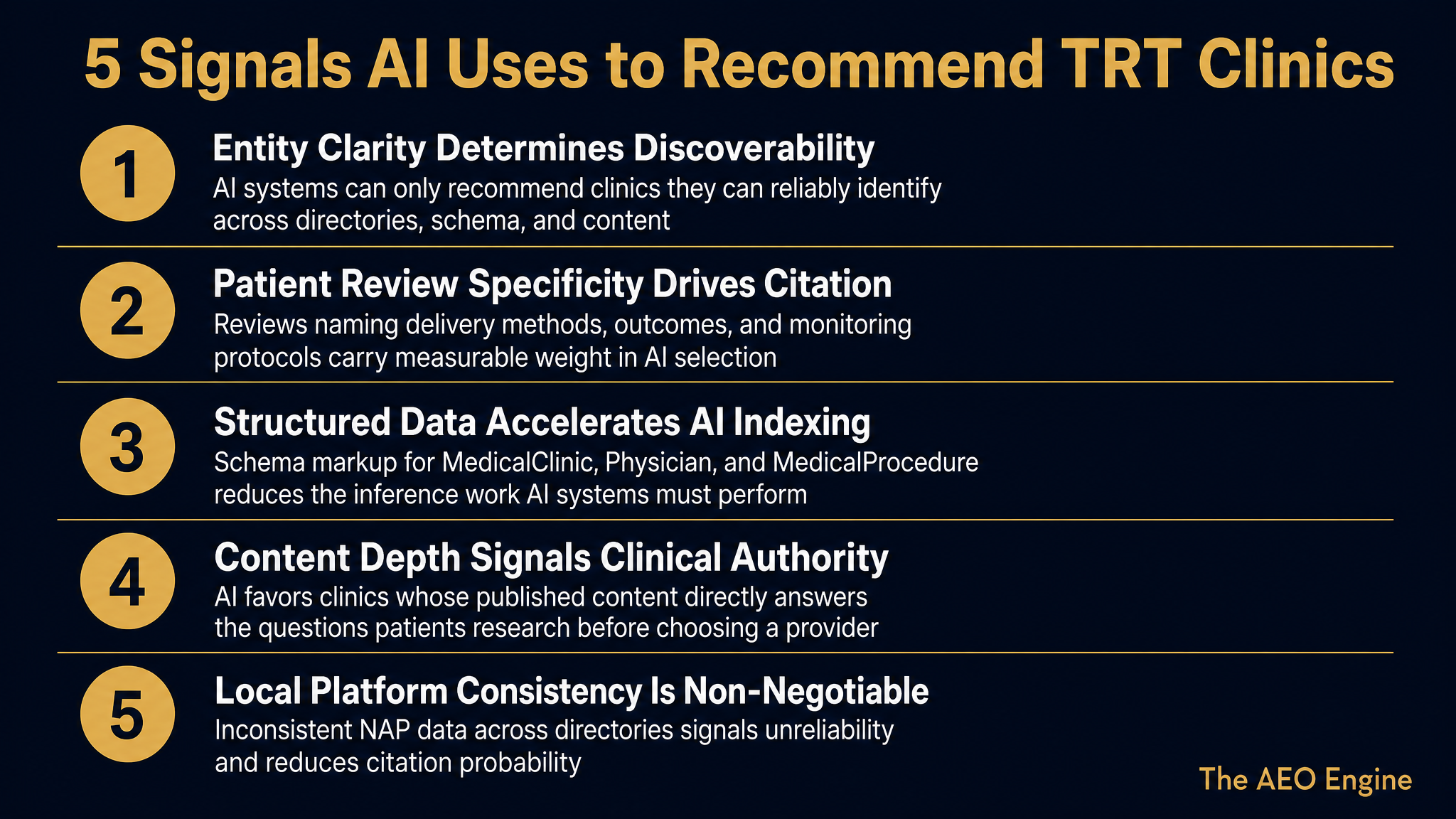
Why Does "TRT Near Me" Return Different Results in AI Than Google?
When a patient types "TRT near me" into Google Maps, results are driven primarily by proximity, review volume, and Google Business Profile completeness. The algorithm is location-first: it returns clinics within a geographic radius sorted by relevance and local ranking signals.
AI assistants operate differently. ChatGPT, Perplexity, and similar platforms do not have real-time GPS access in most implementations. They construct recommendations from content they have ingested and indexed, weighted by signals that determine whether a practice qualifies as a credible, identifiable entity worth recommending. A clinic 5 miles away with strong local SEO may appear prominently in Google Maps but remain invisible to ChatGPT if its content does not answer clinical questions, its schema is incomplete, or its practice identity is inconsistently stated across platforms.
The result is two ranking systems operating simultaneously for the same "TRT near me" query, and they do not rank practices in the same order. Clinics that appear in both AI and traditional search typically have invested in entity clarity and structured clinical content that satisfies both systems. Clinics appearing in only one have a meaningful gap in their patient acquisition infrastructure.
What Signals Does AI Use to Select TRT Providers Near You?
AI platforms evaluate TRT clinic recommendations using a combination of entity signals, content authority markers, and local trust indicators that operate differently from traditional search ranking factors.
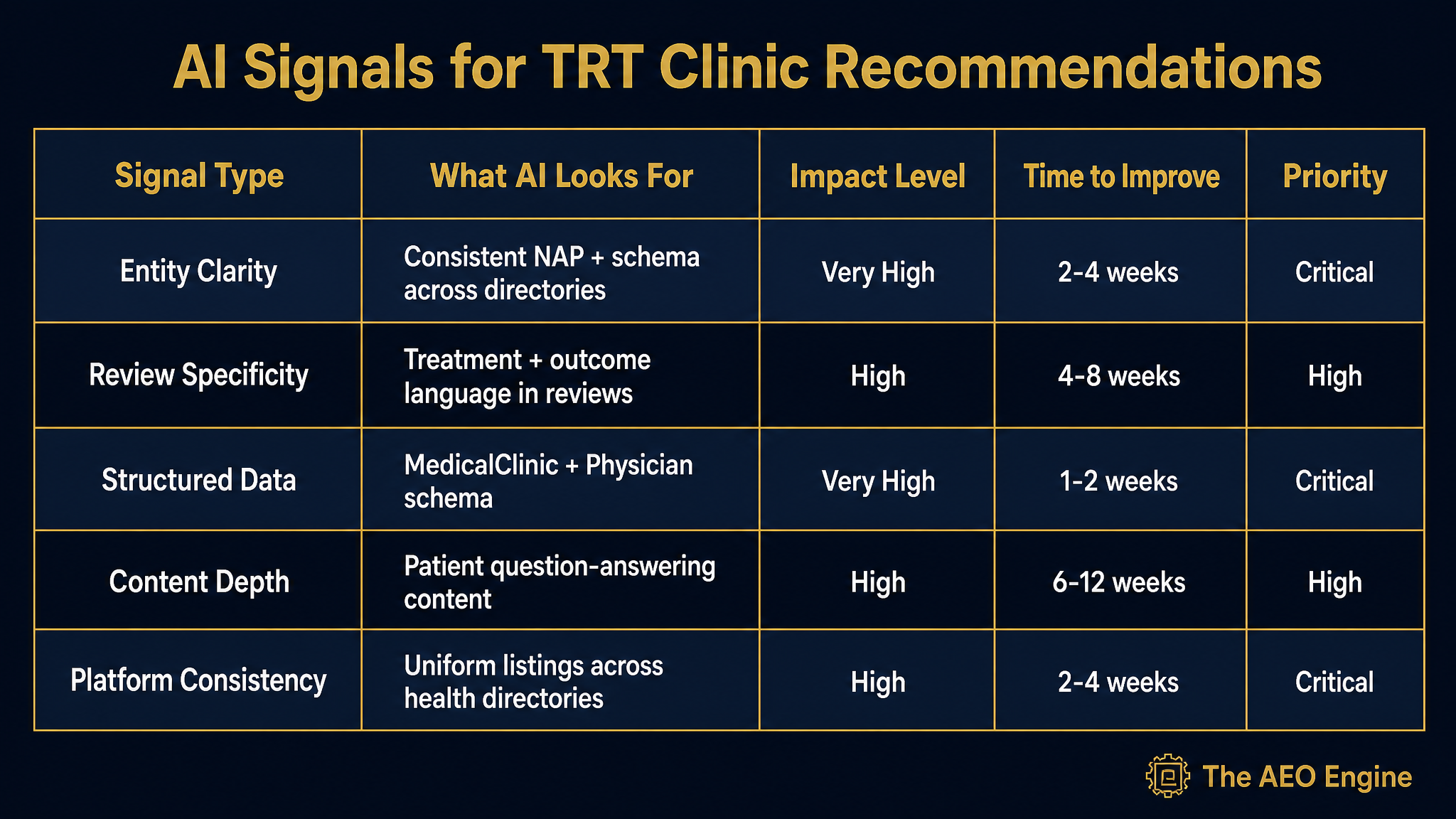
- Practice identity signals cover the consistency of the clinic's legal name, address, phone number, and provider names across its website, Google Business Profile, Healthgrades, WebMD, Zocdoc, and other health directories. AI platforms cross-reference these sources to verify that a named entity is real, stable, and consistently described. Any discrepancy, such as a DBA name on the website that differs from the legal name in health directories, introduces ambiguity that reduces citation probability.
- Content authority signals include whether the clinic's published content answers the specific questions patients ask about TRT: delivery method options, PSA monitoring frequency, how lab values are interpreted, and what cost structure looks like with and without insurance. AI systems extract answer-ready content and cite the practices whose content most directly and accurately addresses those queries.
- Clinical credential signals come from schema markup identifying named physicians, their specialties, board certifications, and relationship to the practice. A MedicalClinic schema that includes Physician entities with named specialties and credentials signals to AI platforms that the practice is operated by verifiable medical professionals rather than a marketing-facing brand without clinical depth.
How Do Patient Reviews Shape AI Clinic Recommendations?
Patient reviews influence AI recommendations differently from how they affect Google Maps rankings. Volume and star rating matter less than the informational content of the reviews themselves. AI platforms extract clinical specificity from review text as part of their entity verification process.
A review reading "The team monitored my PSA and testosterone levels monthly and adjusted my protocol based on the results" signals to AI systems that the practice follows clinical monitoring protocols. A review reading "Great staff, very professional" provides no clinical authority signal, regardless of its rating.
Three review characteristics carry the most weight in AI recommendation contexts:
- Treatment specificity - Reviews naming the delivery method used (injections, cream, pellets), describing the monitoring protocol, or referencing follow-up scheduling signal that real clinical care occurred. These reviews function as secondary content reinforcing the practice's clinical authority claims.
- Outcome description - Reviews describing a change in energy, lab values, or symptom profile provide AI platforms with patient-reported outcome signals. These are particularly relevant for TRT clinics because they align directly with the clinical questions patients research before choosing a provider.
- Recency and distribution - A practice with reviews dated across the past 12 months signals ongoing clinical activity. Reviews clustered in a single month followed by a long gap suggest a managed campaign rather than sustained patient care, which AI platforms can detect through pattern analysis.
If your TRT practice is not appearing in AI-generated recommendations for local patient searches, The AEO Engine offers a Free Gap Check at theaeoengine.com/contact#gap-check-form that identifies the specific entity, content, and schema gaps preventing citation across ChatGPT, Perplexity, and Google AI Overviews.
What Should Patients Look for in an AI-Recommended TRT Clinic?
An AI recommendation for a TRT clinic is not a medical endorsement. It signals that the practice has established sufficient entity clarity and content authority to be extracted from the AI's indexed data. Patients should treat it as a starting point for evaluation rather than a final selection.
When evaluating AI-recommended TRT clinics, patients should confirm:
- Physician-led care - The clinic should identify the supervising physician by name, credential, and specialty. Testosterone replacement therapy requires a licensed prescriber, and AI-recommended clinics that obscure physician identity warrant additional scrutiny before a patient moves forward.
- Monitoring protocols - Clinically appropriate TRT includes regular testosterone level testing, PSA monitoring, hematocrit checks, and protocol adjustments based on results. Clinics that emphasize enrollment convenience without addressing monitoring requirements may be optimizing for patient volume rather than patient outcomes.
- Cost transparency - According to SingleCare, testosterone replacement therapy with insurance typically costs $10 to $30 per month in copays when prescribed for documented hypogonadism, while out-of-pocket costs range from $100 to $450 monthly depending on delivery method. Clinics that cannot provide a clear cost structure during an initial inquiry limit a patient's ability to make an informed financial decision before committing to treatment.
- Telehealth versus in-person care clarity - Telehealth TRT platforms have expanded access, but monitoring requirements for bloodwork and follow-up visits still apply. Patients should confirm whether the clinic manages all aspects of care or requires them to arrange separate lab and monitoring services independently.
How Can a TRT Clinic Improve Its AI Recommendation Rate?
TRT clinics that want to appear consistently in AI-generated near-me recommendations need to address the signals AI platforms use to evaluate them. This is an ongoing program of entity management, content production, and schema maintenance rather than a single optimization task.
The foundational work covers four areas:
- Entity consistency audit - A review of every platform where the clinic appears to confirm that practice name, address, phone, physician names, and credentials are identical across sources. Discrepancies at this level block citation even when all other signals are strong.
- Clinical content depth - Publishing content that directly answers the specific questions patients research before choosing a TRT provider: delivery method comparisons, monitoring timelines, insurance navigation, and what lab values indicate successful therapy. Hone Health's cost analysis illustrates the kind of specific, patient-useful content that AI systems extract and cite consistently.
- Schema markup implementation - Adding MedicalClinic, Physician, and MedicalSpecialty structured data to the clinic website so AI systems can verify clinic identity, physician credentials, and service scope from machine-readable sources rather than inferring them from unstructured content.
- Review content strategy - A structured approach to requesting reviews that encourages patients to describe specific aspects of their care, monitoring experience, and protocol management rather than providing only sentiment ratings.
The CITE Framework applies this four-area approach in a sequenced program designed for practices operating under healthcare advertising restrictions, where paid acquisition channels carry compliance risk and AI citation represents a more sustainable patient acquisition path.
Frequently Asked Questions
How much does the average TRT cost?
TRT costs vary based on delivery method, insurance status, and provider model. With insurance coverage for documented hypogonadism, monthly copays typically range from $10 to $30. Without insurance, testosterone injections represent the most affordable option at roughly $40 to $100 per month, while gels and creams range from $400 to $1,000 monthly. Pellet implants cost $650 to $2,000 per treatment session. Annual costs including labs, consultations, and monitoring typically range from $500 to $12,000 depending on delivery method and the scope of monitoring included.
Can I get TRT without seeing a doctor?
No. Testosterone replacement therapy requires a prescription from a licensed physician or authorized prescriber in every US state. Telehealth platforms have made the consultation process more accessible by allowing patients to complete initial assessments and blood work remotely, but a prescribing physician must review lab results and medical history before issuing a testosterone prescription. Patients should be cautious of any platform offering testosterone without verifiable physician oversight, as this arrangement does not meet the clinical and regulatory standards required for safe TRT management.
Can TRT raise PSA levels?
Yes. Testosterone replacement therapy can cause a modest increase in PSA (prostate-specific antigen) levels, which is why established TRT protocols include baseline PSA testing before therapy begins and regular PSA monitoring during treatment, typically every three to six months in the first year. A significant or rapidly rising PSA level during TRT warrants evaluation by a urologist. Patients should confirm that PSA monitoring is included in a clinic's standard TRT protocol before beginning therapy.
Is TRT covered by insurance?
Most commercial insurance plans, Medicare Part D, and many Medicaid programs cover testosterone replacement therapy when prescribed for documented hypogonadism, typically requiring at least two low morning testosterone lab results before approving coverage. Coverage is more variable when testosterone is prescribed for symptoms without a formal hypogonadism diagnosis. Injectable testosterone is the most widely covered formulation and the most cost-effective option under most insurance plans. Prior authorization is commonly required for brand-name or less common delivery methods.
How does a TRT clinic improve its visibility in AI recommendations?
A TRT clinic improves its AI recommendation rate by addressing the entity signals AI platforms use to evaluate practices: consistent practice identity across all health directories and platforms, clinical content that answers the specific questions patients research before choosing a provider, structured schema markup identifying the clinic as a MedicalClinic with named physician entities and specialties, and a review strategy that generates patient feedback describing specific aspects of care and monitoring. These four areas collectively determine whether an AI platform has sufficient confidence to name a specific clinic in response to a near-me query.
What is the difference between TRT and testosterone optimization?
Testosterone replacement therapy is a medically prescribed treatment for clinically diagnosed low testosterone (hypogonadism), defined by blood test results below established clinical thresholds. Testosterone optimization is a broader term used by some providers to describe testosterone supplementation for men whose levels fall in the low-normal range and who experience symptoms associated with declining testosterone. TRT is typically covered by insurance when a hypogonadism diagnosis is documented. Testosterone optimization programs often operate on a cash-pay basis because insurance coverage is less predictable without a formal clinical diagnosis.
How long does TRT take to show results?
Most patients report initial changes in energy, mood, and libido within the first four to six weeks of therapy. Improvements in muscle composition, bone density, and cognitive clarity typically emerge over three to six months of consistent treatment. Lab values, including testosterone and PSA levels, are typically re-tested at six to twelve weeks to assess initial response and determine whether protocol adjustments are needed. A complete clinical benefit assessment is generally not meaningful before 90 days of consistent therapy at a stable dose.
What should I ask a TRT clinic before starting treatment?
Before starting TRT, patients should ask: Who is the supervising physician and what are their credentials? What is the monitoring protocol for testosterone levels, PSA, and hematocrit during therapy? How are protocol adjustments handled if initial results fall outside target range? What is the total monthly cost including consultations, labs, and medication? Does the clinic handle all monitoring or require separate lab arrangements? What happens if symptoms change between scheduled appointments? Clinics that answer these questions clearly during an initial inquiry are demonstrating the clinical transparency that AI platforms also reward in their recommendation signals.
Executive Summary
AI platforms like ChatGPT, Perplexity, and Google AI Overviews select TRT clinics for near-me recommendations based on entity clarity, clinical content depth, structured schema data, and patient review specificity, signals that operate differently from traditional local search ranking factors. Patients searching for TRT providers near them increasingly encounter AI-generated recommendations rather than simple map results, and understanding what drives those recommendations helps them evaluate whether a clinic has invested in clinical transparency or only in digital presence. TRT practices that want to appear consistently in AI-generated recommendations need a structured approach to entity management, clinical content, and review strategy, the same signals The AEO Engine's CITE Framework addresses for regulated healthcare practices operating under advertising restrictions.
What Should You Do Next?
Patients evaluating AI-recommended TRT clinics should use the signals described in this article as a verification checklist: named physician credentials, published monitoring protocols, transparent cost structures, and clear telehealth versus in-person care distinctions. A clinic that meets all four criteria is demonstrating the clinical transparency that earns both patient trust and AI citations.
TRT practices that are not appearing in AI-generated recommendations can identify the specific gaps through The AEO Engine's Free Gap Check, which maps current citation status across ChatGPT, Perplexity, and Google AI Overviews and identifies the entity, content, and schema deficiencies preventing recommendation. Schedule yours at theaeoengine.com/contact#gap-check-form.
People Also Read
- What Is the AI Recommendation Gap and Why Are You Listed But Not Recommended?
- How Does Med Spa Marketing Work in 2026?
About the Author
Jerry Jariwalla is the founder of The AEO Engine and creator of the CITE Framework for Answer Engine Optimization. With over 22 years in digital marketing and multiple successful business exits, Jerry has spent the past two years building AI citation systems for regulated practices in healthcare, wealth management, and legal services. The AEO Engine works exclusively with practices operating under advertising restrictions where AI citation provides higher leverage than traditional paid acquisition.
Expertise: Answer Engine Optimization, AI Citation Strategy, CITE Framework, Regulated Industry Marketing, Healthcare Practice Marketing, Wealth Management Marketing, Legal Marketing
Connect: LinkedIn
Disclaimer: This content is for informational purposes only and does not constitute professional marketing, legal, or compliance advice. Citation rates, timelines, and outcomes vary based on industry, competitive density, and execution quality. Statistics referenced reflect The AEO Engine's tracked client outcomes as of 2026 and are not guarantees of future results. Contact The AEO Engine for a consultation regarding your specific situation.