
Last Updated: June 2026
A retirement planner near me search is now answered as often by AI as by a map. People ask ChatGPT, Perplexity, and Google AI Overviews to name a planner. The AI replies with specific firms. Harvard researchers note that AI tools are reshaping how people get financial guidance. The planners those tools name are decided by signals most firms have never managed. The firms AI names are rarely the biggest. They are the ones with the clearest trust data.
The AEO Engine is a citation program that helps regulated practices move from listed to cited by AI. Its founder, Jerry Jariwalla, brings over 22 years in digital marketing and created the CITE Framework after 18 months of testing across regulated industries. The AEO Engine works with wealth, healthcare, and legal practices. It tracks citation rates across client programs and closes the gaps that keep providers out of AI answers.
This guide covers the signals AI uses to pick retirement planners, why most firms are missing from these answers, and what a structured citation program does differently.
Key Takeaways
- AI Treats Retirement Advice as a High-Trust Category - Retirement questions touch money and security, so AI applies stricter trust filters before naming any planner.
- Entity Clarity Decides Citations More Than Reputation - AI checks how clearly a planner is described across sources. A strong local reputation does not transfer to AI without structured data.
- Most Retirement Planners Are Invisible to AI - A firm can have decades of happy clients and still be absent from AI answers because its digital entity signals are thin.
- The CITE Framework Closes the Citation Gap - It builds the structured signals AI needs to name a provider with confidence in a regulated category.
- Citation Rates on Structured Programs Run 18 to 26 Percent - The AEO Engine tracks this range across client programs based on its own program data.
Each of these points separates planners that AI names from those it skips.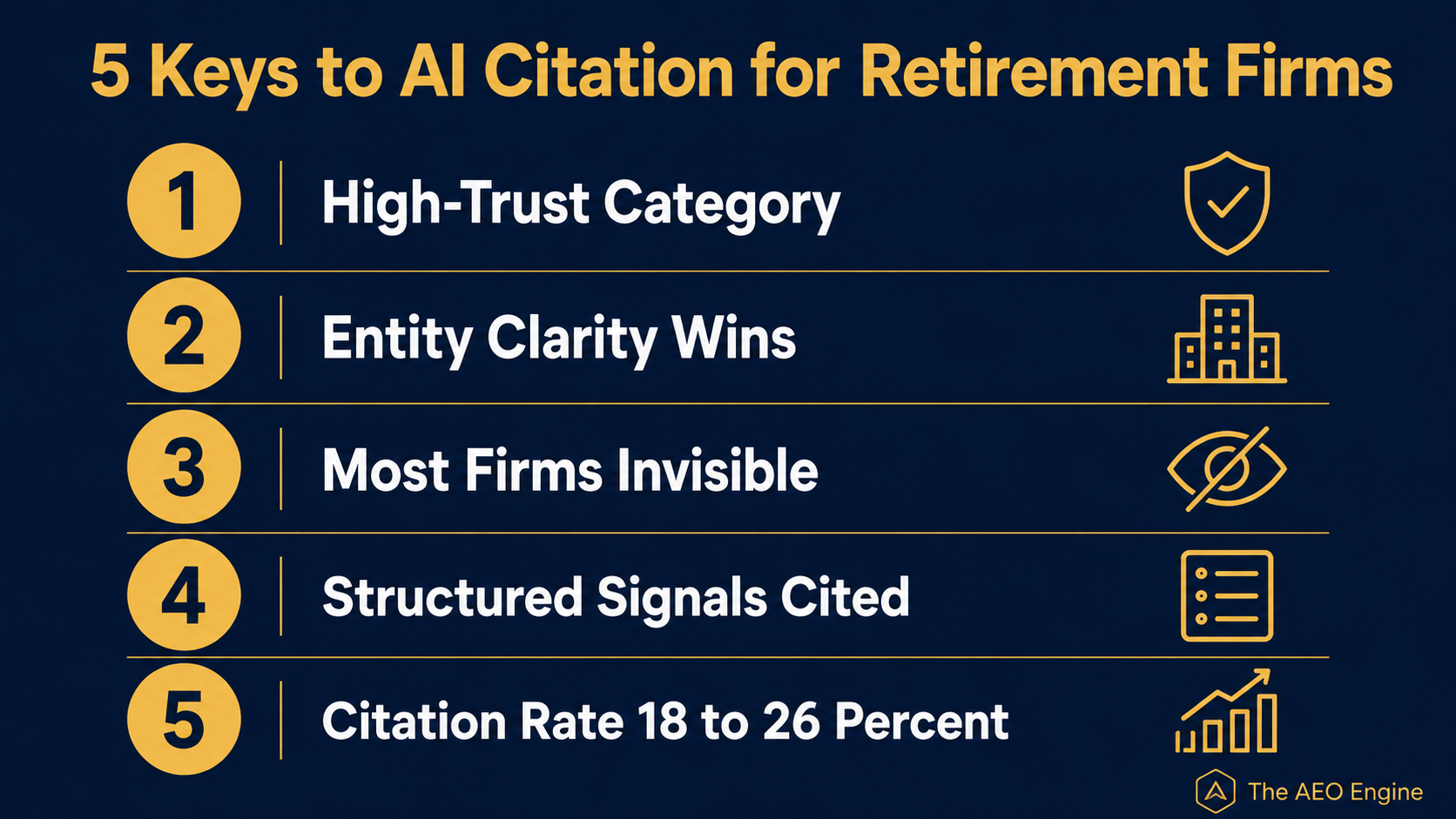
Why Does AI Treat Retirement Planners as a High-Trust Category?
AI applies stricter filters to money, health, and legal topics. A wrong answer here can cause real harm. Google calls this YMYL, short for "your money or your life." ChatGPT and Perplexity apply the same caution.
AI will not name a retirement planner without strong trust signals. One website is not enough. One review page is not enough. AI looks for the same planner across regulatory databases, directories, and media. The name, credential, and specialty must match.
Retirement planners have one edge. Their registrations are verifiable. The SEC's investor tools let anyone check a planner's standing. AI can read those same public records. A clean record gets a planner into the pool AI considers. It does not decide who AI names.
What Signals Does AI Use to Pick a Retirement Planner?
AI checks four signal types. Most planners are strong in one and weak in the rest.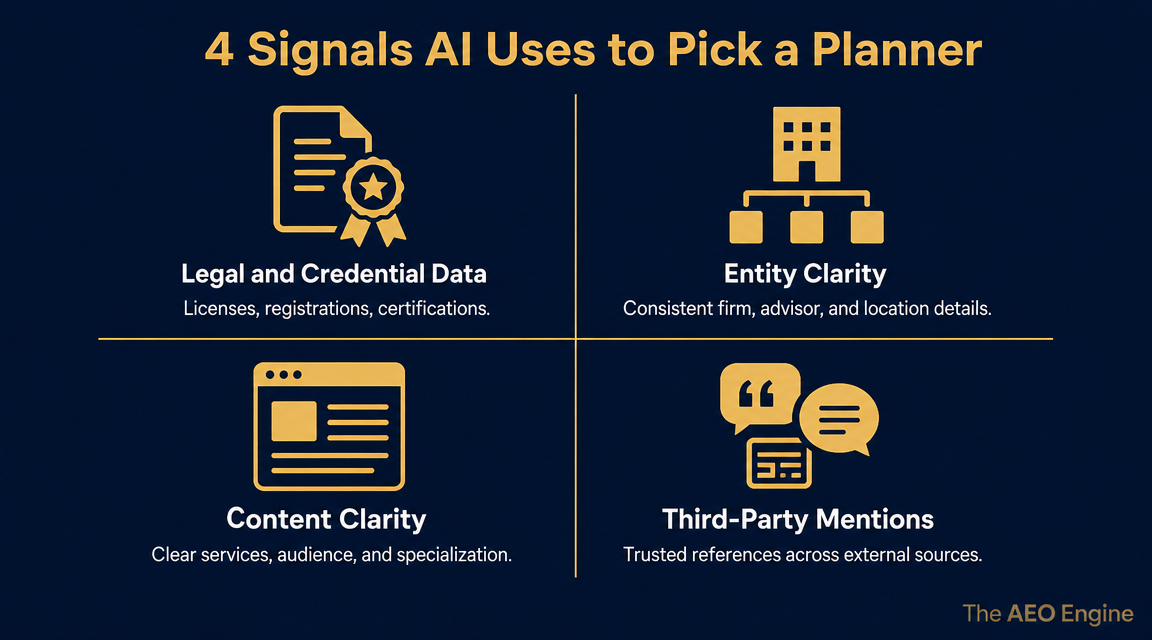
- Legal and credential data - AI scans regulatory databases for current registrations. A complete, current filing signals a legitimate firm. Gaps reduce trust.
- Entity clarity - AI builds a profile of who the planner is. The name, firm, city, and credential must match across the website, directories, and professional listings.
- Content clarity - AI favors planners who publish clear answers. A site with well-structured pages on retirement income, fees, and planning steps signals expertise.
- Third-party mentions - AI weighs mentions in media, professional directories, and community discussion. A planner cited by a trusted outside source carries more weight.
A planner who is strong across all four is a candidate for citation. A planner strong in only one is usually skipped.
What Separates Planners AI Cites From Those It Ignores?
The gap is not reputation. Many respected firms with long client lists never appear in AI answers. The gap is structured digital entity data.
AI cannot evaluate what it cannot find. A firm with 25 years of service but a thin website is hard for AI to read. Citations go to firms with clearer signals, even firms with shorter track records.
A planner with deep experience and no structured online presence competes against a newer firm with clean data and verified credentials. AI names the second firm. The first still gets referrals. Its AI inquiry channel stays empty. That is the cost of the gap.
The AEO Engine runs AI citation audits for wealth and retirement practices. The audit covers all four signal types and delivers a ranked action plan. Book a free Gap Check to see where your firm stands.
How Does AI Read "Near Me" for Retirement Planners?
Local intent makes the picture harder. When someone adds "near me," AI tries to match a planner to a place. It reads location signals from the website, directories, and local mentions.
A planner with consistent location data is easy for AI to place. A planner with mismatched addresses, or no clear city signal, is hard to attach to a local query. AI then skips the firm or names a competitor with cleaner local data.
This is why local reputation alone does not win AI citations. The firm everyone in town knows may still be invisible to a buyer who asks AI for a nearby planner. The signal AI needs is structured and consistent, not just well-known.
Why Are Most Retirement Planners Missing From AI Answers?
Most planners built their digital presence for Google search, not AI citation. They optimized for rankings, ran ads, and collected reviews. None of that was wrong. It just does not produce what AI reads.
AI does not rank a list of links. It names a few providers it trusts. That trust comes from consistent entity data, clear content, and verifiable credentials. Most planners have never managed those signals as a system.
HubSpot's research on answer engine work confirms that AI favors sources with clear, consistent signals. A planner who has never built those signals is absent from AI answers by default. The strength of the practice offline does not change that.
What Does a Structured Citation Program Do Differently?
A structured citation program treats AI visibility as a system, not a one-time fix. It starts with an audit of the four signal types. It finds where the firm's entity data is thin, inconsistent, or missing.
From there, the program builds the signals AI needs. It aligns the firm's name, credential, and location across sources. It structures content so AI can read and cite it. It builds the third-party signals that confirm the firm is a real, trusted provider.
The CITE Framework is the method behind this work. The AEO Engine tracks citation rates of 18 to 26 percent across client programs based on its own program data. That compares with near-zero rates for practices that have not addressed their entity signals.
Frequently Asked Questions
What is the $1000 a month rule for retirement?
The $1000 a month rule is a rough guide some planners use. It says that for every $1000 of monthly income you want in retirement, you need about $240,000 saved. That is based on a 5 percent yearly withdrawal. It is a starting estimate, not a real plan. A true plan accounts for taxes, Social Security, inflation, and personal goals. A good planner builds a plan around your full situation, not a single rule.
Are retirement planners worth it?
For most people near retirement, a good planner adds value beyond the cost. Planners help with withdrawal timing, tax planning, Social Security, and avoiding costly mistakes. The value is highest for people with several income sources. The hard part is finding a planner who fits. Many strong planners are now hard to find through AI search. Their digital trust signals are thin, even when their advice is excellent.
Who is the best person to talk to about retirement planning?
The best fit is usually a fiduciary or certified financial planner who focuses on retirement income. A fiduciary must act in the client's best interest. Look for clear credentials, a fee structure you understand, and experience with cases like yours. You can verify a planner's standing through public tools. AI tools name specific planners now. The ones they name have the clearest trust data, not always the best advice.
What is the cost of a retirement planner?
Retirement planner costs vary by model. Some charge a flat fee for a plan, often in the low thousands. Some charge by the hour. Others charge a percentage of the assets they manage, often about 1 percent per year. Fee-only planners avoid commission conflicts. The right model depends on whether you want a one-time plan or ongoing help. Always ask for the full fee in writing. Confirm there are no hidden commissions before you start.
How does AI decide which retirement planner to recommend?
AI checks four signal types: legal and credential data, entity clarity, content clarity, and third-party mentions. It looks for a planner whose name, credential, and location match across trusted sources. A clean record gets a planner into the running. Clear data and strong content decide which planner AI names. Reputation alone does not drive AI citations. Consistent digital signals do.
Why is my retirement firm not showing up in ChatGPT?
The most common reason is thin or mismatched entity data. If your firm's name, credential, and location do not match across your website, directories, and listings, AI cannot read your firm as one trusted entity. Many firms also lack content that answers buyer questions. The fix is to build consistent signals and clear content that AI can cite. That is the focus of a structured citation program.
How long does it take to get cited by AI?
Most structured programs see citation changes within the first quarter. The exact timeline depends on the firm's starting point, the category, and how complete the build is. Firms with strong credentials but thin digital signals often move faster. The trust already exists. It just needs to be made readable to AI. Building a durable pattern is ongoing work, not a one-time setup.
Can a small retirement practice compete with large firms in AI answers?
Yes. AI does not just name the biggest firms. It names the firms with the clearest, most consistent signals. A small practice with clean data, verified credentials, and strong content can be cited ahead of a large firm with thin signals. This is one edge of AI citation over old search. Size matters less than signal clarity. That puts a well-prepared small practice on even footing.
Executive Summary
AI now names specific retirement planners when people search nearby. The choice comes from four signal types: legal and credential data, entity clarity, content clarity, and third-party mentions. A verifiable regulatory record gets a planner into the pool AI considers, but it does not decide who gets named. Most retirement firms are missing from AI answers, not because of weak advice, but because their digital entity signals are thin or inconsistent. The firms AI names have clear, consistent, verifiable data across many sources. A structured citation program using the CITE Framework builds those signals and closes the gap. The AEO Engine tracks citation rates of 18 to 26 percent across client programs based on its own program data, compared with near-zero rates for firms that have not addressed entity signals.
What Should You Do Next?
Three steps help a retirement firm understand and close its AI citation gap.
First, ask ChatGPT and Perplexity to recommend a retirement planner in your area. Note whether your firm appears. If it does not, the entity signal gap is active.
Second, check your firm's data for consistency. Confirm your name, credential, and location match across your website, directories, and professional listings. Mismatches are a common reason AI skips a firm.
Third, book a free Gap Check with The AEO Engine. The session maps your credential and entity gaps and delivers a ranked fix plan.
People Also Read
- How Do Answer Engine Optimization Services Drive AI Citations?
- How Does Med Spa Marketing Work in 2026?
About the Author
Jerry Jariwalla is the founder of The AEO Engine and creator of the CITE Framework for Answer Engine Optimization. With over 22 years in digital marketing and multiple successful business exits, Jerry has spent the past two years building AI citation systems for regulated practices in healthcare, wealth management, and legal services. The AEO Engine works exclusively with practices operating under advertising restrictions where AI citation provides higher leverage than traditional paid acquisition.
Expertise: Answer Engine Optimization, AI Citation Strategy, CITE Framework, Regulated Industry Marketing, Healthcare Practice Marketing, Wealth Management Marketing, Legal Marketing
Connect: LinkedIn
Disclaimer: This content is for informational purposes only and does not constitute professional marketing, legal, or compliance advice. Citation rates, timelines, and outcomes vary based on industry, competitive density, and execution quality. Statistics referenced reflect The AEO Engine's tracked client outcomes as of 2026 and are not guarantees of future results. Contact The AEO Engine for a consultation regarding your specific situation.