
Last Updated: May 2026
An Answer Engine Optimization service is a structured program that gets a business cited by name when AI platforms like ChatGPT, Perplexity, and Google AI Overviews respond to questions, working through four signal categories: platform coverage, content extractability, trust markers, and entity consistency. According to Search Engine Land's 2024 reporting on AI search, the visibility model that determined business discovery for two decades is being replaced as AI-generated answers cite three to four businesses by name rather than returning ten ranked results. The service category exists because the optimization signals AI uses are different from those traditional SEO programs target.
The AEO Engine provides Answer Engine Optimization services to regulated practices in healthcare, wealth management, and legal sectors, where advertising restrictions make AI citation uniquely valuable. Founder Jerry Jariwalla, creator of the CITE Framework for AEO, has spent over 22 years in digital marketing across multiple industries and led the development of citation tracking methodologies adopted by service businesses operating under FDA, SEC, and bar association compliance constraints. The questions below identify what an AEO service actually delivers, how it differs from SEO, and what citation rate benchmarks practices reach within 60 to 90 days.
The decisions that follow are not theoretical optimization principles. They represent the deliverables, the measurement approach, and the implementation sequence that produce 18 to 26 percent citation rates for actively-AEO-optimized regulated practices. Each takeaway names a specific deliverable, a specific benchmark, or a specific timeline that a practice can apply within the next 30 days.
Key Takeaways
- AEO Services Deliver Citation Rates, Not Ranking Positions - Where SEO services optimize for ranking position on Google, AEO services optimize for citation in AI-generated answers across ChatGPT, Perplexity, Claude, and Google AI Overviews. The deliverable is a measurable citation rate, not a ranking report.
- The CITE Framework Defines What AEO Services Implement. Practices that address all signal categories consistently reach citation activity within the first few months; programs missing any category produce no measurable result.
- Initial Citation Activity Within 60 to 90 Days - Coordinated AEO services produce initial citation activity within 60 to 90 days of program launch based on The AEO Engine's client program data, faster than the 6 to 12 month timeline typical of traditional SEO. The shorter loop comes from AI platforms updating their retrieval more frequently than search engines update ranking algorithms.
- Regulated Industries See the Highest AEO Service Returns - Practices operating under FDA, SEC, or bar association advertising restrictions generate the largest return from AEO services because earned AI citation replaces advertising channels they cannot use. Healthcare, wealth management, and legal practices typically see citation rates of 18 to 26 percent within 12 months of AEO program launch.
- AEO Services Require Continuous Production, Not One-Time Work - Citation rates compound through sustained content production. Practices investing in consistent structured monthly content and ongoing entity signal management consistently maintain target citation rates; programs that publish minimal structured content and stop see no compounding benefit.
Each of these five outcomes is measurable before any retainer is signed. The practices that treat AEO services as a citation-rate procurement decision rather than a content-volume purchase consistently avoid the two failure modes that derail AEO programs: buying volume without entity baseline, and measuring traffic instead of citation rate.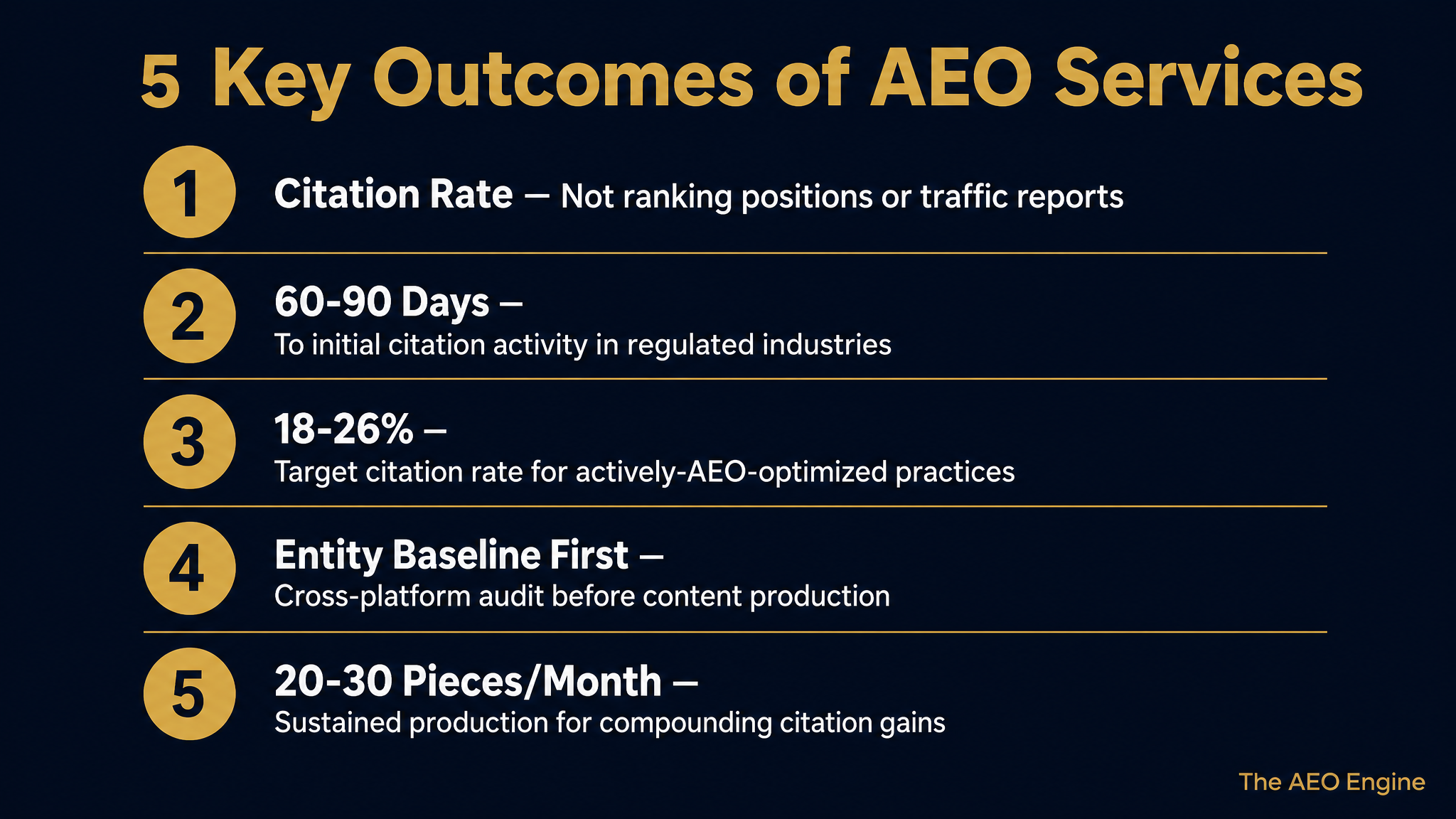
What Do Answer Engine Optimization Services Actually Deliver?
Answer Engine Optimization services deliver citation rate gains by implementing the CITE Framework signal categories simultaneously. The deliverable is not a content output but a measurable shift in how often AI platforms name the business when responding to relevant queries.
Most AEO service programs include three core work streams. First, an entity audit and baseline measurement that identifies inconsistencies across the practice's website, professional directories, review platforms, and association profiles. Second, citation-ready content production paired with structured data implementation and authority-signal documentation. Third, citation tracking that measures AI mentions across ChatGPT, Perplexity, Claude, and Google AI Overviews on a continuous basis.
The service category is distinct from SEO services because the optimization target is different. SEO services work toward ranking position one for target keywords on Google. AEO services work toward citation rate, the percentage of relevant AI queries in which the business is named directly. A practice can rank well on Google and still be invisible to ChatGPT, and vice versa, because the platforms weigh different signal categories.
How Do AEO Services Differ From Traditional SEO Services?
The fundamental difference is the unit of optimization. SEO services optimize pages against keyword rankings on a search engine. AEO services optimize entities against citation rates across AI platforms. The signals overlap because both reward authority and structured content, but the weighting and the success metrics diverge significantly.
The strategic implication for service businesses is that SEO and AEO are complementary rather than substitutionary. SEO drives Google search traffic. AEO drives AI citations that increasingly determine which businesses get recommended in voice search, AI-assisted browsing, and conversational queries. A regulated practice typically benefits from both, but with different budget allocations depending on the buyer journey for its specific niche.
If your practice needs a structured approach to AI citation strategy, The AEO Engine offers Answer Engine Optimization services for regulated practices building their first AI citation program. The team has tracked citation rates across healthcare practices and wealth management firms operating under regulatory constraints since 2024.
How Does the CITE Framework Drive Citation Results?
The CITE Framework structures what every AEO service must address. Each category works in combination with the others; no single category is sufficient to produce citation gains on its own.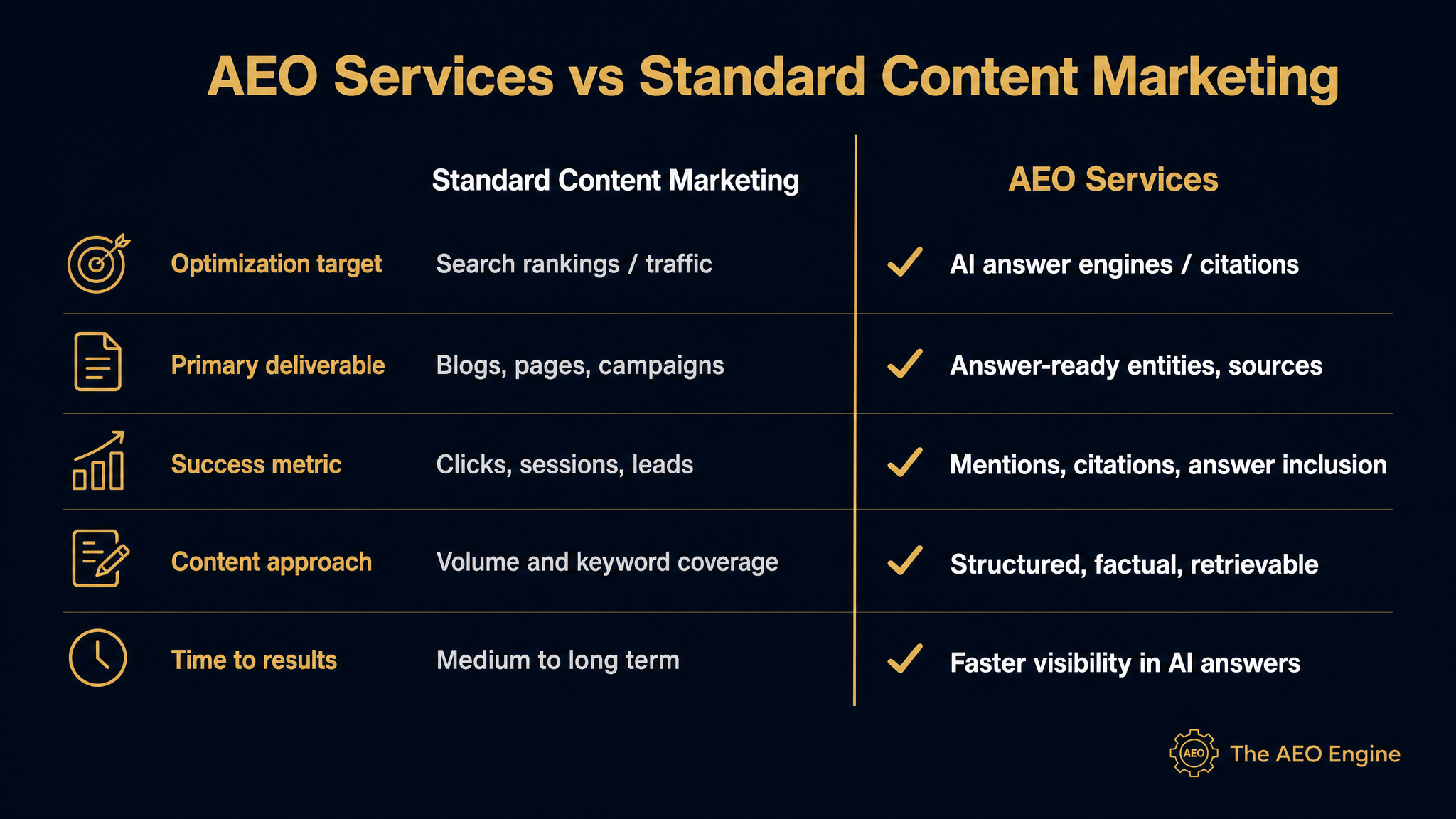
- Platform presence - The practice must appear consistently across the sites AI platforms reference for authority validation, including industry-specific directories, professional association sites, review platforms, knowledge bases, and editorial publications. Inconsistent platform presence produces AI invisibility regardless of website quality.
- Answer-extractable content structure - Content must be formatted in ways AI extraction systems can parse cleanly, supported by structured data and clean HTML body content. AI crawlers parse these structural signals to identify response candidates worth citing.
- Credentials and authority markers - Specific certifications, reviews, awards, and practice qualifications must be documented in content and structured data. Specificity matters: "board-certified estate planning attorney, 18 years of practice, AAEPA member, 200 estates per year" produces stronger AI citation signals than "experienced estate planning lawyer."
- Consistent identity across platforms - The same legal name, address format, service descriptions, and primary credentials must appear everywhere the business is referenced. AI platforms cross-reference this data and reduce citation confidence when identity signals diverge across sources.
These service areas reinforce each other. AEO programs that address only some areas produce uneven results; services addressing all areas consistently reach citation activity within the 60 to 90 day target window.
What Citation Rate Should an AEO Service Deliver?
The AEO Engine tracks citation rates of 18 to 26 percent for actively-AEO-optimized regulated practices based on client program data. This means AI platforms cite the practice in a meaningful share of relevant queries. Very low citation rates indicate effective AI invisibility; rates above 26 percent require sustained content production beyond standard service tiers.
Citation rate is measured by running 25 representative queries that potential customers would ask, then counting the percentage of those queries in which the practice is named directly in the AI response. The methodology requires a baseline measurement before any AEO service work begins, a 30-day check, and a 90-day target measurement. Practices skipping the baseline cannot attribute citation gains to specific AEO interventions.
What Should You Look For When Choosing an AEO Services Provider?
Five evaluation criteria separate effective AEO services from generic content production:
- A Documented Citation Rate Methodology - The provider must show how citation rates are measured before, during, and after service engagement. Providers who measure traffic, ranking position, or content volume rather than citation rate are not delivering AEO; they are delivering SEO with AEO labeling.
- Entity Audit as the First Deliverable - Effective AEO services begin with cross-platform entity consistency audits before content production. Providers who start producing content before establishing entity baseline are skipping the foundation that makes citation gains compound.
- Structured Schema Implementation - The provider must implement JSON-LD schema for Organization, Person, FAQ, Article, and Service entities. Schema markup is the language AI uses to identify and categorize businesses; absence of structured data severely limits citation potential.
- Industry Regulatory Familiarity - Healthcare, financial services, and legal practices benefit from AEO providers familiar with FDA, SEC, and bar association content rules. Providers without regulated-industry experience often produce content that requires extensive compliance rework before publication.
- Multi-Platform Citation Tracking - The provider must track citations across ChatGPT, Perplexity, Claude, and Google AI Overviews simultaneously. Single-platform tracking misses citation activity on the platforms where competitors gain ground first.
How Long Does an AEO Services Engagement Take to Show Results?
Most regulated practices following a coordinated AEO services engagement see initial citation activity within 60 to 90 days. The faster timeline relative to SEO comes from AI platforms updating retrieval and citation behavior more frequently than search engines update ranking algorithms. New authoritative content is incorporated into AI citation surfaces within weeks rather than months.
The 60 to 90 day timeline assumes the program is sustained throughout. Practices that pause content production after the first month or skip cross-platform entity reconciliation typically see no measurable citation activity. Programs hitting the 18 to 26 percent benchmark in regulated industries are publishing 20 to 30 pieces of structured content monthly while continuously reinforcing entity signals.
Practices beginning AEO services without a written entity baseline frequently see no early citation activity because their entity signals remain inconsistent regardless of content volume. Establishing an entity baseline before content production meaningfully reduces the time to first citation.
Frequently Asked Questions
What is Ask Engine optimization?
Ask Engine Optimization, also written as Answer Engine Optimization or AEO, is the practice of optimizing a business's content, entity signals, and platform presence to be cited in AI-generated answers from platforms like ChatGPT, Perplexity, Claude, and Google AI Overviews. The optimization target is citation rate, the percentage of relevant queries in which the business is named directly, rather than ranking position on traditional search engines. The service category exists because the signals AI platforms weigh are different from those traditional SEO programs target.
How to implement generative engine optimization?
Generative Engine Optimization, often used interchangeably with Answer Engine Optimization, is implemented through the CITE Framework. Implementation begins with an entity audit, then proceeds to schema markup, structured content production, and authority signal documentation. Sustained content production over 60 to 90 days typically produces initial citation activity for regulated practices.
What is AEO vs GEO?
AEO and GEO are largely interchangeable terms describing the same optimization category. AEO stands for Answer Engine Optimization and GEO stands for Generative Engine Optimization. Both refer to the practice of optimizing for citation in AI-generated answers rather than ranking position on traditional search engines. Some providers use the terms with subtle distinctions, with GEO focusing more on generative model citations and AEO covering broader AI-powered answer surfaces. In practice, the four signal categories optimized are the same across both terminologies.
How to do AEO?
AEO is implemented as a coordinated program across four work areas: cross-platform entity consistency including business name, address, services, and credentials; structured data covering the page's core entities; citation-ready content production; and authority signal building through industry coverage, association memberships, and credential documentation. Citation rate measurement before, during, and after the program quantifies progress.
How much do AEO services cost?
Answer Engine Optimization services for regulated practices are priced based on content production volume and the number of AI platforms tracked. Costs vary based on the practice's existing entity signal quality, current content baseline, and whether single-vertical or multi-vertical citation surfaces are targeted. The cost is comparable to mid-tier SEO services but the deliverable category and measurement framework differ significantly.
Are AEO services worth it for regulated industries?
AEO services produce the largest returns for regulated practices because advertising restrictions limit other visibility channels. Healthcare practices facing FDA marketing rules, wealth managers operating under SEC requirements, and law firms governed by bar association advertising rules all benefit from earned AI citation more than industries with fewer compliance constraints. Regulated practices with documented credentials and association memberships also have stronger Trust signal foundations than industries lacking those markers.
Can a practice do AEO without hiring an AEO service?
The structural work including entity consistency audits, schema markup implementation, and content restructuring is doable in-house if the practice has technical capability. The harder elements are sustained content production at the volume needed for citation rate compounding and continuous citation tracking across multiple AI platforms. Most practices that attempt fully in-house AEO struggle with the production volume requirement and shift to hybrid arrangements where content production is outsourced while entity audits and credential management remain in-house.
What is the AI Gap Check?
The AI Gap Check is a free 15 minute audit run by The AEO Engine that executes 25 AI queries specific to the practice's specialty and city, then compares the citation rate to the practice's top three competitors. The output is a written assessment of where the practice appears, where it does not, and which signal categories are blocking citation. The Gap Check is available at The AEO Engine, with five sessions per week and no sales call requirement.
Executive Summary
Answer Engine Optimization services deliver citation rate gains by implementing the CITE Framework across the platforms AI pulls from for citation evidence. The standard deliverables include an entity baseline audit, structured content production, schema markup implementation, and continuous multi-platform citation tracking. Regulated practices following a coordinated AEO program reach initial citation activity within 60 to 90 days and target citation rates of 18 to 26 percent over 12 months. The service category is distinct from SEO because the optimization target is different: citation rate across AI platforms rather than ranking position on Google. Practices evaluating AEO providers should require documented citation rate methodology, entity audit as the first deliverable, structured schema implementation, regulatory familiarity, and multi-platform tracking before signing any retainer.
What Should You Do Next?
Before evaluating AEO services providers, run 25 representative queries in ChatGPT today and document the citation rate. List the queries potential customers would ask, then count how often the practice is named directly in AI responses. If the practice appears in fewer than four out of every 25 queries, the citation rate is below the regulated industry benchmark and an AEO program is likely to produce measurable returns within the standard 60 to 90 day window.
The AEO Engine offers a free AI Gap Check that runs 25 queries specific to your specialty and city, then compares the citation rate to the practice's top three competitors. The Gap Check identifies which CITE Framework signal categories are blocking citation before any service engagement begins.
About the Author
Jerry Jariwalla is the founder of The AEO Engine and creator of the CITE Framework for Answer Engine Optimization. With over 22 years in digital marketing and multiple successful business exits, Jerry has spent the past two years building AI citation systems for regulated practices in healthcare, wealth management, and legal services. The AEO Engine works exclusively with practices operating under advertising restrictions where AI citation provides higher leverage than traditional paid acquisition.
Expertise: Answer Engine Optimization, AI Citation Strategy, CITE Framework, Regulated Industry Marketing, Healthcare Practice Marketing, Wealth Management Marketing, Legal Marketing
Connect: LinkedIn
Disclaimer: This content is for informational purposes only and does not constitute professional marketing, legal, or compliance advice. Citation rates, timelines, and outcomes vary based on industry, competitive density, and execution quality. Statistics referenced reflect The AEO Engine's tracked client outcomes as of 2026 and are not guarantees of future results. Contact The AEO Engine for a consultation regarding your specific situation.