
Last Updated: June 2026
A private wealth manager is an advisor who handles investments, planning, and complex finances for high-net-worth clients. Marketing one in 2026 has changed. Harvard researchers note that AI tools are reshaping how people get financial guidance. Even wealthy clients now ask ChatGPT or Perplexity for a firm before they act on a referral. The firm AI names gets considered. The firm AI skips often never comes up.
The AEO Engine is a citation program that helps regulated practices move from listed to cited by AI. Its founder, Jerry Jariwalla, brings over 22 years in digital marketing and created the CITE Framework after 18 months of testing across regulated industries. The AEO Engine works with wealth, healthcare, and legal practices. It tracks citation rates across client programs and closes the gaps that keep firms out of AI answers.
This guide covers how private wealth marketing has changed, what signals AI uses to name a firm, and how a structured citation program works.
Key Takeaways
- Referrals Alone No Longer Fill the Pipeline - Word of mouth still matters, but wealthy clients now verify a referral by asking AI and searching first.
- AI Names Firms With Clear Trust Signals - AI picks private wealth firms with consistent credentials, clean entity data, and clear content, not the firms with the most prestige.
- Most Private Wealth Firms Are Invisible to AI - A strong, discreet firm can be absent from AI answers because it has kept a thin public presence.
- Discretion and Visibility Can Coexist - A firm can stay private with clients while building the structured signals AI needs to name it.
- Citation Rates on Structured Programs Run 18 to 26 Percent - The AEO Engine tracks this range across client programs based on its own program data.
Each of these points shows how private wealth marketing has changed.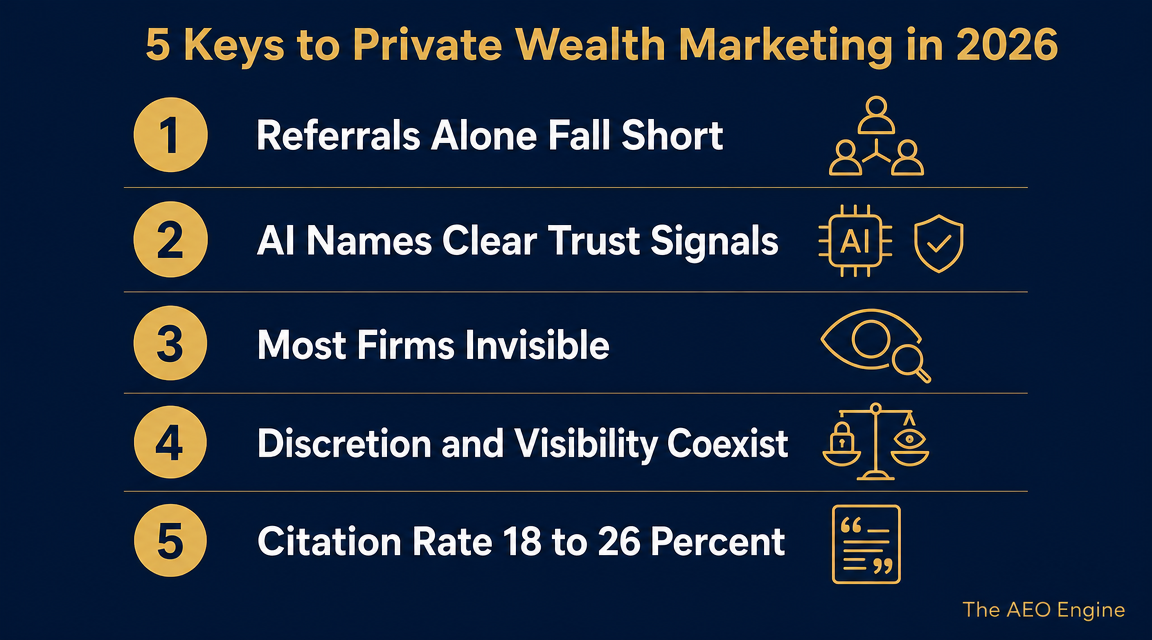
Why Has Private Wealth Marketing Changed?
Private wealth firms long relied on referrals, reputation, and discretion. A trusted introduction brought in a client. A public marketing push felt unnecessary, even off-brand. That model worked when referrals were the only path in.
The path has changed. A wealthy prospect who gets a referral now checks it. They search the firm. They ask an AI tool what it knows. If the firm has a thin or inconsistent presence, the check raises doubt. If the firm does not come up in AI answers at all, the prospect wonders why.
This does not mean private wealth firms must market loudly. It means they need to be findable and verifiable when a prospect checks. Discretion with clients and visibility to AI are not in conflict. A firm can hold both.
How Does Private Wealth Marketing Work Now?
Modern private wealth marketing builds a clear, verifiable presence that holds up when a prospect checks. It has three layers. The first is a consistent digital entity: the firm's name, credentials, and people matching across every source. The second is clear content that explains the firm's approach and answers prospect questions. The third is third-party validation through directories, media, and verifiable credentials.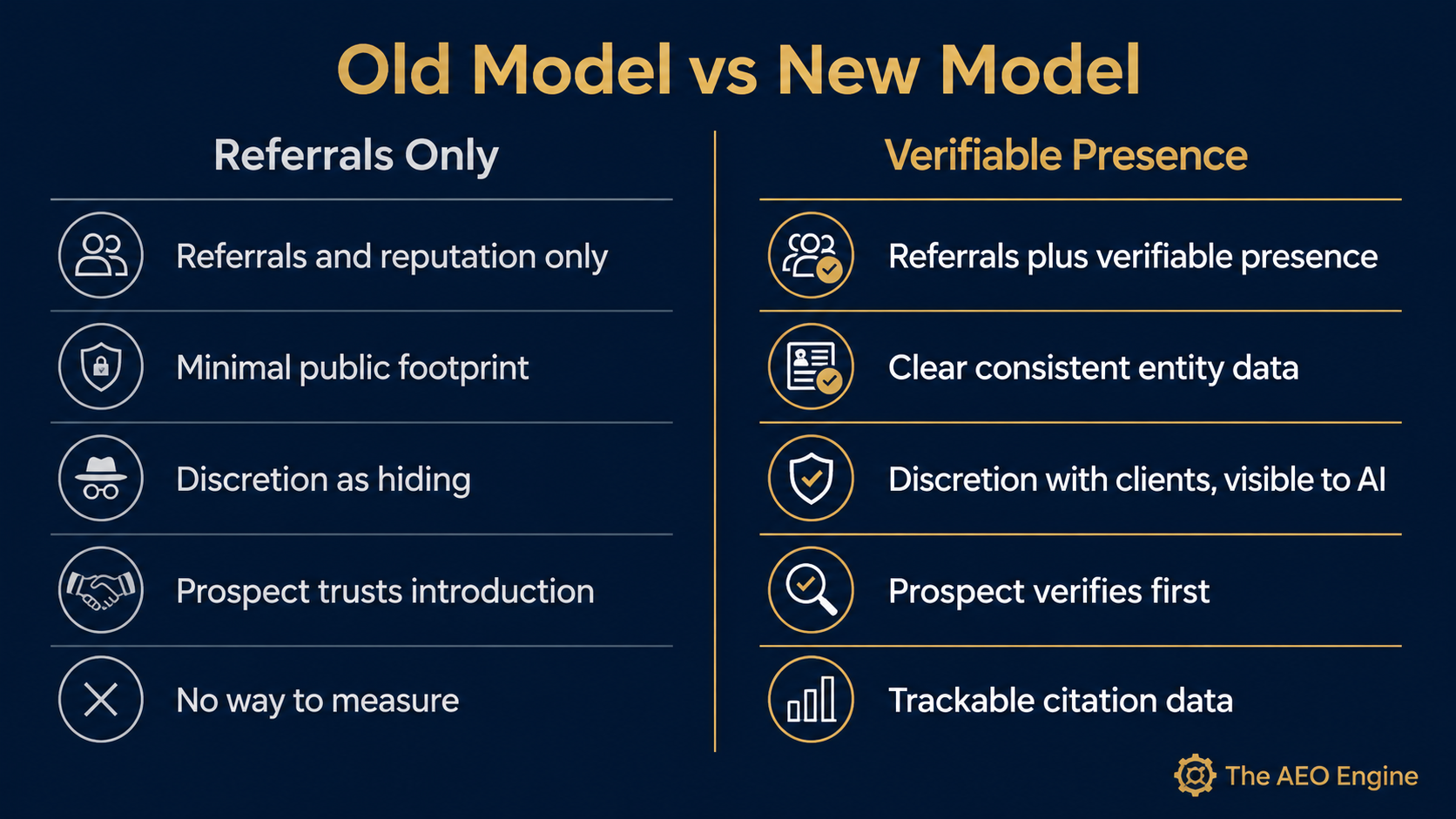
These layers serve both search and AI. A prospect who searches finds a coherent, credible firm. An AI tool asked about the category can name the firm with confidence. The referral still opens the door. The verifiable presence keeps it open.
What Signals Does AI Use to Name a Private Wealth Firm?
AI checks a few signal types before naming any firm. Most private wealth firms are strong in reputation but weak in digital signals.
- Credential data - AI reads public regulatory records. A current, complete registration signals a legitimate firm.
- Entity clarity - The firm's name, credential, and team must match across the website, directories, and listings.
- Content clarity - AI favors firms that publish clear answers on their approach, services, and fees.
- Third-party mentions - AI weighs mentions in directories and media that confirm the firm is real and trusted.
A firm strong across all four is a candidate for citation. A firm that relies only on private reputation, with little public signal, is usually skipped.
Why Are Most Private Wealth Firms Missing From AI Answers?
Most private wealth firms kept a deliberately thin public presence. A simple site, little content, and no push for outside mentions. That choice fit the referral model. It does not fit a world where prospects check with AI.
The gap is structural. The SEC's investor tools let anyone verify a firm's standing, and AI reads those same records. But a clean record alone does not win citations. The firm also needs consistent entity data and clear content. A thin presence gives AI almost nothing to read.
HubSpot's research on answer engine work confirms that AI favors sources with clear, consistent signals. A discreet firm with no public content is invisible to AI by default, no matter how strong its client roster.
The AEO Engine runs AI citation audits for private wealth firms. The audit covers every signal type and delivers a ranked action plan, without compromising client discretion. Book a free Gap Check to see where your firm stands.
How Does a Structured Citation Program Work for Private Wealth?
A structured citation program treats AI visibility as a system, built with discretion in mind. It starts with an audit of the firm's current signals. It finds where the entity data is thin, inconsistent, or missing.
From there, it builds what AI needs. It aligns the firm's name, credentials, and team across sources. It structures content that explains the firm's approach without exposing client details. It builds the third-party signals that confirm the firm is trusted.
The CITE Framework is the method behind this work. The AEO Engine tracks citation rates of 18 to 26 percent across client programs based on its own program data. That compares with near-zero rates for firms that rely only on referrals and keep a thin public presence.
Frequently Asked Questions
What does a private wealth manager do?
A private wealth manager handles investments, financial planning, and complex financial decisions for high-net-worth clients. The role often combines investment management, tax and estate planning, and coordination with other advisors like attorneys and accountants. Private wealth managers usually serve clients with significant or complex assets. The goal is to grow and protect wealth while managing the many moving parts of a wealthy client's financial life through one trusted relationship.
Is CPWA better than CFP?
Neither credential is simply better. A CFP, or Certified Financial Planner, covers broad financial planning. A CPWA, or Certified Private Wealth Advisor, focuses on advanced strategies for high-net-worth clients, such as tax and estate complexity. A CFP suits comprehensive planning for most clients. A CPWA suits advisors who specialize in wealthy clients. Many strong advisors hold both. The right fit depends on the client's needs, not the acronym alone.
How much does a private wealth manager cost?
Private wealth management fees often run around 1 percent of assets managed per year, with the rate usually dropping as account size grows. Very large accounts may negotiate lower rates or flat fees. Some firms bundle planning, tax, and estate coordination into the fee. Others charge separately. Always ask for the full fee schedule in writing and confirm what services are included, since private wealth relationships vary widely in scope and structure.
Can financial advisors make $500,000 a year?
Yes, some financial advisors earn $500,000 a year or more, though most earn far less. Top earners usually manage large books of high-net-worth clients or own their firms. Income depends on the fee model, the size of assets managed, and whether the advisor is an employee or a firm owner. Building to that level takes years and a strong client base. Visibility in how clients now find advisors, including AI, increasingly shapes who grows fastest.
How do private wealth managers market themselves in 2026?
Modern private wealth marketing builds a clear, verifiable presence that holds up when a prospect checks. That means consistent entity data, clear content on the firm's approach, and third-party validation. These signals make the firm credible in search and citable by AI. Referrals still matter, but prospects now verify them before engaging. A firm that is findable and verifiable converts more referrals than one with a thin public presence.
Why does my private wealth firm not show up in ChatGPT?
The most common reason is a thin or inconsistent public presence. If your firm keeps a minimal site and few outside mentions, AI has little to read and cannot name your firm with confidence. Inconsistent details across sources make it worse. The fix is to build consistent entity data and clear content that AI can cite, while keeping client details private. Visibility to AI does not require exposing your clients.
How long does it take to get cited by AI?
Most structured programs see citation changes within the first quarter. The exact timeline depends on the firm's starting point, the category, and how complete the build is. Firms with strong credentials but a thin public presence often move quickly once the content and entity data are built. The trust already exists offline. It just needs to be made readable to AI. Building a durable citation pattern is ongoing work, not a one-time setup.
Can a private wealth firm stay discreet and still be visible to AI?
Yes. Discretion is about protecting client details, not hiding the firm itself. A firm can publish clear content about its approach, services, and credentials without naming clients or sharing private information. That content gives AI what it needs to cite the firm. Many private wealth firms confuse client discretion with firm invisibility. The two are separate. A firm can protect clients fully while remaining findable and citable.
Executive Summary
Private wealth manager marketing has changed in 2026. Firms long relied on referrals, reputation, and a thin public presence. That worked when referrals were the only path in. Now even wealthy prospects verify a referral by searching and asking AI. AI names firms with clear, consistent trust signals: verifiable credentials, clean entity data, and clear content. Most private wealth firms are missing from AI answers because they kept a deliberately thin presence. The fix is not loud marketing. It is a verifiable presence that holds up when a prospect checks. A structured citation program using the CITE Framework builds those signals while protecting client discretion. The AEO Engine tracks citation rates of 18 to 26 percent across client programs based on its own program data, compared with near-zero rates for firms with a thin public presence.
What Should You Do Next?
Three steps help a private wealth firm adapt to how clients now find advisors.
First, ask ChatGPT and Perplexity to recommend a private wealth firm for a situation like your clients'. Note whether your firm appears. If it does not, the visibility gap is active.
Second, check your public presence for consistency. Confirm your firm's name, credentials, and team match across your website, directories, and listings.
Third, book a free Gap Check with The AEO Engine. The session maps your credential and entity gaps and delivers a ranked fix plan.
People Also Read
- How Do You Pick an AEO Agency That Drives Real Citations?
- How Do You Start a Med Spa and Get AI Recommending You?
About the Author
Jerry Jariwalla is the founder of The AEO Engine and creator of the CITE Framework for Answer Engine Optimization. With over 22 years in digital marketing and multiple successful business exits, Jerry has spent the past two years building AI citation systems for regulated practices in healthcare, wealth management, and legal services. The AEO Engine works exclusively with practices operating under advertising restrictions where AI citation provides higher leverage than traditional paid acquisition.
Expertise: Answer Engine Optimization, AI Citation Strategy, CITE Framework, Regulated Industry Marketing, Healthcare Practice Marketing, Wealth Management Marketing, Legal Marketing
Connect: LinkedIn
Disclaimer: This content is for informational purposes only and does not constitute professional marketing, legal, or compliance advice. Citation rates, timelines, and outcomes vary based on industry, competitive density, and execution quality. Statistics referenced reflect The AEO Engine's tracked client outcomes as of 2026 and are not guarantees of future results. Contact The AEO Engine for a consultation regarding your specific situation.