
Last Updated: May 2026
An AEO agency is a digital marketing firm that specializes in Answer Engine Optimization, working to get a business cited by name when AI platforms like ChatGPT, Perplexity, and Google AI Overviews respond to questions, rather than focusing on traditional Google ranking position. According to Search Engine Land's coverage of AI search shifts, the agency category is emerging as service businesses recognize that AI citation requires a different signal mix than traditional SEO. The factor that determines whether an AEO agency engagement produces citation gains is not agency size or tenure, but the agency's measurement methodology and the specific deliverables defined before the retainer is signed.
The AEO Engine operates as an AEO agency for regulated practices in healthcare, wealth management, and legal sectors, where advertising restrictions make AI citation uniquely valuable. Founder Jerry Jariwalla, creator of the CITE Framework for AEO, has spent over 22 years in digital marketing across multiple industries and led the development of citation tracking methodologies adopted by service businesses operating under FDA, SEC, and bar association compliance constraints. The questions below identify what an AEO agency actually delivers, how to separate effective providers from rebadged SEO firms, and what evaluation criteria distinguish agencies that produce citation rate gains from those that produce content volume only.
The decisions that follow are not vendor selection theory. They represent the specific evaluation questions, the contract terms, and the measurement frameworks that produce citation rate gains within 60 to 90 days for regulated practices. Each takeaway names a specific criterion, a specific red flag, or a specific contract clause that a practice can apply within the next 30 days.
Key Takeaways
- Effective AEO Agencies Measure Citation Rate, Not Traffic - The agency must show how citation rates are measured before, during, and after engagement. Providers measuring traffic, ranking position, or content volume rather than citation rate are delivering SEO with AEO labeling, not AEO services.
- Entity Audit Must Be the First Deliverable - The right AEO agency begins with a cross-platform entity consistency audit before any content production. Agencies that start producing content before establishing entity baseline are skipping the foundation that makes citation gains compound over time.
- Regulated Industry Familiarity Reduces Compliance Rework - Healthcare, wealth management, and legal practices benefit from AEO agencies familiar with FDA, SEC, and bar association content rules. Agencies without regulated-industry experience often produce content that requires extensive compliance rework before publication, eroding the time savings the engagement was meant to provide.
- Multi-Platform Tracking Is Required, Not Optional - The agency must track citations across ChatGPT, Perplexity, Claude, and Google AI Overviews simultaneously. Single-platform tracking misses citation activity on the platforms where competitors gain ground first and produces an incomplete picture of program performance.
- The Right Engagement Length Is 6 to 12 Months Minimum - Citation rate compounds through sustained content production and ongoing entity signal management. Short engagements rarely produce measurable citation rate gains; the agencies hitting the 18 to 26 percent benchmark in regulated industries operate on 6 to 12 month minimum commitments.
Each of these five criteria is verifiable before a retainer is signed. The practices that treat AEO agency selection as a citation-rate procurement decision rather than a content-volume purchase consistently avoid the two failure modes that derail AEO programs: hiring a generalist agency that has rebadged its SEO services as AEO, and committing to engagements too short to produce compounding results.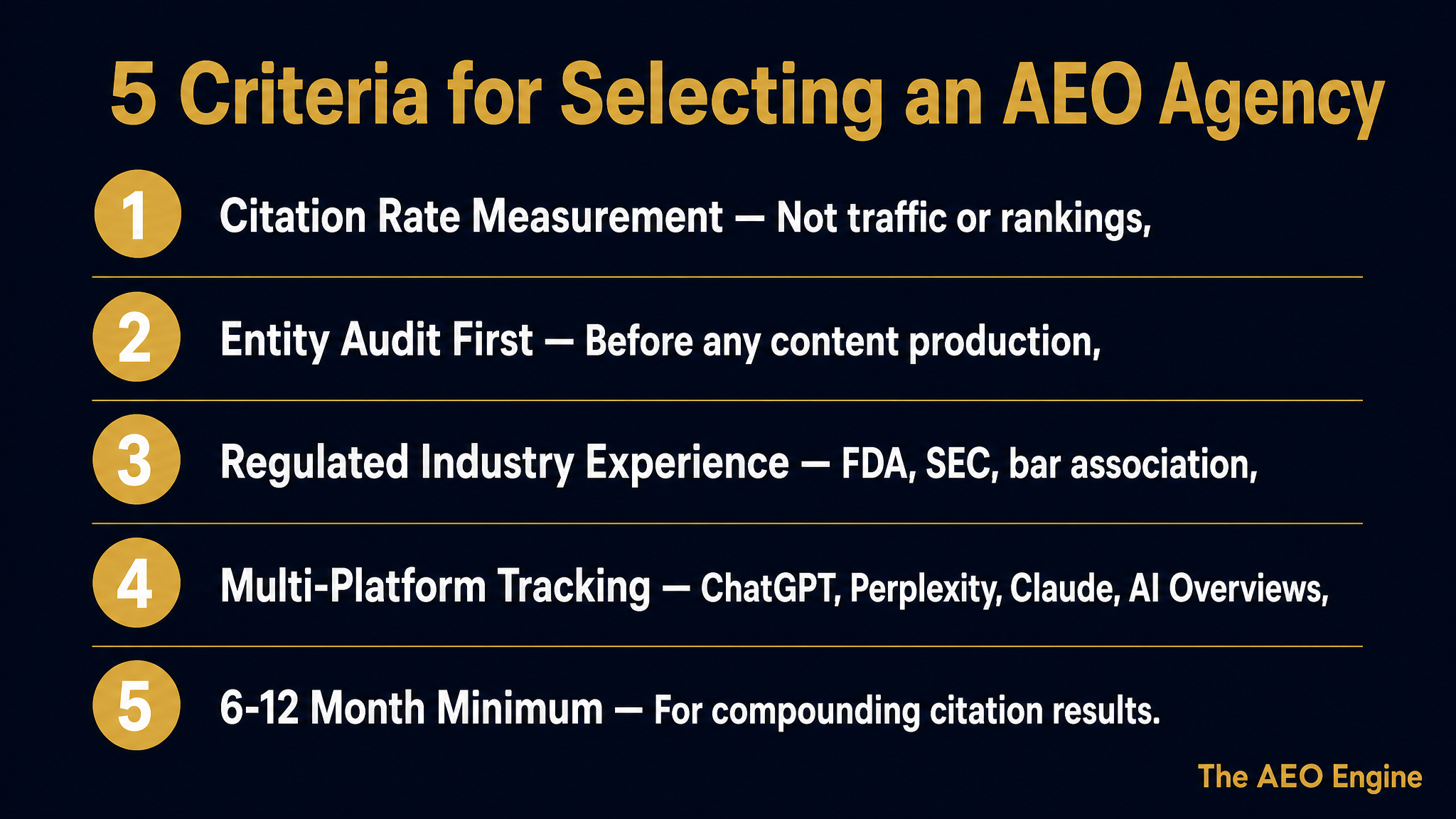
What Is an AEO Agency?
An AEO agency is a digital marketing firm whose primary deliverable is citation rate, the percentage of relevant queries in which AI platforms name a business directly in their response. The agency category exists because the optimization signals AI uses are different from those traditional SEO programs target, requiring a distinct service mix that includes entity audits, schema markup implementation, structured content production, and continuous multi-platform citation tracking.
Most AEO agencies fall into one of three categories. First, dedicated AEO firms that work exclusively on Answer Engine Optimization across multiple verticals. Second, vertical-specialist agencies focusing on regulated industries where AEO produces the highest returns due to advertising restrictions. Third, general digital marketing agencies adding AEO as a service line alongside SEO, paid search, and content marketing. The third category often produces uneven AEO results because the agency's measurement systems and content production teams are still oriented toward traffic and ranking metrics.
The strategic question for a practice evaluating AEO agencies is whether the agency's primary measurement framework is citation rate or whether AEO is positioned as an add-on to existing SEO services. Agencies treating AEO as primary tend to produce stronger citation rate gains than those treating it as supplementary.
How Does an AEO Agency Differ From a Traditional Digital Marketing Agency?
The fundamental difference is the optimization target. Traditional digital marketing agencies optimize for traffic, leads, and ranking position across SEO, paid search, and content marketing channels. AEO agencies optimize for citation rate across AI platforms, with content production as one component of a broader signal management program.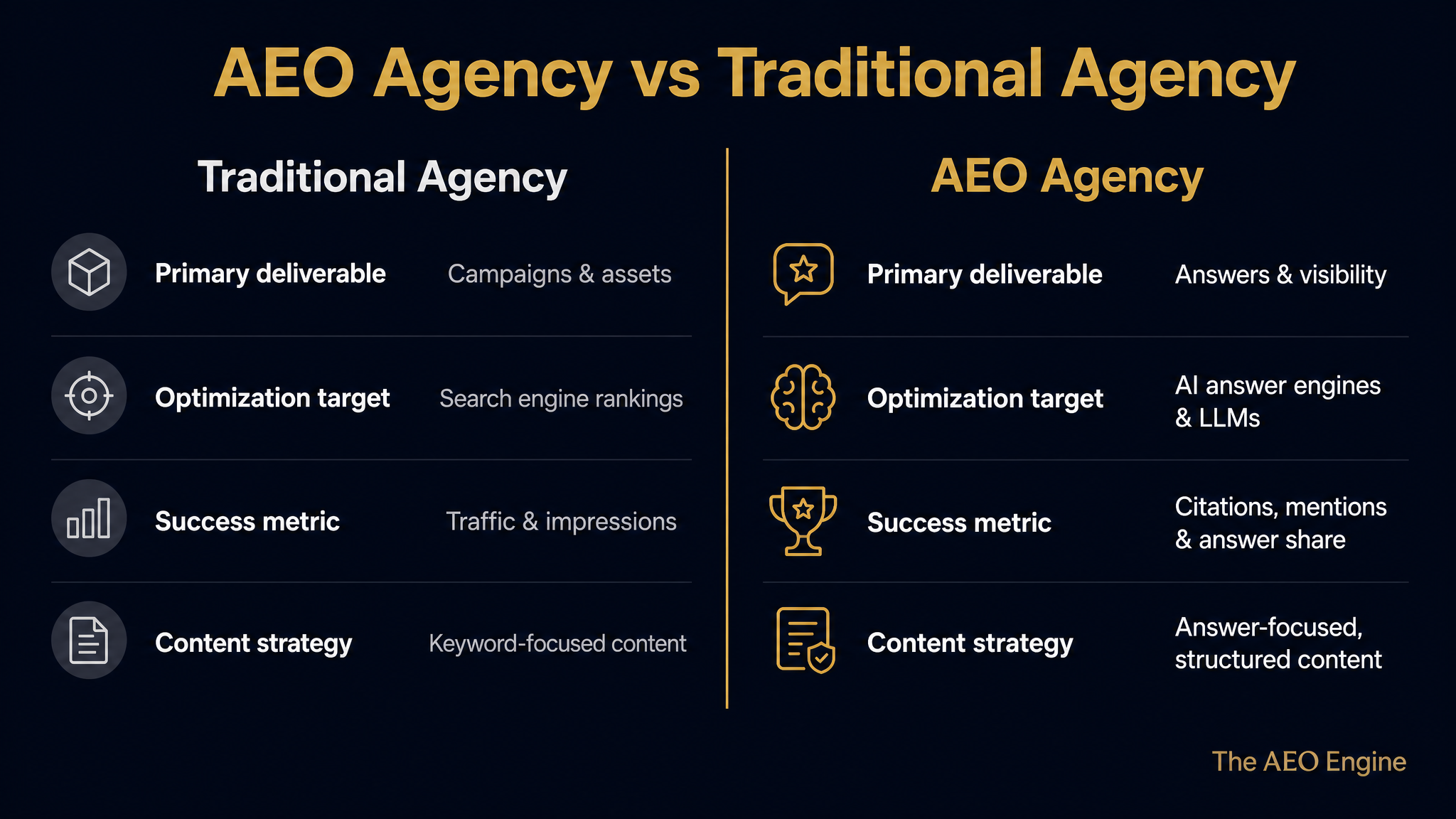
A practice working with a traditional digital marketing agency typically receives content marketing services, SEO optimization, and paid media management. An AEO agency engagement produces those outputs as well, but with citation rate as the primary success metric and entity signal management as a foundational deliverable that traditional agencies usually skip.
If your practice needs a structured approach to AI citation strategy, The AEO Engine offers Answer Engine Optimization services for regulated practices building their first AI citation program. The team has tracked citation rates across healthcare practices and wealth management firms operating under regulatory constraints since 2024.
What Should You Evaluate When Choosing an AEO Agency?
Seven evaluation criteria separate effective AEO agencies from generalist providers:
- Citation Rate Measurement Methodology - The agency must show, in writing, exactly how it measures citation rate before, during, and after engagement. The standard methodology runs 25 representative queries across each tracked AI platform, counts citations by name, and reports the percentage. Agencies without a documented methodology are improvising on measurement, which produces unreliable results and unverifiable claims.
- Entity Audit Process - The agency should describe its first 14 to 30 days of work in terms of entity baseline establishment, not content production. The audit identifies inconsistencies in business name, address, services, and credentials across the practice's website, professional directories, review platforms, and association profiles.
- Schema Markup Implementation - Confirm the agency implements JSON-LD schema for Organization, Person, FAQ, Article, and Service entities. Schema markup is the language AI platforms use to identify and categorize businesses; agencies skipping schema produce content that is harder for AI to extract and cite.
- Industry Regulatory Familiarity - Healthcare, financial services, and legal practices should require agency experience with FDA marketing rules, SEC compliance requirements, and bar association advertising rules. Agencies without regulated-industry experience often produce content that requires extensive compliance rework, eroding the time savings the engagement was meant to provide.
- Multi-Platform Citation Tracking - The agency must track citations across ChatGPT, Perplexity, Claude, and Google AI Overviews simultaneously, not just one or two platforms. Tools such as Otterly.AI automate this tracking continuously across all four platforms.
- Content Production Volume Aligned to Citation Compounding - Citation rate compounds through sustained content production. Agencies with low monthly content production rarely produce measurable citation gains in regulated industries; programs hitting the 18 to 26 percent benchmark are typically producing 20 to 30 pieces of structured content monthly.
- Reporting Cadence and Transparency - The agency should provide monthly citation rate reports showing the queries tested, the citations captured, and the platform breakdown. Quarterly reporting is too infrequent to identify program issues before they compound; weekly reporting is excessive for citation rate which moves on a slower timeline than ranking position.
What Red Flags Signal a Poor AEO Agency Fit?
Five patterns signal that an AEO agency is unlikely to produce citation rate gains:
- Promises Citation Activity Within 30 Days - Citation rate compounding requires entity baseline establishment and content production volume that typically produces no measurable activity in the first 30 days. Agencies promising 30-day citation results are either misrepresenting the timeline or planning to count brand mention events rather than citation rate.
- No Documented Citation Rate Methodology - The agency cannot describe in writing how it measures citation rate, or describes a methodology that includes traffic and ranking metrics as primary success measures.
- Generic Content Production With No Entity Audit - The first deliverable is content production rather than an entity audit. Agencies that skip the audit cannot diagnose why content is or is not driving citation rate gains.
- Single-Platform Citation Tracking - The agency tracks ChatGPT only, or Google AI Overviews only, but not all four major AI platforms. Single-platform tracking produces an incomplete picture and misses citation gains on platforms where competitors are gaining ground.
- No Schema Markup as a Standard Deliverable - Schema markup is optional, charged separately, or described as a future enhancement rather than a foundational deliverable. Schema is the language AI uses to identify entities; agencies treating it as optional are unlikely to produce strong citation results.
Should You Choose a Generalist or Vertical-Specialist AEO Agency?
The choice depends on the practice's vertical, content volume requirements, and compliance complexity. Generalist AEO agencies serve multiple verticals from a single content production team, which produces breadth but typically less depth on industry-specific terminology, credentials, and compliance requirements. Vertical-specialist agencies focus on a specific industry, which produces deeper subject matter expertise but limits the agency's ability to apply learnings across non-related verticals.
For regulated practices in healthcare, wealth management, and legal services, vertical-specialist agencies generally produce stronger results because compliance familiarity reduces content rework and credential documentation reflects industry-specific authority signals. For service businesses outside heavily regulated verticals, generalist agencies often produce comparable results at lower retainer levels because the compliance overhead is less significant.
The middle path is regulated-industry-specialist agencies that work across healthcare, wealth, and legal but not outside those three verticals. This category typically combines compliance familiarity with cross-vertical pattern recognition, producing strong results for any of the three regulated industries served.
What Does an AEO Agency Engagement Typically Cost?
Answer Engine Optimization agency retainers for regulated practices vary by content production volume and platform scope. The cost varies based on content production volume, the number of AI platforms tracked, the practice's existing entity signal quality, and whether single-vertical or multi-vertical citation surfaces are targeted. Engagements at the lower end of the range typically include 8 to 12 pieces of monthly content with citation tracking; engagements at the higher end include 25 to 30 pieces and entity signal management across multiple verticals or locations.
Setup fees are common at engagement start, covering the entity audit, schema markup implementation, and baseline citation rate measurement. Practices skipping setup work to avoid the fee typically see slower citation rate gains because content production runs against an inconsistent entity baseline.
Cost should be evaluated against citation rate target and measurement framework rather than against content volume alone. An agency producing fewer monthly pieces with rigorous citation tracking and a documented entity baseline typically produces stronger citation rate results than an agency producing more content with no measurement methodology.
How Long Should You Commit to an AEO Agency?
The minimum engagement length that produces measurable citation rate gains for regulated practices is 6 months. The reason is that citation rate compounds through three sequential phases: entity baseline establishment in the first few weeks, initial content production and citation activity in days 45 to 90, and citation rate compounding from day 90 forward. Engagements ending before day 90 capture only the foundational work without seeing the compounding returns.
12-month commitments produce stronger results than 6-month commitments because the second six months is where content authority compounds and entity signals are reinforced across platforms. Practices preferring shorter commitments typically build in performance review checkpoints at regular intervals with the option to extend or pause based on citation rate progress.
Month-to-month agreements are rare in established AEO agencies because the engagement structure does not support the timeline required for citation rate compounding. Agencies offering month-to-month terms often do so by reducing the entity audit and schema implementation deliverables, which produces lower-quality results.
Frequently Asked Questions
What is AEO?
AEO stands for Answer Engine Optimization, the practice of optimizing a business's content, entity signals, and platform presence to be cited in AI-generated answers from platforms like ChatGPT, Perplexity, Claude, and Google AI Overviews. The optimization target is citation rate, the percentage of relevant queries in which the business is named directly, rather than ranking position on traditional search engines. AEO emerged as a distinct service category because the signals AI platforms weigh are different from those traditional SEO programs target.
What is AEO in search?
AEO in search refers to the visibility a business has in AI-powered search experiences including ChatGPT search, Perplexity, Claude, and Google AI Overviews. Where traditional search visibility is measured by ranking position on results pages, AEO visibility is measured by citation rate in AI-generated answers. A business can have strong traditional search visibility while having weak AEO visibility, and vice versa, because the platforms weigh different signal categories.
What is AEO marketing?
AEO marketing is the practice of building business visibility in AI-generated answers rather than traditional search results. The marketing discipline includes entity signal management, structured content production, schema markup implementation, authority documentation, and citation rate tracking. AEO marketing is distinct from content marketing because content production is one component of a broader signal management program rather than the primary deliverable.
What is AEO and GEO?
AEO and GEO are largely interchangeable terms. AEO stands for Answer Engine Optimization and GEO stands for Generative Engine Optimization. Both refer to the practice of optimizing for citation in AI-generated answers rather than ranking position on traditional search engines. Some providers use the terms with subtle distinctions, with GEO focusing more on generative model citations and AEO covering broader AI-powered answer surfaces. In practice, the four signal categories optimized are the same across both terminologies.
How much does an AEO agency cost?
Answer Engine Optimization agency retainers for regulated practices vary by content production volume and platform scope. Setup fees are common at engagement start. Cost varies based on content production volume, the number of AI platforms tracked, the practice's existing entity signal quality, and whether single-vertical or multi-vertical citation surfaces are targeted.
How do I find a good AEO agency?
Effective AEO agency selection starts with seven evaluation criteria: citation rate measurement methodology, entity audit process, schema markup implementation, regulatory familiarity, multi-platform citation tracking, content production volume aligned to compounding, and reporting cadence transparency. Agencies that satisfy all seven criteria typically produce citation rate gains within 60 to 90 days for regulated practices.
Should I hire an AEO agency or do AEO in-house?
The choice depends on technical capability and content production volume requirements. The structural work including entity consistency audits and schema markup is doable in-house with technical staff. The harder elements are sustained content production at the volume needed for citation compounding and continuous citation tracking across multiple AI platforms. Most regulated practices that attempt fully in-house AEO struggle with production volume and shift to hybrid arrangements where content production is outsourced.
What is the AI Gap Check?
The AI Gap Check is a free 15 minute audit run by The AEO Engine that executes 25 AI queries specific to the practice's specialty and city, then compares the citation rate to the practice's top three competitors. The output is a written assessment of where the practice appears, where it does not, and which signal categories are blocking citation. The Gap Check is available at The AEO Engine, with five sessions per week and no sales call requirement.
Executive Summary
An AEO agency is selected by evaluating citation rate measurement methodology, entity audit process, schema markup implementation, regulatory familiarity, multi-platform tracking capability, content production volume, and reporting cadence transparency. Agencies satisfying all seven criteria typically produce citation rate gains within 60 to 90 days for regulated practices, with target rates of 18 to 26 percent over 12 months. Engagement retainers range from $1,000 to $5,000 per month for regulated practices, with 6 to 12 month minimum commitments aligned to citation rate compounding timelines. Practices avoiding the five red flags, including 30-day citation guarantees, missing entity audits, single-platform tracking, no schema markup, and content-volume-only deliverables, consistently produce stronger results than practices selecting on retainer cost alone.
What Should You Do Next?
Before evaluating any AEO agency, run 25 representative queries in ChatGPT today and document the citation rate. List the queries potential customers would ask, then count how often the practice is named directly in AI responses. The baseline citation rate becomes the measurement starting point against which any agency engagement is evaluated. Without a documented baseline, citation rate gains cannot be attributed to specific agency interventions.
The AEO Engine offers a free AI Gap Check that runs 25 queries specific to your specialty and city, then compares the citation rate to the practice's top three competitors. The Gap Check identifies which CITE Framework signal categories are blocking citation before any agency engagement begins, providing the baseline measurement and signal diagnosis that informs agency selection.
About the Author
Jerry Jariwalla is the founder of The AEO Engine and creator of the CITE Framework for Answer Engine Optimization. With over 22 years in digital marketing and multiple successful business exits, Jerry has spent the past two years building AI citation systems for regulated practices in healthcare, wealth management, and legal services. The AEO Engine works exclusively with practices operating under advertising restrictions where AI citation provides higher leverage than traditional paid acquisition.
Expertise: Answer Engine Optimization, AI Citation Strategy, CITE Framework, Regulated Industry Marketing, Healthcare Practice Marketing, Wealth Management Marketing, Legal Marketing
Connect: LinkedIn
Disclaimer: This content is for informational purposes only and does not constitute professional marketing, legal, or compliance advice. Citation rates, timelines, and outcomes vary based on industry, competitive density, and execution quality. Statistics referenced reflect The AEO Engine's tracked client outcomes as of 2026 and are not guarantees of future results. Contact The AEO Engine for a consultation regarding your specific situation.