Last Updated: May 2026
A medical spa launch is a regulated aesthetic medicine business that combines licensed clinical procedures with a retail customer experience, and starting one requires a medical director, a state-compliant ownership structure, capital between roughly the low and mid six figures, and a visibility strategy that now extends into AI answer engines. According to the American Med Spa Association, the category has expanded into one of the fastest-growing segments of aesthetic medicine in the United States, which means new entrants face both rising demand and rising competitive density on every discovery surface, including ChatGPT, Perplexity, Gemini, and Google AI Overviews.
The AEO Engine helps regulated practices position for AI recommendation rather than only for traditional search rankings. Founder Jerry Jariwalla has spent more than 22 years in digital marketing and has built citation systems for healthcare practices operating under advertising restrictions, including med spas, plastic surgery groups, GLP-1 clinics, and hormone therapy practices. The shift from listed-in-results to recommended-by-AI is now the defining visibility question for any new aesthetic medicine business that wants patients to find it inside AI-mediated discovery.
This article covers what it actually takes to start a med spa in 2026, including capital requirements, licensing structure, medical director arrangements, profitability expectations, common failure causes, and the AI visibility layer that most new owners overlook entirely.
Key Takeaways
- Capital Range Reality - Build-out, equipment, licensing, and working capital for a new med spa typically land in the low to mid six figures, with substantial variation by state, treatment menu, and location.
- Medical Director Structure - Most states require a licensed physician to own or directly supervise the medical components of the practice, and the structure dictates everything from corporate filings to malpractice coverage.
- Profitability Window - The majority of profitable med spas reach break-even within the first 12 to 24 months, driven by treatment mix, retention, and operational discipline rather than volume alone.
- Failure Causes Cluster - Most med spa closures trace back to undercapitalization, weak medical compliance, or a discovery strategy that depends on a single channel.
- AI Visibility Layer - New patients increasingly start aesthetic research inside ChatGPT and Perplexity, which means the practice needs to be cited inside AI answers from launch, not after year three.
Most new med spa owners build operational and clinical readiness carefully but treat marketing as a Phase Two problem. By the time the doors open, AI engines have already decided which local practices to recommend. The owners who launch well are the ones who treat AI citation as part of the build plan, not as a post-launch project.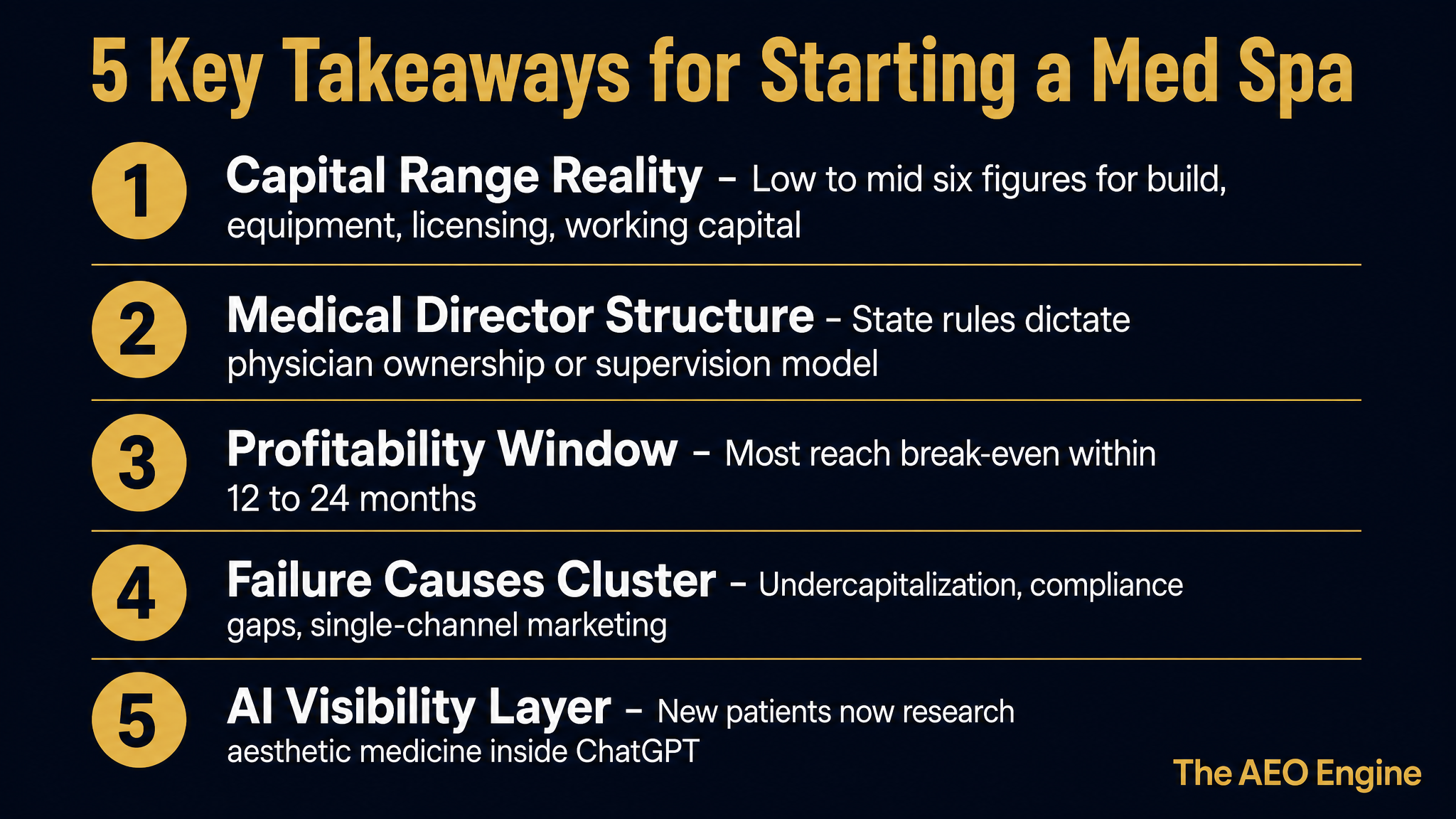
What Does It Actually Cost to Start a Med Spa?
Starting a med spa requires capital across five distinct categories, and the total typically lands in the low to mid six figures depending on geography, treatment menu, square footage, and equipment financing posture. The American Med Spa Association tracks build costs as one of the most variable inputs in the category because a single laser platform can shift the total budget by a meaningful amount.
The five capital categories every new owner should plan for are clinical, build-out, licensing and legal, working capital, and marketing.
- Clinical Equipment - Laser platforms, injectable inventory, body-contouring devices, and consumables, with leasing options available for the largest items.
- Build-Out and Buildout - Lease deposit, construction, plumbing for treatment rooms, signage, and front-of-house design.
- Licensing and Legal - State medical board filings, corporate structure setup, malpractice coverage, and HIPAA-compliant systems.
- Working Capital - At least six months of payroll, rent, and operating expenses to cover the ramp before recurring revenue stabilizes.
- Marketing and Visibility - Brand, website, schema, AI citation positioning, and local discovery setup before launch.
Owners who underestimate the working capital and marketing categories are the ones who tend to struggle in months four through twelve. Treatments may generate revenue from day one, but retention and word-of-mouth take longer to compound than most new entrants forecast.
What License Do You Need to Open a Med Spa?
A med spa is a regulated medical practice in most states, which means the licensing structure is determined less by the spa side of the business and more by the medical procedures being delivered. Botox, dermal fillers, laser treatments, microneedling with PRP, and any prescription-based weight loss or hormone protocol require a licensed physician to be either the owner of the medical entity or the direct medical director of the practice.
State requirements vary, and a handful of states impose strict corporate practice of medicine rules that require physician ownership of the medical entity itself, with a separate management services organization handling non-clinical operations. Other states allow more flexible structures. The licensing layer also dictates which providers can deliver which treatments, which is why the medical director relationship is one of the most consequential early decisions a new owner makes.
The practical licensing checklist for most new med spas includes:
- Medical Entity Formation - Often a professional corporation or professional limited liability company, depending on state rules.
- Medical Director Agreement - A written agreement defining supervision, protocols, compensation, and standing orders.
- State Medical Board Filings - Required for the medical entity and sometimes for the practice location.
- HIPAA Compliance Program - Policies, training, business associate agreements, and electronic medical record setup.
- Malpractice and Liability Coverage - Coverage for the medical director, any nurse injectors, aestheticians, and the entity itself.
Skipping or rushing the licensing stack is one of the most common reasons new med spas face enforcement action or insurance gaps within the first 24 months. According to Berxi, malpractice insurance carriers track licensing posture as a leading indicator of claim risk in the aesthetic medicine category.
Is Owning a Med Spa Actually Profitable?
A profitable med spa generates margin primarily through repeat treatments, membership programs, and a treatment menu balanced between high-ticket procedures and recurring-revenue services like neurotoxin maintenance. The majority of well-run med spas reach break-even within the first 12 to 24 months, though the path varies considerably based on capital structure, geography, and the treatment mix.
Profitability in aesthetic medicine is less about top-line revenue and more about retention, average lifetime value, and operational discipline. Practices that build a strong membership or loyalty layer in the first 18 months tend to outperform those relying on single-treatment acquisition. The category also rewards owners who track treatment-level contribution margin carefully rather than tracking revenue alone.
If your practice needs help getting recommended by AI as you launch, The AEO Engine offers Answer Engine Optimization built for regulated healthcare practices operating under advertising restrictions. The team has spent the past two years building citation systems for med spas, GLP-1 clinics, hormone therapy practices, and aesthetic medicine groups across the United States. Request a free citation gap check.
How Many Med Spas Fail and Why?
A meaningful share of new med spas close or are sold within their first three to five years, and the failure patterns cluster around a small number of predictable causes. Failure rarely traces to a single mistake. It typically reflects a combination of undercapitalization, weak medical compliance posture, narrow service mix, and a marketing strategy that depends entirely on one discovery channel.
The five most common failure causes are:
- Undercapitalization - Running out of working capital before the patient base compounds.
- Medical Director Drift - A medical director who is not engaged, leading to compliance gaps and treatment quality variance.
- Treatment Mix Imbalance - Heavy reliance on a single high-ticket procedure rather than a portfolio with recurring-revenue anchors.
- Single-Channel Marketing - Practices that depend solely on paid social, organic search, or referrals find their economics break when any one channel shifts.
- Discovery Invisibility - Practices that are invisible to the new AI discovery layer lose patient flow without ever knowing why.
The fifth cause is the newest and the most overlooked. Patients researching aesthetic medicine increasingly start inside ChatGPT, Perplexity, Gemini, or Google AI Overviews, and the practice that gets recommended inside those answers captures the search before any traditional ranking battle begins. Practices invisible to AI lose a growing share of pipeline that they cannot trace through standard analytics.
How Should a New Med Spa Position for AI Recommendation?
A new med spa positions for AI recommendation by treating its entity foundation, content layer, and citation surface as launch infrastructure rather than post-launch marketing. The CITE Framework that The AEO Engine uses for regulated practices addresses entity consistency, intent-aligned content, third-party trust signals, and ongoing measurement. New owners who address these layers from launch typically begin appearing in AI citations within the first 60 to 120 days rather than waiting years.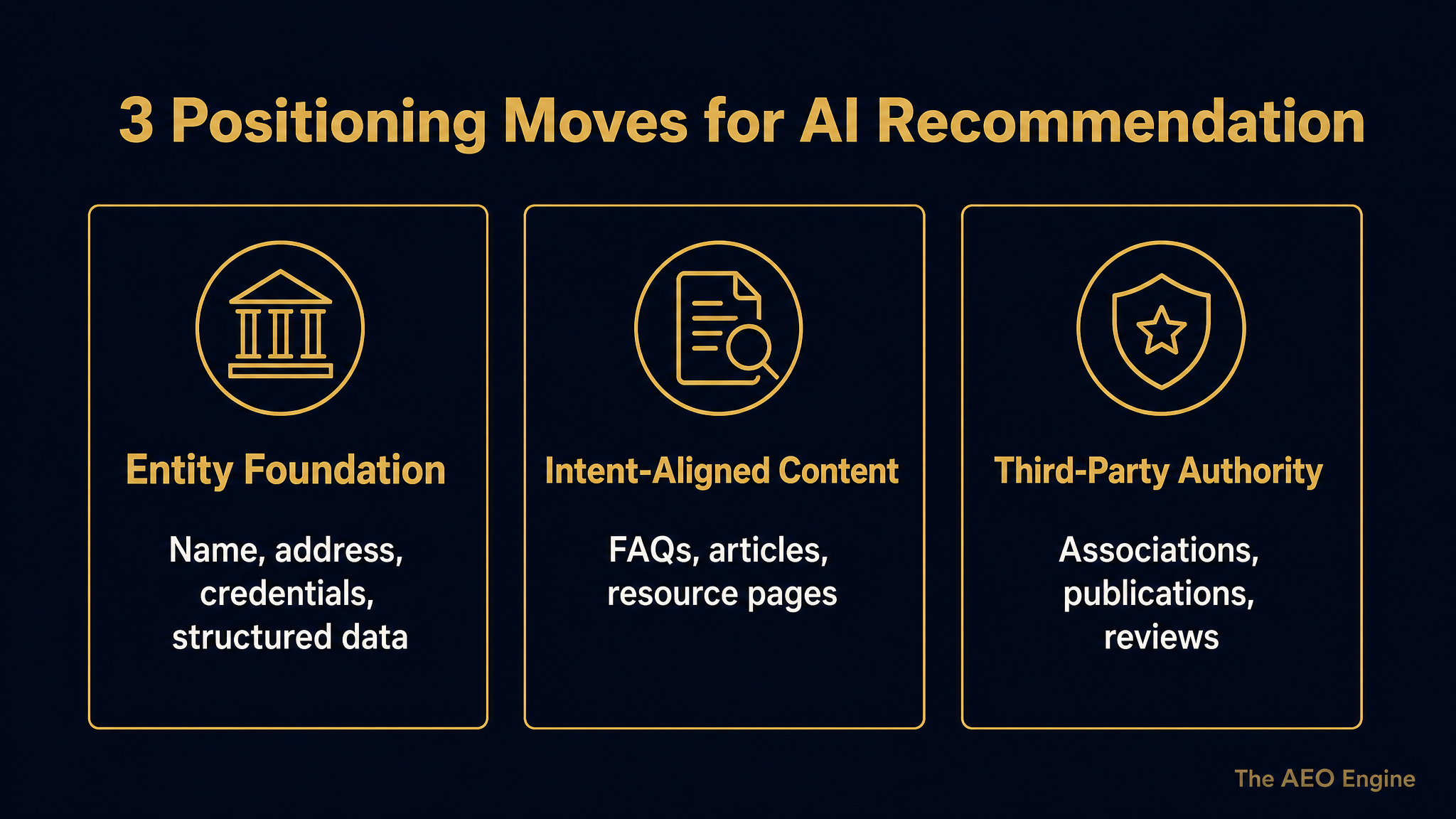
Three positioning moves matter most in the launch window:
- Entity Foundation From Day One - Consistent name, address, treatment scope, medical director credentials, and structured data across the website, directory listings, and professional profiles.
- Intent-Aligned Content Library - Articles, FAQs, and resource pages built around the questions patients actually ask AI engines, not the keywords legacy SEO targeted.
- Third-Party Authority Signals - Citations from medical associations, recognized publications, and verified review platforms that AI engines treat as trust inputs.
These positioning moves do not replace clinical excellence, licensing rigor, or operational discipline. They sit alongside those layers and determine whether a new med spa appears inside the AI answer when a prospective patient asks ChatGPT for a recommended provider in their area.
The channel mix that works for a new med spa typically combines two or three of these surfaces, with AI citation positioned as the discovery layer that compounds alongside organic search rather than competing with it. Practices that build AI citation early are the ones positioned to capture the share of patient research that now starts inside AI engines.
What Do Clients Say About Working With The AEO Engine?
Practices working with The AEO Engine come from regulated industries where traditional paid acquisition has either become uneconomic or runs into platform advertising restrictions. The pattern they report is consistent. They were visible in traditional search results but invisible inside AI-mediated discovery, and the gap was growing faster than their existing marketing stack could address. The AEO Engine builds the citation positioning that makes the practice appear inside the AI answer rather than only on the results page, which is the discovery surface that increasingly drives high-intent inbound consultations.
Frequently Asked Questions
How much does it cost to start a medspa?
A new med spa typically requires capital in the low to mid six figures, with the total driven by build-out scope, equipment choices, geography, and working capital reserves. Owners who plan for at least six months of operating expenses on top of the build budget tend to navigate the ramp far more comfortably than those who launch with thinner reserves. Capital costs also vary significantly based on whether the practice leases or owns its laser and body-contouring equipment, which can shift the total budget by a meaningful amount.
Is owning a medspa profitable?
A well-run med spa can be profitable, with the majority of successful practices reaching break-even within the first 12 to 24 months. Profitability tends to follow retention, membership program design, and treatment mix discipline rather than top-line revenue alone. The practices that perform best track contribution margin at the treatment level and build recurring-revenue anchors like neurotoxin maintenance and skincare memberships alongside high-ticket procedures.
How many medspas fail?
A meaningful share of new med spas close or change ownership within the first three to five years. The most common failure causes are undercapitalization, medical compliance gaps, narrow treatment mix, and single-channel marketing dependence. The newest failure pattern is invisibility inside AI discovery surfaces, which removes a growing share of pipeline that practices cannot trace through standard analytics until the patient flow has already declined.
What license do you need to open a medspa?
A med spa is a regulated medical practice in most states, which means the licensing structure depends on the medical procedures the practice delivers. Most jurisdictions require a licensed physician to own or directly supervise the medical entity, and the practical licensing checklist includes a medical entity formation, a medical director agreement, state medical board filings, a HIPAA compliance program, and malpractice and liability coverage. State rules vary, so a healthcare attorney experienced in the corporate practice of medicine is one of the most valuable early hires.
How long does it take to launch a med spa?
A realistic launch timeline runs roughly six to twelve months from initial planning to opening day, depending on lease build-out complexity, equipment lead times, licensing processing, and hiring. Practices that compress this timeline aggressively often pay for it in working capital shortfalls or compliance gaps in months three through nine. Building the AI citation foundation during the pre-launch window means the practice has discovery momentum on opening day rather than starting from invisibility.
What is the right treatment menu for a new med spa?
A balanced launch menu typically combines high-ticket procedures with recurring-revenue services that compound retention. Common anchors include neurotoxin injectables, dermal fillers, laser hair removal, skincare-grade chemical peels, and body-contouring services. The right mix depends on local competitive density, medical director comfort, and the demographic profile of the practice area. Adding services over time is generally safer than launching with a sprawling menu that strains medical supervision capacity.
How does AI citation differ from traditional SEO for a med spa?
Traditional search optimization aims to rank a page in the results list when a prospective patient enters a query. AI citation aims to be the practice the AI engine actually recommends inside its answer when the patient asks for a provider. The two surfaces overlap but reward different signals, with AI engines weighting entity consistency, structured data, third-party trust signals, and content that directly answers patient questions. New med spas that build both layers from launch tend to compound discovery more durably than those treating AI as a future concern.
When should a new med spa start marketing?
The most effective new med spas begin building their entity foundation and content layer well before opening day. AI citation typically takes 60 to 120 days to compound after the foundational layer is in place, which means a practice that waits until launch day to begin loses the first quarter of patient flow it could have captured. The pre-launch window is also when the practice's medical director credentials, schema, and authority signals can be set up cleanly before the operational pressure of an open practice.
Executive Summary
Starting a med spa in 2026 requires capital in the low to mid six figures, a state-compliant medical director structure, a licensing stack that includes entity formation and malpractice coverage, and a treatment menu that balances high-ticket procedures with recurring-revenue anchors. The majority of well-run practices reach break-even inside 24 months, and the most common failure patterns trace to undercapitalization, compliance drift, and single-channel marketing dependence. The newest failure pattern is invisibility inside AI discovery, which now drives a growing share of aesthetic medicine pipeline. Practices that build entity foundation, intent-aligned content, and third-party trust signals from launch tend to begin appearing inside AI citations within the first 60 to 120 days rather than waiting years for traditional rankings to compound.
What Should You Do Next?
A practice planning to launch a med spa in the next six to twelve months should treat AI citation positioning as part of the build plan, not as a Phase Two marketing project. The pre-launch window is when entity foundation, structured data, content library, and third-party trust signals can be built cleanly. Practices that wait until opening day to start spend the first year of operations rebuilding visibility they could have established before the doors opened.
Request a free AI citation gap check from The AEO Engine to understand where a new or planned med spa currently appears inside ChatGPT, Perplexity, Gemini, and Google AI Overview answers, and what foundation work matters most before launch.
About the Author
Jerry Jariwalla is the founder of The AEO Engine and creator of the CITE Framework for Answer Engine Optimization. With over 22 years in digital marketing and multiple successful business exits, Jerry has spent the past two years building AI citation systems for regulated practices in healthcare, wealth management, and legal services. The AEO Engine works exclusively with practices operating under advertising restrictions where AI citation provides higher leverage than traditional paid acquisition.
Expertise: Answer Engine Optimization, AI Citation Strategy, CITE Framework, Regulated Industry Marketing, Healthcare Practice Marketing, Wealth Management Marketing, Legal Marketing
Connect: LinkedIn
Disclaimer: This content is for informational purposes only and does not constitute professional marketing, legal, or compliance advice. Citation rates, timelines, and outcomes vary based on industry, competitive density, and execution quality. Statistics referenced reflect The AEO Engine's tracked client outcomes as of 2026 and are not guarantees of future results. Contact The AEO Engine for a consultation regarding your specific situation.