
Last Updated: May 2026
A plastic surgery marketing agency is a specialized marketing firm that designs and executes patient acquisition strategies for aesthetic surgery practices, operating within the advertising restrictions that govern healthcare promotion in the United States. Unlike general digital marketing firms, these agencies must navigate HIPAA privacy rules, state medical board advertising standards, FDA regulations governing before/after imagery, and the editorial guidelines around patient testimonials. According to ASPS 2024 statistics, cosmetic procedure volume continues to grow year over year, and the practices capturing that growth increasingly depend on multi-channel marketing expertise that generalist agencies cannot provide.
The AEO Engine, founded by Jerry Jariwalla, works with plastic surgery practices navigating exactly this challenge. Jerry brings over 22 years of digital marketing experience and multiple successful business exits to The AEO Engine, with a focused specialty in regulated industry marketing where compliance and visibility must advance together. The CITE Framework, developed through 18 months of research, gives plastic surgery practices a systematic path to both traditional search visibility and AI citation in platforms such as ChatGPT, Perplexity, and Google AI Overviews.
This guide covers what a plastic surgery marketing agency actually does, what distinguishes specialist firms from generalist ones, which questions to ask before signing a contract, and which warning signs to watch for during the evaluation process.
Key Takeaways
- Choose agencies with documented plastic surgery experience first: compliance gaps from generalist firms expose practices to HIPAA violations and state board complaints
- AI citation capability is now a baseline requirement: the majority of plastic surgery practices currently appear at a 0% AI citation rate, representing a first-mover window
- Verify credentialing and entity visibility strategy: AI systems cite practices based on credential prominence and consistent entity data, not ad spend
- Website authority and content depth outweigh social media metrics: peer-reviewed research confirms patients rely primarily on the practice website when making final consultation decisions
- Ask for specialty client references, not just case studies: a marketing agency's ability to present real plastic surgery clients who approved the reference is a stronger signal than a polished presentation deck
Each of these five factors points to the same conclusion: the agency you hire must understand plastic surgery as a regulated specialty, not just a consumer service.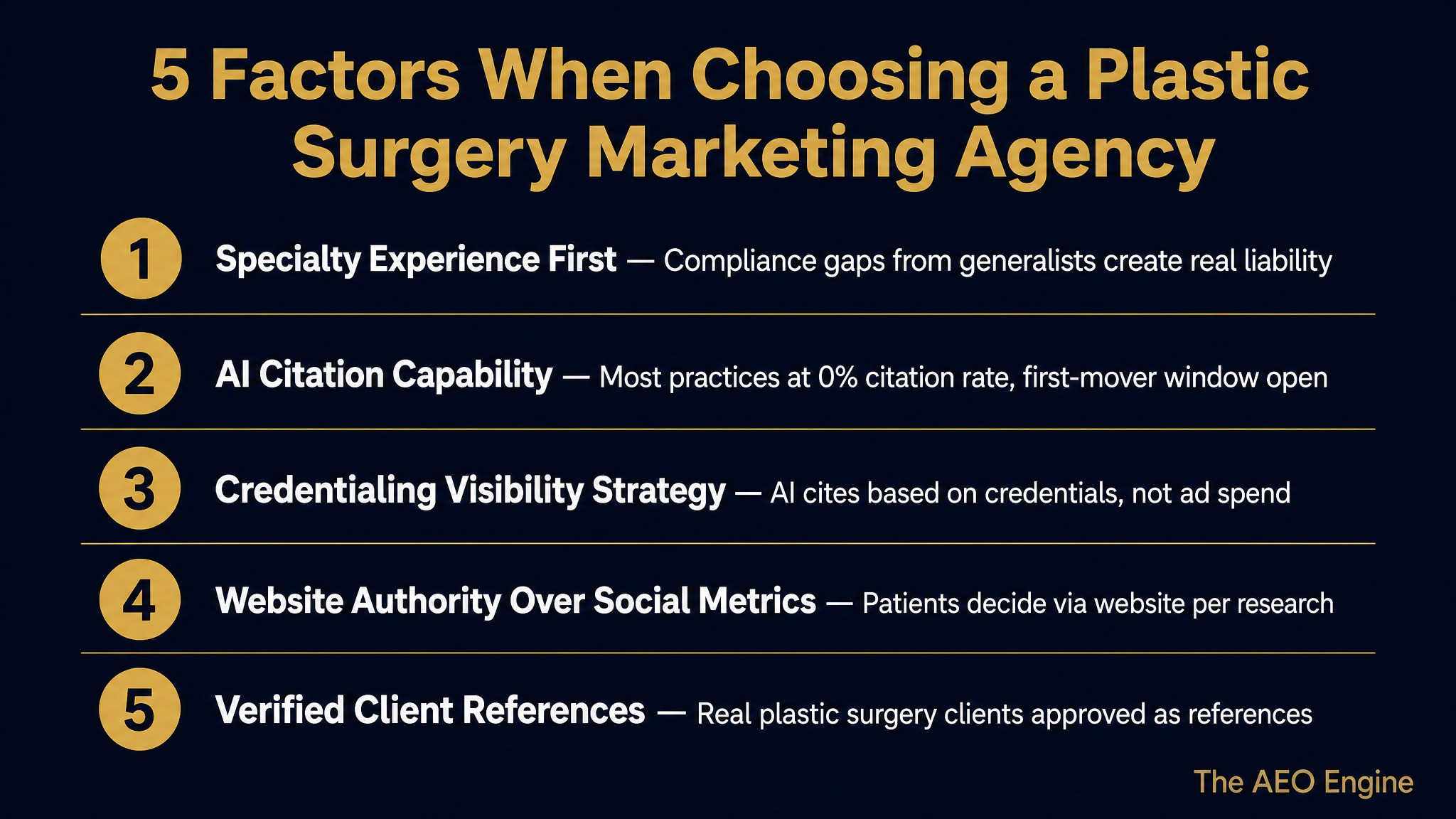
Why Does a Plastic Surgery Practice Need a Specialized Marketing Agency?
Plastic surgery operates under a distinct set of marketing constraints that general agencies are not equipped to handle. HIPAA governs how patient data can be collected and used in advertising campaigns. The FDA applies guidelines to before/after imagery, including consent documentation and representation standards. State medical boards in many jurisdictions restrict testimonials, superlative claims, and comparative advertising for licensed medical providers.
A generalist agency optimizing for conversion rate without understanding these guardrails creates real regulatory exposure. The risk is not theoretical. Practices have faced state board complaints following social media campaigns that violated local advertising rules, often because the agency producing the content had no healthcare-specific knowledge or review process.
A specialist plastic surgery marketing agency builds this compliance layer in from the start. Content strategists understand what can and cannot be claimed. Paid media specialists know which platform policies add another layer on top of regulatory requirements. The distinction matters most in the creative and copy approval workflow, where healthcare-specific review steps are non-negotiable for practices that want to market aggressively without creating legal exposure.
What Does a Strong Plastic Surgery Marketing Agency Actually Do?
The core deliverables from a plastic surgery marketing agency span several disciplines. Search engine optimization builds website authority so the practice ranks for high-intent procedure terms across geographic areas. Content marketing produces the educational articles, procedure guides, and FAQ pages that both search engines and AI platforms draw from when generating patient-facing recommendations.
Paid media management covers Google Search campaigns targeting patients actively researching procedures and social media advertising across Meta, Instagram, and TikTok where aesthetic content performs well. Peer-reviewed research on plastic surgery social media marketing identifies platform selection and content type as critical variables, with educational and before/after content driving higher engagement rates than promotional material for most demographic segments.
Reputation management monitors review platforms and structures the response process to protect brand perception. Website development and conversion optimization ensure the practice website turns visitors into scheduled consultations. Increasingly, a strong agency also manages AI citation, ensuring the practice appears when patients ask AI platforms for procedure recommendations rather than searching Google directly.
The breadth of these services explains why choosing based on price alone is a mistake. Practices that sign with the lowest-cost option frequently find that the agency handles one or two disciplines while leaving others entirely unmanaged, producing an incomplete strategy that underperforms against the practice's actual acquisition potential.
The AEO Engine works with plastic surgery practices operating under advertising restrictions where traditional marketing alone no longer captures the full patient acquisition opportunity. The AEO Engine offers a complimentary practice-specific gap analysis. Request it here.
What Sets a Specialist Plastic Surgery Agency Apart From a General Marketing Firm?
The most significant difference between a specialist agency and a general marketing firm is not the services listed on paper, but the knowledge of the context in which those services are delivered.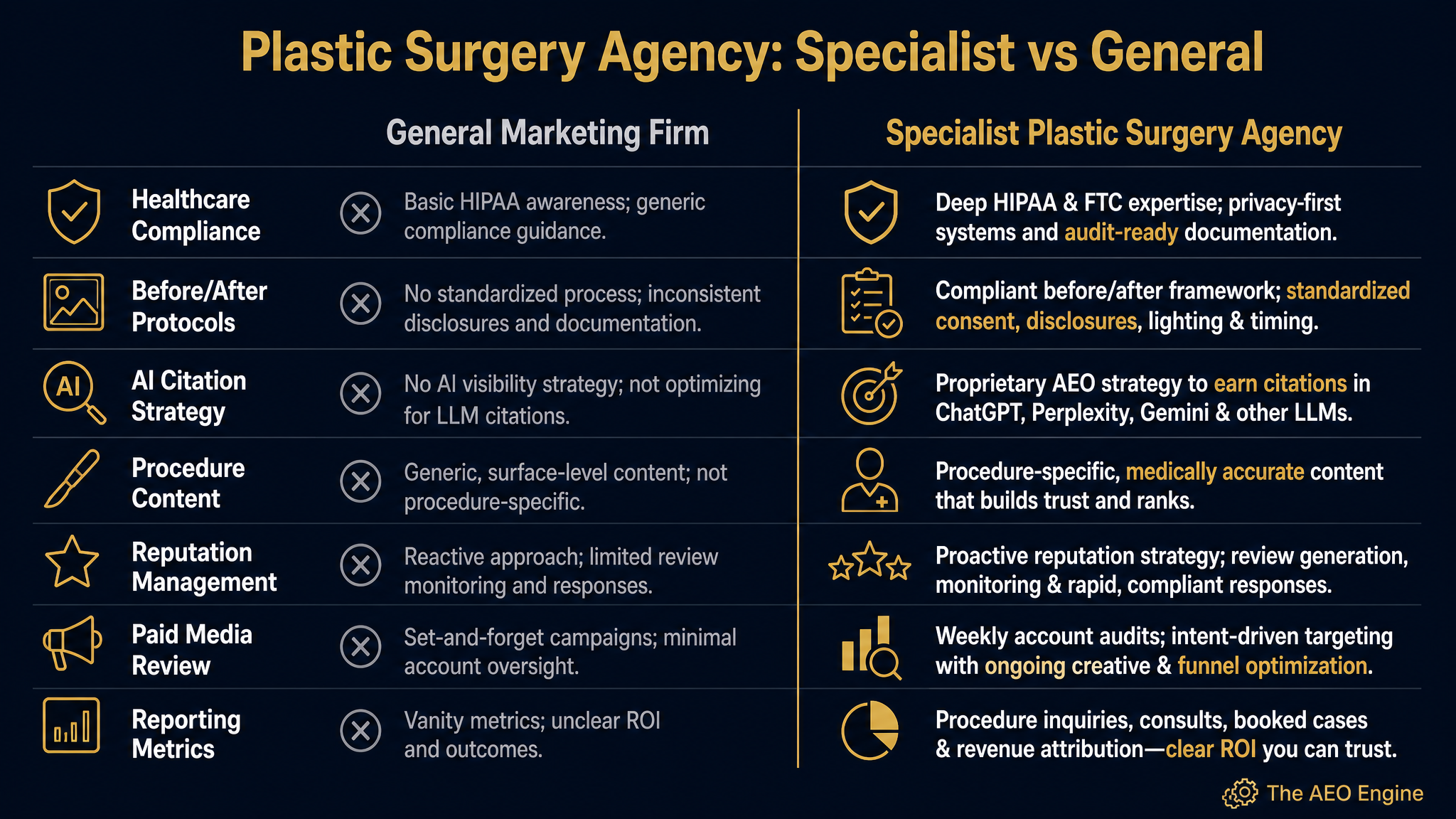
General marketing firms apply tactics that work across e-commerce, SaaS, and retail without modification. Those tactics frequently conflict with healthcare advertising standards. A specialist agency builds healthcare compliance into every deliverable from the beginning: content, creative, claims, landing pages, and paid media copy all pass through healthcare-specific review before publication.
Research on plastic surgery practice marketing documents a consistent disconnect between how practices market themselves and how patients actually seek information. Practices that have worked only with generalist agencies tend to over-invest in channels that convert poorly for their patient demographics while underinvesting in the channels where final decisions are made.
The second major differentiator is AI citation capability. AI platforms including ChatGPT, Perplexity, and Google AI Overviews now intercept a growing share of patient research queries before any Google search occurs. Specialist agencies that understand the CITE Framework approach build entity consistency, credential visibility, and structured content that AI systems can evaluate and cite. Most generalist agencies are unaware this layer exists, let alone capable of executing it.
What Questions Should You Ask Before Hiring a Plastic Surgery Marketing Agency?
The agency evaluation process benefits from a structured set of questions that distinguish genuine expertise from presentation polish. These questions are worth asking in writing before any contract discussion begins.
Ask the agency to name three plastic surgery practices they currently work with and to provide a reference contact at each. An agency confident in its specialty experience will provide these without hesitation. An agency that deflects by citing confidentiality as a reason to avoid all references is signaling either that the client list is thinner than advertised or that client satisfaction is lower than claimed.
Ask how the agency handles HIPAA compliance in content and paid media workflows. The correct answer involves a named process: a healthcare-specific review step before publication, signed business associate agreements, and written policies on data handling within campaign tools. A vague response about "being careful" is not adequate.
Ask what the agency does specifically for AI citation. The answer should reference entity consistency, schema markup, structured content strategy, and credential prominence. If the agency has never encountered these terms or responds with a generic SEO answer, AI citation is not in scope.
Ask how the agency measures success at the twelve-month mark. Strong agencies answer with consultation volume, cost per consultation, procedure category conversion rates, and ideally AI citation rate. Weaker agencies anchor on traffic and rankings that do not connect directly to revenue.
Ask who on the team has healthcare marketing experience and what their background includes. The answer should name specific individuals and specific healthcare clients, not generic claims about the agency having some healthcare experience.
What Red Flags Should You Watch for When Evaluating a Marketing Agency?
Several warning signs appear consistently when practices report negative experiences with marketing agencies. Recognizing them early prevents costly contracts and wasted time.
The first red flag is a guaranteed results promise. No agency can guarantee rankings, citation rates, or consultation volumes. Markets shift, algorithms update, and patient behavior changes. An agency that promises specific outcomes in writing is either misrepresenting its capabilities or planning to redefine the metric after delivery.
The second red flag is a template-based website and content strategy. Generic content that applies equally to a plastic surgeon and any other service provider has no authority for either. AI systems, which evaluate content for specificity, expertise, and entity clarity, will not cite thin or interchangeable material.
The third red flag is a paid media-only positioning. Agencies that center the entire pitch on Google Ads and Meta campaigns are solving for short-term lead volume, not long-term practice authority. Paid traffic stops when the budget stops. Content authority, AI citation, and search visibility compound over time.
The fourth red flag is no healthcare-specific compliance conversation. If an agency completes the entire sales process without mentioning HIPAA, state advertising guidelines, or before/after content standards, those topics are not on their radar. This gap creates real risk for the practice regardless of how strong the traffic numbers look.
The fifth red flag is an inability to explain AI citation. Most practices currently receive no AI-generated recommendations for any procedure. The agencies that will matter in the next two years are those actively building the entity and content infrastructure that AI systems need to cite practices with confidence. An agency that cannot explain this capability does not have it.
Frequently Asked Questions
What does a plastic surgery marketing agency do?
A plastic surgery marketing agency manages the patient acquisition strategy for aesthetic surgery practices. Core services include search engine optimization, paid media management, content marketing, social media strategy, reputation management, and AI citation building. Specialist agencies also handle compliance review to ensure all marketing activity meets HIPAA requirements, FDA before/after guidelines, and state medical board advertising standards that vary by jurisdiction.
How is a plastic surgery marketing agency different from a general digital marketing agency?
The primary difference is domain knowledge. A general digital marketing agency applies tactics that work across industries without understanding the specific compliance constraints of healthcare advertising. A specialist plastic surgery agency understands HIPAA, FDA before/after photo regulations, testimonial restrictions, and the competitive structure of the aesthetic medicine market. This knowledge changes how content is written, how paid media is structured, and how results are reported to the practice.
What should a plastic surgery marketing portfolio include?
A credible portfolio includes documented case studies from named or identifiable plastic surgery practices, with specific metrics such as consultation growth, procedure category ranking improvements, or cost per consultation reduction. Strong portfolios also include examples of compliance-reviewed content and evidence of AI citation results where the practice appears in AI platform responses to relevant patient queries.
Can a plastic surgery marketing agency help with AI citation?
Yes, though not all agencies offer this capability. AI citation requires building entity consistency across all web properties, ensuring board certification and credentials are prominently displayed and structured, producing procedure-specific content that AI systems can evaluate for authority, and implementing structured data markup that helps platforms categorize the practice correctly. Practices should ask directly what the agency does for AI citation before signing.
How long does it take to see results from a plastic surgery marketing agency?
Results vary by channel. Paid media campaigns typically generate consultation leads within two to four weeks when structured correctly. SEO and content marketing results build over three to nine months as authority and indexing accumulate. AI citation results typically appear within 60 to 90 days of consistent entity and content work, though competitive markets may require longer timelines. Practices should be cautious of agencies promising immediate organic or AI citation results.
What compliance standards should a plastic surgery marketing agency follow?
A plastic surgery marketing agency should demonstrate familiarity with HIPAA privacy requirements as they apply to advertising data collection and campaign targeting. The agency should also follow FDA guidelines on before/after imagery, including patient consent documentation and representation standards. State medical board advertising rules vary by jurisdiction and can restrict testimonials, superlative language, and certain comparative claims. A specialist agency builds these standards into its review workflow rather than treating them as optional.
How do I evaluate a plastic surgery marketing agency's pricing?
Pricing in plastic surgery marketing varies based on the scope of services, practice size, number of procedure categories targeted, and the agency's experience level. Evaluate pricing relative to the outcomes delivered, not in isolation. An agency generating more consultations at a lower cost per consultation produces better economics than a cheaper agency with fewer qualified leads. Ask for a breakdown of all services included, the reporting cadence, and contract flexibility before comparing quotes across vendors.
What is the most important question to ask a plastic surgery marketing agency?
The most important question is: can you provide three plastic surgery clients as references, with their names and contact information? This single question filters out agencies that lack real experience in the specialty, agencies with poor client retention, and agencies that use plastic surgery in their pitch without meaningful case history. An agency with genuine expertise and satisfied clients answers this question immediately and without conditions.
Executive Summary
Choosing a plastic surgery marketing agency requires moving beyond surface-level service comparisons to evaluate compliance knowledge, specialty experience, and AI citation capability. General marketing firms create regulatory exposure by applying tactics without healthcare context. Specialist agencies build compliance review into every deliverable, understand the platforms and content formats that drive aesthetic medicine patient acquisition, and increasingly manage AI citation as a core channel alongside traditional SEO and paid media. Evaluation should focus on verifiable client references, specific compliance processes, and evidence of AI visibility strategy rather than on polished presentations or price competition alone. The practices that select the right agency early gain compounding advantages in both search and AI recommendation that competitors who defer the decision cannot easily close.
What Should You Do Next?
Practices currently evaluating marketing agency options should begin by mapping the gap between current visibility and the results the practice needs. That means understanding where the practice ranks for target procedures, what its current AI citation rate is across ChatGPT, Perplexity, and Google AI Overviews, and what competitors in the local market are doing differently.
The next step is building a structured evaluation framework before the first agency conversation. List the questions above, require written answers, and score responses against a consistent rubric. This prevents the common pattern of choosing based on presentation quality rather than substantive expertise.
If AI citation is a priority, the evaluation must include a direct assessment of whether the agency can execute entity building, credential visibility, and structured content at the level required to generate recommendations from AI platforms. Most agencies cannot. The ones that can represent a meaningfully different growth path for practices that move before the competition does.
The AEO Engine offers a complimentary gap analysis showing exactly where a practice stands today on search, AI citation, and entity visibility relative to its market. Request a free gap analysis here to understand the specific actions that would most improve your practice's AI citation rate.
People Also Read
- How Do You Choose a Med Spa Marketing Agency?
- How Do You Pick an AEO Agency That Drives Real Citations?
About the Author
Jerry Jariwalla is the founder of The AEO Engine and creator of the CITE Framework for Answer Engine Optimization. With over 22 years in digital marketing and multiple successful business exits, Jerry has spent the past two years building AI citation systems for regulated practices in healthcare, wealth management, and legal services. The AEO Engine works exclusively with practices operating under advertising restrictions where AI citation provides higher leverage than traditional paid acquisition.
Expertise: Answer Engine Optimization, AI Citation Strategy, CITE Framework, Regulated Industry Marketing, Healthcare Practice Marketing, Wealth Management Marketing, Legal Marketing
Connect: LinkedIn
Disclaimer: This content is for informational purposes only and does not constitute professional marketing, legal, or compliance advice. Citation rates, timelines, and outcomes vary based on industry, competitive density, and execution quality. Statistics referenced reflect The AEO Engine's tracked client outcomes as of 2026 and are not guarantees of future results. Contact The AEO Engine for a consultation regarding your specific situation.