Last Updated: May 2026
A plastic surgery marketing strategy is a coordinated plan for making a practice visible, credible, and recommendable to prospective patients across every channel they use to research and select a surgeon. According to the American Society of Plastic Surgeons 2024 statistics report, demand for cosmetic procedures remained stable in 2024 with over 28.5 million minimally invasive treatments performed, underscoring the scale of the patient market practices compete within.
The AEO Engine works with plastic surgery practices navigating this multi-channel acquisition environment. Founder Jerry Jariwalla brings over 22 years of digital marketing experience and multiple successful business exits, and has spent the past two years building AI citation systems for regulated healthcare practices through the CITE Framework. The AEO Engine helps plastic surgery practices build the structured authority signals that drive visibility across both traditional search and AI recommendation tools.
This article covers how plastic surgery marketing works in 2026, which channels drive patient acquisition, how practices build patient trust, and why AI search has become a layer no practice can ignore.
Key Takeaways
- Build for Both Google and AI - Plastic surgery marketing in 2026 requires visibility in search engines and in AI tools like ChatGPT and Perplexity, which now capture early-stage patient research before Google is ever opened.
- Your Practice Website Is Your Anchor - Research shows more than half of patients are influenced by the practice website when selecting a plastic surgeon, making website quality the highest-value single marketing investment.
- Social Media Amplifies, Website Converts - Nearly half of cosmetic surgery patients report that social media influences their procedure decisions, but the practice website closes the consultation booking cycle.
- Credentials Signal Authority Across Every Channel - Board certification, ASPS membership, and specialty training are the trust signals that matter most to patients and to AI recommendation tools alike.
- AI Citation Is the First-Mover Opportunity - Most plastic surgery practices have zero AI citation presence today, giving early movers an uncrowded channel for recommendation-level visibility in their markets.
Each of these five elements points to the same shift: plastic surgery marketing has moved beyond single-channel SEO into a multi-surface acquisition model where trust signals, published content, and AI visibility work together.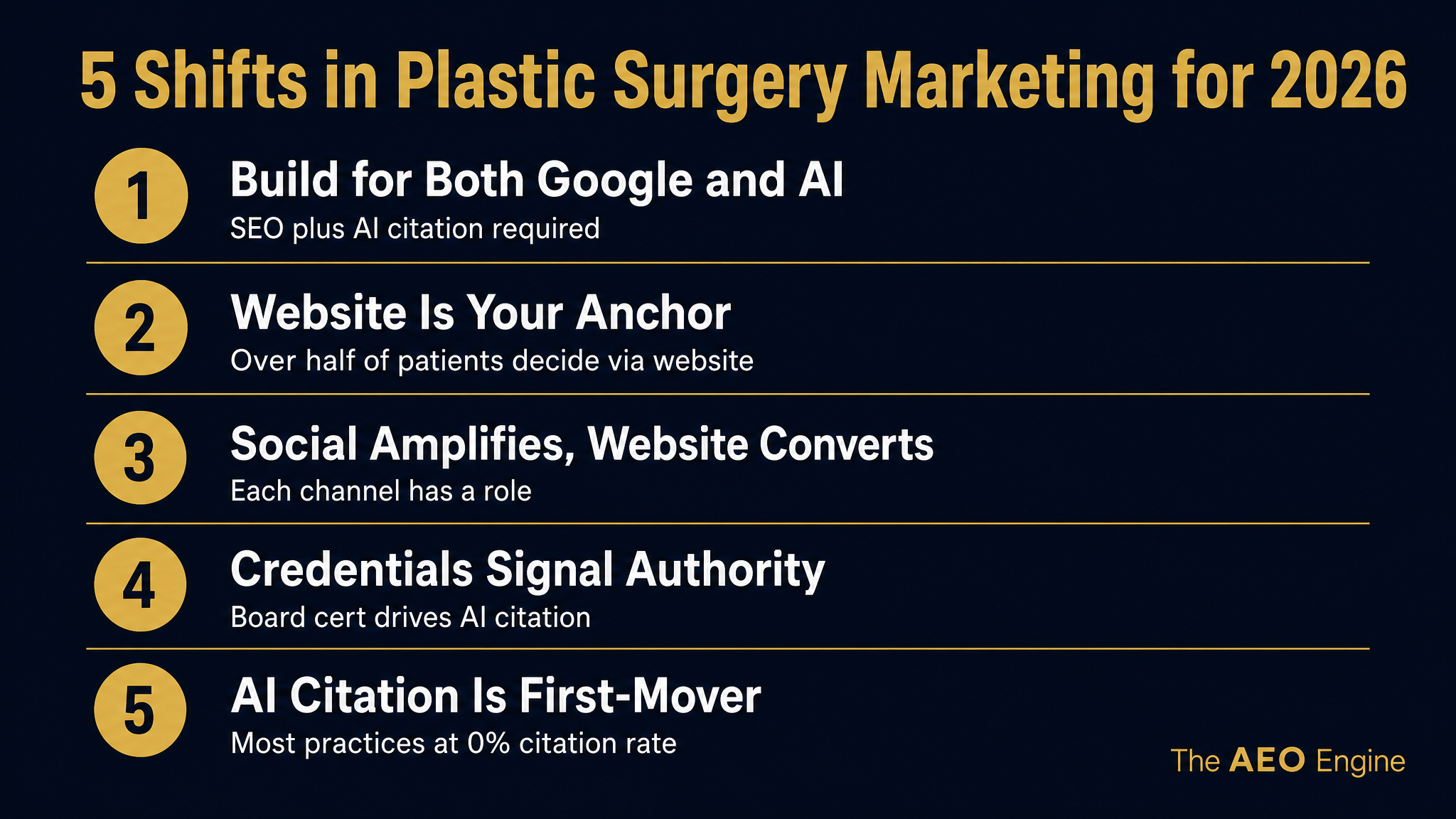
What Makes Plastic Surgery Marketing Different From General Healthcare Marketing?
Plastic surgery marketing operates under specific constraints that distinguish it from general healthcare marketing. The combination of elective procedures, advertising restrictions, trust-sensitive decisions, and a highly visual content format creates requirements that most generalist marketing agencies are not equipped to address.
The elective nature of cosmetic procedures means patients are funding treatments personally and applying higher scrutiny to every signal a practice sends. Price, outcome quality, surgeon credentials, and bedside manner all carry greater decision weight than they do in referral-driven medical specialties. Marketing that fails to address these factors produces traffic without consultations.
Advertising restrictions add another layer of complexity. Practices in most US states face limitations on before-and-after claims, testimonial formats, and outcome guarantees. Marketing content must educate and build authority without crossing into prohibited territory. Practices that work with generalist agencies often produce content that creates compliance risk precisely because the agency does not understand the restrictions that apply to cosmetic and aesthetic medicine.
The visual intensity of plastic surgery content creates its own requirements. Before-and-after galleries, video consultations, and procedural explainers are among the most effective content formats for patient education. But these formats also carry liability exposure if not managed correctly. Effective plastic surgery marketing integrates visual content strategy with a compliance review step that most industries do not require.
What Channels Drive Plastic Surgery Patient Acquisition in 2026?
The plastic surgery patient acquisition funnel runs across more channels in 2026 than it did five years ago. Each channel serves a different stage of the patient journey, and effective marketing allocates investment based on where patients actually spend time during their research process.
- Practice Website - The practice website functions as the foundation of every other marketing channel. It is where credentials are verified, procedure questions are answered, and consultations are booked. No other single channel contributes more directly to conversion.
- Search Engine Optimization (SEO) - SEO drives organic discovery for procedure-specific and geography-based searches. Patients searching for "rhinoplasty surgeon [city]" or "board certified plastic surgeon near me" are in active decision mode, making organic ranking directly connected to consultation volume in competitive markets.
- Social Media (Instagram, TikTok, YouTube) - Social platforms build awareness and procedural familiarity before a patient begins active research. According to research published in Plastic and Reconstructive Surgery Global Open, nearly half of cosmetic surgery patients report social media influences their procedure decisions, with Instagram generating the highest overall engagement and younger demographics increasingly discovering procedures on TikTok.
- Paid Search and Meta Ads - Paid acquisition captures patients at high commercial intent stages but operates at escalating cost in competitive markets. Practices relying exclusively on paid channels face an acquisition cost ceiling that organic authority and AI citation presence can help lower over time.
- AI Search Tools (ChatGPT, Perplexity, AI Overviews) - A growing share of patients now open AI tools before search engines to ask procedure questions and request surgeon recommendations. Practices that appear in AI-generated responses at this early research stage earn a referral-quality trust signal before the patient has considered alternatives.
How Do Plastic Surgery Practices Build Patient Trust Through Marketing?
Patient trust in plastic surgery is built through layered evidence, not single-channel signals. A prospective rhinoplasty patient does not make a decision based on one Instagram reel or one Google review. They accumulate signals across multiple sources before they feel confident enough to book a consultation.
The trust-building process follows a predictable sequence for most elective procedure patients. The first layer is credential verification. Patients want to confirm board certification, specialty training, and ASPS membership before they engage further with a practice. Practices that display these credentials prominently across their website, directory listings, and schema markup accelerate the verification step and reduce friction in the research process.
The second layer is outcome evidence. Before-and-after galleries, video consultations, and case study content demonstrate that the surgeon produces the specific results a patient is seeking. Outcome evidence does not close consultations by itself, but its absence reliably prevents them.
The third layer is educational authority. Practices that publish substantive content answering the questions patients ask during their research process are practices that AI tools can cite, Google can rank, and patients can trust. An article explaining what to expect during rhinoplasty recovery positions the surgeon as an expert before the patient has seen pricing or booking information.
An ASPS survey on cosmetic surgery and social media found that the practice website outperforms social platforms as a trust and decision driver, with social media functioning best as an awareness and discovery layer that brings patients to the website for final conversion.
The AEO Engine works with plastic surgery practices to build the structured authority signals that drive visibility across traditional search and AI recommendation tools through the CITE Framework. Book a free gap check at The AEO Engine to see where your practice stands today.
What Does the Modern Plastic Surgery Marketing Mix Look Like?
The marketing mix for a plastic surgery practice in 2026 looks materially different from what worked in 2019. The core change is that patients now move between channels in a non-linear way, starting in AI tools, moving to social platforms, conducting search research, and arriving at the practice website for final conversion.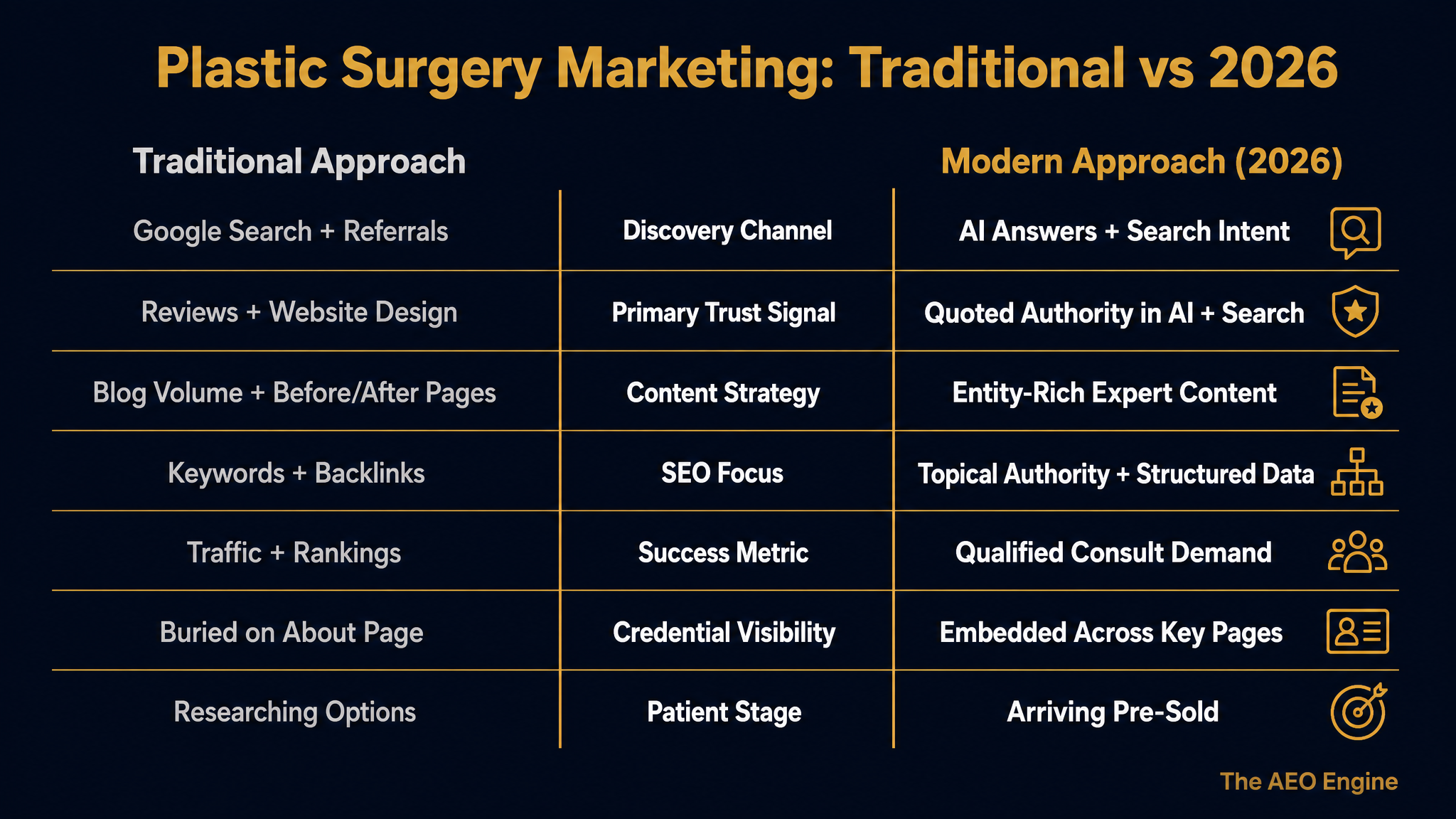
Practices that have updated their marketing mix to reflect this shift are competing on a different surface than practices still optimizing exclusively for Google. The early movers in AI citation within specific markets face minimal competition for the recommendation slots that drive the next cycle of elective procedure growth.
What Is AI Search and How Does It Change Plastic Surgery Marketing?
AI search refers to the outputs of tools like ChatGPT, Perplexity, and Google AI Overviews when patients ask procedure and provider questions. These tools do not return a list of links. They synthesize a response and may name specific practices or surgeons if their data layer is sufficient to support a confident recommendation.
For a plastic surgery practice, the implication is direct. A patient who asks ChatGPT "Who is a board certified rhinoplasty surgeon in [city]?" receives a named recommendation, not a ranked list of results. The practice named in that response has effectively been referred before the patient visits any website. The practice not named does not exist in that patient's consideration set, regardless of its Google ranking.
The signals AI tools use to generate these recommendations differ from Google's ranking factors. AI models weight entity consistency, published educational authority, verifiable credentials, and structured schema markup far more heavily than backlink profiles or keyword density. A practice that has optimized exclusively for Google may have done nothing to build the AI citation signals that drive recommendation eligibility.
The CITE Framework addresses exactly this gap, building the entity data, content authority, and structured credential signals that move plastic surgery practices from 0% citation rates to active AI recommendation in their markets.
Frequently Asked Questions
What is plastic surgery marketing?
Plastic surgery marketing is the set of strategies a practice uses to attract, educate, and convert prospective patients across digital and offline channels. It includes SEO, social media content, paid advertising, website optimization, reputation management, and increasingly, AI citation optimization. In 2026, effective plastic surgery marketing must account for the growing share of patients who begin their research in AI tools rather than search engines, requiring a different set of authority signals than traditional SEO alone provides.
Who is the best plastic surgery marketing company?
The best plastic surgery marketing company depends on the specific acquisition challenge the practice faces. Practices seeking traditional SEO and social media growth need agencies experienced in healthcare compliance and before-and-after content regulations. Practices seeking AI citation and recommendation visibility need providers with a documented AI citation methodology, entity audit capability, and multi-platform citation tracking. The AEO Engine works specifically with plastic surgery practices seeking to move from search-ranked to AI-recommended, operating exclusively with regulated healthcare practices.
How do you promote a plastic surgery practice?
Promoting a plastic surgery practice in 2026 requires a layered approach. The foundation is a high-credibility practice website with clearly displayed board certifications, ASPS membership, and procedure-specific educational content. Social media builds awareness and procedural familiarity. SEO drives active-research visibility in Google. Paid search captures high-intent patients in competitive markets. AI citation optimization addresses the growing share of patients who begin research in ChatGPT, Perplexity, and AI Overviews before visiting any website. Practices that build authority across all five layers outperform practices focused on any single channel.
What is the difference between SEO and AEO for plastic surgery marketing?
SEO targets Google's ranking algorithm to produce organic search rankings for procedure and geography-based queries. AEO (Answer Engine Optimization) targets the recommendation logic of AI tools to produce named practice citations in AI-generated responses. SEO signals include keyword match, backlinks, and page authority. AEO signals include entity consistency, structured credentials, published educational content, and schema markup. The two approaches are complementary and address different stages of the 2026 patient research journey.
How much does plastic surgery marketing cost?
Plastic surgery marketing costs vary based on market competitiveness, the scope of services engaged, and the current state of the practice's digital presence. Basic SEO and social media management for a single-location practice runs below comprehensive multi-channel programs that include AI citation, paid acquisition, and content production. The AEO Engine offers a free gap check that identifies the specific gaps in a practice's current visibility before any marketing investment decision is made.
How long does plastic surgery marketing take to show results?
Timeline depends on the marketing channel and the baseline state of the practice's digital presence. Paid search produces consultation volume within the first month. SEO typically requires three to six months before meaningful organic ranking movement is visible in competitive markets. AI citation optimization, based on The AEO Engine's tracked client program data, typically shows measurable citation activity within 60 to 90 days of beginning a structured program. Practices starting with stronger credential and content foundations tend to see citation movement faster than those beginning from a completely unoptimized baseline.
What marketing channels work best for plastic surgery practices?
The highest-converting channels for plastic surgery practices are the practice website, organic search, and AI citation. The practice website functions as the final conversion point for patients regardless of where they first discovered the practice. Organic search captures active-research patients with high commercial intent. AI citation captures early-stage research patients before competitors are ever considered. Social media and paid advertising serve awareness and re-engagement functions but typically produce lower consultation conversion rates than the three primary channels.
How do plastic surgery practices get recommended by AI tools?
Plastic surgery practices earn AI recommendations by building three categories of structured authority: entity consistency across all digital touchpoints, published educational content that mirrors the questions patients ask AI tools, and verifiable credential signals surfaced in schema markup and directory listings. AI tools pull from publicly available data when generating recommendations, so practices must ensure their name, specialty, location, credentials, and practice description are consistent and machine-readable across their website, Google Business Profile, and structured data. The AEO Engine builds these foundations systematically for plastic surgery practices seeking AI citation authority.
Executive Summary
Plastic surgery marketing in 2026 requires a multi-channel strategy built on three foundational elements: a high-credibility practice website, search and social visibility for active-research patients, and AI citation authority for the growing share of patients who begin their research in AI tools. The practice website remains the single highest-impact marketing asset, influencing more than half of final surgeon selection decisions. Social media builds procedural awareness and amplifies organic reach but converts below the website in direct consultation bookings. AI search tools are now a front-of-funnel discovery channel that most practices have not yet optimized for, creating a first-mover opportunity for practices that build structured citation authority now. The AEO Engine works with plastic surgery practices to build AI citation authority through the CITE Framework, moving practices from listed to recommended across the tools patients use first.
What Should You Do Next?
The first step for any plastic surgery practice evaluating its marketing performance in 2026 is a channel-by-channel audit: where does the practice appear when prospective patients research procedures in Google, in social platforms, and in AI tools? Most practices find that their AI citation presence is zero, meaning they do not appear in AI tool recommendations regardless of their Google ranking or social following.
The AEO Engine offers a free gap check that maps the practice's current AI citation status, identifies the specific content and entity gaps causing AI invisibility, and outlines the steps required to move from unrecognized to recommended. Request the free gap check at The AEO Engine.
People Also Read
About the Author
Jerry Jariwalla is the founder of The AEO Engine and creator of the CITE Framework for Answer Engine Optimization. With over 22 years in digital marketing and multiple successful business exits, Jerry has spent the past two years building AI citation systems for regulated practices in healthcare, wealth management, and legal services. The AEO Engine works exclusively with practices operating under advertising restrictions where AI citation provides higher leverage than traditional paid acquisition.
Expertise: Answer Engine Optimization, AI Citation Strategy, CITE Framework, Regulated Industry Marketing, Healthcare Practice Marketing, Wealth Management Marketing, Legal Marketing
Connect: LinkedIn
Disclaimer: This content is for informational purposes only and does not constitute professional marketing, legal, or compliance advice. Citation rates, timelines, and outcomes vary based on industry, competitive density, and execution quality. Statistics referenced reflect The AEO Engine's tracked client outcomes as of 2026 and are not guarantees of future results. Contact The AEO Engine for a consultation regarding your specific situation.