Is Plastic Surgeon SEO the Old Game and What's the New One?
Last Updated: May 2026
A plastic surgeon SEO strategy is a practice's plan for appearing in search engine results when prospective patients research rhinoplasty, breast augmentation, body contouring, or board-certified surgeons in their area. For over a decade, ranking on the first page of Google determined which practices grew and which ones stalled. According to the 2024 ASPS Plastic Surgery Statistics Report, cosmetic procedure demand remained stable in 2024 with over 28.5 million minimally invasive treatments performed, underscoring that patients are actively researching and booking procedures, making digital visibility a non-negotiable for any competitive practice.
The AEO Engine works with plastic surgery practices navigating exactly this shift. Founder Jerry Jariwalla brings over 22 years of digital marketing experience and multiple successful business exits, and has spent the past two years building AI citation systems for regulated healthcare practices through the CITE Framework. The AEO Engine specializes in moving practices from generic search rankings to direct AI recommendations in the tools patients now use first.
This article explains why traditional plastic surgeon SEO is losing competitive ground, what the AI search shift means for practice acquisition, and what steps practice owners can take in 2026 to remain visible where patients are already looking.
Key Takeaways
- Shift Your KPI - Patients increasingly open ChatGPT or Perplexity before Google when researching elective procedures, making AI citation rate a more relevant acquisition metric than keyword ranking position alone.
- Board Certification Is a Citation Signal - AI models weight formal credentials and medical association affiliations heavily when recommending surgeons, giving board-certified practices a structural advantage over uncredentialed competitors.
- SEO Still Contributes, But Less - Traditional organic rankings still drive some traffic, but AI chatbot adoption has roughly doubled among American adults since 2023, and practices that ignore the AI layer are ceding ground to early movers.
- Entity Consistency Drives AI Recognition - Practices cited by AI typically maintain consistent name, specialty, location, and credential data across their website, directories, and schema markup.
- The First-Mover Window Is Open - Most plastic surgery practices have a 0% AI citation rate today. Practices that build citation authority now face minimal competition for AI recommendation slots in their market.
Each of these five shifts reflects the same underlying change: the patient acquisition funnel now starts in AI tools, and the practices that build AI citation authority first will own the next decade of elective procedure growth.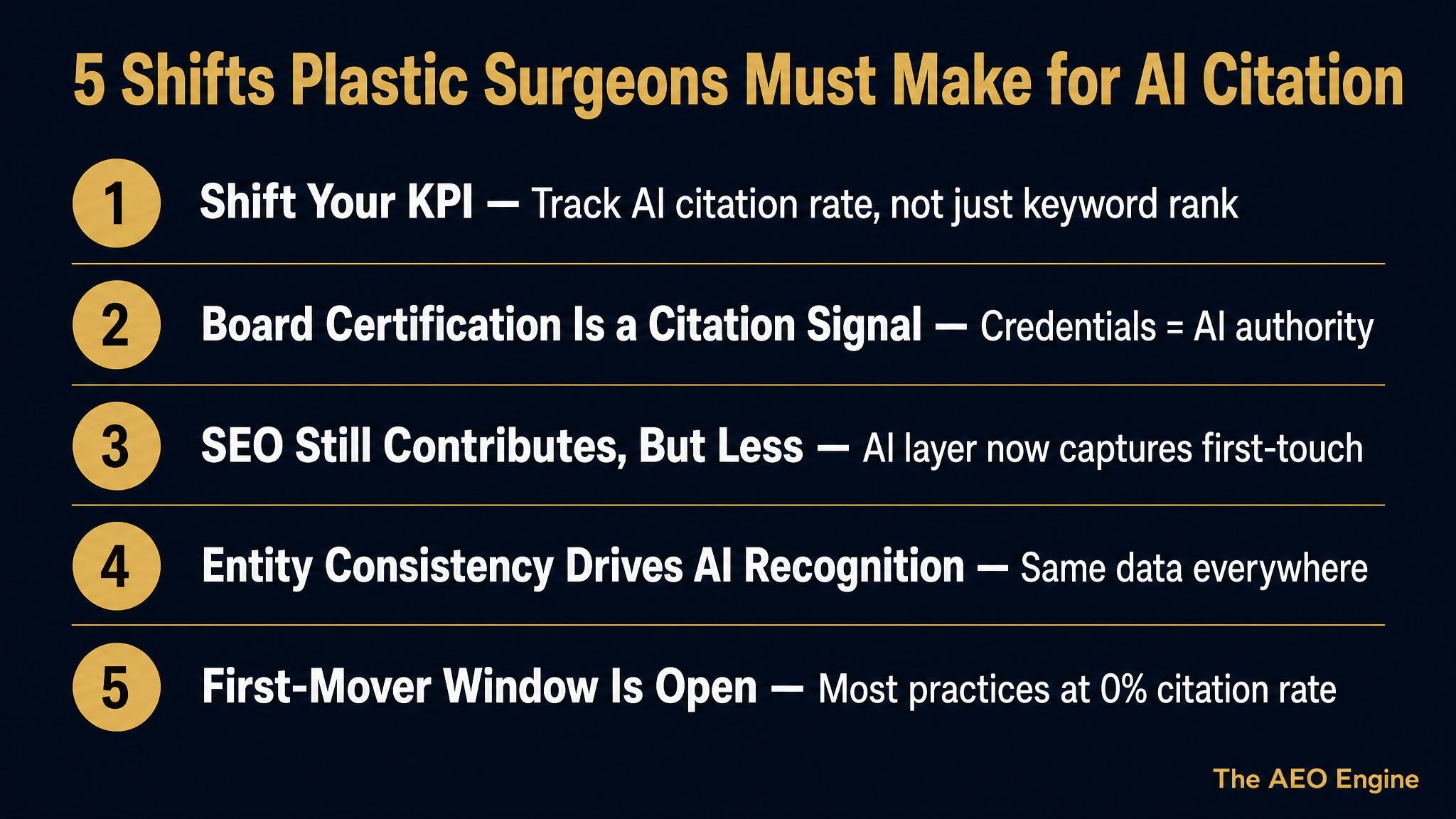
Traditional plastic surgeon SEO optimized for one surface: the Google search results page. The new game optimizes for a different surface entirely. AI tools now read, evaluate, and summarize a practice's published content and entity data before producing a recommendation. The practices that understand this shift first will own the next decade of elective procedure acquisition.
What Is Plastic Surgeon SEO and Why Did It Work Before?
Plastic surgeon SEO is the process of optimizing a practice website to rank higher in Google's organic results for procedure-related and geography-based searches. For practices in competitive markets, this meant investing in keyword-targeted service pages, local citations, backlink acquisition, and conversion-focused content.
The model worked because Google was the undisputed starting point for patient research. A prospective rhinoplasty patient would type "rhinoplasty surgeon [city]" into Google, scan the first three results, and book a consultation with whoever ranked highest and carried the strongest review profile. Practices that understood the ranking algorithm captured a predictable, consistent flow of consultation requests.
Three dynamics made traditional SEO effective for plastic surgeons specifically:
- High Commercial Intent - Patients searching for procedures had already decided to explore surgery, so ranking in front of them was directly connected to booked consultations.
- Low Search Literacy - Most patients did not scroll past page one or compare across multiple sources, so rankings functioned as an implicit referral.
- No AI Competition - Until 2023, no AI tool was capable of answering "who is the best rhinoplasty surgeon near me?" with enough specificity to displace the Google results page.
All three of those dynamics have changed.
Why Is Traditional Plastic Surgeon SEO Losing Ground?
The core problem with traditional SEO for plastic surgeons is not that it stopped working. It is that the patient's first stop has shifted. A growing share of prospective patients now open an AI assistant before they open a browser tab.
A West Health and Gallup survey reported by PBS NewsHour found that roughly one in four U.S. adults used AI tools for health information in the past 30 days, representing a fundamental shift in how patients research and evaluate healthcare providers. Patients ask conversational questions such as "What should I know before getting a rhinoplasty?" or "How do I find a board-certified plastic surgeon?" and receive synthesized answers without ever visiting a Google results page.
For a plastic surgery practice, this creates a specific risk: ranking on page one of Google no longer guarantees visibility to the patients most likely to convert. An AI tool that names three practices in a city is effectively replacing the first page of Google for that patient. If a practice is not in that recommendation, the ranking position is irrelevant for that acquisition.
Traditional SEO also struggles with the trust dynamics of elective surgery specifically. AI tools weight verifiable credentials, association affiliations, and published educational content far more heavily than keyword density or backlink counts. A practice that has optimized for Google's ranking signals may have done nothing to build the structured authority signals that AI systems use when evaluating which practices to recommend.
The AEO Engine works with plastic surgery practices and other healthcare providers to build AI citation authority through the CITE Framework. The program moves practices from listed to recommended across the AI tools patients now use most. Book a free gap check at The AEO Engine.
How Do Patients Actually Find Plastic Surgeons in 2026?
Patient research behavior for elective procedures has become multi-channel in ways that traditional SEO was not designed to capture. The path to a booked consultation now involves AI tools, review platforms, social content, and only then, potentially, a Google search.
The research phase differs based on the patient's starting point:
- First-Time Researchers open an AI assistant to ask general questions about procedures, risks, recovery, and costs. AI tools that cite specific practices at this stage plant a referral seed before the patient has formed a shortlist.
- Comparison Shoppers use AI to ask directly which practices or surgeons are well-regarded in their market. These queries produce named recommendations, and practices not in the AI's knowledge layer are invisible at this stage.
- Decision Validators return to an AI tool to ask confirmation questions such as "Is Dr. [Name] board certified?" or "What are patients saying about [Practice]?" These queries rely on structured data, review signals, and published credentials.
None of these three stages is reliably captured by a Google ranking strategy alone. Each requires a different type of authority signal, and the most powerful of those signals (consistent entity data, structured credentials, published educational content) are exactly what answer engine optimization targets.
What Does the New Game Look Like for Plastic Surgery Practices?
The new game for plastic surgery practice acquisition is AI citation. A practice that earns a recommendation from ChatGPT, Perplexity, or Google's AI Overviews in response to a procedure query has secured something more valuable than a first-page Google ranking: a direct, trusted referral delivered before the patient has even considered alternatives.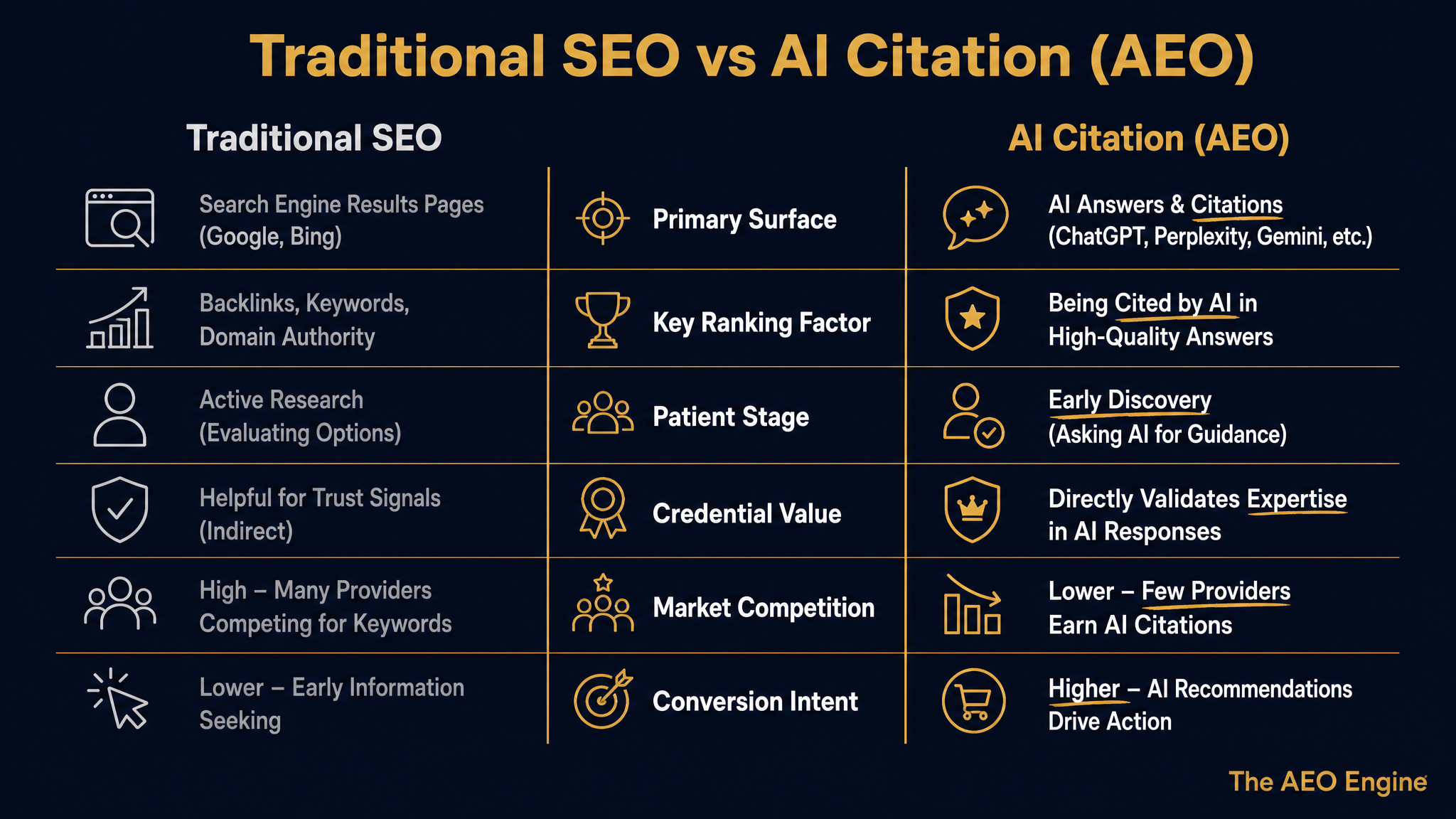
The practices positioned to win the AI citation game share common characteristics. They publish substantive educational content that mirrors the specific questions AI tools receive about plastic surgery. They maintain consistent name, specialty, location, and credential data across every digital touchpoint. They hold and surface verifiable board certifications and association memberships in structured formats. And they build content designed for machine extraction, not just human readability.
How Do Plastic Surgery Practices Get Recommended by AI?
AI citation for a plastic surgery practice is not accidental. It results from a deliberate program of entity building, content publishing, and structured data maintenance. The practices earning AI recommendations share a common foundation.
The first element is entity consistency. AI models build a representation of a practice from every data point they can find: the practice website, Google Business Profile, directory listings, schema markup, and published articles. When those sources tell the same story with the same credentials and the same details, the AI's confidence in the practice as a recommendable entity increases significantly.
The second element is published educational content that mirrors the questions patients actually ask AI tools. A practice with ten substantive articles answering procedure questions, credential questions, and recovery questions is a practice that AI tools can quote, cite, and recommend. A practice with a website full of promotional copy and generic procedure descriptions is not.
The third element is credential and association signaling. Board certification from the American Board of Plastic Surgery, ASPS membership, and fellowship status are exactly the kinds of verifiable trust signals that AI tools are built to recognize and weight. Practices that bury these credentials in a bio page instead of surfacing them consistently across all content miss a critical citation trigger.
The CITE Framework used by The AEO Engine builds all three elements systematically for regulated practices that cannot rely on paid advertising for differentiation.
Frequently Asked Questions
What is plastic surgeon SEO?
Plastic surgeon SEO is the process of optimizing a plastic surgery practice's website and digital presence to appear in search engine results for procedure and location-based queries. It includes technical website optimization, keyword-targeted content, local citation management, and backlink acquisition. In 2026, effective plastic surgery digital marketing extends beyond traditional SEO to include AI citation optimization, which targets the recommendation outputs of AI tools like ChatGPT and Perplexity.
Does traditional SEO still work for plastic surgeons?
Traditional SEO still generates organic traffic for plastic surgery practices, but its share of the patient acquisition funnel is shrinking as AI search tools capture more of the early-stage research journey. Practices that rely exclusively on Google rankings are missing the patients who start their research in AI assistants rather than search engines. A complete digital strategy for plastic surgeons in 2026 includes both traditional SEO and AI citation optimization working together.
How do patients use AI to find plastic surgeons?
Patients use AI tools like ChatGPT and Perplexity to ask procedure questions, compare options, and request practice recommendations in their city. These tools respond with synthesized answers that may name specific practices or surgeons if the AI has sufficient structured data to make a confident recommendation. Patients who receive an AI recommendation before visiting Google are already pre-sold on the suggested practice, which compresses the consultation booking cycle.
What is the difference between SEO and AEO for plastic surgeons?
SEO targets Google's ranking algorithm to appear in search results. AEO (Answer Engine Optimization) targets the recommendation logic of AI tools to appear in AI-generated responses. SEO signals include backlinks, keyword match, and page authority. AEO signals include entity consistency, structured credentials, published educational authority, and schema markup. The two approaches are complementary but require different content strategies and different performance metrics.
How long does it take for AEO to show results for a plastic surgery practice?
Based on The AEO Engine's tracked client program data, practices typically see measurable AI citation activity within 60 to 90 days of beginning a structured AEO program. The timeline varies based on competitive density in the practice's market, the quality and volume of existing published content, and the baseline state of the practice's entity data. Practices starting from a 0% citation baseline with strong credential signals tend to see movement faster than practices with inconsistent or incomplete entity data.
What does it cost to switch from SEO to AEO for plastic surgeons?
Pricing for AEO programs varies based on the scope of work, market competitiveness, and the current state of the practice's digital presence. The AEO Engine works exclusively with healthcare, wealth management, and legal practices operating under advertising restrictions. Contact The AEO Engine for a practice-specific gap analysis before any investment decision.
How do plastic surgeons get recommended by ChatGPT or Perplexity?
AI tools like ChatGPT and Perplexity build recommendations from the data they can access about a practice: published web content, schema markup, directory listings, and credential sources. A plastic surgeon earns AI recommendations by publishing substantive educational content, maintaining consistent entity data across all digital touchpoints, surfacing board certifications and association affiliations in structured formats, and building a content library that mirrors the questions patients actually ask AI tools. This is the core work of an AEO program.
What is the first step for a plastic surgery practice to improve AI visibility?
The first step is a citation gap analysis: an audit of what AI tools currently know about the practice, how consistent the entity data is across sources, and which competitors are already earning AI recommendations in the practice's market. The AEO Engine offers a free gap check for qualified practices. The audit identifies the specific gaps between current AI visibility and citation-ready status.
Executive Summary
Plastic surgeon SEO built successful practices for over a decade by targeting Google's ranking algorithm. In 2026, the patient journey increasingly begins in AI tools rather than search engines, and the practices earning new consultations are the ones AI tools recommend rather than simply the ones Google ranks. Moving from SEO to AEO requires a different set of signals: entity consistency, published educational authority, structured credentials, and schema markup designed for machine extraction. The AEO Engine works with plastic surgery practices to build this AI citation foundation through the CITE Framework, moving practices from 0% citation rates to active AI recommendations in their markets. The window for first-mover advantage in AI search for plastic surgeons is open, and the practices that act now face minimal competition for the recommendation slots that will drive the next decade of practice growth.
What Should You Do Next?
The first decision is not which AEO program to buy. It is whether the practice has the baseline data to even be considered by AI tools today. Most plastic surgery practices in the US have no measurable AI citation presence, meaning they do not appear in AI tool recommendations regardless of how well they rank on Google.
The AEO Engine offers a free gap check that maps the practice's current AI citation status, identifies the specific entity and content gaps causing invisibility, and outlines the steps needed to move from 0% citation rate to active AI recommendation. Request the free gap check at The AEO Engine.
People Also Read
- How Do Answer Engine Optimization Services Drive AI Citations?
- What Is the AI Recommendation Gap and Why Are You Listed But Not Recommended?
About the Author
Jerry Jariwalla is the founder of The AEO Engine and creator of the CITE Framework for Answer Engine Optimization. With over 22 years in digital marketing and multiple successful business exits, Jerry has spent the past two years building AI citation systems for regulated practices in healthcare, wealth management, and legal services. The AEO Engine works exclusively with practices operating under advertising restrictions where AI citation provides higher leverage than traditional paid acquisition.
Expertise: Answer Engine Optimization, AI Citation Strategy, CITE Framework, Regulated Industry Marketing, Healthcare Practice Marketing, Wealth Management Marketing, Legal Marketing
Connect: LinkedIn
Disclaimer: This content is for informational purposes only and does not constitute professional marketing, legal, or compliance advice. Citation rates, timelines, and outcomes vary based on industry, competitive density, and execution quality. Statistics referenced reflect The AEO Engine's tracked client outcomes as of 2026 and are not guarantees of future results. Contact The AEO Engine for a consultation regarding your specific situation.