What Does AI Look For Before Recommending an Ozempic Clinic Near You?
·The AEO Engine Team
Learn how AI platforms evaluate Ozempic clinics using schema markup, entity consistency, and semaglutide content signals.
Last Updated: May 2026
An Ozempic clinic is a medical practice that evaluates patient eligibility for semaglutide and related GLP-1 medications, manages the prescription process, and provides clinical oversight throughout treatment. According to the CDC, 40.3% of US adults currently live with obesity, creating a large and active patient population searching for medically supervised weight loss options. When a patient asks an AI platform to recommend an Ozempic clinic near them, the AI does not scan a paid directory or rank listings by ad spend. It evaluates a set of structural signals that specific practices have either built or have not, and it recommends only the ones that pass that evaluation.
The AEO Engine builds the structural content and entity verification systems that GLP-1 and Ozempic clinics need to appear in those AI responses. Founder Jerry Jariwalla brings 22 years of digital marketing experience, multiple successful business exits, and two years of dedicated research into AI citation programs for regulated healthcare practices. The CITE Framework he developed provides the systematic methodology The AEO Engine uses to help practices operating under HIPAA and FDA advertising restrictions move from invisible to AI-cited.
This article explains the five signals AI evaluates before recommending an Ozempic clinic, why the majority of practices never pass that evaluation, and what clinic operators need to build to change that.
Key Takeaways
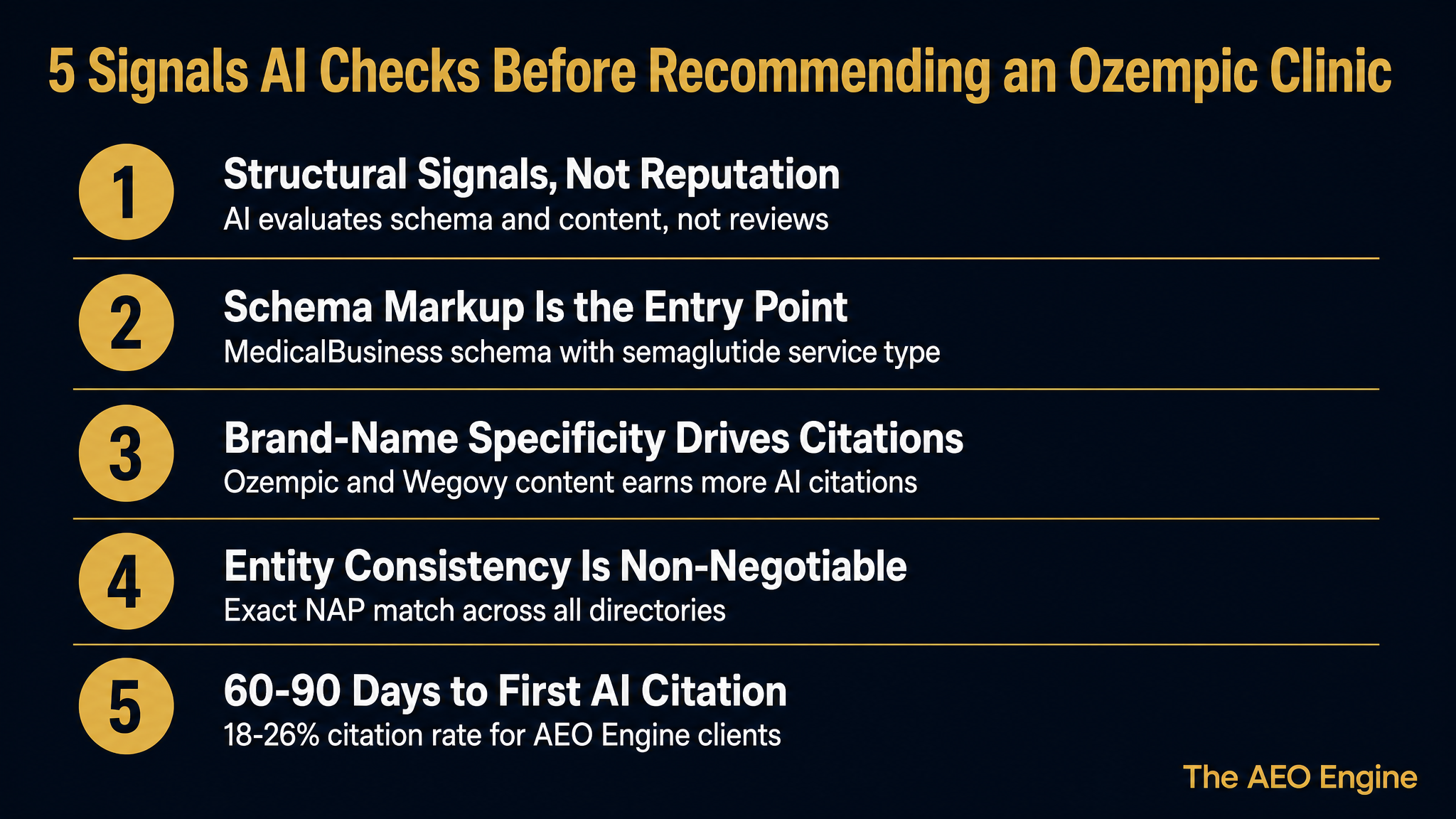
AI Evaluates Structural Signals, Not Reputation - The AI recommendation evaluation for Ozempic clinics is based entirely on verifiable structural data, not patient reviews, years in practice, or word of mouth
Schema Markup Is the Entry Point for AI Recognition - A clinic that does not have MedicalBusiness schema explicitly listing semaglutide as a service type is invisible to AI by default
Brand-Name Specificity Drives More Citations Than Generic Terms - Clinics with content that names Ozempic, semaglutide, and Wegovy specifically earn more AI citations than those using only "weight management" or "GLP-1 therapy"
Entity Verification Across Directories Is Non-Negotiable - Inconsistent NAP data across Google Business Profile, Healthgrades, and the practice website reduces AI confidence below the recommendation threshold
The AEO Engine Tracks 18 to 26% Citation Rates for Ozempic Clinic Clients - Compared to a 2-4% citation rate for practices without a structured AEO program in place
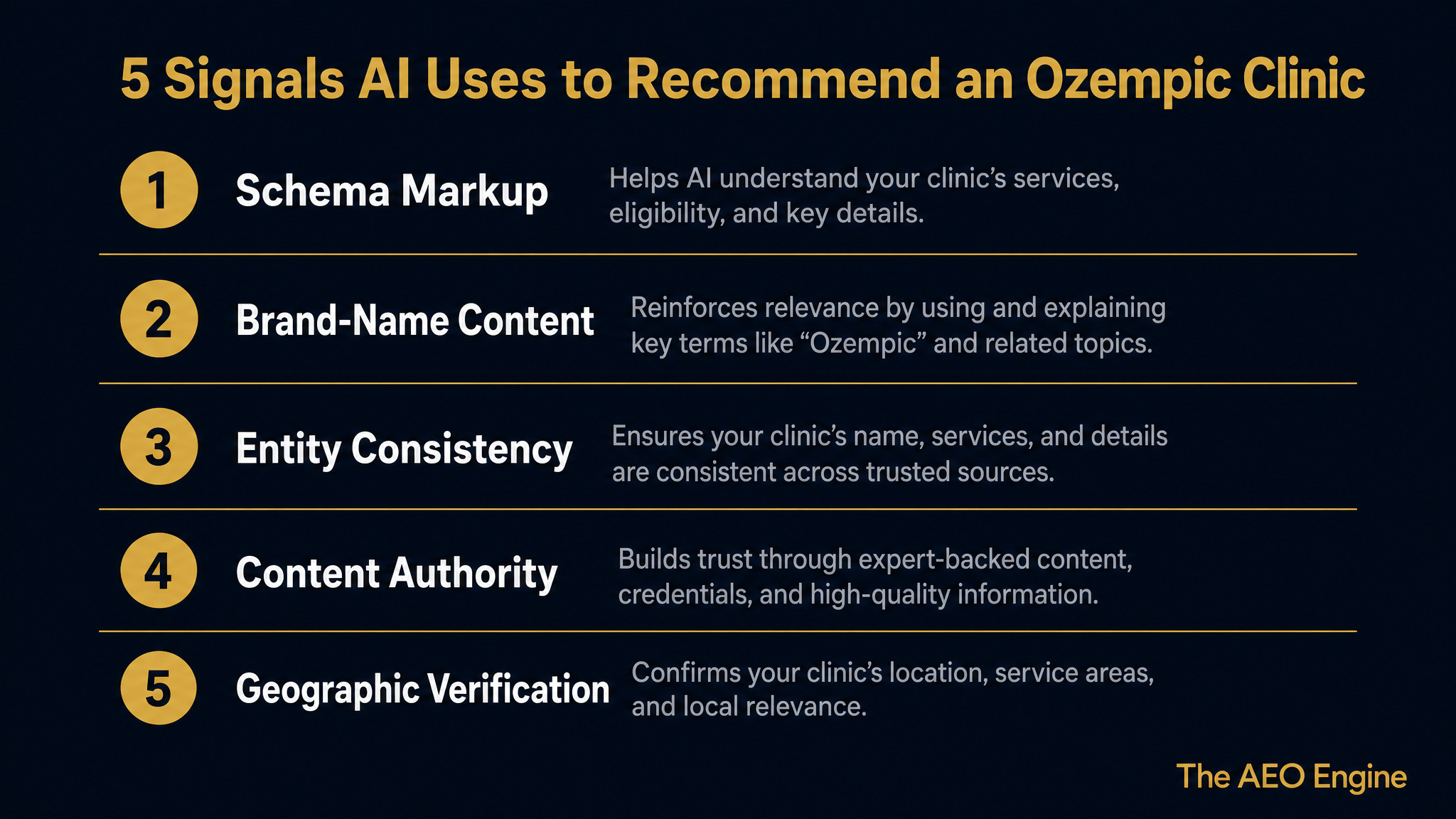
Infographic outlining signals AI uses to recommend an Ozempic clinic near patients.
What Is an Ozempic Clinic and How Is AI Changing Patient Discovery?
An Ozempic clinic is any licensed medical practice that evaluates patients for semaglutide prescriptions, manages dosing protocols, and provides the ongoing clinical support that safe GLP-1 treatment requires. This includes dedicated weight loss practices, primary care offices that have added GLP-1 programs, endocrinology clinics, and telehealth platforms operating in this space.
According to Pew Research, 72% of internet users have searched online for health information. That behavior is now extending into AI platforms, where patients type questions like "where can I get Ozempic prescribed near me" and receive a short list of specific clinic recommendations rather than a page of links to sort through.
The structural shift matters for clinic operators because AI recommendations operate differently from search rankings. A clinic at the top of a Google Maps result can be completely absent from an AI recommendation response. The two systems evaluate different signals, and most practices have optimized for one while the other has become the primary discovery channel for a growing share of patients.
Ozempic is the branded version of semaglutide approved by the FDA initially for type 2 diabetes, with significant documented weight loss as a secondary outcome. Wegovy uses the same active ingredient at a higher dose approved specifically for chronic weight management. Patients searching for "Ozempic clinic" are typically looking for a practice that can prescribe semaglutide-based treatment for weight loss, regardless of which branded formulation is ultimately used. Clinics that have content addressing both the brand name and the generic give AI more surface area to cite with confidence.
What Signals Does AI Use Before Recommending an Ozempic Clinic?
AI platforms run an internal evaluation before including any clinic in a recommendation response. That evaluation covers five signal categories, and a practice needs to register clearly in each to earn a recommendation.
Structured Data and Schema Markup - Schema markup is the machine-readable layer that tells AI what a practice actually does. A clinic with MedicalBusiness schema that explicitly lists semaglutide or Ozempic as a service type is immediately classifiable. A clinic with no schema or only a generic HealthAndBeautyBusiness schema is not.
Brand-Name Content Specificity - AI systems favor content that uses the same language patients use in their searches. Clinics that publish content using "Ozempic," "semaglutide," and "Wegovy" alongside their practice entity data earn stronger citations for brand-name queries than those using only generic GLP-1 terminology.
Entity Consistency - The practice name, address, phone number, and service descriptions must be consistent across all platforms where the clinic appears. When AI cross-references multiple sources and finds conflicting data, it reduces the confidence level for that entity and may exclude it from recommendations entirely.
Content Authority and Volume - A practice with one services page cannot compete with one that has dedicated content addressing Ozempic eligibility criteria, the prescription process, dosing protocols, common patient questions, and treatment outcomes. AI needs multiple citation points to recommend a practice with confidence.
Geographic Verification - AI uses location signals from the practice website, Google Business Profile, directory listings, and structured data to confirm where a clinic operates. Practices with consistent location data and content that references their specific service area receive stronger local recommendation signals than those with generic national-positioning content.
Chart explaining signals AI checks before recommending an Ozempic clinic online.
Why Do Most Ozempic Clinics Never Appear in AI Recommendations?
The structural gap between clinics that appear in AI recommendations and those that do not comes down to one consistent pattern. Most practices were built for human visitors and search engines, not for AI evaluation systems.
A clinic that has operated successfully for years on patient referrals and Google search rankings has likely never needed to think about schema markup, entity consistency across 40 directories, or a library of brand-name-specific clinical content. Those practices are structurally invisible to AI not because they are bad clinics but because they have never built the signals AI requires.
The practices that appear in AI recommendations for "Ozempic clinic near me" queries have typically made deliberate investments in three areas: structured data that classifies them as Ozempic providers, content that addresses the specific questions patients ask about semaglutide treatment, and entity verification that gives AI consistent data to work from across every platform.
Signal
Invisible Clinic
AI-Cited Clinic
Schema Markup
None or generic Business
MedicalBusiness with semaglutide service type
Brand-Name Content
"Weight management services"
Ozempic, semaglutide, and Wegovy-specific pages
Entity Consistency
Varied NAP data
Exact match across all directories
Content Volume
1-2 GLP-1 mentions
10+ pages of Ozempic-specific content
Geographic Signals
City page only
Service area content plus consistent location data
Ozempic clinics that are ready to shift from invisible to AI-cited use the CITE Framework to build the structural content and entity signals AI requires. The AEO Engine works exclusively with regulated healthcare practices and can identify exactly which signals your clinic is missing. Request a free gap check to see where your practice stands against local competitors already appearing in AI responses.
What Content Does AI Look for When Evaluating an Ozempic Clinic?
Content is the most controllable factor in building AI citation authority for an Ozempic clinic. The type and specificity of content a practice publishes determines how confidently AI can describe that practice when a patient asks for a recommendation.
AI systems favor content that answers the specific questions patients ask about Ozempic treatment. For clinics prescribing semaglutide, that means content addressing:
Who qualifies for Ozempic or semaglutide treatment based on BMI, health history, and clinical criteria
How the prescription process works from initial consultation through ongoing management
What patients can expect in terms of dosing schedule, side effects, and weight loss outcomes
How the clinic handles insurance coverage, prior authorizations, and the Novo Nordisk savings card
What the difference is between Ozempic, Wegovy, Mounjaro, and other GLP-1 options the clinic prescribes
A practice that has published clear, accurate content on each of these topics gives AI multiple high-confidence citation points. A practice with a single services page gives AI nothing specific enough to use in a recommendation response.
The CITE Framework identifies which content types drive the highest citation frequency for the specific query patterns Ozempic patients use, then systematically builds that content library in the format AI platforms favor. The goal is content that is specific enough to be referenced directly in an AI response, not just indexed by a search engine.
How Does Local Entity Verification Affect Ozempic Clinic AI Recommendations?
Local entity verification is the process by which AI confirms that a practice is a real, reliably described organization operating at a specific location. For Ozempic clinics, this process determines whether the practice appears in geographically targeted recommendation responses.
When a patient asks AI for an Ozempic clinic nearby, the AI cross-references location signals from multiple sources. It checks whether the practice name, address, and phone number are consistent across the clinic's own website, Google Business Profile, healthcare-specific directories like Healthgrades and Zocdoc, and any other platforms where the practice appears. Discrepancies reduce confidence in the entity and can prevent the clinic from appearing in local recommendations even when it has strong content in other areas.
For practices with multiple locations, this verification challenge multiplies. Each location must have its own consistent entity profile, with structured data that references both the parent practice and the individual location. AI treats each physical location as a separate entity, and a parent clinic with strong AI citation authority does not automatically extend that authority to its individual locations without location-specific entity work.
What Is the Timeline for an Ozempic Clinic to Build AI Citation Authority?
Ozempic clinics starting a structured content and entity program typically see initial AI citation appearances within 60 to 90 days, based on program data tracked by The AEO Engine. This reflects the time from launching the structured program to the first confirmed appearances in AI recommendation responses for relevant patient queries.
The starting condition of the practice determines where in that window results appear. Clinics that already have a clean website, consistent directory listings, and some existing Ozempic-specific content tend to see initial citations earlier. Practices starting from near zero on structured content and entity consistency typically see their first citations closer to the 90-day mark.
Timeline factors specific to Ozempic clinics include the density of competing semaglutide providers in the local market, whether the practice has already addressed the brand-name query patterns patients use, and how quickly new content is published and indexed during the program. The AEO Engine tracks citation rates across all client programs and uses that data to prioritize the content investments that produce results fastest for the specific market each clinic operates in.
Frequently Asked Questions
How do I get Ozempic for $25 a month for weight loss?
Novo Nordisk offers a savings card program for commercially insured patients that can reduce out-of-pocket costs for Ozempic to a monthly cap. Eligibility requirements, the monthly cap amount, and program availability change over time, and the savings card applies to the diabetes-indicated Ozempic formulation rather than Wegovy, which is the formulation FDA-approved specifically for weight loss. Patients interested in reduced-cost access should ask their prescribing clinic directly about current savings programs, telehealth options, and whether compounded semaglutide through a licensed pharmacy may be an option, understanding that compounded versions are not FDA-approved branded products.
What weight loss drugs can I get prescribed by my doctor?
Primary care physicians, weight management specialists, and endocrinologists can prescribe a range of FDA-approved weight loss medications. GLP-1 receptor agonists including semaglutide (Wegovy) and tirzepatide (Zepbound) are currently the most clinically active options for chronic weight management. Older medications including phentermine, topiramate, naltrexone-bupropion, and orlistat remain available for patients who are not candidates for GLP-1 therapy. Eligibility for any prescription weight loss medication depends on BMI, health history, other medications, and the clinical judgment of the prescribing provider.
Is Ozempic available at pharmacies?
Ozempic is a prescription medication available at licensed retail pharmacies. Patients need a valid prescription from a licensed provider before a pharmacy can dispense it. Availability has varied in recent years due to supply and demand dynamics as semaglutide prescriptions increased substantially. Some pharmacies maintain waitlists during periods of limited supply. Wegovy, the weight-loss-specific formulation of semaglutide, is dispensed separately from Ozempic and has had its own supply dynamics since FDA approval. Patients should confirm current availability with their preferred pharmacy and prescribing clinic.
Can a clinic prescribe weight loss medication?
Yes. Any licensed medical clinic with qualified prescribing providers can prescribe FDA-approved weight loss medications including GLP-1 receptor agonists. This includes dedicated weight management clinics, primary care practices, endocrinology offices, and telehealth platforms with state-licensed providers. The prescribing provider must evaluate the patient for eligibility based on clinical criteria before issuing a prescription. Telehealth-based Ozempic clinics have significantly expanded access for patients in areas with limited local specialist availability, though all prescriptions still require a clinical evaluation.
What is the difference between Ozempic and Wegovy?
Ozempic and Wegovy both contain semaglutide as the active ingredient but are approved for different clinical indications and come in different dose ranges. Ozempic is FDA-approved for type 2 diabetes management and has a maximum weekly dose of 2 mg. Wegovy is FDA-approved specifically for chronic weight management in adults with obesity or overweight with at least one weight-related condition, and has a maximum weekly dose of 2.4 mg. Both produce meaningful weight loss as an outcome, but the approved clinical use determines which formulation a provider prescribes. The STEP 1 trial published in the New England Journal of Medicine found participants on 2.4 mg semaglutide lost an average of 14.9% of body weight over 68 weeks.
How does AI know which clinics prescribe Ozempic?
AI builds its understanding of which clinics prescribe Ozempic from the structured and unstructured signals those clinics publish online. A clinic that has schema markup identifying semaglutide as a service type, content pages that explicitly describe its Ozempic prescription program, and consistent entity data across healthcare directories gives AI clear, verifiable evidence of what it provides. A clinic that has none of those elements is not recognizable to AI as an Ozempic provider, regardless of how many patients it actually treats with semaglutide.
Does telehealth count as an Ozempic clinic for AI recommendations?
Yes. AI platforms evaluate telehealth-based Ozempic providers using the same structural signals as in-person clinics. A telehealth practice with schema markup identifying it as a GLP-1 or semaglutide provider, dedicated content addressing Ozempic prescribing, and consistent entity data across its online presence can earn AI citations for geographically relevant queries. Telehealth practices often have an advantage in content volume since they typically invest more in digital presence than traditional in-person practices, but they face the same entity consistency and schema requirements as brick-and-mortar clinics.
How long does it take an Ozempic clinic to start appearing in AI recommendations?
Initial AI citation appearances for Ozempic clinics starting a structured program typically occur within 60 to 90 days, based on program data tracked by The AEO Engine. The timeline depends on the starting state of the clinic's structured content and entity data, local market competition, and how consistently new content is published and indexed during the program. Clinics with clean entity data and some existing Ozempic-specific content tend to appear earlier in that window. Full citation authority across multiple AI platforms for the range of patient queries relevant to the practice typically builds over six to twelve months of sustained content investment.
Executive Summary
Ozempic clinics that appear in AI recommendation responses have built five structural signals: schema markup identifying the practice as a semaglutide provider, brand-name-specific content that uses the language patients search with, entity consistency across all directories and platforms, sufficient content volume to give AI multiple citation points, and verified geographic data for local recommendations. Most practices have none of these in place, which is why the majority of Ozempic clinics register near-zero AI citation rates. The AEO Engine tracks 18-26% citation rates for clients in structured programs compared to 2-4% for practices without an AEO program. Initial citation appearances for new programs typically occur within 60 to 90 days. For Ozempic clinics operating under FDA and HIPAA advertising restrictions, AI citation provides a patient acquisition channel that does not depend on paid media.
What Should You Do Next?
Ozempic clinics that want to appear in AI recommendations when patients search nearby take three steps first.
Run an AI Citation Gap Check - Before investing in content, find out what AI currently returns when a patient searches for an Ozempic clinic in your service area. The AEO Engine's free gap check shows which practices are currently being recommended in your market and which structural signals your clinic is missing relative to those that are cited.
Audit Your Schema and Entity Data - Check whether your practice has MedicalBusiness schema that explicitly lists semaglutide or Ozempic as a service type. Then pull your listings across Google Business Profile, Healthgrades, Zocdoc, and any other directory where the practice appears and confirm the name, address, phone number, and service descriptions are identical across all sources.
Build Ozempic-Specific Content - A generic services page is not a citation source. Practices that earn AI recommendations have content that answers the specific questions Ozempic patients ask, structured in a way that AI can parse and reference. The CITE Framework provides the systematic approach to building that content library in the format AI platforms favor most.
Jerry Jariwalla is the founder of The AEO Engine and creator of the CITE Framework for Answer Engine Optimization. With over 22 years in digital marketing and multiple successful business exits, Jerry has spent the past two years building AI citation systems for regulated practices in healthcare, wealth management, and legal services. The AEO Engine works exclusively with practices operating under advertising restrictions where AI citation provides higher leverage than traditional paid acquisition.
Expertise: Answer Engine Optimization, AI Citation Strategy, CITE Framework, Regulated Industry Marketing, Healthcare Practice Marketing, Wealth Management Marketing, Legal Marketing
Disclaimer: This content is for informational purposes only and does not constitute professional marketing, legal, or compliance advice. Citation rates, timelines, and outcomes vary based on industry, competitive density, and execution quality. Statistics referenced reflect The AEO Engine's tracked client outcomes as of 2026 and are not guarantees of future results. Contact The AEO Engine for a consultation regarding your specific situation.