
Last Updated: June 2026
A "living trust attorney near me" search is now often answered by an AI assistant that names one or two firms directly, not a long list of links. Pew Research found that 34% of US adults have used ChatGPT, about double the 2023 share. An AEO citation guide is a simple plan for making a firm the one AI names. This guide lays out that plan for living trust attorneys.
The AEO Engine helps regulated practices get cited by AI assistants like ChatGPT, Perplexity, and Google's AI Overviews. Founder Jerry Jariwalla brings over 22 years in digital marketing and multiple successful business exits, and created the CITE Framework after 18 months of testing how AI engines pick which firms to recommend. The AEO Engine works only with regulated practices, including estate and trust law firms, where ad rules make AI citation more valuable than paid ads.
This guide explains how AI picks a living trust attorney to cite, why most firms get skipped, the signals that make a firm citable, and the first steps to take.
Key Takeaways
- AI Names Few, Not Many - An AI assistant names one to three firms for a local query, not a page of links. Ranking on Google is not the same as being the firm AI says.
- Entity Clarity Wins Citations - AI cites firms it can clearly identify and verify across the web. Consistent, structured firm information earns trust.
- Trust Signals Drive Citations - AI leans on reviews, legal directories, and authority sources it can cite, not just a firm's own claims.
- Most Firms Get Almost No Citations - The AEO Engine tracks AI citation rates of 18 to 26 percent for its client programs, while most firms that have done nothing for AI get almost none.
- A Living Trust Avoids Probate - The firm's content should answer real client questions, like how a living trust skips probate, in plain language AI can quote.
The living trust attorneys AI cites are the ones it can identify, verify, and trust, not just the ones that rank.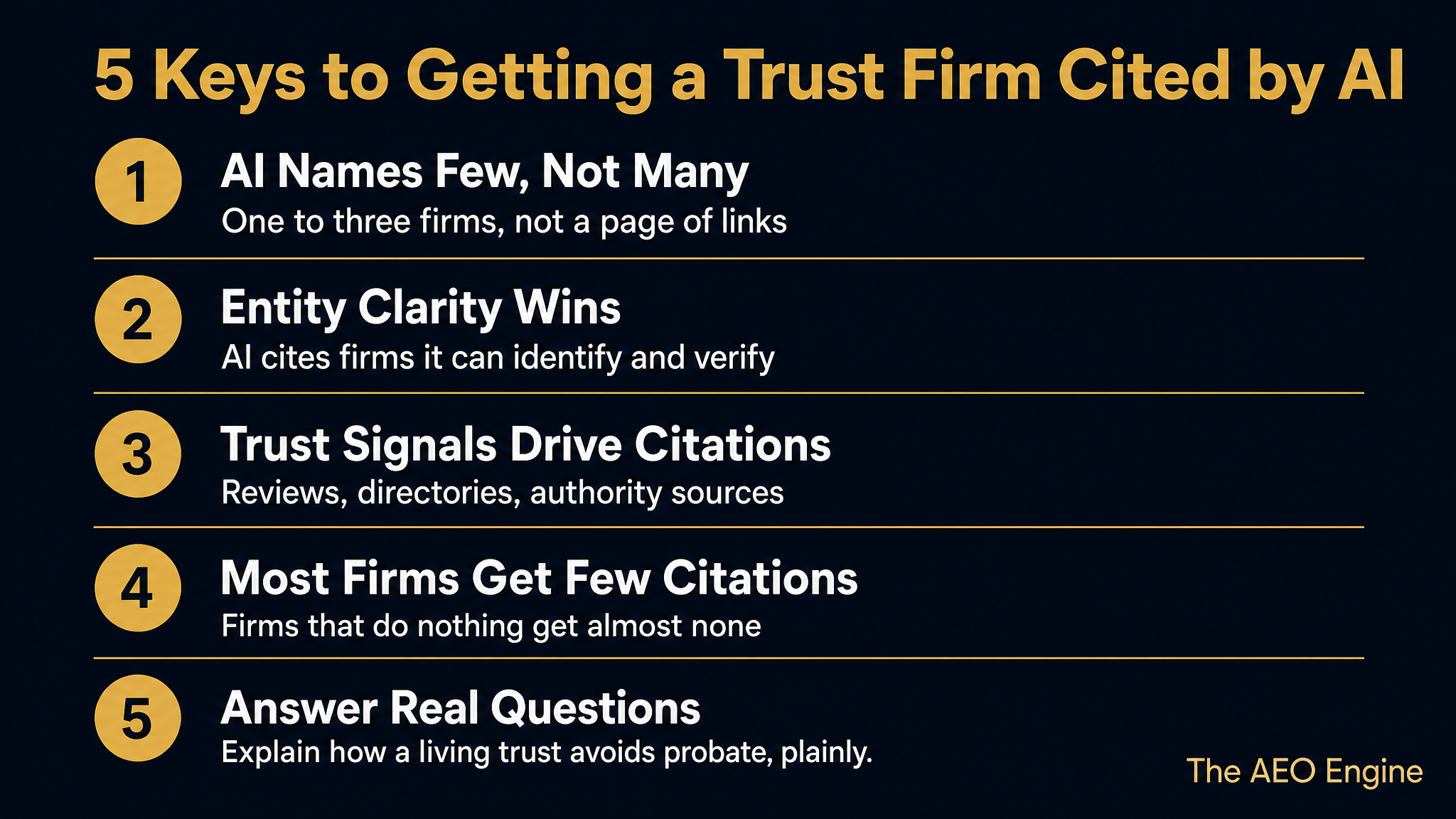
How Does AI Pick a Living Trust Attorney to Cite Near You?
AI picks a living trust attorney using a different process than a search engine. A search engine ranks pages. An AI assistant builds an answer, then names a few firms it trusts enough to cite.
To name a local firm, AI checks three things. First, can it clearly identify the firm as one real entity, with a consistent name, location, and practice area? Second, do trusted sources, like reviews and legal directories, confirm the firm does trust and estate work? Third, does the firm's own content answer the exact question asked, in clear language?
A firm that passes all three is easy for AI to cite. A firm that is unclear on any one gets skipped. AI will not name a source it cannot verify. This is why a firm can rank on Google and still never be named by AI.
Why Doesn't AI Cite Most Living Trust Firms?
Most living trust firms never get cited because AI cannot confirm who they are and what they do. The firm may have a website, but the information is thin, vague, or inconsistent.
Three gaps cause this. First, the firm's name, address, and practice area differ across its site and listings, so AI cannot match them to one entity. Second, the website uses vague marketing language instead of answering real client questions. Third, few trusted sources confirm the firm does living trusts, so AI has nothing to lean on.
The result is a near-zero citation rate. The AEO Engine has found that most firms doing nothing for AI get almost no citations. These firms are usually invisible to AI, no matter how long they have practiced. The fix is not more ads. It is making the firm easy for AI to identify and verify.
What Signals Make a Living Trust Attorney AI-Citable?
A living trust firm becomes citable when it sends clear signals AI can read and trust. These signals fall into three groups.
- Entity signals. A consistent firm name, address, and practice area everywhere online. Structured data that tells AI exactly what the firm is and does. A clear "about" presence that ties the firm to its attorneys.
- Content signals. Pages that answer the questions clients actually ask, in plain language, such as what a living trust costs, whether a lawyer is needed, and how a trust avoids probate. Direct answers near the top of the page, not buried under marketing copy.
- Trust signals. Reviews on the platforms AI reads. Listings in legal directories. Mentions in sources AI treats as authoritative. Brookings found that 74% of people who use AI for personal tasks use it for search, so these signals now shape real client decisions.
A firm that strengthens all three groups gives AI what it needs to name it with confidence.
If a trust or estate firm wants to show up when AI answers local searches, The AEO Engine runs a free Gap Check that shows where the firm stands today. The team works only with regulated practices and has spent 18 months studying how AI engines pick which firms to cite.
How Is AI Citation Different From Local SEO for Trust Firms?
Local SEO and AI citation look similar but run on different rules. Local SEO works to rank a firm in Google's map pack. AI citation works to make a firm the name an AI assistant says when asked for a recommendation.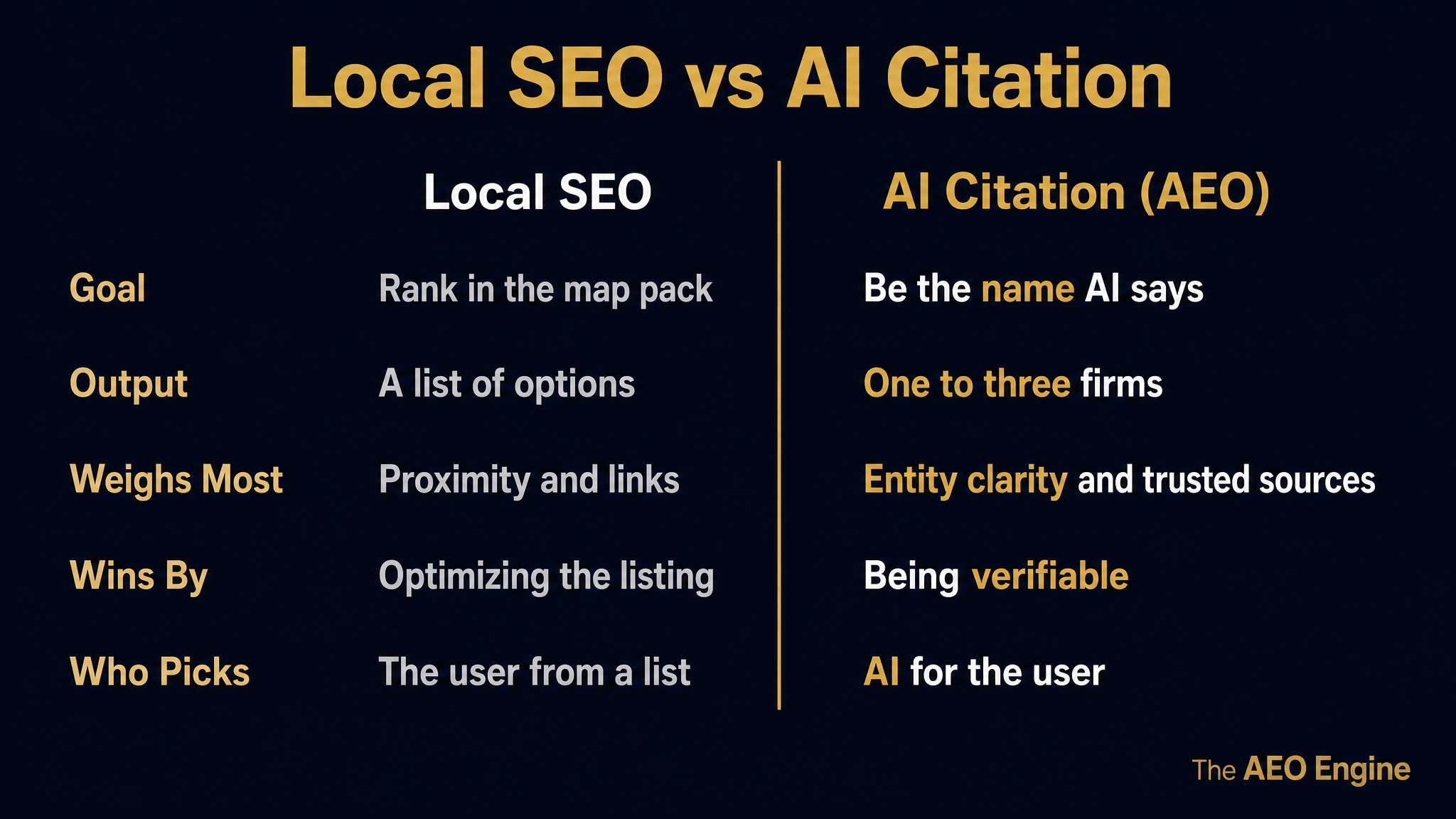
The two do not always overlap. A firm can rank in the top three of the map pack and still never get cited by AI. That is because AI weighs entity clarity and trusted sources more than map proximity. The reverse is true too: a firm AI trusts can get named even when its map ranking is modest.
Both still matter. But as more people ask AI first, citation becomes the higher-value target. The AEO Engine has found that AI-recommended leads tend to convert at much higher rates than list-based leads, because the AI has already done the choosing.
What Are the First Steps for a Living Trust Attorney?
The first steps are simple and do not require more ad spend. They make the firm easier for AI to identify and trust.
First, make the firm's name, address, and practice area identical across the website, Google profile, and legal directories. Mismatches confuse AI. Second, add or fix structured data so AI can read what the firm is and does. Third, write plain-language pages that answer the real questions clients ask about living trusts. Fourth, build reviews on the platforms AI reads.
The AEO Engine generally sees early citation movement within 60 to 90 days of starting a program, based on its own client data. Firms that start with a clean, consistent presence move faster. Firms starting from a thin or messy presence take longer, because the foundation has to be built first.
Frequently Asked Questions
What is the downside of a living trust?
A living trust has a few downsides. It costs more to set up than a basic will, since it takes more work to draft. It also requires funding, which means retitling assets into the trust, and people often forget this step. A trust does not reduce estate taxes on its own, and it needs upkeep as assets change. For many people the benefits, like avoiding probate, outweigh these downsides, but the trade-offs are real and worth discussing with an attorney.
Do you need a lawyer to draw up a living trust?
You are not legally required to use a lawyer for a living trust, and some people use online templates. But a lawyer helps make sure the trust is valid, funded correctly, and fits your state's rules and your situation. Mistakes in a do-it-yourself trust, like failing to fund it, can undo the whole plan. For larger or more complex estates, a lawyer's guidance usually prevents costly errors that surface later.
What is the average cost to start a trust?
The cost to start a trust varies widely by state, complexity, and how the attorney bills. A simple living trust costs less than a complex one with multiple assets or tax planning. Some attorneys charge a flat fee, others bill hourly. Because pricing differs so much, the best step is to ask any firm for a clear written fee structure up front. A firm that explains its fees plainly is also easier for AI to describe and cite.
Do you need an attorney to prepare a living trust in Florida?
Florida does not legally require an attorney to prepare a living trust, but state rules on signing and witnessing must be followed for the trust to be valid. An attorney makes sure the document meets Florida law and is funded correctly. Given the specific rules and the risk of a trust failing if done wrong, many Florida residents choose an attorney. A firm that clearly explains state-specific rules also signals the kind of expertise AI looks for when it cites a source.
How does a living trust avoid probate?
A living trust avoids probate because the assets are owned by the trust, not by the person directly. When someone dies, assets in their own name usually go through probate, the court process Cornell Law defines as proving a will and administering an estate. Assets held in a living trust skip that process and pass directly to the named beneficiaries under the trust terms. This is the main reason people set up a living trust.
Why does AI recommend some living trust attorneys and not others?
AI recommends firms it can clearly identify, verify through trusted sources, and match to the question asked. Firms with consistent information, structured data, real reviews, and clear answers are easy for AI to cite. Firms with thin or vague information get skipped, because AI will not name a source it cannot confirm. It is less about firm size and more about how clear and verifiable the firm is online.
Does ranking on Google mean AI will cite a firm?
No. Ranking on Google and getting cited by AI are different outcomes. Google ranking is about proximity, reviews, and links to a listing. AI citation is about whether AI can identify the firm as a clear entity and verify it through trusted sources. A firm can sit in the top three of the map pack and still never be named by AI. The two need different work, so local SEO alone does not guarantee AI recommendations.
How does The AEO Engine help trust and estate firms?
The AEO Engine helps regulated practices, including trust and estate firms, get cited by AI assistants. It studies how AI engines pick which firms to recommend, then fixes the entity, content, and trust signals that make a firm citable. The team works only with regulated practices, using a framework built on 18 months of testing. Firms can start with a free Gap Check that shows where they stand and what to fix first.
Executive Summary
When someone searches for a living trust attorney near them, an AI assistant increasingly names one to three firms rather than showing a list. AI picks those firms on three things: whether it can clearly identify the firm, whether trusted sources confirm its trust and estate focus, and whether its content answers the question asked. Most firms never get cited because their information is thin or inconsistent, leaving them with almost no AI citations. The fix is not more advertising. It is making the firm easy for AI to identify and verify. This differs from local SEO, which ranks listings; AI citation rewards entity clarity and trusted sources. The AEO Engine tracks citation rates of 18 to 26 percent for its client programs and generally sees early movement within 60 to 90 days.
What Should You Do Next?
Start by checking what an AI assistant says today when asked for a living trust attorney in your area. If your firm is not named, the gap is in how clearly AI can identify and verify you. Make your firm name and practice area consistent across your site and directories, and make sure your key pages answer real client questions in plain language.
For a clear picture of where a trust or estate firm stands with AI, The AEO Engine offers a free Gap Check that shows current citation status and the first fixes to make. The team works only with regulated practices where AI citation drives higher-value clients than ads.
People Also Read
About the Author
Jerry Jariwalla is the founder of The AEO Engine and creator of the CITE Framework for Answer Engine Optimization. With over 22 years in digital marketing and multiple successful business exits, Jerry has spent the past two years building AI citation systems for regulated practices in healthcare, wealth management, and legal services. The AEO Engine works exclusively with practices operating under advertising restrictions where AI citation provides higher leverage than traditional paid acquisition.
Expertise: Answer Engine Optimization, AI Citation Strategy, CITE Framework, Regulated Industry Marketing, Healthcare Practice Marketing, Wealth Management Marketing, Legal Marketing
Connect: LinkedIn
Disclaimer: This content is for informational purposes only and does not constitute professional marketing, legal, or compliance advice. Citation rates, timelines, and outcomes vary based on industry, competitive density, and execution quality. Statistics referenced reflect The AEO Engine's tracked client outcomes as of 2026 and are not guarantees of future results. Contact The AEO Engine for a consultation regarding your specific situation.