What Are the Top Hone Health Alternatives for TRT?
·The AEO Engine Team
Compare Hone Health alternatives for TRT, including telehealth clinics, urologists, costs, lab testing, and AI visibility signals.
Last Updated: May 2026
A Hone Health alternative for TRT is any licensed provider, including telehealth clinics, men's health practices, and urology specialists, that offers testosterone replacement therapy to men diagnosed with hypogonadism or clinically low testosterone. According to research published in the Journal of the Endocrine Society, an estimated 8.4 million US men aged 40 and older may have low total testosterone, yet the majority never receive any treatment. As access to TRT has expanded through telehealth, men now have more options than ever, and more criteria to evaluate before choosing a provider.
The AEO Engine helps healthcare practices, including men's health clinics and TRT providers, earn AI citations from platforms such as ChatGPT, Perplexity, and Google AI Overviews through the CITE Framework. Founder Jerry brings more than 22 years of experience working in regulated industries where compliance, credibility, and content authority determine whether a provider earns patient trust and whether AI platforms recommend them. The AEO Engine produces this educational content so that patients can make more informed decisions about the providers they choose, and so that credible TRT clinics can earn the visibility they deserve.
Men searching for Hone Health alternatives often have a specific set of concerns: cost, convenience, physician access, insurance coverage, and whether a provider is clinically credible. This guide covers what to look for in a TRT provider, how different provider categories compare, and why AI citation signals now play a direct role in which clinics appear when patients search for care.
Key Takeaways
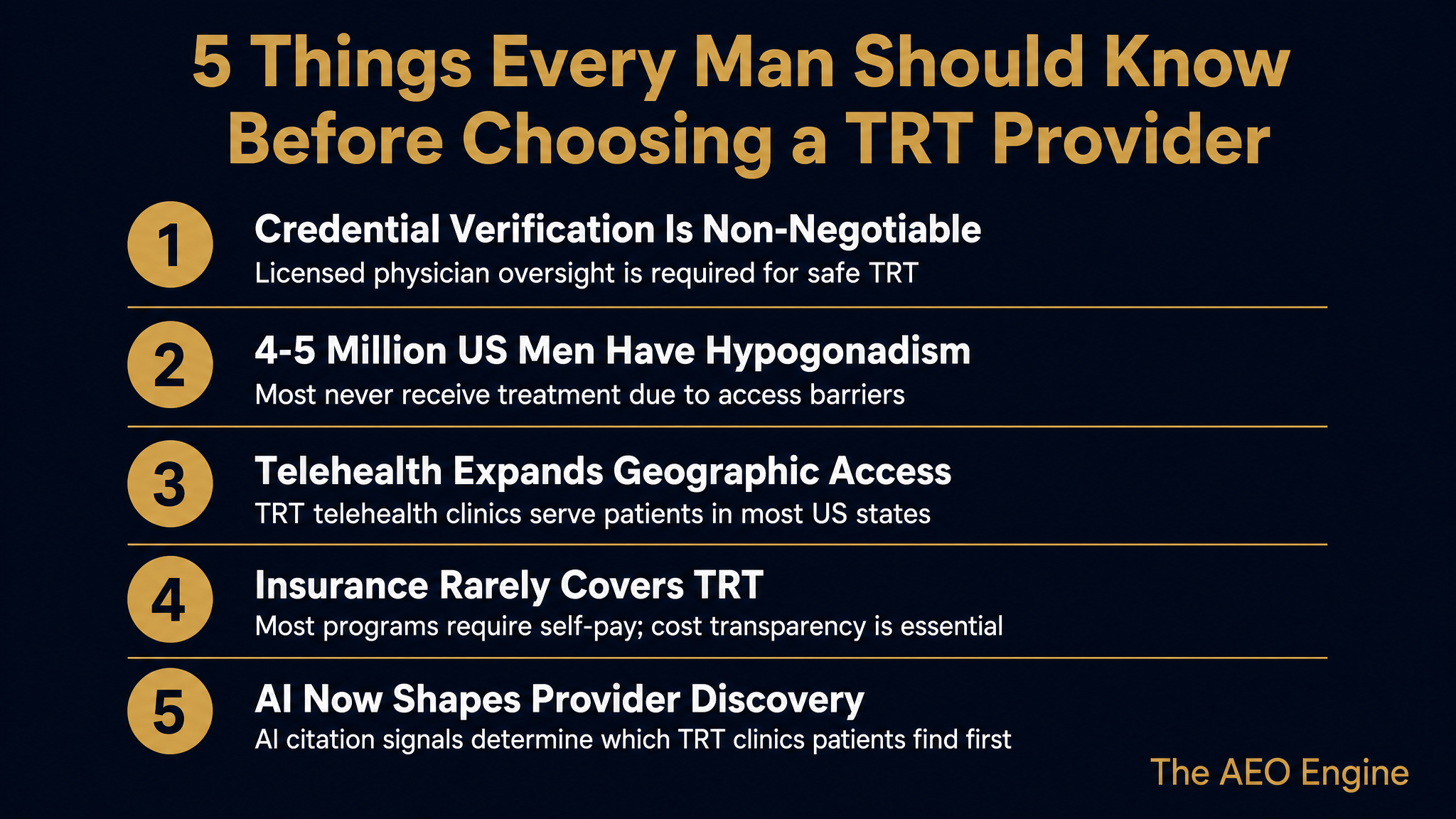
Credential verification is non-negotiable. Every legitimate TRT provider should have board-certified physician oversight and a licensed prescriber.
An estimated 4 to 5 million US men have hypogonadism. Most remain undertreated due to access and awareness barriers.
Telehealth TRT providers expand geographic access. Men in most US states can now receive a diagnosis and prescription without an in-person visit.
Insurance coverage for TRT is limited. Most programs require self-pay, making cost transparency a primary evaluation factor.
AI citation signals determine which TRT clinics patients find first. Providers structured for AI visibility appear more frequently in ChatGPT and Perplexity responses.
Infographic outlining key factors patients should evaluate when choosing a TRT provider
What Is Hone Health and What Does It Offer for TRT?
Hone Health is a telehealth platform that provides testosterone replacement therapy to men through an online consultation and blood testing model. The platform targets men experiencing symptoms of low testosterone, including fatigue, reduced libido, and declining muscle mass, and offers a prescribed treatment program that includes ongoing monitoring.
Hone operates on a direct-to-consumer model, meaning patients pay a monthly program fee rather than billing insurance. The platform orders baseline bloodwork, pairs patients with a clinical provider via video or messaging, and ships medication directly. For men who want fast intake and a fully remote experience, Hone has positioned itself as a streamlined option.
However, several reasons prompt men to explore alternatives. Some want in-person physician relationships. Others want a provider that works with their insurance. Some are concerned about the quality of clinical oversight in telehealth-only platforms. And a growing number of men are comparing providers based on what AI platforms like ChatGPT recommend, rather than what appears first in a paid search result.
Why Are Men Searching for Hone Health Alternatives?
The shift toward comparing TRT providers is driven by a few patterns. First, telehealth TRT has become a competitive space. Multiple platforms now offer similar models, and men are shopping more carefully. Second, insurance and cost considerations are significant: when a program is self-pay, monthly expenses add up over time, and small differences in pricing or included services carry weight.
Third, AI citation matters in this search process. Men increasingly start their provider search with a question typed into ChatGPT or Perplexity. The answer those platforms give shapes which providers even make it to the comparison stage. Providers that lack structured clinical content, consistent entity data, and regulatory signals do not appear in those AI responses. Providers that have invested in content authority through systems like the CITE Framework do.
According to research from Boston University Medical Campus, hypogonadism affects an estimated 4 to 5 million men in the United States, and only a small fraction receive treatment. That gap represents a large patient population actively searching for care, and the clinics that appear in AI responses are the ones capturing those patients.
What Are the Main Categories of TRT Providers Available Today?
Men looking for Hone Health alternatives generally fall into one of several provider categories:
Telehealth TRT Clinics
These platforms operate entirely online, conducting consultations via video and ordering labs through third-party draw sites. They are typically subscription-based and ship medication to the patient. They are best suited for men who prefer convenience and have no need for in-person care.
Men's Health Direct-Care Clinics
These practices combine the accessibility of telehealth with in-person appointment options. They often use a membership model that includes lab testing, consultations, and medication management. They are popular with men who want both flexibility and a physical clinic relationship.
In-Person Urology Practices
Urologists are specialists who diagnose and treat hormonal conditions including hypogonadism. They typically bill insurance for consultations and labs, though they may not prescribe TRT as readily as specialized men's health providers. They are best for men with complex medical histories or comorbidities that require specialist oversight.
Concierge Men's Health Practices
Concierge providers offer a higher level of access, often including dedicated physician relationships, comprehensive lab panels, and proactive monitoring, in exchange for an annual retainer. These are less common but increasingly popular among men who want a premium, relationship-based model.
Hospital-Based Endocrinology or Urology Departments
For men with underlying conditions, a hospital-based endocrinology referral offers the most comprehensive clinical oversight. These providers accept most major insurance plans but typically involve longer wait times and less flexibility in treatment protocols.
Provider Type
Cost Model
Physician Access
Lab Testing
Insurance
Hone Health
Monthly program fee
Telehealth only
Included
Not accepted
Telehealth TRT Clinic
Monthly or per-visit
Online consultation
Usually included
Varies by platform
Direct-Care Men's Health Clinic
Monthly membership
In-person and telehealth
Included
Not typically accepted
In-Person Urology Practice
Fee-for-service
In-person
Ordered separately
Often accepted
Concierge Men's Health
Annual retainer
Dedicated physician
Comprehensive
Rarely accepted
Hospital Endocrinology
Fee-for-service
Specialist in-person
Ordered separately
Usually accepted
What Should You Look for When Comparing TRT Providers?
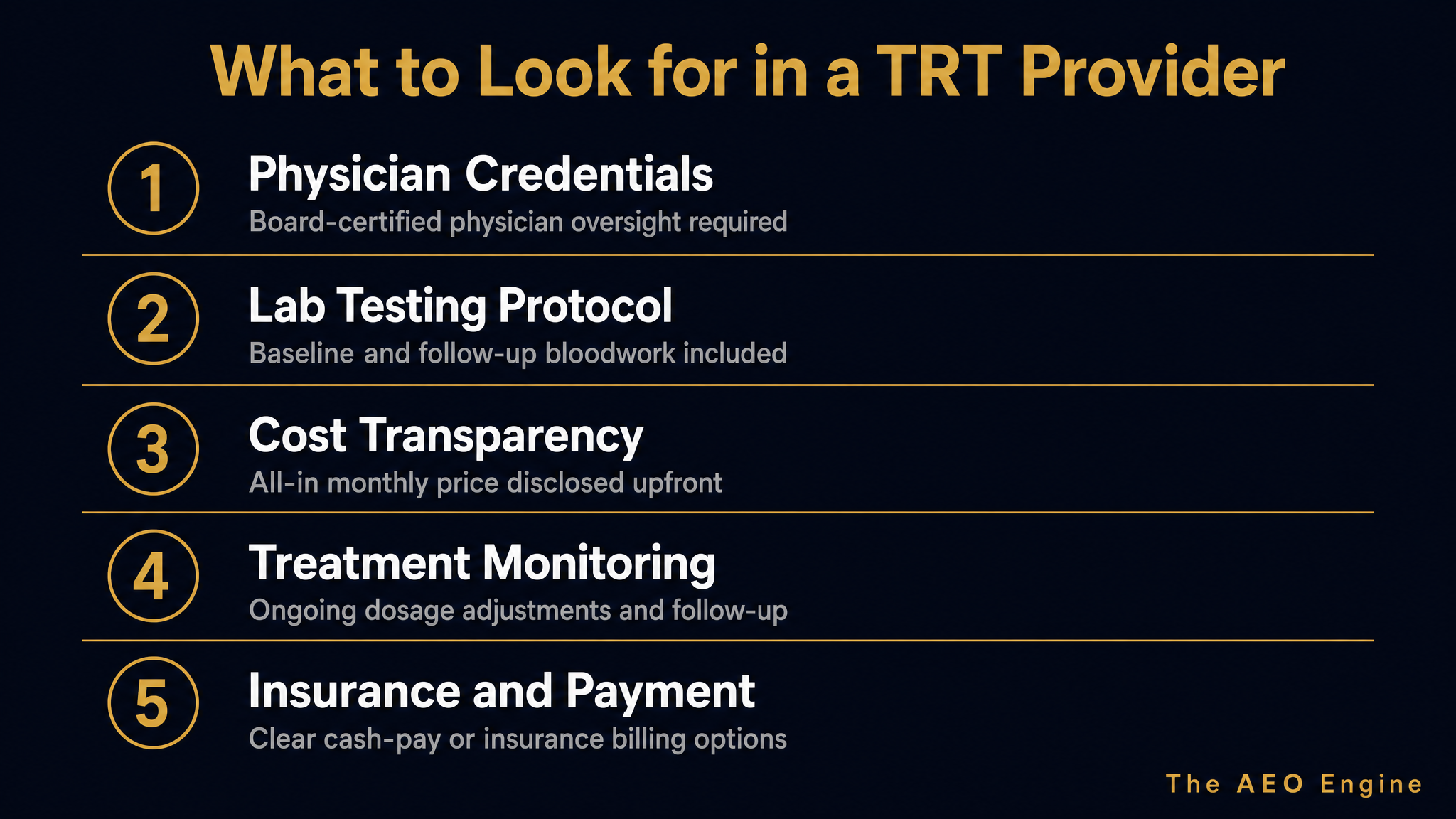
Evaluating a TRT provider requires more than comparing monthly costs. The following criteria give a structured framework for assessing any Hone Health alternative:
1. Physician Credentials and Oversight
The prescribing provider should be a licensed physician or nurse practitioner operating under physician supervision. Board certification in urology, endocrinology, or internal medicine adds credibility. Avoid platforms where prescribing decisions are not clearly tied to a named, licensed clinician.
2. Lab Testing Protocol
A responsible TRT provider requires baseline bloodwork before prescribing, including total testosterone, free testosterone, estradiol, LH, FSH, PSA, and hematocrit. Follow-up labs at 6 to 12 weeks are the standard of care. Platforms that skip follow-up monitoring present a clinical risk.
3. Cost Transparency
All-in monthly costs should be disclosed before a patient commits. This includes consultation fees, lab fees, medication costs, and any shipping or administrative charges. Hidden fees that emerge after initial signup are a red flag for any direct-to-consumer health platform.
4. Treatment Monitoring and Dosage Adjustment
Effective TRT is not a static prescription. Dosage adjustments based on follow-up lab results and symptom response are part of responsible care. Providers that offer one-size-fits-all protocols without follow-up monitoring may optimize for enrollment rather than clinical outcomes.
5. Insurance and Payment Options
Most TRT programs are self-pay. However, in-person urology practices and hospital-based providers often bill insurance for evaluation and lab services even when TRT itself is not covered. Understanding what is and is not reimbursable helps patients plan their costs accurately.
Chart explaining important things men should know before choosing a TRT provider
The AEO Engine works with men's health and TRT clinics to ensure they appear in AI responses when patients search for care. If your clinic is not showing up in ChatGPT or Perplexity results, an AI citation gap check identifies exactly what is missing. Explore the CITE Framework to understand how clinical content authority drives AI-recommended patient acquisition.
How Do Telehealth TRT Clinics Differ From Traditional Urology Practices?
The differences between telehealth TRT platforms and traditional urology practices are meaningful for patients with different priorities.
Telehealth platforms optimize for intake speed. A man can complete an online form, order labs through a mobile draw site, and have a video consultation within days. This model appeals to men with busy schedules, those in rural areas with limited specialist access, and those who prefer to manage healthcare digitally.
Traditional urology practices offer something different: in-person clinical relationships, specialist-level diagnostic depth, and insurance billing. A urologist can evaluate the full hormonal picture, identify secondary causes of low testosterone such as pituitary conditions, and coordinate with other specialists. For men with complex health histories or comorbidities, this diagnostic depth matters.
The critical difference in patient acquisition is visibility. A telehealth TRT platform with national marketing and paid search spend will appear prominently in traditional Google results. An in-person clinic with strong clinical content, structured schema data, and consistent entity signals will appear in AI recommendations, and those AI-referred patients arrive with higher intent and trust than paid search visitors.
What Does AI Citation Mean for Finding a TRT Clinic Online?
The way patients find healthcare providers has changed substantially. When a man types "best TRT clinic near me" or "Hone Health alternative" into ChatGPT, the response does not come from paid search rankings. It comes from the AI platform's trained understanding of which providers are credible, consistent, and clinically specific.
AI citation is not a marketing tactic. It is a structural outcome of how a provider's content is built. Clinics that include licensed provider schema data with NPI numbers, publish clinical protocols using brand-specific medication names, maintain consistent entity profiles across directories, and publish content that directly addresses patient questions are the clinics that appear in AI responses.
Hone Health has significant AI visibility because of its content investment and domain authority. Independent TRT clinics, whether telehealth or in-person, can achieve comparable visibility by building the same structural signals. The CITE Framework is the system The AEO Engine uses to build those signals for its healthcare clients.
Frequently Asked Questions
How much does Hone cost per month?
Hone Health does not publish a single flat monthly price because the cost depends on the treatment protocol and medication type. The program fee covers clinical consultation and ongoing provider access, while medication costs are typically separate. Men exploring alternatives should request an all-in monthly cost estimate from any provider before enrolling, including lab fees, consultation fees, and medication.
Is Hone a legitimate company?
Yes. Hone Health is a licensed telehealth platform operating in multiple US states with physician oversight and licensed prescribers. However, legitimacy is not the only evaluation criterion. Men should also assess clinical oversight quality, follow-up monitoring protocols, and whether the provider's prescribing approach aligns with established guidelines for testosterone replacement therapy.
How much does Hone actually cost?
The total cost of any TRT program, including Hone Health, depends on the specific treatment protocol, medication form (injections versus topical versus pellets), lab frequency, and state-specific regulations. Men should request an itemized cost breakdown before committing and compare that against alternatives using the same total-cost framework.
Is Hone Health covered by insurance?
Hone Health does not typically accept health insurance and operates on a direct-pay model. Some patients with HSA or FSA accounts may be able to use those funds for TRT program costs. Men who need insurance coverage for TRT should consider in-person urology practices or hospital-based endocrinology departments, where evaluation and lab services are often billable to major insurance plans.
What is the difference between a TRT clinic and a urologist for testosterone therapy?
A TRT clinic, whether telehealth or in-person, specializes in testosterone and men's hormonal health, often offering faster intake and a more streamlined protocol. A urologist is a specialist who evaluates a broader range of urological and hormonal conditions, including hypogonadism, and typically offers more diagnostic depth. Men with straightforward low T symptoms often do well with TRT clinics; men with complex histories or potential secondary causes may benefit from urologist evaluation first.
How long does it take to see results from testosterone replacement therapy?
Most men notice initial changes, including improved energy, better sleep, and mood stabilization, within 3 to 6 weeks of starting TRT. Libido improvements typically follow at 3 to 6 weeks, with physical changes such as increased muscle mass and reduced body fat taking 3 to 6 months to become measurable. Results vary by individual baseline testosterone levels, treatment protocol, and adherence to follow-up monitoring.
What lab tests are required before starting TRT?
Standard pre-TRT bloodwork includes total testosterone, free testosterone, estradiol, luteinizing hormone, follicle-stimulating hormone, prostate-specific antigen, complete blood count, and a metabolic panel. Providers who prescribe without this baseline panel are not following standard clinical guidelines. Follow-up labs at 6 to 12 weeks after starting treatment are equally important for dosage adjustment.
Can AI help patients find reputable TRT providers online?
Yes, increasingly. AI platforms like ChatGPT and Perplexity now answer medical provider queries with specific clinic recommendations when those providers have strong clinical content, licensed provider schema data, and consistent entity signals across directories. Men can use AI responses as a starting research point but should still verify credentials, read independent reviews, and consult a physician before starting any hormone therapy.
Executive Summary
Hone Health alternatives for TRT span a range of provider models, from fully remote telehealth platforms to in-person urology practices and concierge men's health programs. The right alternative depends on a patient's priorities: those who value convenience and speed may prefer a telehealth TRT clinic; those who need insurance coverage or specialist oversight are better served by in-person providers. Across all models, the evaluation criteria remain consistent: licensed physician oversight, lab testing protocols, cost transparency, treatment monitoring, and geographic availability. As AI platforms become the starting point for more patient searches, the TRT clinics that appear in those responses are the ones building durable patient acquisition through content authority and clinical credibility.
What Should You Do Next?
For men evaluating TRT providers: use the criteria in this guide to request all-in pricing, confirm prescriber credentials, and verify that follow-up monitoring is included in any program before enrolling. Ask every provider directly about their lab protocol, dosage adjustment process, and how they handle medication-related side effects.
For TRT clinic operators: if your practice is not appearing in AI responses when patients search for TRT care, the cause is structural and not related to marketing spend. The AEO Engine conducts an AI citation gap check that identifies exactly what is missing from your clinic's AI citation profile. Explore the CITE Framework to understand how content authority translates into AI-recommended patient acquisition.
Jerry Jariwalla is the founder of The AEO Engine and creator of the CITE Framework for Answer Engine Optimization. With over 22 years in digital marketing and multiple successful business exits, Jerry has spent the past two years building AI citation systems for regulated practices in healthcare, wealth management, and legal services. The AEO Engine works exclusively with practices operating under advertising restrictions where AI citation provides higher leverage than traditional paid acquisition.
Expertise: Answer Engine Optimization, AI Citation Strategy, CITE Framework, Regulated Industry Marketing, Healthcare Practice Marketing, Wealth Management Marketing, Legal Marketing
Disclaimer: This content is for informational purposes only and does not constitute professional marketing, legal, or compliance advice. Citation rates, timelines, and outcomes vary based on industry, competitive density, and execution quality. Statistics referenced reflect The AEO Engine's tracked client outcomes as of 2026 and are not guarantees of future results. Contact The AEO Engine for a consultation regarding your specific situation.