How Does AI Sort Real GLP-1 Telehealth Clinics From Marketing?
·The AEO Engine Team
Learn how AI evaluates GLP-1 telehealth clinics using provider schema, clinical authority, compliance content, and entity trust.
Last Updated: May 2026
A GLP-1 telehealth clinic is a licensed medical practice that evaluates patient eligibility for GLP-1 receptor agonist medications through virtual consultations, manages prescriptions remotely, and provides ongoing clinical oversight without requiring in-person visits. According to Pew Research, 72% of internet users have searched online for health information, and a growing share now ask AI platforms directly when looking for a GLP-1 provider. When a patient asks AI to recommend a GLP-1 telehealth clinic, the AI does not simply rank providers by ad spend or website traffic. It evaluates a set of structural signals that distinguish clinically credible practices from marketing-heavy providers, and it surfaces only the ones that clear that evaluation.
The AEO Engine helps GLP-1 telehealth clinics and other regulated healthcare practices build the structural content and entity signals that AI platforms require for citation. Founder Jerry Jariwalla brings 22 years of digital marketing experience, multiple successful business exits, and two years of dedicated research into AI citation systems for practices operating under HIPAA and FDA advertising restrictions. The CITE Framework he developed provides the systematic methodology The AEO Engine uses to help telehealth GLP-1 providers build lasting AI citation authority.
This article explains how AI evaluates GLP-1 telehealth providers, what structural signals separate the ones that earn recommendations from those that do not, and what telehealth clinic operators need to build to appear in those responses.
Key Takeaways
AI Applies Higher Scrutiny to Telehealth GLP-1 Providers Than to In-Person Clinics - Because telehealth is associated with higher volumes of marketing-first content, AI citation systems apply stricter entity verification requirements to virtual GLP-1 providers
Schema Markup With Licensed Provider Data Signals Clinical Legitimacy - Telehealth practices that include licensed physician credentials and state-specific prescribing data in their schema markup earn stronger AI citation scores than those with generic business schema
Content Depth Differentiates Clinical Providers From Lead-Gen Sites - AI citation favors practices with substantive clinical content over providers whose pages are structured primarily to capture leads and push sign-up actions
Regulatory Compliance Signals Build AI Confidence - Telehealth GLP-1 clinics that address FDA guidelines, state prescribing laws, and HIPAA compliance in their content signal institutional credibility that AI uses as a trust proxy
60 to 90 Days to First AI Citation for Telehealth Providers With a Structured Program - The AEO Engine tracks 18-26% citation rates for clients in structured programs compared to 2-4% for practices without one
What Is a GLP-1 Telehealth Clinic and Why Are Patients Using AI to Find One?
A GLP-1 telehealth clinic provides the same core service as an in-person weight management practice but delivers it entirely or primarily through virtual consultations. A patient completes a medical intake form, consults with a licensed provider via video or asynchronous messaging, receives a prescription if clinically appropriate, and manages ongoing treatment remotely. The clinical standard of care requirements are identical to those of in-person prescribing.
Patients are using AI to find these providers because the GLP-1 telehealth space has become crowded with marketing content that makes distinguishing legitimate clinical practices from aggressive lead-generation sites genuinely difficult. AI recommendation systems emerged partly to solve this problem: rather than returning a list of paid placements, AI synthesizes available evidence about a provider's clinical credibility and returns only the practices it can verify as legitimate.
The demand for GLP-1 telehealth is substantial. According to the CDC, 40.3% of US adults live with obesity, and access to licensed prescribers varies significantly by geography. Telehealth closes that access gap for patients in areas without local weight management specialists, making it a structurally important delivery channel as semaglutide and tirzepatide prescriptions continue to grow.
For telehealth GLP-1 clinic operators, the key insight is that AI is not just sorting providers by content volume. It is specifically evaluating whether the signals a practice publishes are consistent with a legitimate clinical operation rather than a marketing-first acquisition funnel.
What Signals Does AI Use to Evaluate a GLP-1 Telehealth Provider?
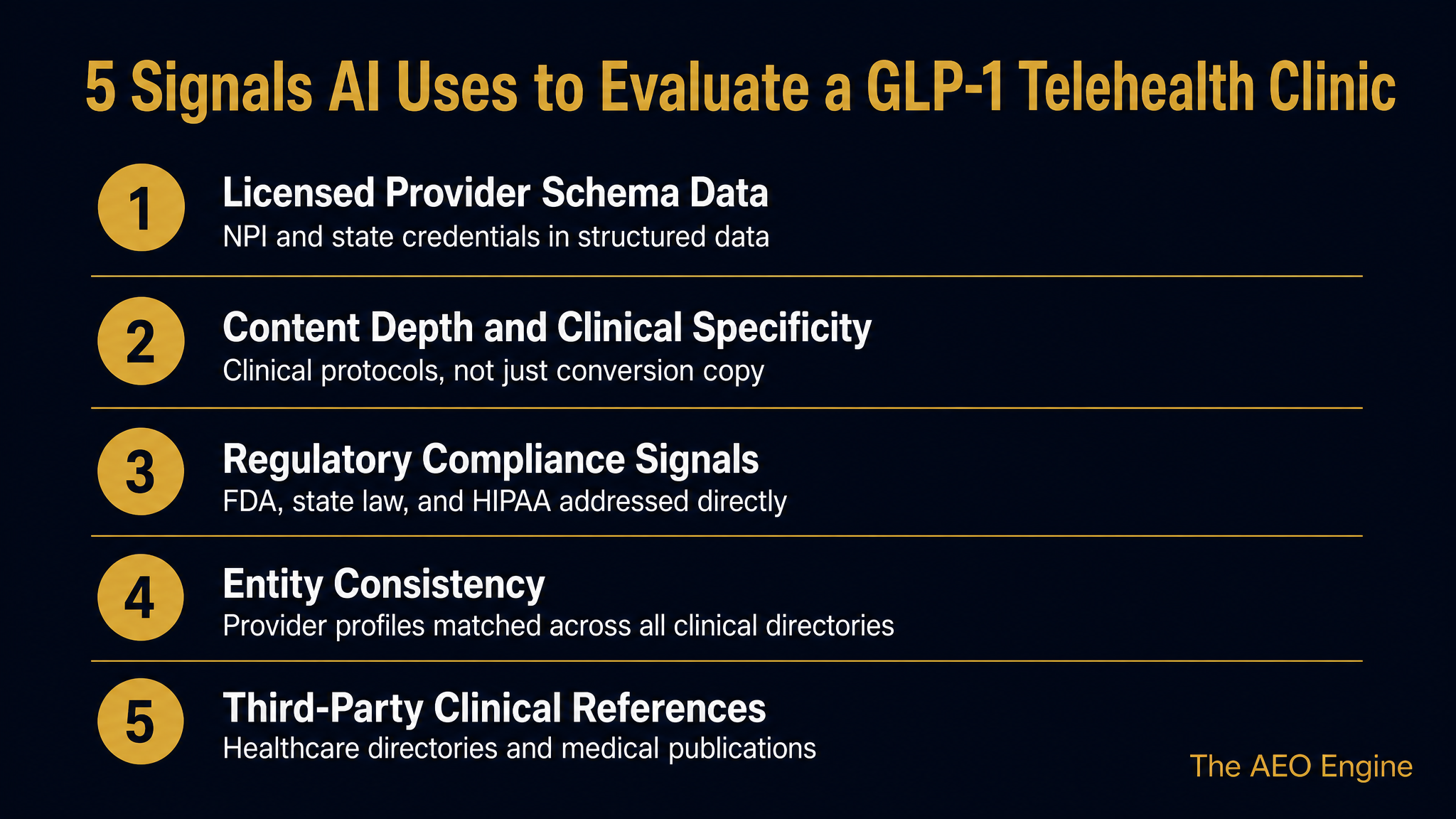
AI platforms evaluate GLP-1 telehealth providers across five signal categories. These signals apply to all GLP-1 providers, but telehealth practices face additional scrutiny in each because the category has a higher baseline of non-clinical marketing content.
Licensed Provider Schema Data - Telehealth GLP-1 clinics that include licensed physician names, NPI numbers, and state licensure information in their schema markup give AI verifiable evidence of clinical legitimacy. A generic business schema entry with no provider credential data reads as a marketing site, not a clinical practice.
Content Depth and Clinical Specificity - Legitimate telehealth GLP-1 practices publish content that addresses clinical eligibility criteria, prescribing protocols, expected outcomes, and treatment management. Marketing-heavy providers publish content focused on sign-up urgency, price comparison, and before-and-after framing. AI distinguishes between these content profiles and uses them as clinical credibility signals.
Regulatory Compliance Content - Telehealth practices that address FDA-approved indications for semaglutide and tirzepatide, state prescribing law requirements, and the distinction between FDA-approved branded medications and compounded alternatives signal institutional credibility that AI uses as a trust proxy. Providers that avoid this topic entirely register lower clinical authority scores.
Entity Consistency - The practice name, licensed provider names, and service descriptions must be consistent across the telehealth platform, Google Business Profile, professional directories, and any state medical board listings. Inconsistencies signal marketing-first positioning rather than established clinical practice.
Third-Party Clinical References - When professional medical organizations, healthcare publications, or legitimate health directories reference a telehealth practice in a clinical context, those third-party signals reinforce AI's confidence in recommending it. Practices with no third-party clinical references beyond their own content register lower citation authority.
Infographic outlining signals AI uses to evaluate a GLP-1 telehealth clinic.
What Red Flags Does AI Detect in GLP-1 Telehealth Marketing?
AI recommendation systems are pattern-matching engines that have been trained on substantial volumes of health content. They recognize marketing-first content structures and apply lower confidence scores when those patterns appear in a GLP-1 telehealth provider's digital presence.
Content that emphasizes guaranteed outcomes, extremely low pricing relative to clinical norms, minimal intake requirements, or same-day prescription availability without addressing clinical eligibility criteria registers as marketing-first positioning. This does not mean a telehealth practice cannot be efficient or affordable, but the content framing matters. AI distinguishes between "streamlined clinical intake that confirms eligibility" and "no questions asked, sign up today."
Marketing-heavy providers also tend to have thin entity profiles. They may have a high-quality landing page and active social media but no consistent directory listings, no licensed provider schema data, and no clinical content that goes beyond conversion-oriented copy. AI cross-references these inconsistencies and downgrades the provider's citation confidence.
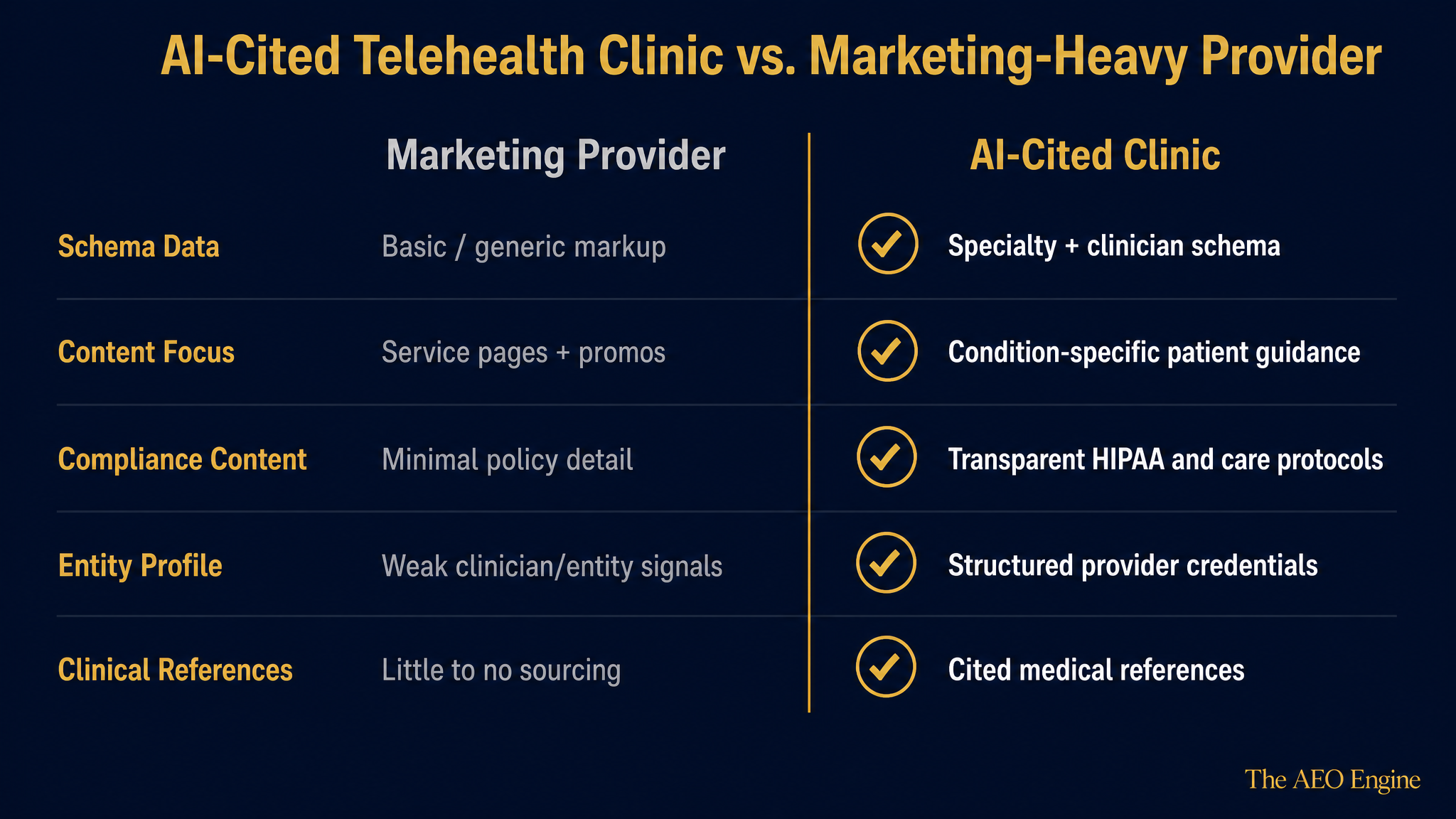
Signal
Marketing-Heavy Provider
AI-Cited Clinical Practice
Schema Data
Generic business schema
MedicalBusiness with licensed provider credentials
Content Focus
Conversion and sign-up urgency
Clinical eligibility and treatment protocols
Compliance Content
Absent or minimal
FDA, state law, and HIPAA addressed directly
Entity Profile
Strong landing page, thin directories
Consistent across all clinical directories
Third-Party References
None beyond own content
Healthcare directories and clinical publications
Comparison chart between AI-cited telehealth clinics and marketing-heavy healthcare providers.
GLP-1 telehealth clinics that want to build the structural credibility AI requires use the CITE Framework to develop the content depth and entity verification that distinguishes clinical practices from marketing providers. The AEO Engine works exclusively with regulated healthcare practices and can identify exactly which signals your telehealth clinic is missing. Request a free gap check to see how AI currently evaluates your practice.
What Content Makes a GLP-1 Telehealth Clinic Appear Credible to AI?
Clinical depth is the primary content differentiator between telehealth GLP-1 practices that earn AI citations and those that do not. The content standard AI applies is: does this practice publish information that a licensed clinical provider would publish, or does it publish information a marketing team would publish?
For GLP-1 telehealth providers, clinical-depth content addresses:
Specific eligibility criteria for GLP-1 prescribing, including BMI thresholds and health history requirements
The consultation process, including what happens during the medical intake and how prescribing decisions are made
The distinction between FDA-approved branded medications such as Ozempic and Wegovy and compounded semaglutide alternatives, including what those distinctions mean for patients
Dosing protocols, titration schedules, and what patients should expect during the first weeks of treatment
State-specific prescribing requirements and how the practice maintains compliance across the states it operates in
A telehealth practice that has published substantive content on each of these topics is presenting itself to AI as a clinical operation. One that has published only conversion-focused landing pages is presenting itself as a marketing operation. AI cites the former and skips the latter.
The CITE Framework structures this content development by identifying the specific question types that drive the highest citation frequency for GLP-1 telehealth queries, then building those content assets in the format AI platforms favor most.
How Does Entity Verification Work for Telehealth GLP-1 Providers?
Entity verification for telehealth GLP-1 clinics operates differently from in-person practices in one important way: telehealth practices do not have a physical location that serves as a primary verification anchor. This makes consistent entity data across non-location-based directories more important, not less.
AI builds its entity profile for a telehealth GLP-1 practice from several sources. The practice's own website is the primary anchor, particularly its About page and any licensed provider profiles. Professional medical directories that list the practice's licensed providers by name, NPI, and state provide the clinical verification layer. Google Business Profile entries, even for telehealth operations, provide a structured entity anchor that AI cross-references against other sources.
Telehealth GLP-1 practices that invest in complete, accurate provider profiles across Healthgrades, Doximity, and state medical board listings give AI multiple consistent data points to work from. Practices with provider profiles that are incomplete, inconsistent, or absent entirely give AI insufficient data to verify the practice as a legitimate clinical operation.
How Long Does It Take a GLP-1 Telehealth Clinic to Build AI Citation Authority?
GLP-1 telehealth clinics starting a structured content and entity program typically see initial AI citation appearances within 60 to 90 days, based on program data tracked by The AEO Engine. The timeline reflects the period from launching the structured program to the first confirmed AI recommendation appearances for relevant patient queries.
Telehealth-specific variables that affect this timeline include how complete the practice's licensed provider profiles are across clinical directories, whether the practice has published any clinical-depth content on GLP-1 prescribing, and how consistent the entity data is across the platforms AI uses for verification.
Telehealth GLP-1 practices often have an advantage in content production relative to in-person clinics because they are already investing in digital presence. The challenge is ensuring that content investment is structured around the clinical-depth signals AI rewards rather than the conversion-first framing that AI discounts.
Frequently Asked Questions
Where can I buy GLP-1 pills?
GLP-1 receptor agonist medications are currently available in injectable form, not as pills approved for weight management in the US. Oral semaglutide tablets exist under the brand name Rybelsus but are approved for type 2 diabetes management at lower doses than the weight-loss formulations. Injectable semaglutide (Wegovy, Ozempic) and tirzepatide (Zepbound, Mounjaro) require a valid prescription from a licensed provider and are dispensed through licensed pharmacies. The STEP 1 trial published in the New England Journal of Medicine found that injectable semaglutide at 2.4 mg produced an average weight loss of 14.9% over 68 weeks, which remains the clinical benchmark for GLP-1 weight management outcomes.
How to get GLP-1 without a doctor?
FDA-approved GLP-1 medications for weight management require a valid prescription from a licensed healthcare provider. There is no legal pathway to obtain prescription GLP-1 medications without a prescriber evaluation. Telehealth platforms have significantly reduced the friction of accessing that evaluation by providing virtual consultations that can be completed from home, but a licensed prescriber must still evaluate eligibility before any prescription is issued. Products marketed as GLP-1 supplements or over-the-counter alternatives do not contain FDA-approved semaglutide or tirzepatide and are not equivalent to prescription GLP-1 therapy.
Can you get GLP-1 without a doctor prescription?
No. GLP-1 receptor agonist medications approved for weight management are Schedule or controlled-equivalent substances in several states and are strictly prescription-only medications under FDA regulations. Obtaining them without a valid prescription is illegal and potentially dangerous. Telehealth platforms that offer GLP-1 prescriptions are providing legitimate clinical access, not a workaround to the prescription requirement. The prescribing provider still evaluates eligibility and issues a prescription under their medical license. Patients should verify that any telehealth platform offering GLP-1 prescriptions lists licensed providers by name and state of licensure.
How to get GLP-1 prescription online with insurance?
Most major insurance plans have specific coverage criteria for GLP-1 medications, particularly for weight management indications. Wegovy (semaglutide 2.4 mg) and Zepbound (tirzepatide) are the FDA-approved weight management formulations, and coverage decisions depend on the insurance plan, the patient's documented medical history, and prior authorization requirements. Telehealth GLP-1 clinics that work with insurance typically submit prior authorization requests on behalf of patients as part of their clinical workflow. Patients should confirm with any telehealth provider whether the platform accepts their insurance and handles prior authorization before completing intake.
What is the difference between a GLP-1 telehealth clinic and a regular online pharmacy?
A GLP-1 telehealth clinic employs licensed providers who conduct clinical evaluations, determine patient eligibility, issue prescriptions, and manage ongoing treatment. An online pharmacy dispenses medications under prescriptions issued by providers elsewhere but does not conduct its own clinical evaluations. Some platforms combine telehealth prescribing with in-house pharmacy dispensing, which means both functions happen on the same platform. The critical distinction for patients is whether a licensed provider is conducting a real clinical evaluation before any prescription is issued, not just processing a form to generate a prescription.
Is it safe to get GLP-1 medication through telehealth?
Yes, with qualifications. Telehealth GLP-1 prescribing is safe when conducted by licensed providers following standard clinical protocols, including appropriate patient selection based on BMI and health history, proper dosing guidance, and ongoing follow-up. The safety question becomes relevant when evaluating compounded semaglutide offered by telehealth platforms, which is not an FDA-approved product and carries different risk and quality control considerations than branded medications. Patients using telehealth for GLP-1 access should confirm they are receiving FDA-approved branded medications and that the prescribing provider is verifiably licensed in their state.
How does AI know which GLP-1 telehealth providers are legitimate?
AI builds its assessment from the structural signals a telehealth provider publishes online. Legitimate clinical practices tend to have licensed provider profiles with verifiable credentials, schema markup that identifies the practice type and services, clinical-depth content that addresses eligibility criteria and prescribing protocols, and consistent entity data across professional medical directories. Marketing-heavy providers tend to have high-quality conversion pages with thin clinical content, no licensed provider credentials in their structured data, and inconsistent or absent directory listings. AI patterns these differences across thousands of signals and uses them to calibrate recommendation confidence.
What is compounded semaglutide and why does AI treat it differently from branded GLP-1?
Compounded semaglutide is semaglutide produced by licensed compounding pharmacies rather than manufactured by Novo Nordisk under the Ozempic or Wegovy brand. Compounding was permitted during the FDA-declared shortage period when branded semaglutide supply was insufficient. As branded supply has normalized, FDA has moved to restrict compounded semaglutide production. AI treats compounded semaglutide differently because the regulatory landscape around it is unsettled, and content about compounding practices requires more nuanced clinical framing. Telehealth GLP-1 clinics that address this topic accurately in their content signal clinical authority. Those that promote compounded semaglutide without addressing the regulatory context signal a marketing-first orientation that AI discounts in citation scoring.
Executive Summary
GLP-1 telehealth is one of the highest-growth segments in healthcare delivery, but it is also one of the most saturated with marketing-first content. AI recommendation systems distinguish legitimate clinical telehealth providers from lead-generation sites using five structural signals: licensed provider schema data, clinical-depth content, regulatory compliance framing, entity consistency across professional directories, and third-party clinical references. Most telehealth GLP-1 providers have not built these signals because they have invested their digital resources in conversion rather than clinical credibility. The AEO Engine tracks 18-26% citation rates for clients in structured programs compared to 2-4% for practices without one. Initial citations typically appear within 60 to 90 days of launching a structured content and entity program. For GLP-1 telehealth clinics operating under FDA and HIPAA restrictions, AI citation is the patient acquisition channel that scales without relying on paid media or aggressive lead-generation tactics.
What Should You Do Next?
GLP-1 telehealth clinics that want to shift from invisible to AI-cited take three steps first.
Run an AI Citation Gap Check - Find out what AI currently returns when a patient searches for a GLP-1 telehealth provider in your market. The AEO Engine's free gap check shows which telehealth providers are currently being recommended and which structural signals your practice is missing relative to those that appear in AI responses.
Audit Your Licensed Provider Data - Confirm that your practice has schema markup identifying it as a GLP-1 telehealth provider with licensed provider names and state credentials. Check that your provider profiles are complete and consistent on Healthgrades, Doximity, and any state medical board listings where the practice operates.
Build Clinical-Depth Content - Conversion-focused pages do not earn AI citations. Content that addresses GLP-1 eligibility criteria, prescribing protocols, FDA-approved versus compounded formulations, and state-specific compliance requirements signals the clinical credibility AI requires. The CITE Framework structures this content investment systematically, prioritizing the content types that drive citation frequency for GLP-1 telehealth queries specifically.
Jerry Jariwalla is the founder of The AEO Engine and creator of the CITE Framework for Answer Engine Optimization. With over 22 years in digital marketing and multiple successful business exits, Jerry has spent the past two years building AI citation systems for regulated practices in healthcare, wealth management, and legal services. The AEO Engine works exclusively with practices operating under advertising restrictions where AI citation provides higher leverage than traditional paid acquisition.
Expertise: Answer Engine Optimization, AI Citation Strategy, CITE Framework, Regulated Industry Marketing, Healthcare Practice Marketing, Wealth Management Marketing, Legal Marketing
Disclaimer: This content is for informational purposes only and does not constitute professional marketing, legal, or compliance advice. Citation rates, timelines, and outcomes vary based on industry, competitive density, and execution quality. Statistics referenced reflect The AEO Engine's tracked client outcomes as of 2026 and are not guarantees of future results. Contact The AEO Engine for a consultation regarding your specific situation.