Last Updated: May 2026
A med spa SEO strategy built only on keyword rankings, link building, and traditional on-page tactics is no longer enough to drive consultations in 2026. A growing share of consumers now begin service research inside AI chat tools, which means the practices winning new patients are the ones AI assistants recommend by name rather than the ones that rank highest on a results page.
The AEO Engine was founded by Jerry Jariwalla to help regulated practices adapt to this shift. With over 22 years of digital marketing experience and multiple successful business exits, Jerry built the CITE Framework specifically for aesthetic practices and other regulated verticals where AI citation drives a meaningful share of consultation flow and traditional SEO no longer carries the program on its own.
This article explains why traditional med spa SEO is losing ground, what is replacing it, how Answer Engine Optimization integrates with the SEO work still worth doing, what evaluation criteria practice owners should use when reviewing their current SEO program, and how to migrate from a keyword-first to a citation-first strategy without losing the ranking ground that already exists.
Key Takeaways
- Med Spa SEO Is Not Dead, But Diminished - Traditional SEO still produces results, but it can no longer carry the program alone.
- AI Citation Is the New Headline Metric - Named recommendations on ChatGPT, Perplexity, and AI Overviews now drive the consultation pipeline.
- Keyword Content Is Out, Citation-Ready Content Is In - Articles engineered for AI extraction outperform keyword-stuffed pages.
- Structured Data Has Moved From Optional to Required - Article, business, and provider-level schema is now the floor.
- SEO Wins Compound When Integrated With AEO - Practices that keep what works and layer AEO on top capture both channels.
The shift from SEO to AEO does not mean abandoning the previous program. It means reweighting the investment toward the metrics and signals that actually drive recommendations in the new search environment.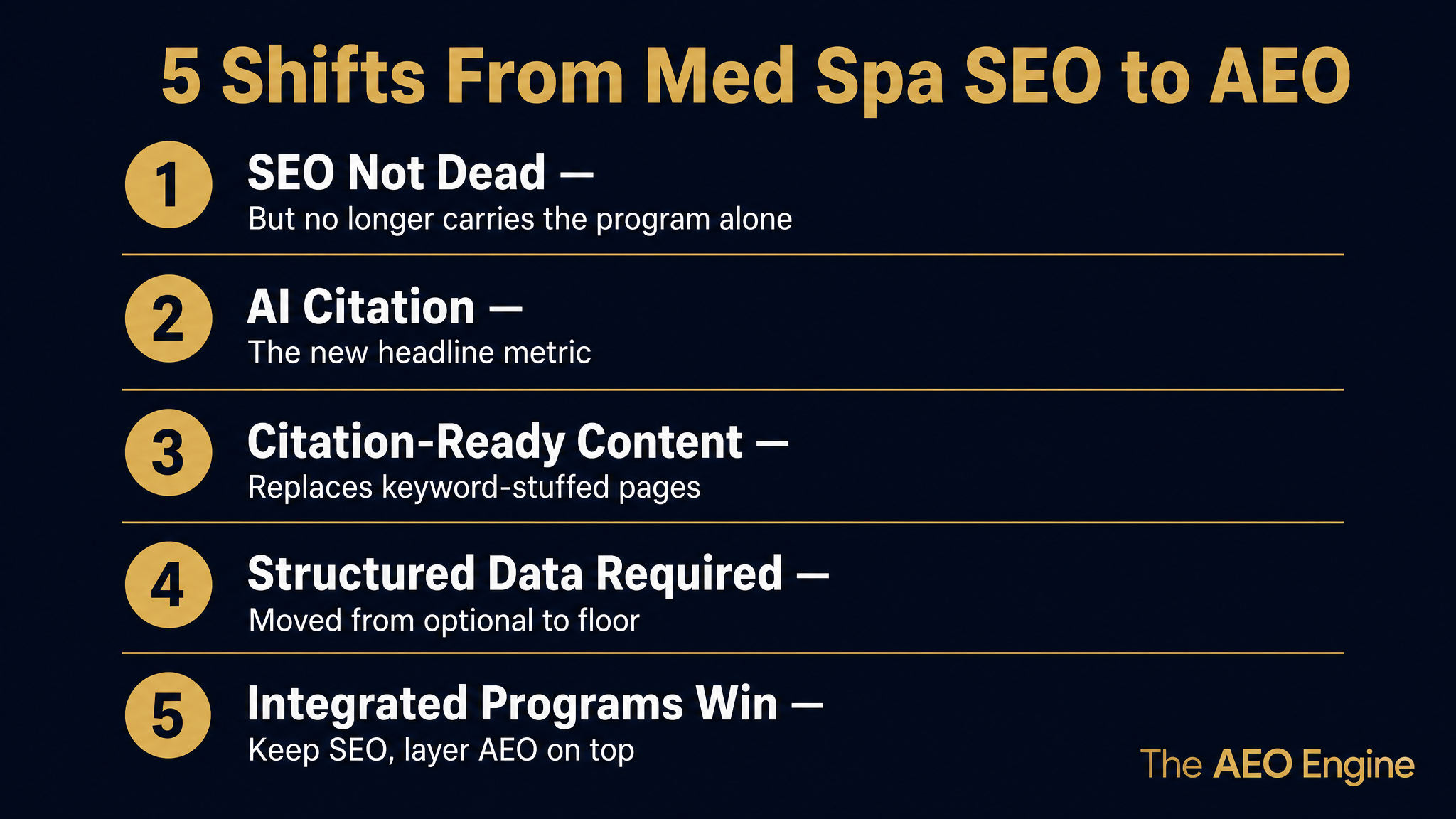
Why Is Traditional Med Spa SEO Losing Ground?
Traditional med spa SEO is losing ground because the consumer behavior that fed it is changing. Patients increasingly start research inside AI chat tools that answer questions with a single recommended provider rather than handing back a ten-link results page. A practice that ranks third on Google for a local search query may never be seen if the patient never reaches the results page in the first place.
The second pressure on traditional SEO is the rise of AI Overviews and zero-click answers. Google's own AI summaries now answer many service-research questions inline, which means the click-through rate from a top organic result has dropped meaningfully for high-volume aesthetic queries. Practices invested heavily in ranking content are seeing diminishing returns even when the rankings themselves hold steady.
What Is Replacing Med Spa SEO?
What is replacing traditional med spa SEO is Answer Engine Optimization. AEO builds the entity foundation, citation-ready content, authority signals, and structured data that AI tools use to decide which practices to name when a patient asks for a recommendation. The practice that wins is no longer the one with the highest keyword density, it is the one AI tools verify as the most trustworthy and most relevant answer.
AEO does not erase the underlying SEO discipline. The work of clean URLs, fast page load, semantic HTML, and authoritative backlinks all still matters. What changes is the headline outcome. The program is now measured against named AI mentions and consultation pipeline, with rankings and traffic serving as leading indicators rather than the headline.
- Entity foundation - Consistent NAP, provider credentials, and service descriptions across the entire web presence.
- Citation-ready content - Articles structured for clean AI extraction with question-driven headings and concise factual answers.
- Authority and reviews - Mentions on third-party publications AI tools trust, paired with verified patient reviews.
- Trust-signal infrastructure - Article-level, business-entity, and provider-level structured data layered into every page.
How Does AEO Integrate With SEO Work That Still Works?
AEO integrates with the SEO work that still works by treating traditional optimization as one input into a larger AI-citation strategy. Technical SEO, clean architecture, fast load times, and legitimate backlinks all remain valuable because they help AI tools confirm the practice is a serious entity worth recommending. The integration breaks down only when an agency keeps treating rankings as the headline metric instead of recognizing them as a supporting signal.
The cleanest migration path retains the SEO foundation, adds the AEO foundation on top, and reweights the reporting to lead with citation activity. Practices that try to abandon SEO entirely tend to lose ranking ground that was paid for over years, while practices that refuse to add AEO end up watching consultation flow drop as patients move to AI-mediated discovery.
If your med spa is running a traditional SEO program and wants to know what migrating to AEO would actually look like, The AEO Engine offers a free AI visibility audit that maps current ranking ground, current AI citation status, and the gap between the two. The team has spent the past two years building citation systems for regulated practices including aesthetic medicine.
What Should a Med Spa Audit in Its Current SEO Program?
A med spa should audit its current SEO program against citation readiness, not against ranking position. The audit covers entity consistency across the website, Google Business Profile, and major directories, structured-data coverage on every published page, content extractability for AI tools, and authority signals from third-party sources. Ranking reports remain useful as leading indicators, but the audit verdict should rest on how the program performs against AI citation.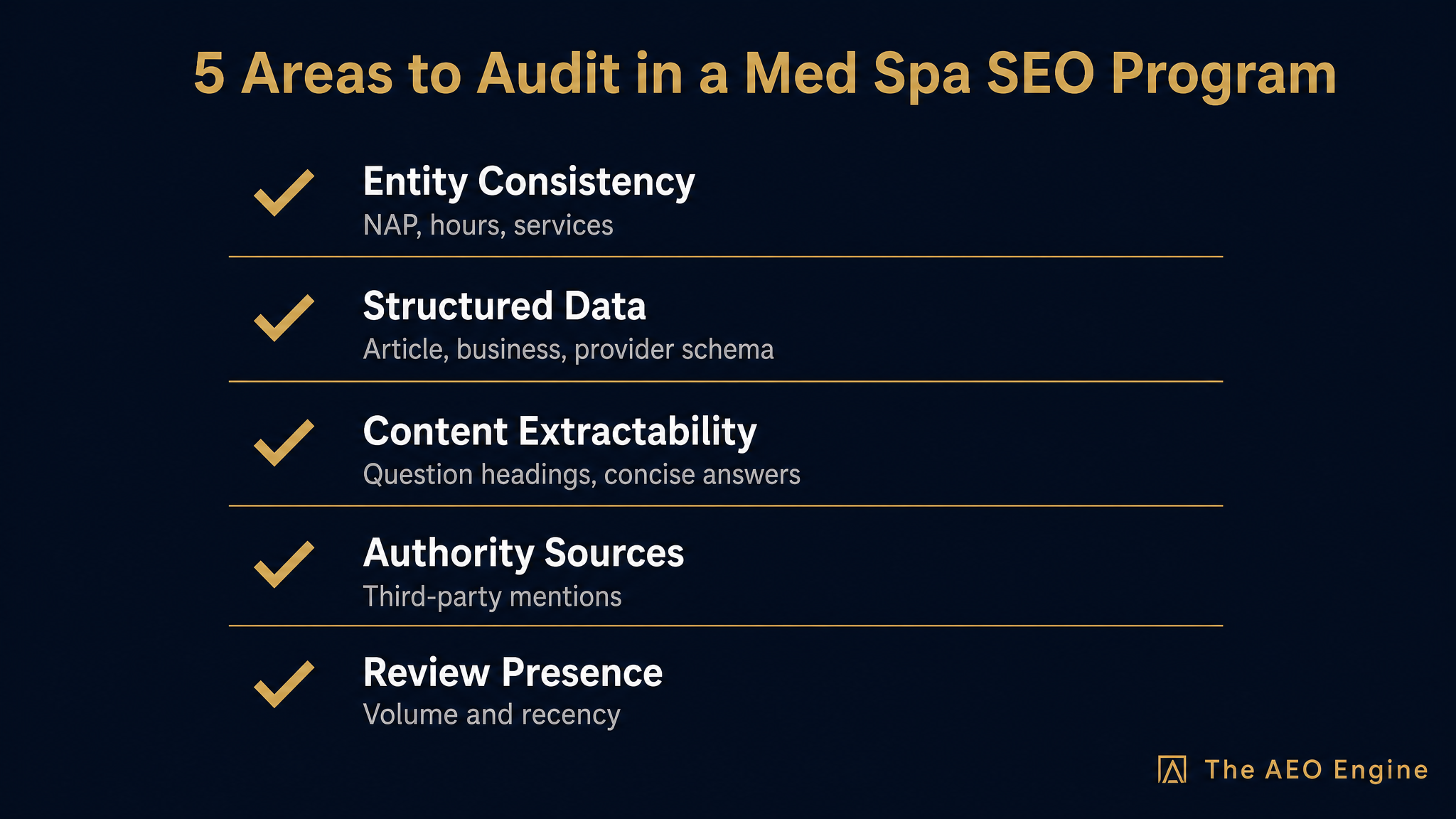
Most audits surface a small number of high-impact gaps that explain the citation underperformance. Practices commonly discover inconsistent NAP across legacy listings, schema markup that does not match the visible content, provider bios that lack structured-data backing, and authority signals concentrated on directories AI tools weight lightly. Fixing those gaps usually produces visible citation lift inside the first 90 days even when the underlying SEO program continues unchanged.
What Does a Migration From SEO to AEO Look Like?
A migration from SEO to AEO looks like a phased upgrade rather than a rebuild. Phase one is the entity foundation audit and the structured-data backfill. Phase two is the citation-ready content rewrite, prioritizing the highest-traffic existing pages and the highest-intent service pages. Phase three is the authority and review program that compounds across the back half of the year as trust signals age into the AI confidence layer.
Most practices complete the migration over six to nine months. The first 90 days deliver foundation fixes and the first citation-ready content wave. Months three to six produce visible citation lift on tracked queries. Months six to twelve produce the compounding gains as authority signals mature and structured data ages.
What Are the Biggest Mistakes Practices Make During the Migration?
The biggest mistakes practices make during the SEO-to-AEO migration include abandoning the SEO foundation entirely, treating AEO as a content add-on rather than a structured program, switching agencies in the middle of the migration, and choosing partners that do not understand regulated-industry compliance. Each mistake breaks the compounding effect and resets the citation timeline.
Practices that try to skip the foundation phase and jump directly into content production end up producing content AI tools cannot verify. Practices that fire an agency at month six because citation lift has not fully matured restart the migration with a different partner who has to redo the foundation work. The pattern is consistent: trust the migration timeline, work with one partner end to end, and resist the impulse to shortcut the foundation phase.
Frequently Asked Questions
Is med spa SEO completely dead in 2026?
Med spa SEO is not completely dead in 2026, but the playbook from 2018 no longer carries the program. Traditional optimization still produces results, especially for high-intent local queries where ranking matters and AI Overviews are less dominant. What has changed is the headline outcome. AI citation now drives a meaningful share of consultation flow, which means a practice optimized only for keyword rankings is leaving the recommendation channel to competitors who built citation programs.
What is the difference between med spa SEO and med spa AEO?
Med spa SEO is the discipline of optimizing for keyword rankings and organic traffic. Med spa AEO is the discipline of optimizing for AI citations, named recommendations, and structured-data signals that AI tools use to decide which practices to mention. AEO covers much of the SEO discipline, but it adds the entity foundation, citation-ready content engineering, authority outreach, and structured-data work that SEO traditionally treated as optional.
Can a med spa skip SEO and just do AEO?
A med spa cannot completely skip SEO and just do AEO because AI tools verify entities and content using many of the same signals SEO produces. Clean URLs, fast page load, semantic HTML, legitimate backlinks, and a well-architected site all remain inputs into the AI confidence calculus. The right approach is to keep the SEO foundation, add the AEO foundation on top, and reweight reporting to lead with citation activity rather than ranking position.
How long does it take to migrate from SEO to AEO?
A typical SEO-to-AEO migration takes six to nine months from foundation audit to mature citation activity. The first 90 days deliver structured-data backfill and the first wave of citation-ready content. Months three to six produce visible citation lift on tracked queries. Months six to twelve compound the gains as authority signals age. Practices that try to compress the timeline usually skip foundation work and end up restarting the migration with a different partner inside the first year.
Will keyword rankings still matter for med spas in 2026?
Keyword rankings will still matter for med spas in 2026, especially for local-intent service queries where the map pack and traditional organic results continue to deliver consultations. What changes is the weight assigned to rankings in the reporting hierarchy. A practice that ranks first but is never cited by ChatGPT or Perplexity is missing a growing channel. The practice that captures both is the one running an integrated SEO-plus-AEO program rather than treating one as a replacement for the other.
Should a med spa fire its current SEO agency to switch to AEO?
A med spa should not automatically fire its current SEO agency to switch to AEO. The right move is to assess whether the agency is capable of executing the AEO discipline alongside SEO, or whether the agency only knows the older playbook. Agencies that can show citation reporting, structured-data competence, and a content workflow built for AI extraction are worth keeping. Agencies that resist the migration or downplay AI citation are signaling that the practice should evaluate alternatives.
What metrics should a med spa track during the migration?
A med spa should track AI citation rates across ChatGPT, Perplexity, and AI Overviews, consultation request volume, consultation-to-treatment conversion rates, and revenue per acquired patient. Traditional metrics like keyword rankings, organic traffic, and bounce rate remain useful as leading indicators, but they should never be the headline of the report. The headline metric is named AI mentions on the platforms patients use to research aesthetic providers.
What is the smallest investment that makes sense for migrating to AEO?
The smallest investment that makes sense for migrating to AEO covers the entity foundation audit, structured-data backfill on existing pages, and the first wave of citation-ready content on the top service pages. Below that scope the work cannot produce reliable citation lift because the AI confidence signal is not built. Practices should request a scope that includes the foundation, not a bare-bones content add-on, even when the budget is smaller than a full enterprise build.
Executive Summary
Med spa SEO is not dying outright, but the keyword-first playbook from earlier in the decade no longer drives consultation flow the way it used to. AI citation has replaced ranking position as the headline metric, which means practices that win consultations in 2026 are the ones AI tools recommend by name. The cleanest path forward is to keep the SEO foundation that already works, layer the AEO foundation on top, and reweight reporting to lead with citation activity. A typical migration runs six to nine months, with foundation work in the first 90 days and compounding gains across the back half of the year. The biggest mistakes are abandoning SEO entirely, skipping the foundation phase, switching agencies mid-migration, and choosing partners that do not understand regulated-practice compliance.
What Should You Do Next?
Practice owners ready to evaluate where their current SEO program stands should start with an audit that maps existing ranking ground against current AI citation status. The audit shows whether the practice's strongest organic positions also produce AI recommendations, where the structured-data gaps live, and what the first 30 days of migration work should cover.
Request a free AI visibility audit from The AEO Engine. The audit covers entity consistency, structured data, current AI citation activity, and a prioritized migration plan, which gives the practice a concrete benchmark before committing to a longer engagement.
About the Author
Jerry Jariwalla is the founder of The AEO Engine and creator of the CITE Framework for Answer Engine Optimization. With over 22 years in digital marketing and multiple successful business exits, Jerry has spent the past two years building AI citation systems for regulated practices in healthcare, wealth management, and legal services. The AEO Engine works exclusively with practices operating under advertising restrictions where AI citation provides higher leverage than traditional paid acquisition.
Expertise: Answer Engine Optimization, AI Citation Strategy, CITE Framework, Regulated Industry Marketing, Healthcare Practice Marketing, Wealth Management Marketing, Legal Marketing
Connect: LinkedIn
Disclaimer: This content is for informational purposes only and does not constitute professional marketing, legal, or compliance advice. Citation rates, timelines, and outcomes vary based on industry, competitive density, and execution quality. Statistics referenced reflect The AEO Engine's tracked client outcomes as of 2026 and are not guarantees of future results. Contact The AEO Engine for a consultation regarding your specific situation.