
Last Updated: May 2026
A GLP-1 clinic is a medical practice that prescribes and manages GLP-1 receptor agonist medications such as semaglutide and tirzepatide for weight management and metabolic health. According to the CDC, 40.3% of US adults currently live with obesity, and millions more are actively seeking medically supervised treatment options. When a patient types "GLP-1 clinic near me" into an AI platform today, the response they receive is not a paid listing or a directory ranking. It is an AI recommendation built from structured content, verified entity signals, and authoritative citations that specific practices have earned.
The AEO Engine helps GLP-1 clinics and other regulated healthcare practices build the structural content required for AI citation. Founder Jerry Jariwalla brings 22 years of digital marketing experience, multiple successful business exits, and two years of dedicated research into AI citation systems for regulated industries. The CITE Framework he developed is the methodology used by The AEO Engine to systematically build AI citation authority for practices operating under HIPAA and FDA advertising restrictions.
This article explains the five signals AI platforms use to identify and recommend GLP-1 clinics, why most practices currently register near-zero citation rates, and what clinic operators need to do to shift from invisible to recommended.
Key Takeaways
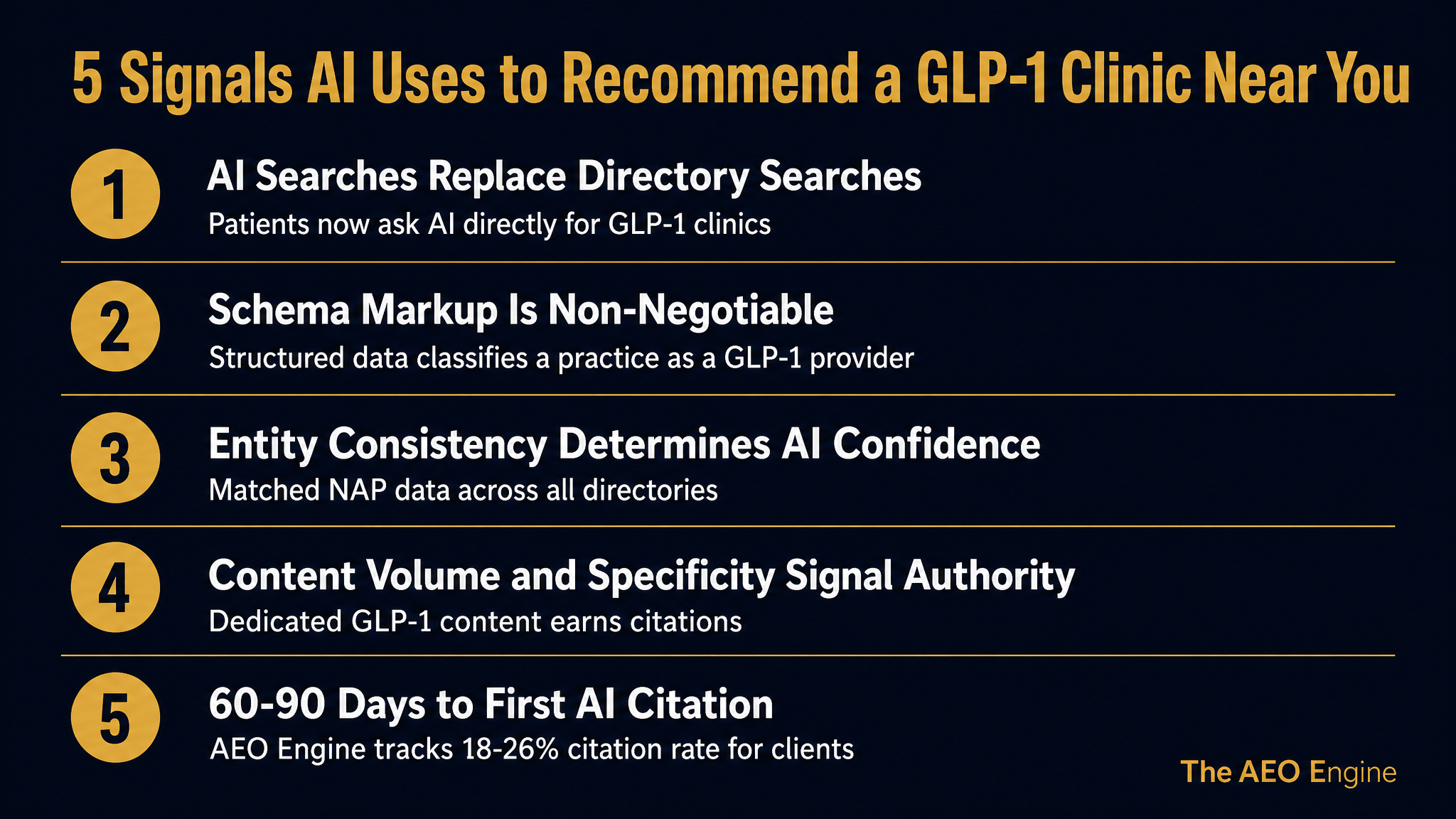
- AI Searches for Local GLP-1 Providers Are Replacing Directory Searches - Patients who previously used Yelp or Healthgrades to find GLP-1 providers are now asking AI directly, and AI surfaces only citation-ready practices
- Schema Markup Is Non-Negotiable for GLP-1 Clinic Recognition - AI platforms require structured data to classify a practice as a GLP-1 provider; without it, even well-established clinics remain invisible to AI recommendation engines
- Entity Consistency Across Platforms Determines AI Confidence - When a clinic's name, address, phone number, and service descriptions match across all directories and its own website, AI treats it as a verified entity worth citing
- Content Volume and Specificity Signal GLP-1 Authority - Practices with dedicated content addressing GLP-1 protocols, patient eligibility, and treatment outcomes receive more AI citations than those relying on a single services page
- 60 to 90 Days Is the Typical Timeline for Initial AI Citation Appearance - The AEO Engine tracks an 18-26% citation rate for clients in structured programs, compared to a 2-4% rate for practices that have not implemented an AEO program
What Is a GLP-1 Clinic and Why Are Patients Finding One Through AI?
A GLP-1 clinic is any licensed medical practice that evaluates patient eligibility for GLP-1 receptor agonist medications, manages prescriptions, and provides clinical oversight throughout treatment. This includes primary care practices, weight loss clinics, endocrinology offices, and telehealth providers operating in this space.
The reason patients are finding these clinics through AI rather than traditional search is a structural shift in how people look for healthcare. According to Pew Research, 72% of internet users have searched online for health information. That behavior is now extending into AI platforms, where conversational queries like "where can I get a GLP-1 prescription near me" produce direct clinic recommendations rather than a list of links to sort through.
AI does not return a map pack or a paid placement. It synthesizes available information about a practice and either has enough confidence to recommend it or does not. For GLP-1 clinics, this means the practices that have invested in structured content and entity verification appear in responses. Those that have not are absent, regardless of how long they have been operating or how strong their clinical reputation is.
The demand signal for GLP-1 providers is substantial. With 40.3% of US adults living with obesity and the clinical profile of semaglutide and tirzepatide well-established, patients are actively researching their options. The difference between a clinic that captures AI-referred patients and one that does not comes down to five structural signals.
What Signals Does AI Use to Identify a GLP-1 Clinic Near a Patient?
AI platforms evaluate several categories of evidence when deciding which GLP-1 clinics to include in a recommendation response. These signals operate at the entity level, not the keyword level.
- Schema Markup and Structured Data - A practice with MedicalBusiness schema that explicitly lists GLP-1 therapy as a service type gives AI a machine-readable confirmation of what the clinic provides. Without structured data, AI must infer services from unstructured text, which reduces confidence in the recommendation.
- Entity Consistency - The clinic's name, address, phone number, and service descriptions must match across its website, Google Business Profile, major health directories, and any other online presence. Inconsistencies signal to AI that the entity is not reliably verified.
- Content Specificity and Volume - A single services page listing "weight management" is not the same as a library of content addressing GLP-1 protocols, eligibility criteria, medication comparisons, and patient outcomes. AI citations go to practices that have invested in specific, authoritative content.
- Citation Authority - When other authoritative sources reference a practice in the context of GLP-1 treatment, that third-party signal strengthens the AI's confidence in recommending it. This includes media coverage, provider directory listings with clinical detail, and cross-citations from related health content.
- Geographic and Proximity Signals - AI cross-references location data from multiple sources to establish where a practice operates. Practices with consistent location data and content that references their service area receive stronger local recommendation signals.
What Separates an AI-Cited GLP-1 Clinic From One That Stays Invisible?
The gap between cited and uncited GLP-1 clinics is not a question of clinical quality. It is a question of structural readiness. AI platforms do not have access to a practice's patient outcomes or clinical reputation in any meaningful direct form. They work from what is published, structured, and verifiable.
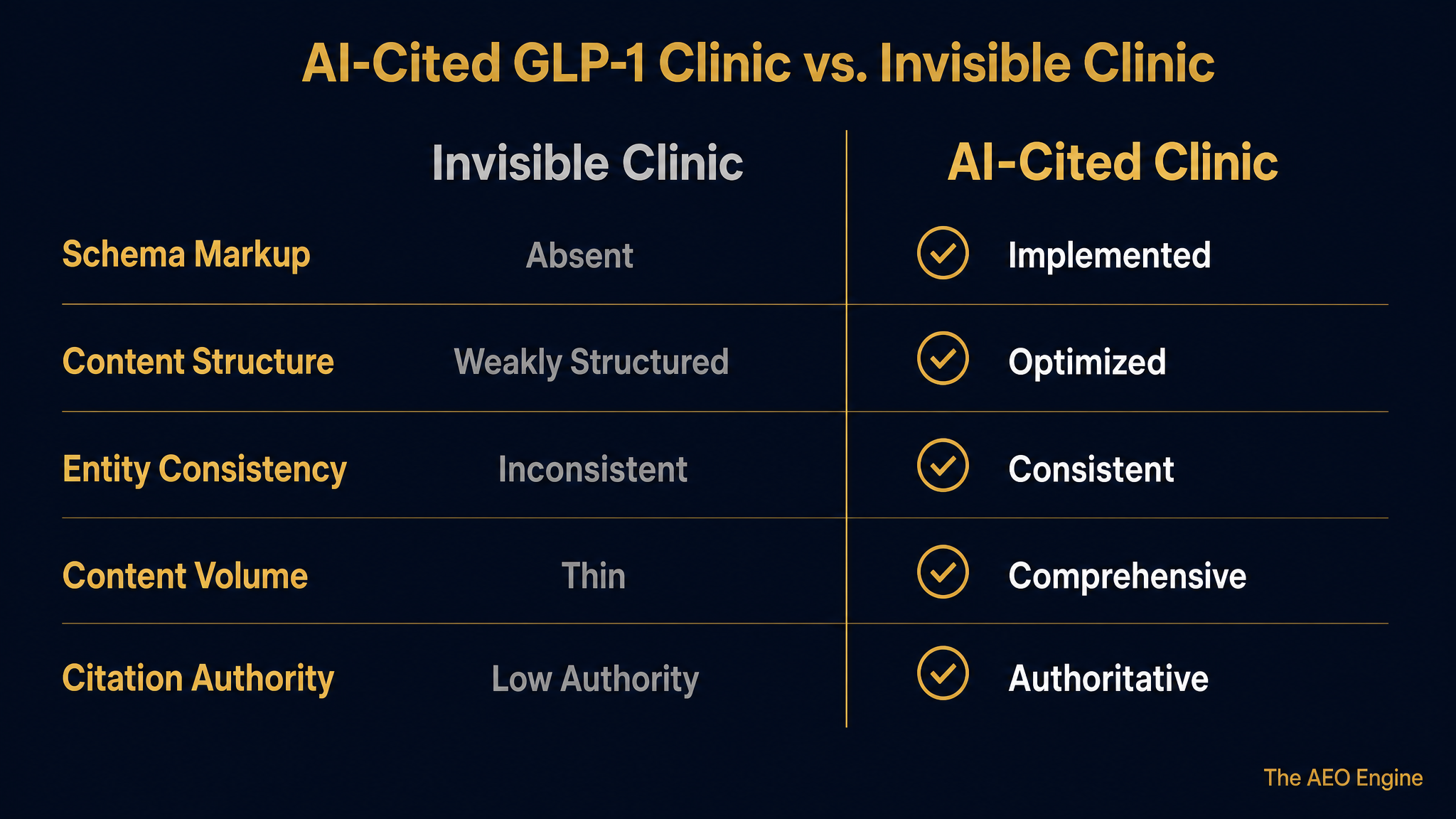
A clinic that stays invisible typically has a website built for human visitors rather than machine-readable verification. It has a services page that mentions weight management among many other offerings. It has no schema markup. Its Google Business Profile and website describe the practice in different language. Its directory listings are incomplete or inconsistent.
A clinic that earns AI citations has made different choices. Its schema explicitly identifies the practice as a GLP-1 provider. Its content addresses the specific questions patients ask about semaglutide, tirzepatide, and treatment protocols. Its entity data is consistent across every platform where the practice appears. And it has built a body of content substantial enough that AI can draw from multiple sources when constructing a recommendation.
GLP-1 practices that want to move from invisible to cited use the CITE Framework to build the structural content and entity verification AI platforms require. The AEO Engine works exclusively with healthcare practices and can identify exactly where a clinic's AI citation gap sits. Run a free gap check to see what AI currently sees when a patient searches for your clinic.
Why Does Entity Consistency Determine Whether AI Recommends Your Clinic?
AI recommendation engines operate by building confidence in entities. An entity in this context is any clearly identified, verifiable organization. For a GLP-1 clinic, that means the practice must present itself as a consistent, recognizable entity across every surface where it appears.
When AI encounters conflicting information about a practice, for example a different phone number on the website versus Google Business Profile, or a service description that mentions weight management on one platform and hormone therapy on another, it reduces confidence that it has correctly identified what this entity provides. The result is that the practice gets skipped in favor of one with cleaner data.
The practical implications for GLP-1 clinics are specific. Every directory listing, every review platform, and every social profile that references the practice needs to describe it in the same terms. The practice name must be identical across all sources. The address must be formatted consistently. The services listed must include GLP-1 or semaglutide language wherever that is clinically accurate and appropriate.
Entity consistency is not a one-time fix. As practices add new locations, change contact information, or expand their service offerings, the same consistency work must extend to all new touchpoints. Clinics that treat this as ongoing maintenance rather than a setup task hold their AI citation positions more reliably.
What Role Does Structured Content Play in GLP-1 Clinic AI Recommendations?
Content volume and specificity are the most controllable factors in building AI citation authority for a GLP-1 clinic. AI recommendation systems favor practices that have invested in answering the actual questions patients ask, in a format that is easy for AI to parse and reference.
For GLP-1 clinics, this means content that addresses:
- What GLP-1 medications are available and how they differ
- Who is a candidate for GLP-1 treatment based on clinical criteria
- What the treatment process looks like from consultation through ongoing management
- What patients should expect in terms of results and timeline
- How the clinic handles insurance, telehealth, and in-person visits
A practice that has published detailed, accurate content on each of these topics gives AI multiple sources to draw from when responding to a patient query. A practice with only a services page gives AI nothing specific enough to cite with confidence.
The CITE Framework structures this content development systematically, prioritizing the question types that drive the highest citation frequency across AI platforms. The goal is not just to have content but to have content that is structured and specific enough to be pulled into AI responses verbatim or near-verbatim.
How Fast Can a GLP-1 Clinic Start Appearing in AI Recommendations?
AI citation programs for GLP-1 clinics typically produce initial results in 60 to 90 days, based on program data tracked by The AEO Engine. This timeline reflects the period from launching a structured content and entity program to the point where AI platforms begin incorporating the practice into recommendation responses.
The variables that affect this timeline include the starting state of the practice's existing content, how consistent the entity data already is, how competitive the local market is for GLP-1 referrals, and how quickly new content is published and indexed.
Practices that begin with a strong foundation, meaning a clean website, consistent directory data, and some existing GLP-1-specific content, tend to see initial citation appearances earlier in the 60-90 day window. Practices starting with no structured content or significant entity inconsistencies typically sit at the later end of that range.
The AEO Engine tracks citation rates for client practices from program launch through ongoing monthly reporting. Early-stage practices entering a structured program register a baseline citation rate, then track progress as content authority builds. The target range is 24 to 30% citation rate for queries relevant to the practice's service area and specialty.
Frequently Asked Questions
Where can I get a GLP-1 medication?
GLP-1 medications are available through licensed healthcare providers including primary care physicians, endocrinologists, weight management specialists, and telehealth platforms that offer virtual consultations. Patients typically need a clinical evaluation to confirm eligibility based on BMI and health history before a prescription is issued. Many dedicated GLP-1 clinics now offer streamlined intake processes designed specifically for patients seeking semaglutide or tirzepatide under medical supervision.
What doctor do I go to for GLP-1?
Primary care physicians are often the first point of contact for patients interested in GLP-1 medications. Endocrinologists manage GLP-1 prescriptions for patients with type 2 diabetes. Bariatricians and weight management specialists focus specifically on medically supervised weight loss and are experienced with GLP-1 protocols. Telehealth providers have also expanded access significantly, allowing patients in areas without local specialists to receive evaluations and prescriptions remotely.
What is the Costco $179 3 month subscription weight loss program?
The Costco Health membership program has offered a prescription weight loss service that includes access to GLP-1 medication management at a flat monthly rate through a telehealth provider. The specific pricing and program details have varied over time, and eligibility requirements, included medications, and pricing are subject to change. Patients interested in this program should consult Costco Health directly for current availability and terms, and should compare it against clinical programs offered by dedicated GLP-1 clinics to evaluate supervision levels and ongoing care support.
Can you lose 20 pounds in 2 months with Ozempic?
Clinical outcomes with semaglutide vary by individual. The STEP 1 trial published in the New England Journal of Medicine found that participants taking semaglutide 2.4 mg lost an average of 14.9% of body weight over 68 weeks. For a 200-pound adult, that equates to roughly 30 pounds over 16 months, not 20 pounds in 2 months. Early weight loss can be faster in some individuals, but clinical outcomes depend on starting weight, diet, activity level, dosing protocol, and metabolic factors. Any clinic or program promising specific short-term outcomes should be evaluated carefully.
How does AI decide which GLP-1 clinic to recommend near me?
AI platforms build recommendations from structured signals rather than paid placements or directory rankings. When a patient asks an AI assistant to recommend a GLP-1 clinic nearby, the AI evaluates which practices have machine-readable structured data identifying them as GLP-1 providers, whether their entity information is consistent across directories and their own website, and whether they have published enough specific content about GLP-1 treatment to be cited with confidence. Practices that have invested in structured content programs and entity verification consistently appear in these responses. Practices that have not do not appear, regardless of how long they have operated or how strong their clinical reputation is.
Does my GLP-1 clinic need a website to appear in AI recommendations?
A website is the foundational surface for AI citation because it is the primary location where a practice controls its structured data and content. Without a website, a clinic has no schema markup, no dedicated GLP-1 content, and no controlled entity anchor. However, a website alone is not enough. AI citation also depends on entity consistency across third-party directories, Google Business Profile, and other platforms where the practice appears. The website provides the foundation; the broader digital entity profile provides the verification signals that build AI confidence.
What is the difference between a GLP-1 clinic and a weight loss clinic?
A weight loss clinic is a broader category that may offer dietary counseling, behavioral therapy, surgical referrals, and various medically supervised weight management programs. A GLP-1 clinic specifically focuses on prescription GLP-1 receptor agonist medications as the primary treatment modality. Many weight loss clinics now offer GLP-1 prescriptions as part of their programs, effectively operating as both. For AI recommendation purposes, the relevant distinction is how a practice describes its services in structured data and content. A practice that explicitly identifies GLP-1 therapy in its schema and content will receive GLP-1-specific citations. One that uses only generic weight management language may not.
How long does it take to build AI citation authority for a GLP-1 practice?
Initial AI citation appearances for GLP-1 practices typically occur within 60 to 90 days of launching a structured content and entity program, based on program data tracked by The AEO Engine. The timeline depends on the starting condition of the practice's existing content and entity data, the competitive density of GLP-1 providers in the local market, and how consistently new content is published and indexed during the program. Practices that begin with clean entity data and some existing GLP-1 content tend to appear in AI responses earlier in that window. Full citation authority, meaning consistent appearance across multiple AI platforms for a range of relevant patient queries, typically builds over six to twelve months of sustained content investment.
Executive Summary
GLP-1 clinics are among the fastest-growing healthcare practices in the US, operating in a category where patient demand is high and AI-driven discovery is replacing traditional search. AI platforms recommend specific clinics based on five structural signals: schema markup, entity consistency, content specificity, content volume, and citation authority. Most practices currently register near-zero citation rates because they have not invested in the structural content and entity verification that AI requires. The AEO Engine tracks 18-26% citation rates for clients in structured programs, compared to 2-4% for practices that have not implemented an AEO approach. Initial citation appearances typically occur within 60 to 90 days of launching a structured program. For GLP-1 clinics operating under FDA and HIPAA advertising restrictions, AI citation represents a patient acquisition channel that does not depend on paid media.
What Should You Do Next?
GLP-1 clinics that want to appear in AI recommendations when patients search nearby take three actions first.
- Run a Citation Gap Check - Before investing in content, understand what AI currently returns when a patient searches for a GLP-1 clinic in your service area. The AEO Engine's free gap check identifies where your practice stands relative to the AI citation signals that matter and which competitors are currently being recommended in your place.
- Audit Your Entity Consistency - Pull your practice's listings across Google Business Profile, Healthgrades, Zocdoc, and any other directory where you appear. Confirm that the name, address, phone number, and service descriptions match your website exactly. Any inconsistency is a signal degradation point.
- Build GLP-1-Specific Content - A single services page is not sufficient. Practices that earn AI citations have content that answers the specific questions GLP-1 patients ask, structured in a way that AI can parse and cite. The CITE Framework provides the systematic approach to building that content library in the format AI platforms favor.
People Also Read
- What Does an AI Visibility Audit Reveal About Your Citation Gap?
- How Does Med Spa Marketing Work in 2026?
About the Author
Jerry Jariwalla is the founder of The AEO Engine and creator of the CITE Framework for Answer Engine Optimization. With over 22 years in digital marketing and multiple successful business exits, Jerry has spent the past two years building AI citation systems for regulated practices in healthcare, wealth management, and legal services. The AEO Engine works exclusively with practices operating under advertising restrictions where AI citation provides higher leverage than traditional paid acquisition.
Expertise: Answer Engine Optimization, AI Citation Strategy, CITE Framework, Regulated Industry Marketing, Healthcare Practice Marketing, Wealth Management Marketing, Legal Marketing
Connect: LinkedIn
Disclaimer: This content is for informational purposes only and does not constitute professional marketing, legal, or compliance advice. Citation rates, timelines, and outcomes vary based on industry, competitive density, and execution quality. Statistics referenced reflect The AEO Engine's tracked client outcomes as of 2026 and are not guarantees of future results. Contact The AEO Engine for a consultation regarding your specific situation.