
Last Updated: May 2026
An AI visibility audit is a structured diagnostic that identifies exactly which AI answer engines are recommending a business and which queries are returning competitor citations instead. According to research published by emerging AI SEO platforms, the majority of small and mid-size practices in regulated industries have no measurable AI citation presence, meaning every AI-recommended competitor in their market is capturing leads those practices never see.
The AEO Engine conducts AI visibility audits under a Free Gap Check service designed specifically for healthcare practices, wealth management firms, and legal offices. Founder Jerry Jariwalla brings 22-plus years of digital marketing experience, multiple successful business exits, and the creation of the CITE Framework to this diagnostic, combining entity analysis, schema review, and live AI query testing to produce a citation gap map for each practice.
This article explains what an AI visibility audit covers, what the output reveals, how practice owners should interpret a citation gap finding, and what steps close that gap in a measurable timeframe.
Key Takeaways
- An AI visibility audit tests live AI platforms, not just Google rankings: citation gaps in ChatGPT and Perplexity are invisible to standard SEO audits and require separate diagnostic methodology.
- Most regulated practices sit at effectively zero AI citation rate: competitor benchmarks across The AEO Engine's client base show 2 to 4 percent citation rates as the current competitive baseline, with unoptimized practices at zero.
- A citation gap audit covers entity clarity, schema markup, content structure, and AI query testing: each layer reveals a distinct failure mode that structured optimization can correct.
- The Free Gap Check from The AEO Engine identifies citation gaps in under one business day: it maps the specific queries where a practice is missing and which content and structural fixes close each gap.
- Closing a citation gap typically takes 60 to 90 days with a structured publishing program: based on The AEO Engine's observed client timelines, consistent structured content production at 10 to 30 articles per month produces measurable AI citation emergence.
Each of these findings reflects a diagnostic reality that practice owners in competitive regulated markets face when they first run an AI visibility audit.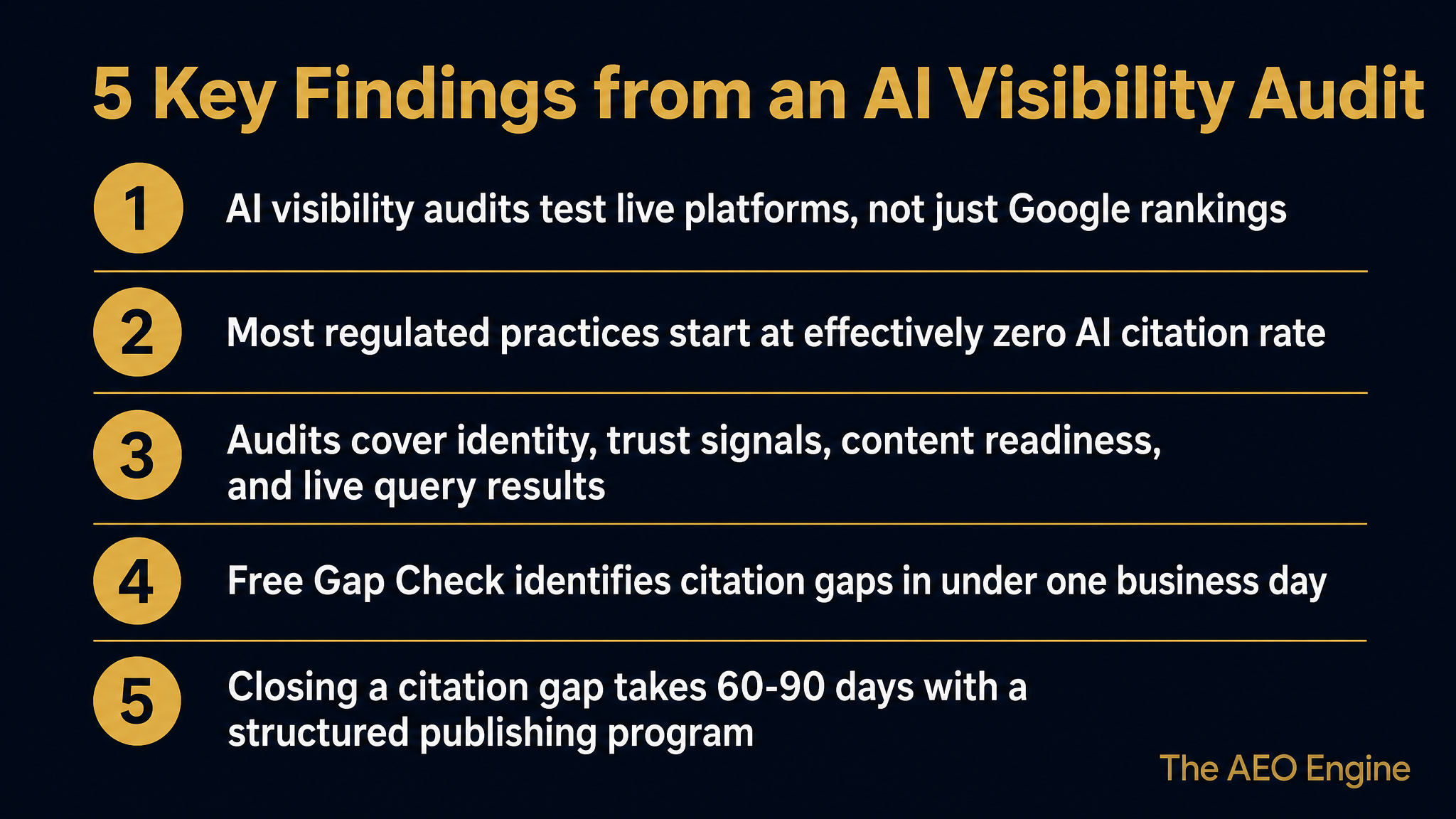
What Is AI Visibility and Why Does It Matter?
AI visibility is the degree to which a business is recommended, cited, or surfaced by AI answer engines when users ask relevant questions. It differs from traditional search visibility, which measures rankings on Google or Bing results pages, because AI platforms do not serve a list of options. They select one or a small number of sources and present them as recommendations.
When a prospective patient asks Perplexity "What is the best GLP-1 clinic in my area?" or a prospective client asks ChatGPT "Which fiduciary financial advisor should I use for retirement planning?", the AI answer engine cites specific businesses based on its assessment of source authority, entity clarity, and structured data quality. Businesses with strong AI visibility appear in these answers. Businesses with zero AI visibility are never mentioned.
The commercial implication is direct: AI-cited leads convert at meaningfully higher rates than leads from search engine results pages, based on The AEO Engine's client program data. A practice with strong AI visibility captures the prospective clients who have already made an intent decision through AI research. A practice with no AI visibility misses that entire segment of the market.
AI visibility matters most in regulated industries because the queries are high-intent and high-value. A personal injury case or a wealth management engagement has substantial lifetime value. Each AI-uncited query in a competitive market represents a tangible revenue loss.
What Does an AI Visibility Audit Cover?
A complete AI visibility audit covers four diagnostic layers: entity clarity, structured data and schema, content structure and coverage, and live AI query testing.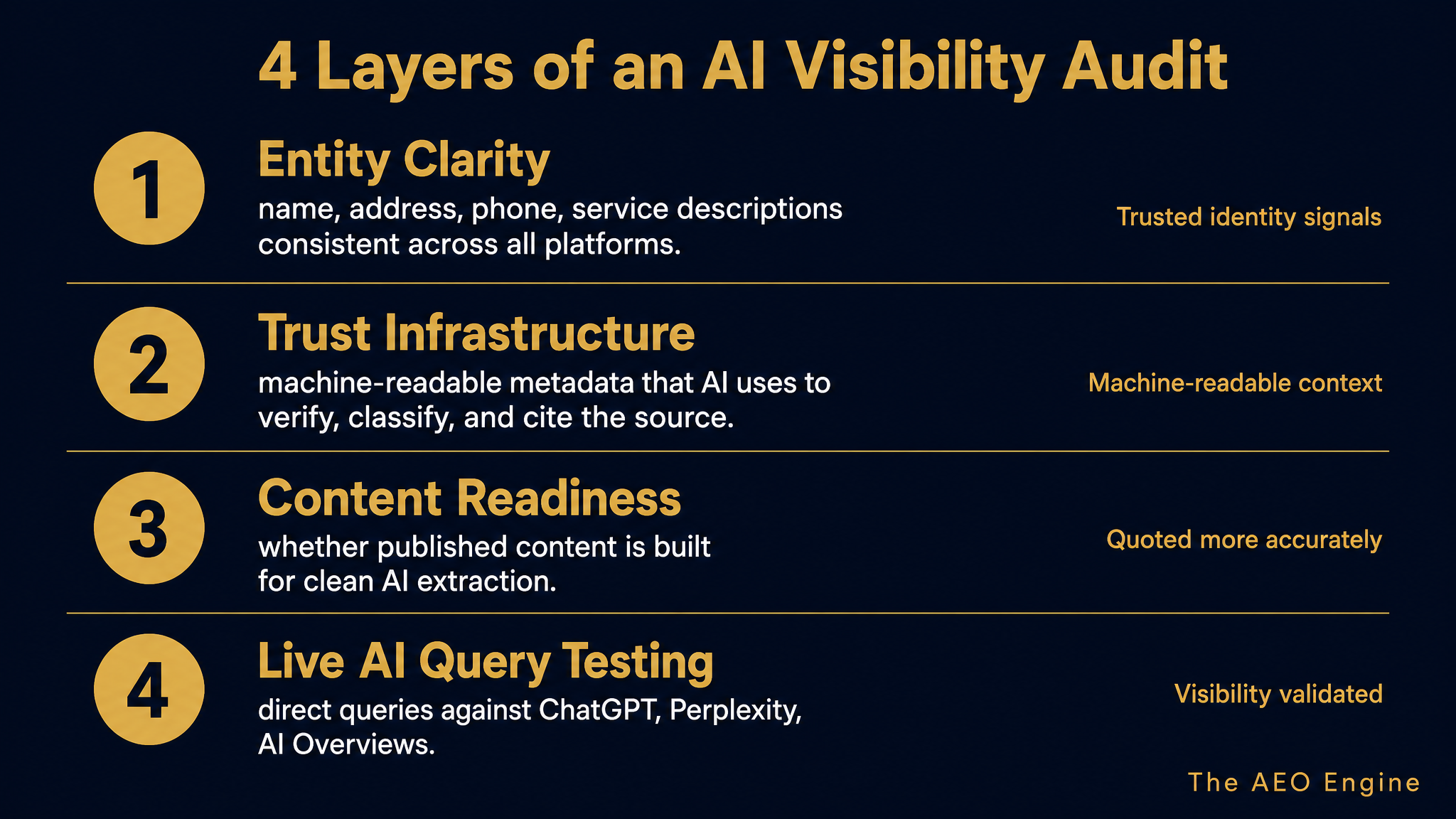
The entity clarity layer examines whether the business, its founder, and its services are clearly represented in the structured data and content on the site. AI platforms use entity graphs to categorize and rank sources. A practice whose site mixes multiple topic areas without clear entity signals for its primary service type presents ambiguous data to AI citation systems.
The structured data layer reviews whether the page's article-level, business-entity, and author-level structured data are correctly implemented, validated, and populated with specific, accurate information. Missing or malformed schema is one of the most common citation blockers, it prevents AI platforms from confidently categorizing the source.
The content structure layer examines whether published articles and pages are formatted for clean AI extraction, with FAQ sections covering the actual questions AI users are asking, and consistent internal linking patterns. Content that answers questions at the right specificity level, not generic, not padded, but directly responsive to the query, is the primary input AI citation systems evaluate.
The live AI query layer tests the practice's name and target keywords in ChatGPT, Perplexity, Claude, and Google AI Overviews to measure actual citation rate. This is the output metric of the audit, the actual share of relevant queries where the practice is cited versus where a competitor appears instead.
How Do You Interpret a Citation Gap Finding?
A citation gap finding shows the specific queries where a practice should be appearing in AI recommendations but is not. The gap map typically identifies three types of failures: structural gaps (missing or malformed schema), coverage gaps (topics that have no published structured content), and authority gaps (thin content that has been indexed but does not meet AI citation quality thresholds).
Structural gaps are the fastest to close. Implementing the correct article and business-entity structured data on existing content can begin producing citation signals within weeks. These changes do not require new content, they require technical implementation on pages that already exist.
Coverage gaps require new content production. If a practice has no published, structured article on "GLP-1 weight loss treatment options" or "fiduciary financial advisor vs. broker differences," it cannot be cited for those queries regardless of how well its other pages are optimized. Closing coverage gaps is the primary driver of the 60 to 90 day timeline in structured AI marketing programs.
Authority gaps indicate that content exists but does not meet the quality threshold AI citation systems apply. These gaps typically manifest as thin content (too short, too generic), content without FAQ sections, or content lacking external authority citations. The fix is a structured rewrite or expansion of existing articles rather than new production.
The AEO Engine's CITE Framework maps all three gap types in the initial diagnostic and assigns a prioritized fix sequence based on estimated citation impact. Request a Free Gap Check to get a structured gap map for your practice.
What Happens After an AI Visibility Audit?
After an AI visibility audit, a practice has a specific gap map showing which queries it is missing and what structural, coverage, and authority changes will close each gap. The next step is a prioritized content and technical roadmap.
High-priority structural fixes, schema implementation and correction, typically execute within one to two weeks. High-priority coverage gaps, articles on the highest-traffic, highest-intent queries where the practice has no content, begin publishing within the first 30 days of a structured program.
The publishing cadence matters considerably. Practices that publish 20 to 30 structured, schema-marked articles per month close citation gaps significantly faster than practices that publish two to three articles per month. AI platforms update their source assessments on an ongoing basis, and consistent publishing volume establishes the entity authority signals those systems reward.
The AEO Engine's structured programs deliver 30 to 120 articles per month depending on engagement scope, with each article built to a full citation-ready structure that includes AI-extractable formatting, FAQ coverage drawn from real user queries, structured data, and internal linking aligned to the practice's service architecture. Based on client program data, this approach produces AI citation rates of 18 to 26 percent within the first program cycle.
How Does The AEO Engine's Free Gap Check Work?
The Free Gap Check is The AEO Engine's no-cost AI visibility diagnostic for regulated practices. It covers all four layers of a standard AI visibility audit, entity clarity, schema review, content structure assessment, and live AI query testing, and delivers a prioritized gap map with specific fix recommendations.
The process runs as follows: Jerry Jariwalla reviews the practice's website and structured data against the CITE Framework diagnostic criteria, runs live queries in ChatGPT, Perplexity, and Google AI Overviews for the practice's primary service keywords, and maps each gap to a specific fix category. The output identifies the queries where the practice is missing, which competitor is appearing instead, and what structural or content change will close each gap.
The Free Gap Check does not require a contract or a sales conversation. It is a diagnostic service designed to show practice owners the exact state of their AI citation presence. The AEO Engine runs a limited number of these checks each week given the manual diagnostic component, Jerry handles each gap check personally rather than delegating to an automated report.
Frequently Asked Questions
What Is AI Visibility?
AI visibility is the degree to which a business is recommended or cited by AI answer engines, ChatGPT, Perplexity, Claude, and Google AI Overviews, when users ask relevant questions. It differs from search visibility in that AI platforms recommend specific sources rather than listing many options. A business with strong AI visibility appears in AI-generated answers for its target queries; a business with no AI visibility is never mentioned.
What Does an AI Visibility Audit Include?
A complete AI visibility audit includes:
(1) entity clarity review, how clearly the business, founder, and services are represented in structured data;
(2) structured data audit covering article, business-entity, and author-level validation;
(3) content structure review covering AI-extractable formatting, FAQ coverage, and internal linking;
(4) live AI query testing in ChatGPT, Perplexity, Claude, and Google AI Overviews. The output is a citation gap map with prioritized fix recommendations.
How Do You Measure AI Citation Rate?
AI citation rate is measured by running a structured set of queries in AI platforms and recording what percentage return a citation of the target business. The AEO Engine benchmarks citation rates across 20 to 50 target queries per practice, covering primary service keywords and PAA-derived questions. Client program data tracks citation rate monthly as the primary AI marketing performance metric.
Why Do Competitors Appear in AI Recommendations and My Practice Does Not?
Competitors appear in AI recommendations when they have stronger entity clarity, better schema implementation, more structured content coverage, or higher publishing volume. AI citation systems prioritize sources that have clearly identified their organization, founder, services, and service area in structured data, and that have published substantial, structured content answering the questions AI users are asking.
How Long Does It Take to Close a Citation Gap?
Structural fixes, schema implementation and entity signal corrections, can produce initial citation improvement within weeks. Coverage gaps, which require new structured content on uncovered topics, typically take 60 to 90 days to produce measurable AI citation at a structured publishing rate of 10 to 30 articles per month, based on The AEO Engine's observed client timelines.
What Is the Difference Between an SEO Audit and an AI Visibility Audit?
An SEO audit examines ranking factors for traditional search engine results pages, keyword density, backlinks, page speed, crawlability. An AI visibility audit examines citation factors for AI answer engines, entity clarity, schema markup quality, content structure, FAQ coverage, and live citation rate. Many practices have strong SEO scores and zero AI citations; the audits address fundamentally different optimization targets.
Is the Free Gap Check from The AEO Engine Really Free?
Yes. The Free Gap Check is a no-cost diagnostic that runs the full AI visibility audit methodology and delivers a prioritized gap map. It does not require a contract, a payment, or a commitment to a paid program. The AEO Engine runs a limited number of these checks each week because the diagnostic is conducted personally by Jerry Jariwalla rather than generated by an automated report tool.
What Industries Benefit Most From an AI Visibility Audit?
Regulated industries with high-intent, high-value queries benefit most: healthcare practices (GLP-1, aesthetic medicine, plastic surgery, TRT), wealth management firms (RIAs, fiduciary advisors, CFPs, retirement planners), and legal practices (estate planning, personal injury, family law). In these verticals, AI-cited leads convert at meaningfully higher rates than organic search leads, and the competitive value of early AI citation establishment is substantial before competitors catch up.
Executive Summary
An AI visibility audit reveals the specific citation gaps between a practice's current AI presence and the queries where competitors are already being recommended by ChatGPT, Perplexity, Claude, and Google AI Overviews. The audit covers entity clarity, schema markup, content structure, and live AI query testing, each layer revealing a distinct failure mode. Most regulated practices currently sit at zero AI citation rate because neither standard SEO practices nor generic content production addresses the structural requirements AI citation systems apply. The AEO Engine's Free Gap Check delivers a full diagnostic and prioritized gap map at no cost for qualified regulated practices. Closing identified gaps through structured content programs, typically 10 to 30 schema-marked, FAQ-rich articles per month, produces measurable AI citation emergence within 60 to 90 days, based on client program data tracked through the CITE Framework.
What Should You Do Next?
Test your practice's current AI citation rate today: search your practice name and top service keywords in ChatGPT, Perplexity, and Google AI Overviews. Count how many relevant queries return your practice as a cited source. Identify which competitors appear in your target queries and note what structured data signals their sites carry that yours may lack.
Audit your current website for full structured data coverage using Google's Rich Results Test. Request The AEO Engine's Free Gap Check, Jerry Jariwalla personally conducts each diagnostic and delivers a specific gap map with prioritized recommendations.
About the Author
Jerry Jariwalla is the founder of The AEO Engine and creator of the CITE Framework for Answer Engine Optimization. With over 22 years in digital marketing and multiple successful business exits, Jerry has spent the past two years building AI citation systems for regulated practices in healthcare, wealth management, and legal services. The AEO Engine works exclusively with practices operating under advertising restrictions where AI citation provides higher leverage than traditional paid acquisition.
Expertise: Answer Engine Optimization, AI Citation Strategy, CITE Framework, Regulated Industry Marketing, Healthcare Practice Marketing, Wealth Management Marketing, Legal Marketing
Connect: LinkedIn
Disclaimer: This content is for informational purposes only and does not constitute professional marketing, legal, or compliance advice. Citation rates, timelines, and outcomes vary based on industry, competitive density, and execution quality. Statistics referenced reflect The AEO Engine's tracked client outcomes as of 2026 and are not guarantees of future results. Contact The AEO Engine for a consultation regarding your specific situation.