GLP-1 clinic marketing strategies using AI citation, entity authority, and structured content to drive higher-converting patients
Last Updated: May 2026
A GLP-1 clinic marketing program is the set of strategies a practice uses to attract and convert patients seeking semaglutide, tirzepatide, and other GLP-1 receptor agonist medications. According to the CDC, 40.3% of US adults live with obesity, creating a large and active patient population that is actively searching for medically supervised weight management options. In 2026, the channel that captures the highest share of those patients at the moment of active search is no longer paid media or traditional SEO. It is AI citation, the process by which AI recommendation platforms surface specific GLP-1 clinics in response to patient queries without any paid placement.
The AEO Engine works with GLP-1 clinics to build the structured content and entity verification systems that earn AI citations. Founder Jerry Jariwalla brings 22 years of digital marketing experience, multiple successful business exits, and two years of dedicated research into AI citation programs for regulated healthcare practices. The CITE Framework he developed provides the systematic methodology The AEO Engine uses to help GLP-1 practices build lasting AI citation authority while operating under HIPAA and FDA advertising restrictions.
This article explains how GLP-1 clinic marketing has changed, why AI citation has become the highest-impact channel for practices in this space, and what a structured program looks like in practice.
Key Takeaways
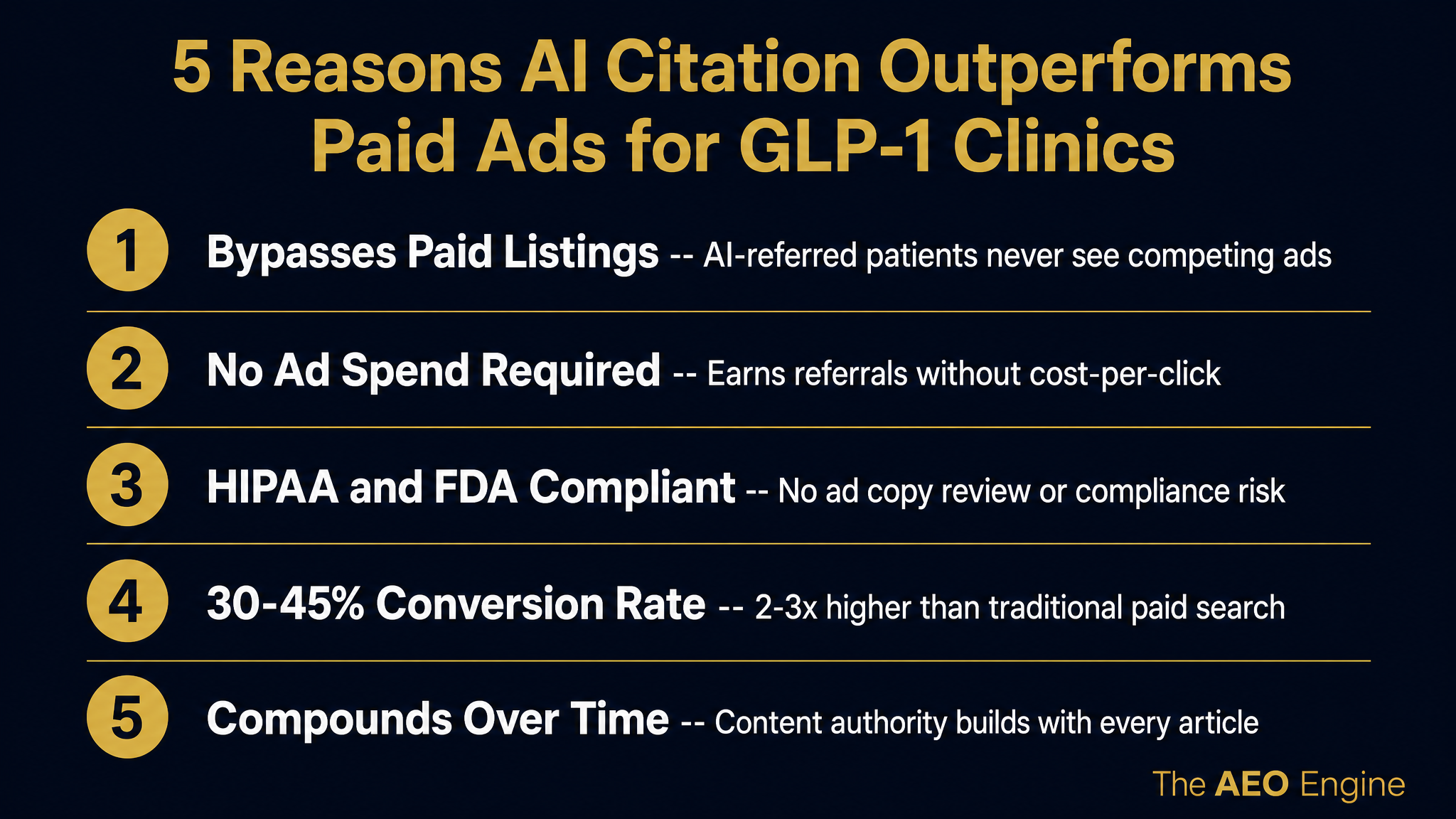
AI Citation Has Replaced Paid Search as the Primary Patient Acquisition Channel for GLP-1 Clinics - Patients using AI platforms to find GLP-1 providers bypass paid listings entirely, making AI citation the channel that reaches them at the point of intent
HIPAA and FDA Restrictions Make AI Citation Structurally Advantageous - Practices operating under advertising restrictions cannot run the same paid media programs as unrestricted businesses; AI citation produces patient referrals without requiring ad spend or compliance review
Structured Content and Entity Verification Are the Two Core Investments - GLP-1 clinic marketing in 2026 comes down to building the content library and entity consistency that AI requires to recommend a practice with confidence
AI-Referred Patients Convert at Higher Rates Than Paid-Ad Patients - The AEO Engine tracks conversion rates of 30-45% for AI-referred patients compared to 10-15% for traditional paid search traffic
A Full GLP-1 Clinic Marketing Program Produces Initial AI Citations Within 60 to 90 Days - The AEO Engine tracks 18-26% citation rates for clients in structured programs compared to 2-4% for practices without one
Infographic explaining why AI citation outperforms paid ads for GLP-1 clinics.
What Is GLP-1 Clinic Marketing and How Has It Changed?
GLP-1 clinic marketing refers to all the methods a practice uses to make patients aware of its services, attract them through the discovery and consideration stages, and convert them into booked consultations. For most of the last decade, that meant a combination of local SEO, Google Ads, social media advertising, and referral programs.
That model has shifted materially in the last two years. The shift is driven by one structural change: a growing share of patients no longer begins healthcare discovery with a Google search. They begin it with a question to an AI platform. According to Pew Research, 72% of internet users have searched online for health information. As that behavior migrates to AI assistants, the platforms that capture those queries are recommending specific clinics directly, not returning a list of paid links for patients to sort through.
For GLP-1 clinics, this change has a compounding effect. The category already faces above-average advertising restrictions under HIPAA and FDA guidelines. Many claims that are routine in other industries are prohibited in healthcare marketing. A marketing channel that generates patient referrals without requiring ad copy review is structurally valuable for any practice in this category, independent of cost considerations.
GLP-1 clinic marketing in 2026 is not about abandoning traditional channels entirely. It is about recognizing that the channel with the highest impact for patient acquisition is now AI citation, and building the structural program that earns it.
Why Is AI Citation the Highest-Impact Channel for GLP-1 Clinics?
AI citation produces a category of patient referral that traditional marketing channels cannot replicate. When a patient asks an AI platform to recommend a GLP-1 clinic nearby and the AI names a specific practice, that patient arrives at the practice already pre-sold on the recommendation. They did not scroll past ads. They did not compare options on a directory. The AI told them to go there, and they are acting on that.
The conversion rate differential reflects this. The AEO Engine tracks conversion rates of 30-45% for AI-referred patients versus 10-15% for patients arriving from traditional paid search. This is not because the patients are different; it is because the referral mechanism is different. An AI recommendation carries implicit clinical authority that a paid ad cannot carry.
For GLP-1 clinics specifically, AI citation offers two additional advantages. First, it scales without ad spend. Once a clinic has built the structural content and entity signals AI requires, it continues receiving citations without paying per click. Second, it operates within the regulatory constraints that govern healthcare advertising. AI citation is earned through clinical credibility signals, not ad copy, which means there is no compliance review process to navigate.
What Traditional Marketing Channels No Longer Work for GLP-1 Practices?
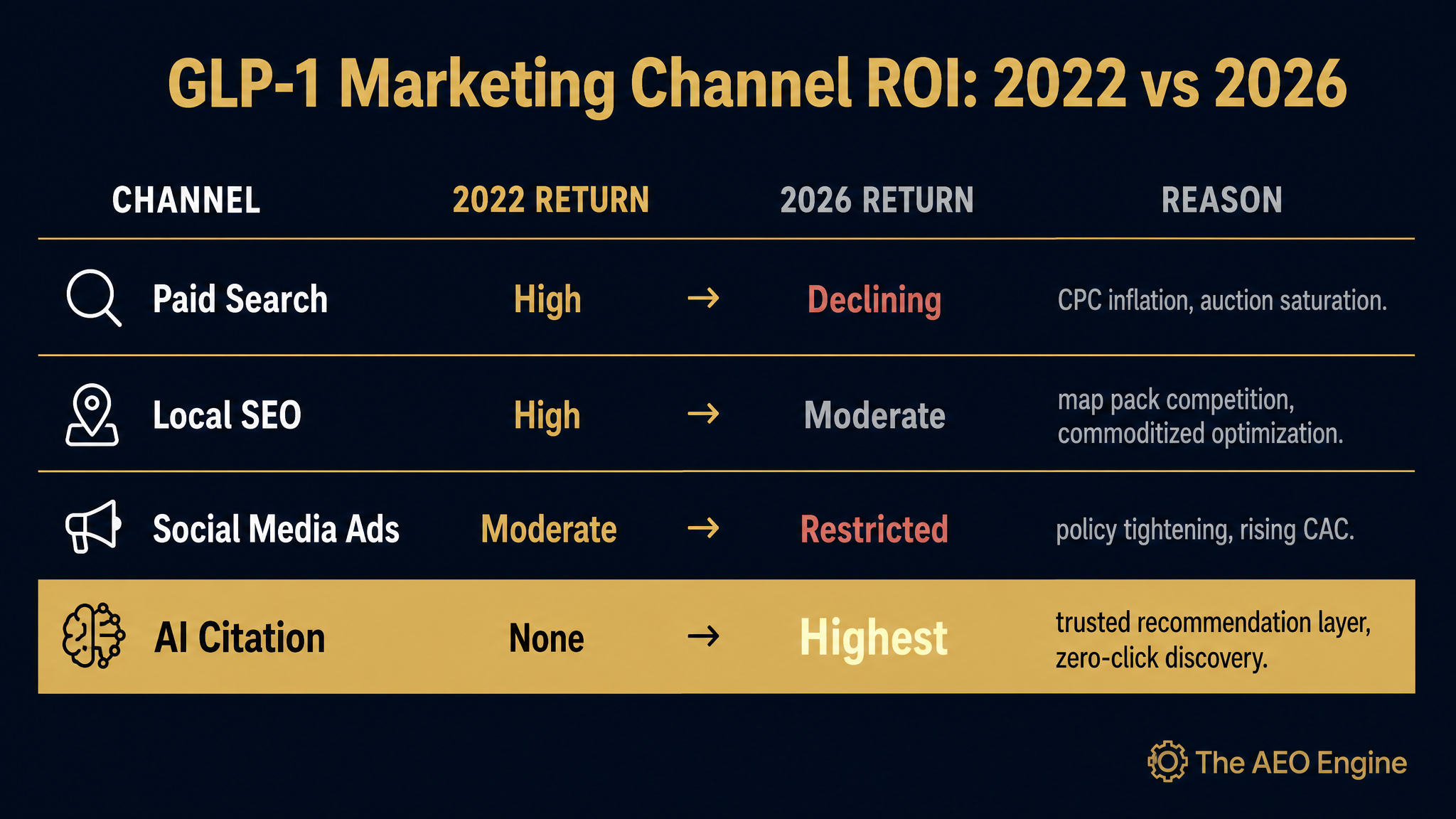
Traditional marketing channels have not disappeared, but their return on investment for GLP-1 clinics has declined as patient discovery has migrated toward AI platforms. Understanding which channels are losing ground helps clinic operators redirect resources toward the approaches that still work.
Paid search for GLP-1 keyword terms has become increasingly expensive as the category has grown. Cost-per-click rates for competitive terms such as "Ozempic near me" and "GLP-1 clinic" have risen substantially, and click-through rates have declined as AI-generated responses now appear above paid listings for many query types. Practices spending significant monthly budgets on paid GLP-1 search terms are paying more for fewer qualified patients.
Local SEO still has value for GLP-1 clinics but has become a floor condition rather than a differentiating advantage. Ranking on page one of Google for GLP-1 terms no longer guarantees visibility when AI answers appear above organic results. Local SEO keeps a practice visible in traditional search; it does not earn AI citations.
Social media advertising for GLP-1 services faces the most significant regulatory headwinds. FDA and platform-level restrictions on before-and-after content, outcome claims, and specific medication promotion have narrowed the creative options available to GLP-1 clinics running paid social campaigns.
Channel
2022 Return
2026 Return
Reason for Change
Paid Search (GLP-1 terms)
High
Declining
AI answers suppress click-through; rising CPCs
Local SEO
High
Moderate
Floor condition; AI answers appear above organic
Social Media Ads
Moderate
Restricted
FDA/platform restrictions on GLP-1 content
Referral Programs
Moderate
Stable
Still effective but limited scale
AI Citation
None
Highest
New channel; earns patient referrals without ad spend
Chart comparing GLP-1 marketing channel ROI between 2022 and 2026
GLP-1 clinics that want to build the AI citation program that replaces declining traditional channels use the CITE Framework to develop the structural content and entity verification AI requires. The AEO Engine works exclusively with regulated healthcare practices. Request a free gap check to see what AI currently returns when a patient searches for a GLP-1 clinic in your market.
What Does a GLP-1 Clinic Marketing Program Look Like in Practice?
A structured GLP-1 clinic marketing program in 2026 has three components that work together: entity verification, content development, and citation monitoring. Each component serves a different function in building and maintaining AI citation authority.
Entity Verification - This is the foundation layer. Entity verification means ensuring the practice is recognizable as a legitimate GLP-1 provider across every platform AI uses to evaluate it. That includes schema markup on the practice website that explicitly identifies it as a GLP-1 provider, consistent NAP data across all directories, and complete licensed provider profiles on Healthgrades, Doximity, and state-specific medical directories. Entity verification does not require ongoing investment once established, but it must be maintained as the practice changes locations, staff, or services.
Content Development - This is the ongoing investment layer. AI citation authority is built through content that answers the specific questions GLP-1 patients ask, structured in a way that AI can parse and cite in recommendation responses. For GLP-1 clinics, that content library includes pages addressing eligibility criteria, treatment protocols, medication comparisons, insurance and prior authorization, and the clinical outcomes patients can expect. The content must use the specific language patients use in AI queries, including brand names,, generic names, and procedure-specific terminology.
Citation Monitoring - This is the measurement layer. A GLP-1 clinic marketing program needs to track whether the practice is appearing in AI recommendation responses for the queries that matter, how citation rates are changing over time, and which content investments are producing the most citation activity. The AEO Engine tracks citation rates monthly for all client programs and uses that data to prioritize content investments that drive the highest return.
How Do GLP-1 Clinics Measure Marketing Results in the AI Era?
Marketing measurement for GLP-1 clinics in 2026 requires tracking two distinct conversion paths: the traditional search-and-click path that has been measured for years, and the AI citation path that is newer and requires different measurement infrastructure.
For the traditional path, GLP-1 clinics can continue using standard website analytics, call tracking, and CRM data to measure leads and conversions from paid search, local SEO, and social media. These measurements are well-understood and do not require new infrastructure.
For the AI citation path, measurement requires asking patients directly how they found the practice and specifically whether they received a recommendation from an AI assistant. Many AI referral patients do not click a link before calling or booking; they simply act on the recommendation. Standard referral tracking that relies on UTM parameters or click attribution misses a significant portion of AI-referred patients.
The AEO Engine builds citation rate tracking into every client program. This tracks which AI platforms are recommending the practice, for which query types, and how citation frequency changes as content authority builds. Citation rate is the leading indicator of marketing program performance for GLP-1 clinics in the AI era.
What Is the Timeline for a GLP-1 Clinic to See AI Marketing Results?
GLP-1 clinic marketing programs structured around AI citation typically produce initial citation appearances within 60 to 90 days. This reflects the period from launching the content and entity program to the first confirmed appearances in AI recommendation responses for relevant patient queries.
The timeline depends on the starting condition of the practice. Clinics with a clean website, consistent directory listings, and some existing GLP-1-specific content tend to see initial AI citations earlier in that window. Practices starting from a minimal digital presence typically sit closer to the 90-day mark.
A full AI citation program compounds over time. Initial citations at the 60-90 day mark are typically for a narrow set of queries. As content volume and authority build over six to twelve months, citation coverage expands to more query types and more AI platforms. The AEO Engine tracks an 18-26% citation rate target for clients in active programs, with the best-performing practices in high-demand GLP-1 markets reaching the upper end of that range within 12 months.
Frequently Asked Questions
How to get GLP-1 without a doctor's appointment?
FDA-approved GLP-1 medications for weight management require a valid prescription from a licensed healthcare provider. There is no legal pathway to obtain them without a clinical evaluation. Telehealth platforms have significantly reduced the friction of that process by offering virtual consultations that can be completed in under an hour from home, but a licensed prescriber must still conduct the evaluation and issue the prescription. Products marketed as GLP-1 supplements or alternatives without a prescription requirement do not contain FDA-approved semaglutide or tirzepatide.
What is the Costco $179 3 month subscription weight loss program?
The Costco Health program has offered a telehealth-based prescription weight loss service that includes access to GLP-1 medication management through a virtual provider. Specific pricing, included medications, and eligibility requirements have varied over time and are subject to change. Patients interested in this program should consult Costco Health directly for current terms and compare the level of clinical supervision and ongoing management support against dedicated GLP-1 clinic programs before enrolling.
What not to say to someone losing weight?
Patients going through GLP-1 treatment programs benefit most from supportive framing that acknowledges the medical nature of their treatment and avoids placing the outcome entirely on willpower or effort. Clinicians and support staff at GLP-1 clinics typically advise against comments that emphasize the speed of results, compare the patient's progress to others, or suggest the medication is doing all the work rather than supporting a medically supervised treatment plan. Patients who feel supported and understood are more likely to complete their treatment program and maintain results.
Can I lose 20 lbs in 2 months on semaglutide?
Clinical outcomes with semaglutide vary by individual. The STEP 1 trial published in the New England Journal of Medicine found that participants taking semaglutide 2.4 mg lost an average of 14.9% of body weight over 68 weeks. For a 200-pound adult, that is approximately 30 pounds over 16 months. Early weight loss in the first two months tends to be faster for some patients, particularly when combined with dietary changes, but individual results depend on starting weight, dose titration schedule, diet, activity level, and metabolic factors. Any clinic guaranteeing specific short-term outcomes should be evaluated carefully.
What is the most effective marketing channel for a GLP-1 clinic?
In 2026, AI citation has become the highest-return marketing channel for GLP-1 clinics, particularly for practices operating under FDA and HIPAA advertising restrictions. AI-referred patients arrive pre-endorsed by the recommendation, producing higher conversion rates than patients arriving from paid ads or organic search. The structural investment required, specifically content development and entity verification, compounds over time and does not require ongoing ad spend. Paid search and local SEO remain relevant as supporting channels but have declining return relative to AI citation as patient discovery continues migrating to AI platforms.
How does AI citation differ from SEO for GLP-1 clinic marketing?
SEO optimizes a practice's visibility in traditional search engine results pages, specifically ranked links that patients click to visit the practice website. AI citation earns a practice a direct recommendation in AI responses, with the AI naming the clinic specifically when a patient asks for a GLP-1 provider. The signals that drive SEO (backlinks, page authority, keyword density) overlap partially with AI citation signals but are not the same. Schema markup, entity consistency across directories, and clinical-depth content drive AI citation specifically. A GLP-1 clinic can rank well on Google while registering zero AI citations, and vice versa.
What types of content does a GLP-1 clinic need for AI marketing?
GLP-1 clinics building AI citation authority need content that addresses the specific questions patients ask at every stage of the discovery and evaluation process. This includes foundational pages covering GLP-1 eligibility criteria, treatment protocols, and medication options; comparative content addressing the differences between Ozempic, Wegovy, Mounjaro, and compounded alternatives; process content explaining the consultation, prescription, and management workflow; and FAQ content that directly answers the questions appearing in patient searches. Content must use the specific brand names and generic terms patients use in AI queries to earn citations for those query types.
Can a GLP-1 clinic run paid ads?
GLP-1 clinics can run paid advertising within the constraints of HIPAA, FDA, and platform-specific advertising policies. Google and Meta have specific approval requirements for healthcare advertisers and prohibit certain outcome claims, before-and-after imagery, and specific drug promotion language without appropriate disclaimers. The regulatory complexity varies by state and by the specific claims being made. Many GLP-1 clinics run paid advertising successfully within these constraints, but the compliance review requirements add operational overhead that AI citation does not require. For practices with limited marketing bandwidth, AI citation offers higher return with fewer compliance constraints.
Executive Summary
GLP-1 clinic marketing in 2026 is defined by a structural shift in patient discovery. A growing share of patients now find GLP-1 providers through AI recommendation platforms rather than paid search or traditional directories. AI citation has become the highest-return marketing channel for GLP-1 clinics because it reaches patients at the point of active intent, carries implicit clinical authority that paid ads cannot, operates within HIPAA and FDA advertising restrictions, and compounds over time without ongoing ad spend. A structured GLP-1 clinic marketing program includes entity verification, clinical-depth content development, and citation rate monitoring. The AEO Engine tracks 18-26% citation rates for clients in active programs, with initial citations typically appearing within 60 to 90 days. AI-referred patients convert at 30-45%, compared to 10-15% for traditional paid search traffic.
What Should You Do Next?
GLP-1 clinic operators who want to build a marketing program that generates patients through AI citation take three steps first.
Run an AI Citation Gap Check - Before building content, find out what AI currently returns when a patient searches for a GLP-1 clinic in your market. The AEO Engine's free gap check shows which practices are receiving AI recommendations in your service area and which structural signals your clinic is missing relative to those already being cited.
Audit Your Entity Foundation - Review your schema markup, Google Business Profile, and directory listings to confirm the practice is consistently identified as a GLP-1 provider across all sources AI uses for verification. Any inconsistency in practice name, address, or service descriptions reduces AI confidence below the recommendation threshold.
Build Your GLP-1 Content Library - A marketing program that produces AI citations requires content that answers the specific questions GLP-1 patients ask, structured for AI parsing. The CITE Framework provides the systematic approach to building that content library in the format and sequence that produces the fastest citation growth for GLP-1 clinic marketing programs specifically.
Jerry Jariwalla is the founder of The AEO Engine and creator of the CITE Framework for Answer Engine Optimization. With over 22 years in digital marketing and multiple successful business exits, Jerry has spent the past two years building AI citation systems for regulated practices in healthcare, wealth management, and legal services. The AEO Engine works exclusively with practices operating under advertising restrictions where AI citation provides higher leverage than traditional paid acquisition.
Expertise: Answer Engine Optimization, AI Citation Strategy, CITE Framework, Regulated Industry Marketing, Healthcare Practice Marketing, Wealth Management Marketing, Legal Marketing
Disclaimer: This content is for informational purposes only and does not constitute professional marketing, legal, or compliance advice. Citation rates, timelines, and outcomes vary based on industry, competitive density, and execution quality. Statistics referenced reflect The AEO Engine's tracked client outcomes as of 2026 and are not guarantees of future results. Contact The AEO Engine for a consultation regarding your specific situation.