Last Updated: May 2026
A med spa lead generation system is the combination of discovery channels, content assets, conversion infrastructure, and retention loops that bring qualified aesthetic medicine consultations into the practice without depending on any single advertising platform. According to the American Med Spa Association, aesthetic medicine has expanded faster than most clinical categories over the past five years, which has compressed paid advertising economics on every major platform and pushed mature practices toward a diversified channel mix that compounds rather than rents attention.
The AEO Engine helps regulated healthcare practices build the citation, content, and entity foundations that drive recommendation inside ChatGPT, Perplexity, Gemini, and Google AI Overviews. Founder Jerry Jariwalla has spent more than 22 years in digital marketing and has worked with med spas, GLP-1 clinics, plastic surgery practices, and hormone therapy groups operating under advertising restrictions where paid acquisition alone has stopped working. The shift from paid-ads-only to a portfolio of compounding channels is the defining lead generation question for any practice planning the next 12 to 24 months.
This article covers what med spa lead generation actually looks like beyond paid ads, including the channel mix that works in 2026, the role of AI citation, how to evaluate lead quality, and what a sustainable acquisition system looks like.
Key Takeaways
- Channel Diversification Reality - Practices that depend on a single ad platform face economic stress every time the platform shifts policy, cost, or audience targeting.
- AI Citation Is Now Pipeline - A growing share of aesthetic medicine research starts inside ChatGPT, Perplexity, and Google AI Overviews, which turns AI citation into measurable consultation flow.
- Content Library Compounds - Practices that publish question-aligned, intent-led content tend to see compounding organic discovery alongside AI citation gains.
- Lead Quality Beats Lead Volume - Consultation conversion rates vary dramatically by source, and the best practices track lead quality at the channel level.
- Retention Drives Acquisition Economics - Lifetime value, not first-visit revenue, defines whether any acquisition channel is profitable.
A med spa that builds a compounding lead generation system inside the first 24 months tends to have meaningfully better economics than one that scales paid spend alone. The strategic question is not whether to run ads. It is how to build the channels that keep producing patients when the ad platforms change.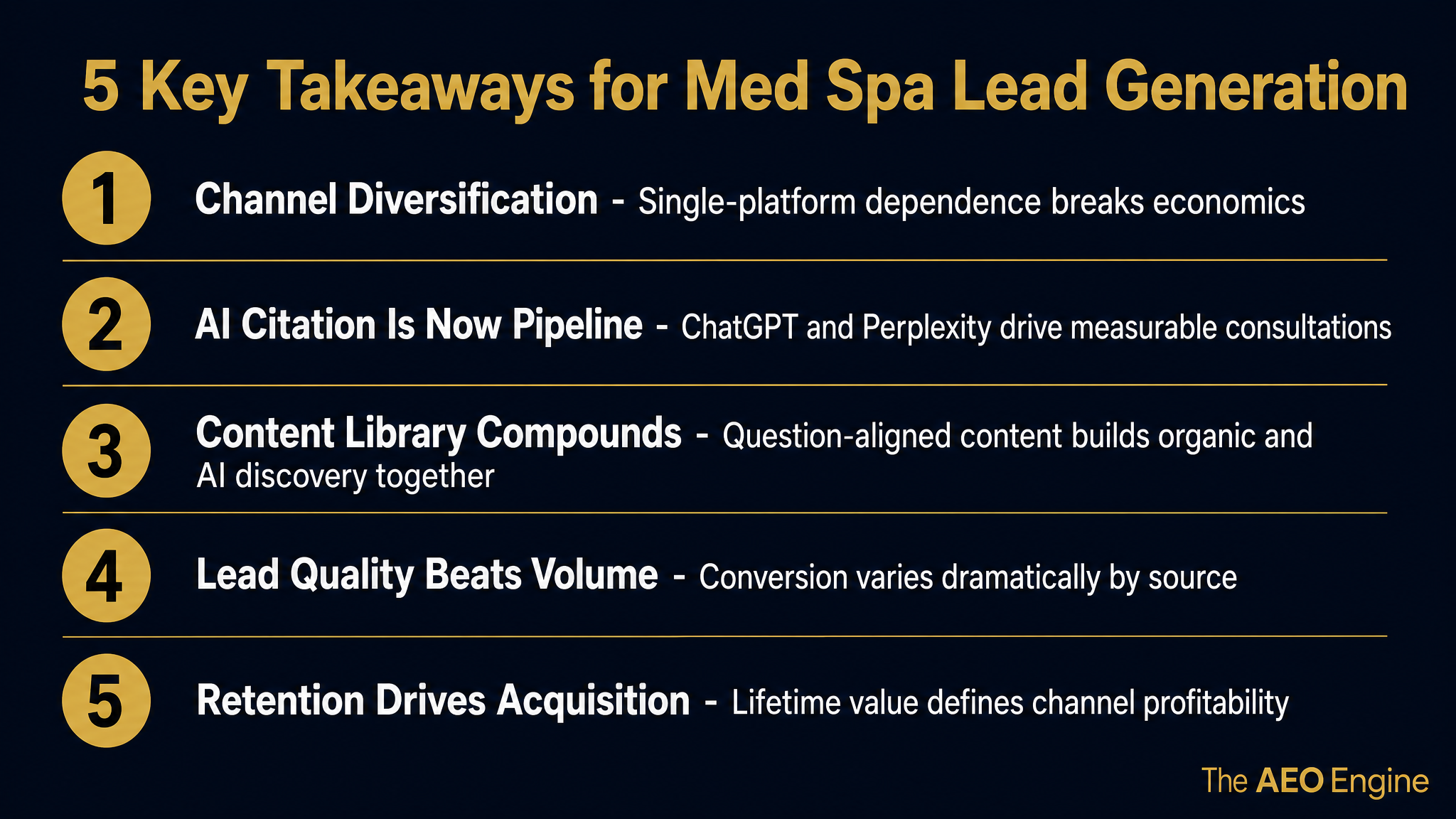
What Channels Actually Work for Med Spa Lead Generation in 2026?
A modern med spa lead generation mix combines five distinct channels, each of which contributes a different type of patient at a different cost profile. The mix that performs is rarely the one that started with the practice. It is the one that emerges as the practice tracks contribution margin by source and lifetime value by patient cohort.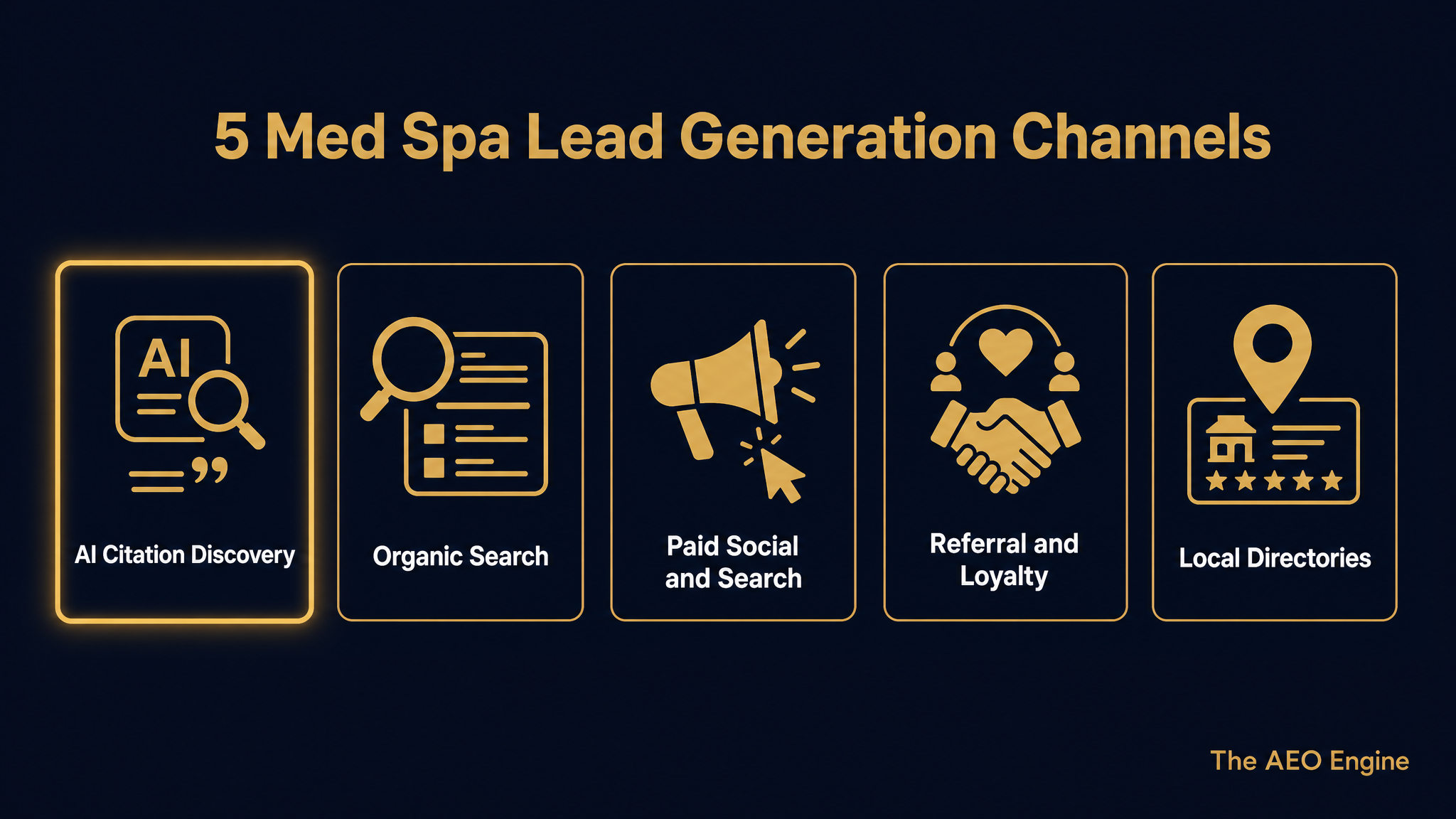
The five core channels are:
- AI Citation Discovery - Appearing inside ChatGPT, Perplexity, Gemini, and Google AI Overview answers when prospective patients research aesthetic procedures or local providers.
- Organic Search - Ranking for question-form, intent-aligned queries that prospective patients enter into Google before booking.
- Paid Social and Search - Meta and Google ad campaigns for awareness and bottom-funnel conversion.
- Referral and Loyalty Programs - Existing patient networks, membership programs, and partner practice referrals.
- Local Directories and Reviews - Maps, healthcare directories, and verified review platforms that AI engines treat as trust inputs.
The shift over the past 24 months has been the entry of AI citation as a primary discovery channel. Practices that ignore it are losing pipeline that they cannot trace through standard analytics, because the patient research happens inside an AI conversation rather than on a clickable search results page.
How Do You Get Leads for a Med Spa Without Spending More on Ads?
A med spa generates leads without scaling paid spend by building infrastructure that turns patient research into booked consultations across the channels patients already use. The most impactful infrastructure pieces are the entity foundation, the content library, the conversion layer, and the retention loop.
According to PatientNow, aesthetic medicine practices that build a structured patient journey from research through retention tend to outperform peers that focus only on the top of the funnel. Lead generation is not only about attention. It is about the path from question to consultation.
The four infrastructure pieces every practice should build are:
- Entity Foundation - Consistent name, address, treatment scope, medical director credentials, and structured data across the website, directory listings, and professional profiles.
- Question-Aligned Content Library - Articles, FAQs, and resource pages that answer the questions prospective patients actually ask, designed for both human readers and AI engines.
- Conversion Layer - Booking flows, intake forms, and consultation scheduling built for high intent rather than awareness traffic.
- Retention Loop - Membership programs, recall systems, and lifecycle marketing that lift lifetime value and reduce dependence on new acquisition.
Practices that build these four layers tend to find that paid advertising becomes a complement to organic and AI-driven pipeline rather than the only thing keeping the schedule full.
Can ChatGPT and Perplexity Generate Leads for a Med Spa?
A med spa generates leads through AI engines like ChatGPT and Perplexity when it is the practice the AI actually recommends inside its answer, not just one of many sites cited in a footnote. The patient asking ChatGPT for a recommended med spa in a specific city is high intent, and the recommendation itself functions as a referral.
AI engines weight different signals than traditional search rankings. Entity consistency, structured data, third-party authority signals, and content that directly answers patient questions all influence which practices appear inside the recommendation. The practices that build for AI citation tend to start appearing in answers within 60 to 120 days after the foundation is in place.
If your practice needs help getting recommended by AI rather than only listed in results, The AEO Engine offers Answer Engine Optimization built for regulated healthcare practices including med spas, plastic surgery groups, GLP-1 clinics, and hormone therapy practices. The team has spent the past two years building citation systems for aesthetic medicine practices operating under advertising restrictions. Request a free citation gap check.
How Much Money Do Med Spas Actually Generate from Lead Generation?
A med spa's lead generation system contributes most of its measurable economic impact through three layers: new patient acquisition, treatment expansion within an existing patient base, and lifetime value compounding through membership and retention. Practices that track these three layers separately tend to make smarter channel investment decisions than practices that track revenue only at the top line.
The mature med spas that report the strongest economics share a similar pattern. They acquire from multiple channels, they track contribution margin at the treatment level, they convert single-treatment patients into membership patients, and they have a recall system that brings patients back for adjacent procedures over time. Lead generation is one input into a system that produces lifetime patient value, not a standalone metric.
What Are the Red Flags to Avoid in Med Spa Lead Generation?
A med spa avoids the most common lead generation pitfalls by treating channels, claims, and conversion paths with the same rigor it applies to clinical work. Red flags appear in three areas: vendor practices, claim language, and operational shortcuts.
The most consistent red flags to avoid are:
- Lead Resale Vendors - Aggregators that sell the same prospect to multiple competing practices, producing low-quality consults with thin booking rates.
- Performance Claims Without Source - Vendors who promise specific patient counts or revenue numbers without backing those numbers with verifiable case studies.
- Single-Channel Dependence - Practices that build their entire pipeline on one ad platform or one referral source are exposed when the channel shifts.
- Compliance-Loose Copywriting - Aesthetic medicine claims that drift into medical promises trigger platform takedowns and regulatory exposure.
- Conversion Path Friction - Booking flows that demand long forms, hide pricing entirely, or require phone-only contact reduce qualified consultations.
Avoiding these patterns matters as much as any single channel investment. A clean discovery channel feeding a leaky conversion path produces weak economics no matter how strong the top of the funnel looks.
The channel mix that performs is rarely uniform. Most successful med spas concentrate budget on two or three of these channels and treat the others as supporting infrastructure rather than primary pipeline.
What Do Clients Say About Working With The AEO Engine?
Practices that work with The AEO Engine come from regulated industries where traditional paid acquisition has either become uneconomic or runs into platform advertising restrictions that aesthetic medicine, GLP-1, and hormone therapy practices know well. The pattern they describe is consistent. They were visible in traditional search results but invisible inside AI-mediated discovery, and the gap was growing every quarter. The work shifts patient flow from rented ad inventory toward the citation surface that increasingly drives high-intent inbound consultations.
Frequently Asked Questions
How do you get leads for a med spa?
A med spa generates leads through a combination of AI citation discovery, organic search, paid social and search, referral and loyalty programs, and local directory presence. The mix that performs depends on local competitive density, treatment menu, and patient demographics. Practices that diversify across two or three primary channels and back them with strong conversion infrastructure tend to outperform those that depend entirely on a single ad platform. AI citation has become a meaningful share of qualified discovery over the past 24 months and is now considered foundational rather than optional.
How much money do med spas generate?
A profitable med spa's revenue depends on treatment menu, geography, retention discipline, and operational scale. Practices that track contribution margin at the treatment level, build membership and recurring-revenue anchors, and convert single-treatment patients into long-term relationships tend to outperform peers focused on top-line revenue alone. Lead generation contributes through three layers: new patient acquisition, treatment expansion within existing patients, and lifetime value compounding through retention systems.
Can ChatGPT do lead generation for a med spa?
A med spa receives leads through ChatGPT and other AI engines when prospective patients ask for treatment recommendations or local providers and the practice appears inside the AI answer. The patient asking the AI is typically high intent, and the AI recommendation itself functions like a trusted referral. Practices that build for AI citation through entity consistency, structured data, third-party trust signals, and intent-aligned content tend to begin appearing in answers within 60 to 120 days.
What are red flags to avoid at spas?
Patients tend to avoid med spas that lack a visible medical director, do not display licensing credentials, advertise pricing significantly below local norms, or pressure same-day treatment decisions. From a marketing perspective, practices also benefit from avoiding lead resale vendors, claim language that drifts into medical promises, single-channel pipeline dependence, and high-friction booking flows. Both sides of the table reward transparency, clinical credentials, and a clear consultation path.
How long does it take for a med spa lead generation system to compound?
A diversified lead generation system typically begins compounding within the first 60 to 120 days for AI citation, six to twelve months for organic search, and year two for referrals and membership-driven economics. Paid social and search produce immediate flow but require ongoing spend to maintain. Practices that invest in the foundational layers early tend to enter year two with meaningfully better unit economics than practices that scale paid spend alone.
How does AI citation compare to paid ads for med spa lead generation?
AI citation and paid ads serve different roles. Paid advertising produces immediate flow but rents attention and rises in cost over time. AI citation compounds with entity authority and content investment, and once a practice is being recommended inside AI answers, the citation surface continues producing flow without per-click cost. Most mature practices run both, with paid handling specific campaigns and AI citation handling the steady baseline of high-intent discovery.
What is the right CRM or platform for med spa lead generation?
A med spa benefits from a patient management platform that handles intake, scheduling, and treatment records together rather than stitching together generic CRM tools. Several aesthetic-medicine-specific platforms exist, and the right choice depends on practice size, treatment menu complexity, and integration needs. The platform decision matters less than the discipline applied to using it consistently for recall, retention, and channel-level attribution.
How should a med spa measure lead generation performance?
A med spa measures lead generation performance by source-level consultation conversion rate, treatment booking rate, average lifetime value per cohort, and contribution margin at the channel level. Volume metrics alone hide the difference between a high-quality channel and a noisy one. The most disciplined practices also track AI citation share of voice, which captures the discovery surface that traditional analytics tools cannot see.
Executive Summary
Med spa lead generation in 2026 is a portfolio question rather than a paid ad question. The five core channels are AI citation discovery, organic search, paid social and search, referral and membership programs, and local directories. The mix that performs combines two or three primary channels with strong conversion infrastructure and a retention loop that lifts lifetime value. AI citation has become a meaningful share of qualified discovery as patient research shifts into ChatGPT, Perplexity, Gemini, and Google AI Overviews, and practices that build the foundational entity, content, and trust signal layers begin appearing in answers within 60 to 120 days. The strongest economics emerge for practices that track contribution margin and lifetime value at the channel level, not for those scaling paid spend alone.
What Should You Do Next?
A practice planning the next 12 months of lead generation should audit where its current pipeline actually originates, which channels carry the strongest unit economics, and where it currently sits inside AI-mediated discovery. The audit usually surfaces a clear pattern. Practices over-indexed on one paid channel face rising costs, while practices invisible to AI lose pipeline they cannot trace.
Request a free AI citation gap check from The AEO Engine to understand where a practice currently appears inside ChatGPT, Perplexity, Gemini, and Google AI Overview answers, and which foundation work would compound the fastest in the next 90 days.
About the Author
Jerry Jariwalla is the founder of The AEO Engine and creator of the CITE Framework for Answer Engine Optimization. With over 22 years in digital marketing and multiple successful business exits, Jerry has spent the past two years building AI citation systems for regulated practices in healthcare, wealth management, and legal services. The AEO Engine works exclusively with practices operating under advertising restrictions where AI citation provides higher leverage than traditional paid acquisition.
Expertise: Answer Engine Optimization, AI Citation Strategy, CITE Framework, Regulated Industry Marketing, Healthcare Practice Marketing, Wealth Management Marketing, Legal Marketing
Connect: LinkedIn
Disclaimer: This content is for informational purposes only and does not constitute professional marketing, legal, or compliance advice. Citation rates, timelines, and outcomes vary based on industry, competitive density, and execution quality. Statistics referenced reflect The AEO Engine's tracked client outcomes as of 2026 and are not guarantees of future results. Contact The AEO Engine for a consultation regarding your specific situation.