
Last Updated: May 2026
A fiduciary financial advisor near me search is a local intent query. The person asking wants a specific advisor in a specific place. AI handles this differently from general searches. It adds a second filter: local entity signals. A firm can pass all the general trust checks and still miss local AI answers. The National Association of Personal Financial Advisors notes that the fiduciary standard requires clear, verified disclosure. AI applies the same rule to location data. If the practice address, phone, and service area are not verified and consistent, AI does not surface it locally.
The AEO Engine is a citation program for practices that want to move from listed to cited by AI. Its founder, Jerry Jariwalla, brings over 22 years in digital marketing and created the CITE Framework to build the entity trust that AI needs before naming a provider. The AEO Engine works with wealth, healthcare, and professional services practices. It tracks citation rates across client programs and closes the gaps that keep practices out of both general and local AI answers.
This guide explains why most fiduciary practices are missing from local AI searches, what local signals AI checks, and what a structured citation program does to close those gaps.
Key Takeaways
- "Near me" AI searches require local entity signals, not just general trust data: a practice can have strong general entity signals and still be invisible in local AI answers
- Google Business Profile is the first signal AI checks for local advisor queries: an incomplete or unverified profile is the most common reason for missing local citations
- NAP consistency across directories outweighs review count: Name, Address, Phone must match exactly across all sources before AI will surface a practice locally
- Most fiduciary advisors have outdated or missing local profiles: the compliance-first mindset that limits marketing also limits local digital presence
- Local AI citations begin to appear within 60 to 90 days once signal gaps are closed: the build is fast once the foundational local entity data is in place
Each of these five gaps keeps a fiduciary practice out of local AI answers even when the practice is the best option in the area.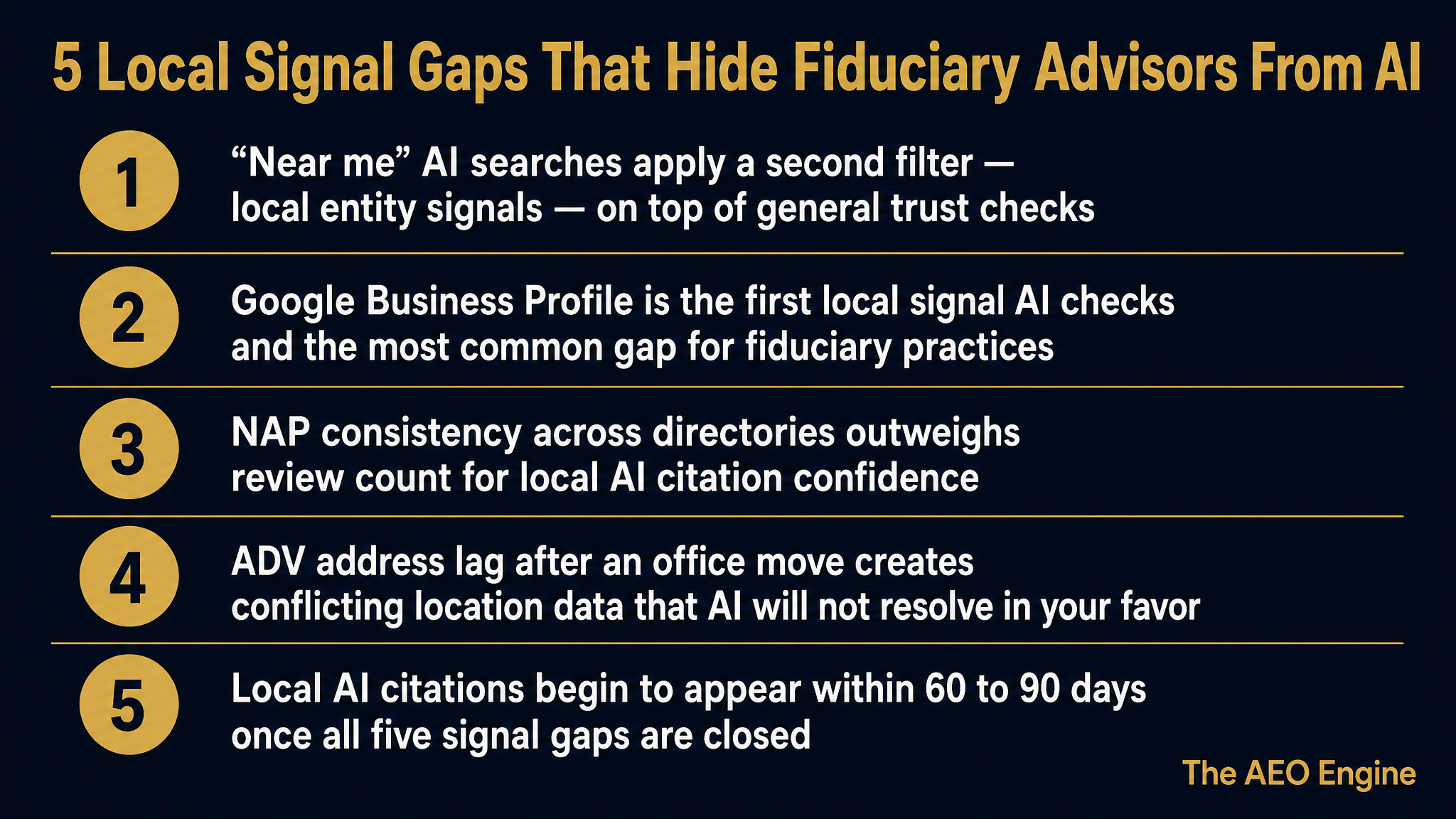
Why Does AI Treat "Near Me" Searches Differently?
A general search for "fiduciary financial advisor" asks AI to name trusted advisors broadly. A "near me" search adds a location requirement. AI must now match trust signals with geographic signals. Both must pass before a practice appears in the answer.
For general trust, AI checks SEC filings, content, and third-party mentions. For local trust, it checks verified location data, local directory listings, and geographic match. A practice with strong SEC filings but no Google Business Profile passes the first check and fails the second.
This is why many well-credentialed advisors are invisible in local AI queries. Their general entity data is solid. Their local entity data is not. AI does not guess at location. If the signal is missing or off, the practice does not appear.
What Local Signals Does AI Use to Evaluate Fiduciary Financial Advisors?
AI checks four local signal types for "near me" queries. Each one is a separate filter.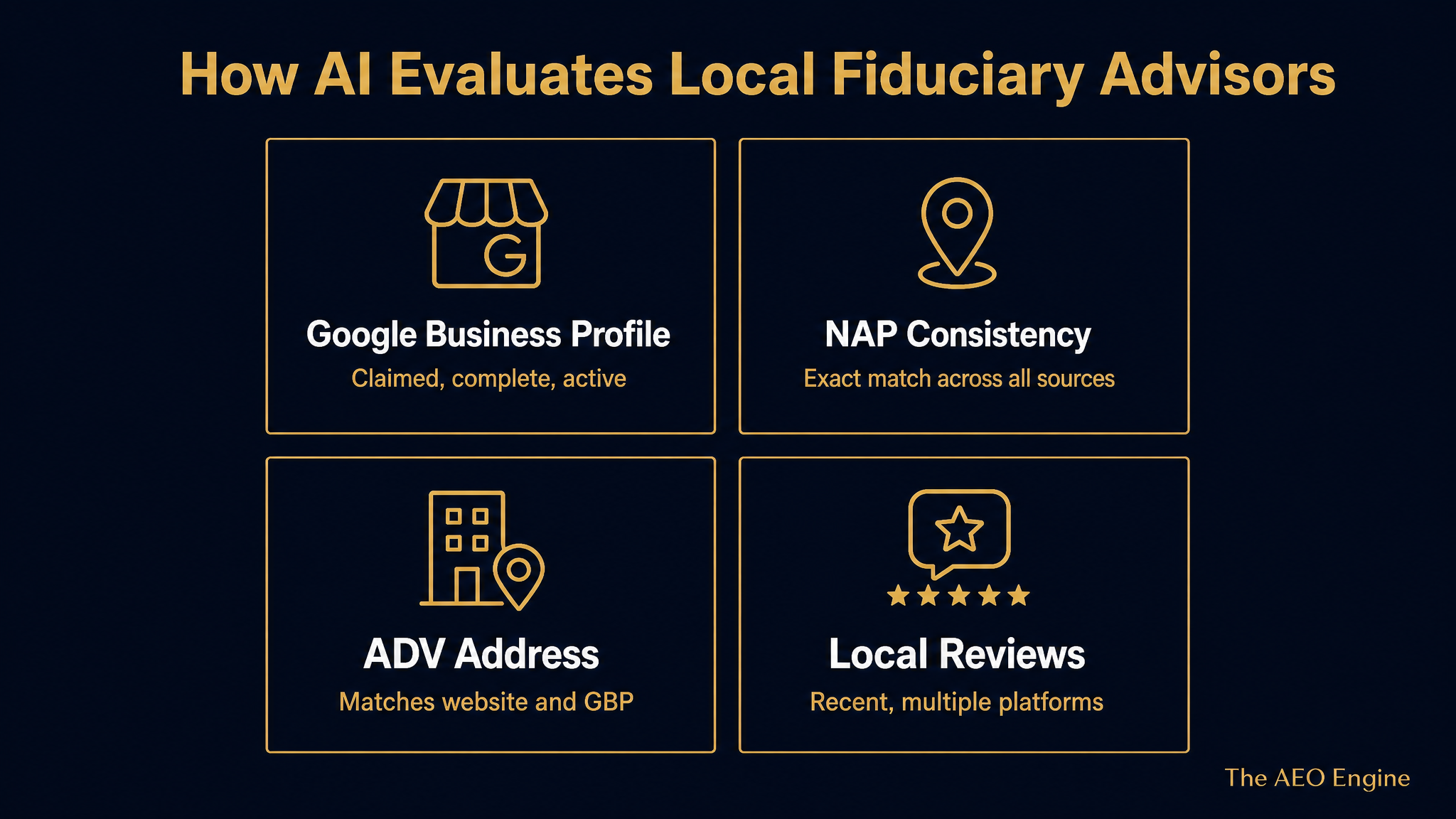
Signal 1: Google Business Profile GBP is the primary local entity source. AI uses it to confirm a practice's name, address, phone, hours, and service area. An unclaimed or incomplete GBP is the most common reason a fiduciary practice is missing from local AI answers. A profile with a correct address, verified phone, and recent activity carries the most weight.
Signal 2: NAP consistency NAP stands for Name, Address, Phone. AI checks NAP data across dozens of sources: Yelp, Bing Places, legal directories, industry listings, and the practice website. Any mismatch cuts confidence. A suite number on the website but not on NAPFA is a signal gap. AI avoids naming uncertain locations.
Signal 3: ADV filing address The SEC Investment Adviser database holds the registered address for every RIA. AI can check it. If the ADV address does not match the website or GBP, AI marks the location as uncertain. This is a common gap for practices that moved and updated the website but did not amend the ADV quickly.
Signal 4: Local reviews and local mentions Review count and recency on Google, Yelp, and local directories act as a proxy for active local presence. AI also weights local media mentions. An advisor quoted in a city journal or local news outlet signals a rooted local presence. Practices with no local mentions outside their own website are harder for AI to verify.
What Are the Most Common Local Signal Gaps for Fiduciary Advisors?
Five gaps come up repeatedly across fiduciary practices that are missing from local AI answers.
Gap 1: No Google Business Profile or an unclaimed one Many fiduciary practices either never claimed their GBP or claimed it years ago and stopped updating it. An outdated GBP sends a stale signal. AI treats it as a lower-confidence location source.
Gap 2: NAP mismatches across key directories The practice name appears in different forms across sources. One directory uses "Smith Wealth Management LLC" and another uses "Smith Wealth." The phone is a mobile on the website but a landline on NAPFA. These are not minor issues. They are signal gaps that cut AI location confidence.
Gap 3: ADV address lag after a move Practices that moved in the past two to three years often have their old address in FINRA or SEC records. The amendment takes time. During the lag, AI sees conflicting location data and skips the local result.
Gap 4: No local review strategy Fiduciary advisors are cautious about soliciting reviews due to compliance rules. That caution is understandable. It results in thin review profiles. AI uses review recency and volume as a proxy for active local service. Zero reviews or reviews from five years ago read as dormant presence.
Gap 5: No local content Most fiduciary advisor websites have no content that names a city, metro area, or local market. AI cannot connect the practice to a place if no content makes that connection. A single page titled "Fiduciary Financial Advisor in [City]" with local context closes this gap quickly.
The AEO Engine audits local citation gaps for fiduciary advisory practices. The audit covers all five signal types and produces a ranked fix plan. Book a free Strategy Session.
Why Does the Compliance Mindset Create a Local AI Visibility Problem?
Fiduciary advisors work under stricter marketing rules than most businesses. FINRA and SEC rules require pre-approval of marketing content. That culture tends to produce a minimal, cautious digital presence. The result is not just fewer reviews or less content. It is a thin local entity footprint that AI cannot verify.
The fix does not require aggressive marketing. It requires accurate, consistent factual data: a verified GBP, a correct ADV address, and a matched NAP across key directories. None of these are marketing content. None require compliance review. They are factual entity data. Closing these gaps does not conflict with fiduciary marketing rules. It fills the factual gaps that AI uses to surface a practice locally.
How Does a Structured Citation Program Address Local AI Gaps?
The CITE Framework addresses local and general entity signals in order. Local signals come first. They are the fastest to fix and produce the fastest citation movement for "near me" queries.
The sequence is:
- Claim and complete the Google Business Profile with a verified address, current phone, and accurate service area
- Audit NAP data across all major directories and fix every mismatch
- Confirm the ADV address matches the GBP and website address exactly
- Build a local review plan that fits within compliance rules
- Add one or two location-specific content pages that link the practice to its market
Practices that complete this local signal build usually begin seeing citation activity within 60 to 90 days. The general entity build runs in parallel and drives citations for broader queries. Together they close the full gap between a practice's reputation and its AI presence.
Research from Google's Business Profile support documentation shows that complete, verified business profiles are much more likely to appear in local discovery searches. AI platforms use that verified data as their primary local entity source.
Frequently Asked Questions
What is the average fee for a fiduciary financial advisor?
Fees vary by model. Fee-only advisors usually charge an hourly rate, a flat annual retainer, or a percentage of assets managed. The NAPFA website has a searchable directory of fee-only advisors where fee structures are disclosed. Commission-based advisors are not held to the same standard.
Is a fiduciary better than a financial advisor?
All fiduciaries are financial advisors, but not all financial advisors are fiduciaries. A fiduciary must put the client first by law. A non-fiduciary adviser only needs to recommend suitable products. That is a lower bar. For most clients, the fiduciary standard offers stronger legal protection and clearer goal alignment.
Can a financial advisor help with crypto?
Some fiduciary advisors include digital assets in their practice scope. Others do not. Advisors who handle crypto must disclose it in their ADV filings under SEC rules. Clients should check whether an advisor's ADV covers digital assets before engaging.
What is a red flag for a financial advisor?
Key red flags include advisors who avoid disclosing fees, advisors not registered with the SEC or FINRA, advisors who push proprietary products without disclosing conflicts, and advisors with complaint records in FINRA BrokerCheck. No fiduciary duty disclosure is itself a red flag.
Why does my fiduciary practice not appear in local AI searches?
The most common reasons are an incomplete GBP, NAP mismatches, an ADV address that does not match the current office, and no local content. Each is a local entity signal gap. Fixing them in order usually produces local AI citation activity within 60 to 90 days.
What is NAP consistency and why does it matter for local AI searches?
NAP stands for Name, Address, Phone. AI checks these three data points across all sources it can find for a business. Any mismatch cuts AI confidence in the location. Low confidence means the practice does not appear in local answers. Exact NAP matching across all directories, legal filings, and owned web pages is the base of local AI visibility.
Does a Google Business Profile actually affect AI recommendations?
Yes. Google Business Profile is the primary local entity source that AI platforms like ChatGPT and Perplexity use to verify location data. An unclaimed or incomplete GBP is the single most common reason a fiduciary practice is missing from local AI answers. Claiming and completing the profile is the fastest single action that improves local citation chances.
How long does it take to appear in local AI searches after fixing signal gaps?
Practices that complete the full local signal build (GBP, NAP, ADV address, and local content) within a single program quarter typically begin seeing local AI citation activity within 60 to 90 days. Practices with only one or two gaps fixed may see partial results sooner.
Executive Summary
Most fiduciary financial advisors are missing from local AI searches. The reason is not a weak reputation. It is a gap in local entity signals. AI adds a second filter for "near me" queries: verified location data, NAP match, ADV address check, and local reviews. A practice can pass all general trust checks and still fail these local filters. The five most common gaps are an unclaimed GBP, NAP mismatches, an ADV address that lags after a move, no local review plan, and no location-specific content. None of these gaps require marketing content to fix. They require accurate, consistent factual data. A structured citation program using the CITE Framework closes local gaps first. It then builds general entity authority in parallel. Practices that complete the full build usually see local AI citation activity within 60 to 90 days.
What Should You Do Next?
Three steps move a fiduciary practice toward local AI citations:
- Search ChatGPT and Perplexity for "fiduciary financial advisor near [your city]." Note whether you appear and who does. That gap is your baseline.
- Check your GBP, NAPFA listing, and ADV filing for NAP match. Any mismatch is a local signal gap to fix.
- Book a free Strategy Session with The AEO Engine. The session maps your local and general citation gaps and delivers a ranked fix plan.
Local AI searches are the new referral channel. Clients who ask AI for a local advisor are high-intent prospects. If your practice is not in the answer, a rival is.
People Also Read
- How Do You Pick an AEO Agency That Drives Real Citations?
- What Is the AI Recommendation Gap and Why Are You Listed But Not Recommended?
About the Author
Jerry Jariwalla is the founder of The AEO Engine and creator of the CITE Framework for Answer Engine Optimization. With over 22 years in digital marketing and multiple successful business exits, Jerry has spent the past two years building AI citation systems for regulated practices in healthcare, wealth management, and legal services. The AEO Engine works exclusively with practices operating under advertising restrictions where AI citation provides higher leverage than traditional paid acquisition.
Expertise: Answer Engine Optimization, AI Citation Strategy, CITE Framework, Regulated Industry Marketing, Healthcare Practice Marketing, Wealth Management Marketing, Legal Marketing
Connect: LinkedIn
Disclaimer: This content is for informational purposes only and does not constitute professional marketing, legal, or compliance advice. Citation rates, timelines, and outcomes vary based on industry, competitive density, and execution quality. Statistics referenced reflect The AEO Engine's tracked client outcomes as of 2026 and are not guarantees of future results. Contact The AEO Engine for a consultation regarding your specific situation.