
Last Updated: May 2026
A fiduciary financial advisor is a licensed professional. They must act in a client's best interest by law. The U.S. Securities and Exchange Commission enforces this rule for registered advisers. AI tools including ChatGPT, Perplexity, and Google AI Overviews now answer money questions. They name specific advisors. The firms they name are not always the best-known. They are the firms with the clearest trust signals. Understanding those signals is where AI presence starts.
The AEO Engine is a citation program. It helps businesses move from listed to cited by AI. Its founder, Jerry Jariwalla brings over 22 years in digital marketing and created the CITE Framework. The framework builds the entity trust that AI needs before naming a provider. The AEO Engine works with wealth, healthcare, and professional services practices. It tracks citation rates across all client programs and closes the gaps that keep providers out of AI answers.
This guide covers the signals AI uses to evaluate these advisors. It explains why most practices are missing from AI answers. It also covers what a structured citation program does differently.
Key Takeaways
- Fiduciary status is a filter, not a ranking factor: AI uses it to narrow the pool. Credential signals decide who appears at the top
- Entity clarity drives citations more than backlinks: AI checks how clearly an advisor is described across sources, not just website traffic
- Most fiduciary advisors are invisible to AI despite strong reputations: offline trust does not transfer to AI citations without structured digital signals
- The CITE Framework closes the AI citation gap: it builds the structured signals that AI needs to name a provider with confidence
- Citation rates for practices on structured programs range from 18 to 26 percent: The AEO Engine tracks this across client programs in competitive categories
Each of these five points separates advisors who appear in AI answers from those who do not.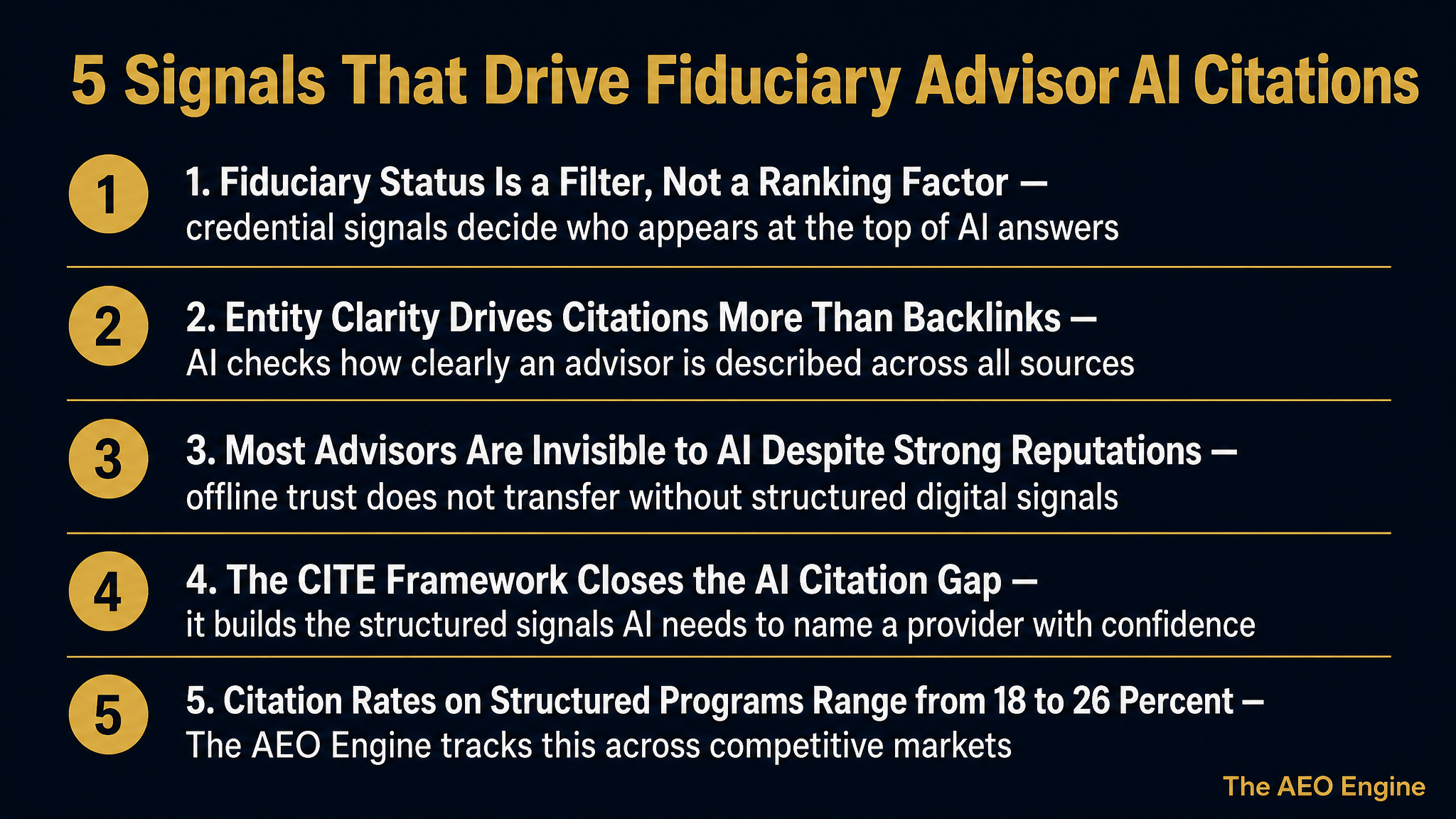
Why Does AI Treat Fiduciary Financial Advisors as a High-Stakes Category?
AI applies stricter filters to money, health, and legal topics. A wrong answer in these areas causes real harm. Google calls this YMYL: "your money or your life." ChatGPT and Perplexity apply the same caution.
AI will not name an advisor without strong trust signals. One website is not enough. One review platform is not enough. AI looks for the same advisor across legal databases, media, and directories. The name, license, and specialty must all match.
These advisors have one structural edge. Their fiduciary standard is a verifiable trust signal. AI can check it through the SEC's database. Advisors with current ADV filings get a trust baseline. But that baseline only gets an advisor into the pool AI considers. It does not determine who AI names.
What Signals Does AI Use to Evaluate Fiduciary Financial Advisors?
AI checks four signal types. Most advisors are strong in one and weak in the others.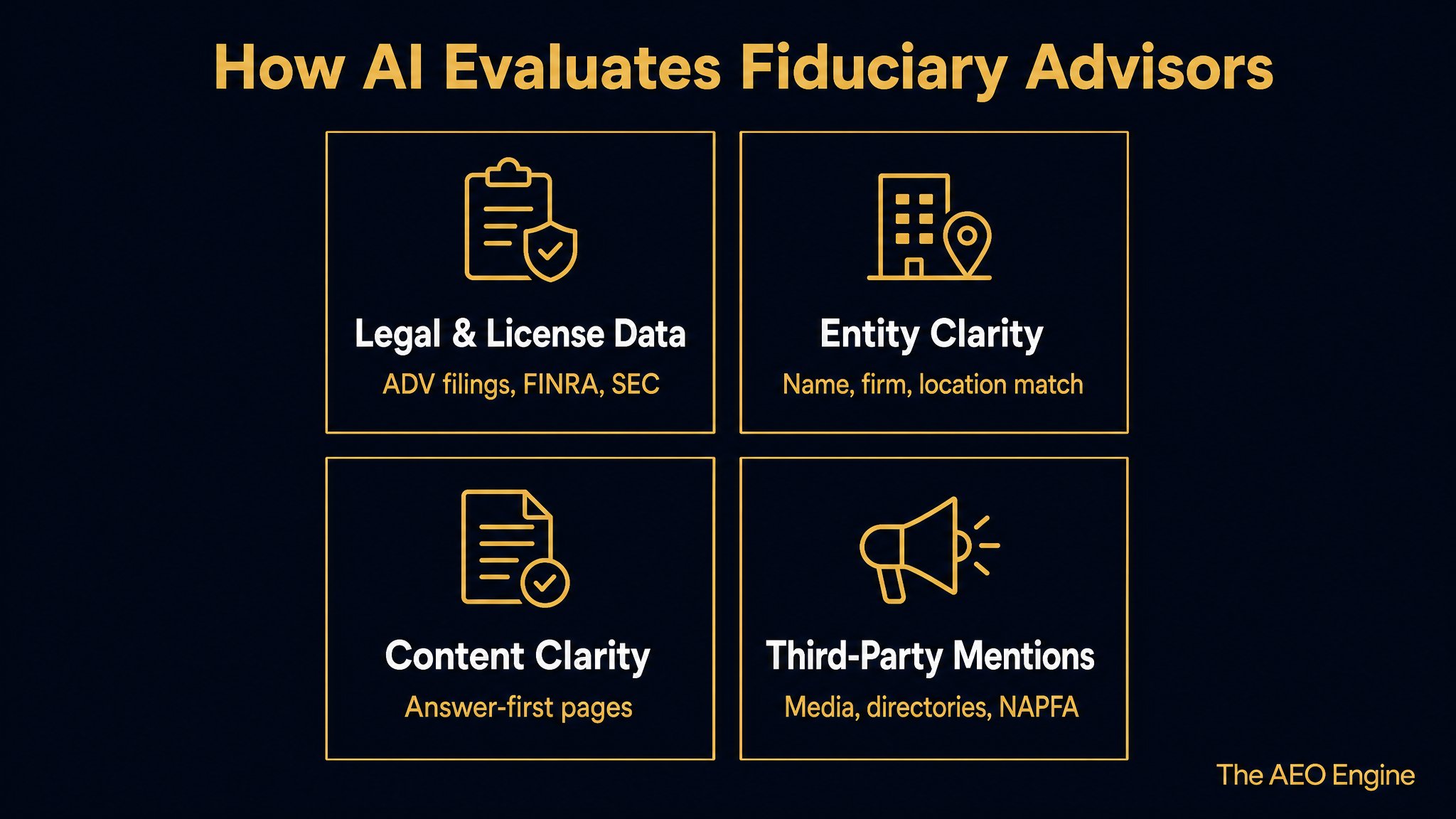
Signal 1: Legal and license data AI scans SEC EDGAR, FINRA BrokerCheck, and state databases. A current, complete ADV filing signals legitimacy. Gaps or outdated filings reduce trust. CFP and CFA licenses that match across legal data and the advisor's website carry extra weight.
Signal 2: Entity clarity AI builds a profile of who the advisor is. It cross-checks sources. The advisor's name, firm, city, license, and specialty must match across their website, Google Business Profile, LinkedIn, directories, and media. Mixed signals mean doubt. AI avoids doubt on money topics.
Signal 3: Content clarity AI looks for advisors who publish clear answers. A site with ten well-structured pages on fiduciary duties, fee types, and retirement planning signals expertise. A site with a homepage and contact form does not. Content that answers what users are asking gets treated as a citation source.
Signal 4: Third-party mentions AI weighs mentions in media, industry publications, and directories. An advisor quoted in a regional business journal carries more weight. NAPFA membership and the National Association of Personal Financial Advisors directory listing are sources AI recognizes as credible.
What Separates Advisors AI Cites From Those It Ignores?
The gap is not reputation. Many well-regarded fiduciary practices with long client lists do not appear in AI answers. The gap is structured digital entity data.
AI cannot evaluate what it cannot find. A practice with 20 years of service but a five-page website is invisible to AI. Citations go to practices with weaker track records but stronger signals.
An adviser with 30 years of experience and no structured online presence competes against a newer practice with clear entity data and backed-up licenses. AI names the second practice. The first still gets referrals. Their AI inquiry channel is empty.
The AEO Engine runs AI citation audits for advisory practices. The audit covers all four signal types and produces a gap report with a ranked action plan. Book a free Strategy Session.
.
Why Are Most Fiduciary Advisors Missing From AI Answers?
Three structural gaps explain most cases.
Gap 1: Compliance rules reduced online presence These advisors operate under strict marketing rules. Content review rules led many practices to default to a minimal online presence. That made legal sense. It created an AI presence problem.
Gap 2: Referrals made digital investment feel optional Many strong practices built their client base through referrals. A digital presence felt secondary. AI has changed that. Prospective clients now ask AI for advisor names before asking colleagues. If the practice is not cited, the referral channel still works. But the AI inquiry channel is closed.
Gap 3: SEO spend did not translate to AI citations Many practices invested in search engine work. SEO builds traffic. It does not build entity trust. AI citations need a different signal set. An advisor can rank on page one of Google and still not appear in a single AI answer. The two systems work differently.
How Does a Structured Citation Program Change the Outcome?
The CITE Framework addresses all four signal types in order. It starts with entity data and license clarity. It then builds content authority through structured, direct-answer pages. Finally it pursues third-party mentions through directories, media, and industry listings.
Practices on the program begin to see citation changes within the first program quarter. The AEO Engine tracks citation rates across client programs. The range sits between 18 and 26 percent for practices that complete the full entity and content build. That compares with near-zero rates for practices that have not addressed entity signals.
The distinction from SEO is the signal type. SEO targets search ranking. Citation programs target the entity trust models that AI uses to decide whom to name. They need different content types, different technical signals, and different third-party strategies.
Research from the CFP Board shows that consumer trust in advisors links to verified licenses and clear communication of the fiduciary standard. AI applies the same logic at scale. It surfaces advisors whose licenses are verified and whose content is clear.
Frequently Asked Questions
What do fiduciary financial advisors do?
A fiduciary financial advisor is licensed to manage investments and build financial plans. They must act in the client's best interest at all times. The SEC enforces this rule for registered advisers. It applies to every advice decision they make.
What is the average cost of a fiduciary financial advisor?
Fees vary by fee model. Fee-only advisors may charge an hourly rate, a flat retainer, or a percentage of assets managed. The NAPFA website lists fee-only advisors with their fee structures disclosed. Commission-based advisors are not fiduciaries under the same standard.
Is it better to have a financial advisor or a fiduciary?
All fiduciaries are financial advisors, but not all financial advisors are fiduciaries. A fiduciary must put the client first. A non-fiduciary adviser only needs to recommend suitable products. That is a lower bar. The fiduciary standard offers stronger legal protection for most consumers.
What are the disadvantages of a fiduciary?
These advisors typically charge fee-only rates rather than commissions. This can mean higher upfront costs for some clients. Compliance rules can limit the product range they recommend. Some practices have account minimums that put them out of reach for clients with smaller portfolios.
How does AI decide which fiduciary financial advisors to recommend?
AI evaluates these advisors across four signal types: legal and license data, entity clarity, content clarity, and third-party mentions. The fiduciary registration provides a baseline trust signal AI can verify. But consistent entity signals across multiple sources determine who gets cited. Registration alone is not enough.
What is the most important signal for fiduciary advisor AI visibility?
Entity clarity is the most commonly overlooked signal. AI builds a profile of who an advisor is by comparing data across sources. If the name, license, specialty, and location match across all platforms, AI treats that as a reliable entity. Mixed signals create doubt. AI avoids doubt on money topics.
How long does it take a fiduciary advisor to appear in AI answers?
Practices that complete the entity and content build within the first program quarter typically begin seeing citation activity within 60 to 90 days. Practices with major gaps in legal data take longer. There is no instant result. AI citation authority builds with consistent signals over time.
Can a small fiduciary practice compete with large firms in AI answers?
Yes. AI does not favor larger firms automatically. It favors practices with clearer, more consistent entity signals. A solo adviser with a current ADV filing, matched entity data, and a well-structured content library can appear above a larger firm with a fragmented online presence.
Executive Summary
AI decides which fiduciary financial advisors to recommend based on four signal types: legal and license data, entity clarity, content clarity, and third-party mentions. The fiduciary registration provides a trust baseline AI can verify through SEC and FINRA databases. But it does not determine who gets cited. Most fiduciary practices are missing from AI answers not because of weak reputations but because of gaps in their digital entity presence. The firms that appear have consistent, backed-up signals across multiple sources. A structured citation program using the CITE Framework addresses all four signal types and builds the entity trust AI needs to name a practice. The AEO Engine tracks citation rates of 18 to 26 percent for practices that complete the full program. Practices that have not addressed entity signals see near-zero rates.
What Should You Do Next?
Three steps move a fiduciary practice toward AI citations:
- Run an AI citation check. Ask ChatGPT, Perplexity, and Google AI Overviews about fiduciary advisors in your market. Most practices find they are not cited. That gap is the baseline.
- Audit your entity signals. Check how your name, license, specialty, and location appear across your website, SEC filings, LinkedIn, Google Business Profile, and key directories. Mixed signals in any source reduce AI trust.
- Book a free Strategy Session with The AEO Engine.The session covers your citation gap, the signals holding your practice back, and a ranked plan to close those gaps.
Fiduciary advisors built their practices on trust. AI citations extend that trust to clients who now ask AI first.
People Also Read
- How Do Answer Engine Optimization Services Drive AI Citations?
- What Does an AI Visibility Audit Reveal About Your Citation Gap?
About the Author
Jerry Jariwalla is the founder of The AEO Engine and creator of the CITE Framework for Answer Engine Optimization. With over 22 years in digital marketing and multiple successful business exits, Jerry has spent the past two years building AI citation systems for regulated practices in healthcare, wealth management, and legal services. The AEO Engine works exclusively with practices operating under advertising restrictions where AI citation provides higher leverage than traditional paid acquisition.
Expertise: Answer Engine Optimization, AI Citation Strategy, CITE Framework, Regulated Industry Marketing, Healthcare Practice Marketing, Wealth Management Marketing, Legal Marketing
Connect: LinkedIn
Disclaimer: This content is for informational purposes only and does not constitute professional marketing, legal, or compliance advice. Citation rates, timelines, and outcomes vary based on industry, competitive density, and execution quality. Statistics referenced reflect The AEO Engine's tracked client outcomes as of 2026 and are not guarantees of future results. Contact The AEO Engine for a consultation regarding your specific situation.