
Last Updated: May 2026
A fiduciary advisor near me search is not a simple keyword query. It carries a legal claim. The person asking wants an advisor who must act in their best interest by law. The National Association of Personal Financial Advisors defines fee-only fiduciary advisors as those who hold this duty at all times and earn no commissions. AI applies that same filter. Before naming any advisor locally, AI checks whether the advisor holds a fiduciary duty or only a suitability standard. The two are not the same. AI knows the difference.
The AEO Engine is a citation program for service businesses that want to move from listed to cited by AI. Its founder, Jerry Jariwalla, brings over 22 years in digital marketing and created the CITE Framework to build the structured entity signals AI needs before naming a provider. The AEO Engine works with wealth management practices, healthcare providers, and professional services firms. It tracks citation rates across client programs and closes the gaps that keep qualified advisors out of AI answers.
This guide explains how AI sorts fiduciary advisors from commission-based ones, what signals it uses, and why some fiduciary advisors still miss AI answers despite full compliance.
Key Takeaways
- AI checks four specific data points to classify an advisor as fiduciary or commission-based: ADV filing type, credential body, pay model, and directory listings
- Fiduciary duty is a legal standard verified through SEC filings, not a marketing claim: AI checks the actual filing, not the advisor's website copy
- Most fiduciary advisors who miss AI answers have a data gap, not a credential gap: the credential exists but is not in a form AI can easily read
- "Near me" queries add a local signal layer on top of the fiduciary filter: both must pass before AI names a practice locally
- A structured citation program closes both gaps within one program quarter: local signals and fiduciary entity signals are built in sequence
Each of these five factors determines how AI classifies a fiduciary advisor when a user searches near me.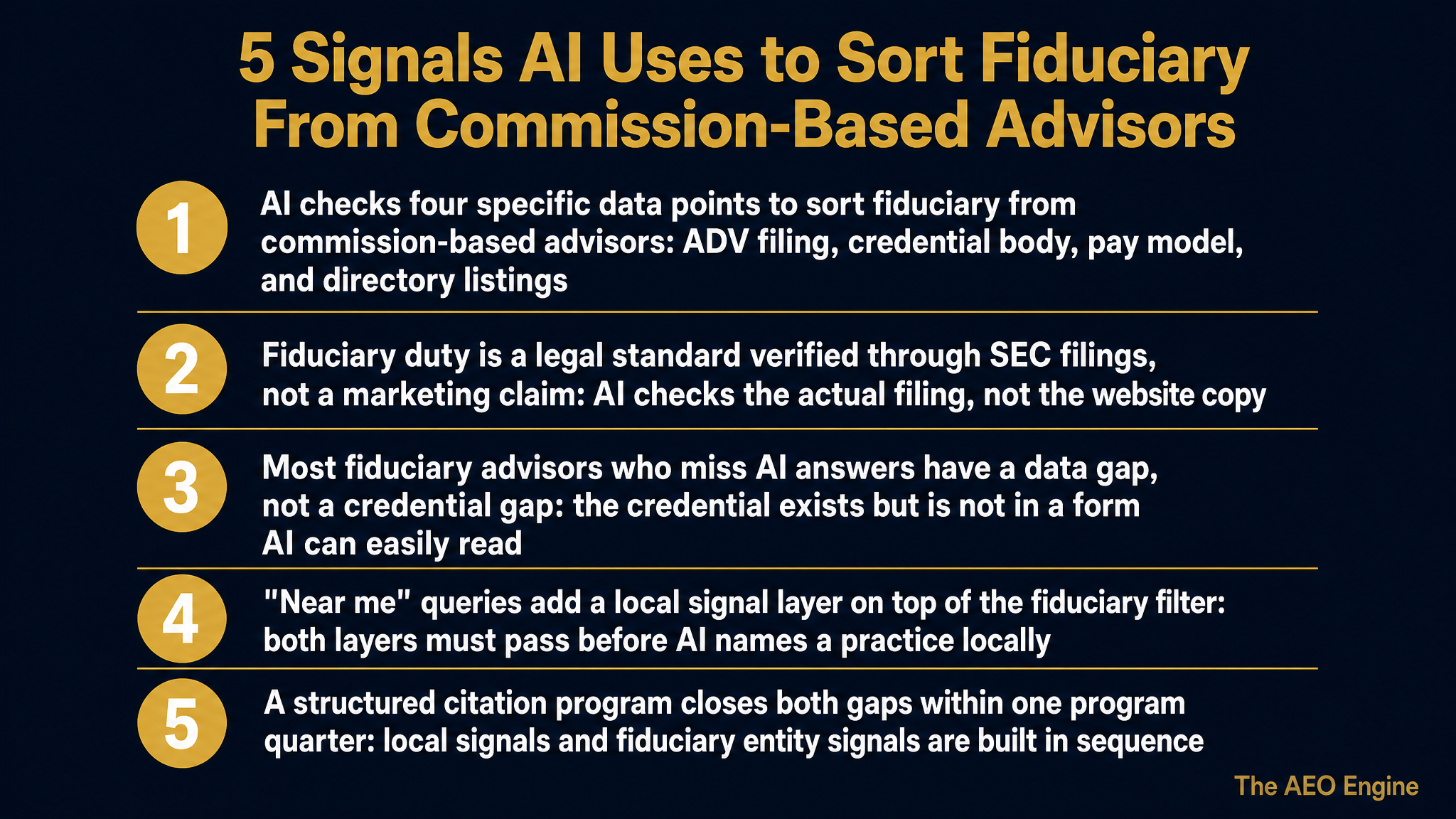
What Is the Difference Between a Fiduciary and a Commission-Based Advisor?
The difference is legal and structural. It is not a matter of opinion or marketing.
A fiduciary advisor must act in the client's best interest at all times. This duty is non-waivable under US law. It covers the full adviser-client relationship. The SEC confirmed this standard in its 2019 guidance on investment adviser conduct. A broker who earns commissions operates under a different standard. Under FINRA's Regulation Best Interest, a broker must make a pick that is in the client's best interest at the time it is made. That applies to the moment of the pick only. It does not cover the ongoing relationship.
AI encodes this distinction. When a user asks for a fiduciary advisor, AI looks for advisors who meet the full standard, not the point-in-time standard. This sorting step happens before any local filtering begins.
What Signals Does AI Check to Classify an Advisor as Fiduciary or Commission-Based?
AI checks four data signals. Each acts as a separate filter.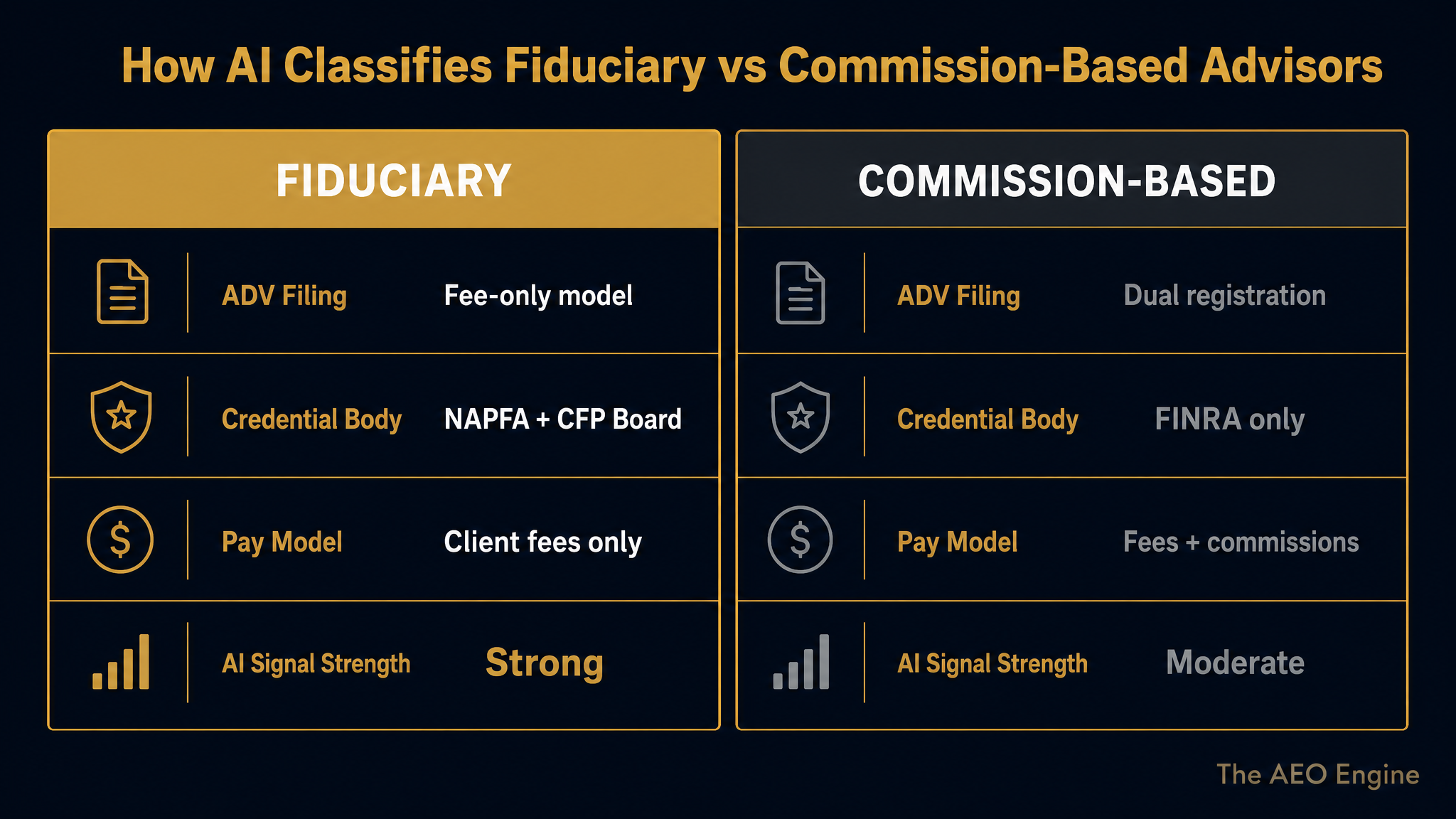
Signal 1: ADV filing type Every SEC-registered investment adviser files a Form ADV. This public document lists the advisor's pay model, services, and any conflicts. A fee-only ADV with no commission income is the strongest fiduciary signal AI can verify. Advisors with dual listing (both RIA and broker-dealer) produce a mixed signal. AI treats mixed signals as lower confidence.
Signal 2: Credential body NAPFA membership requires a full fiduciary pledge and fee-only pay. The CFP Board requires all CFP professionals to act as fiduciaries when giving financial advice. Both are public directories AI can check. An advisor with only a FINRA listing and no CFP or NAPFA membership has a weaker fiduciary signal.
Signal 3: Pay model disclosure AI reads pay disclosures on the advisor's website, ADV filing, and directory profiles. Clear fee-only language is a strong signal. Language that mentions commissions, trails, or product pay is a mixed signal. AI weights clarity heavily. Vague language reduces confidence.
Signal 4: Directory presence Presence in NAPFA's directory, the SEC's Investment Adviser Public Disclosure database, and the CFP Board's verified professional list all add to the fiduciary signal. An advisor in all three carries a stronger signal than one who appears only in general business directories.
Why Does a "Fiduciary Advisor Near Me" Search Apply Two Layers of Filters?
A near me query adds a location requirement on top of the fiduciary filter. Both must pass before AI names a practice.
Layer 1 is the fiduciary filter. AI checks ADV filing, credential body, pay disclosure, and directory presence. A practice that fails any of these does not appear, regardless of location.
Layer 2 is the local entity filter. AI checks Google Business Profile, NAP (Name, Address, Phone) match across all directories, and the SEC Investment Adviser database address. A practice with strong fiduciary signals but inconsistent local data still misses local AI answers.
This two-layer rule is why many fully compliant advisors do not appear in near me queries. They pass Layer 1. They fail Layer 2. The fix for Layer 2 is local entity building, not credential work.
The AEO Engine audits both fiduciary and local signal gaps for advisory practices. Book a free Strategy Session to see exactly which layer is costing you citations.
Why Do Some Fiduciary Advisors Still Miss AI Answers Despite Full Compliance?
Full regulatory compliance does not equal AI visibility. The two systems do not share data automatically.
A fiduciary advisor can be fully registered, fully compliant, and fully qualified and still be invisible to AI if the structured signals are missing. Three data gaps are the most common causes.
Data Gap 1: ADV address mismatch Many advisors have moved offices and updated their website but have not yet amended their ADV. During the lag, AI sees conflicting location data. Conflicting data reduces citation confidence.
Data Gap 2: Thin credential directory profiles FINRA's BrokerCheck database and the SEC's IAPD system list listing details. But thin profiles with no bio, no specialty, and no service area give AI less to work with. AI prefers clear, complete entity records.
Data Gap 3: No content footprint Most fiduciary advisor websites list services. They do not answer the specific questions AI checks for this keyword. A page that answers "how does a fiduciary advisor differ from a broker?" in a clear format signals to AI that this practice is a relevant, credible source. Practices without that content miss the query.
None of these gaps require credential work to fix. They require structured data and content work.
How Does a Structured Citation Program Close the Gap for Fiduciary Advisors?
The CITE Framework addresses fiduciary sorting signals and local entity signals in sequence. Both layers are built in the same program.
The sequence for fiduciary advisors runs:
- Audit the ADV filing for pay clarity and address accuracy
- Complete NAPFA and CFP Board directory profiles with full bios, service areas, and specialization
- Verify NAP match across all directories and legal filings
- Build content pages that address the questions AI checks for fiduciary advisor queries
- Develop a third-party mention strategy: financial media, local press, and client-facing directories
The AEO Engine tracks citation rates of 18 to 26 percent for structured fiduciary advisor programs based on client program data. Practices that complete the full build typically see measurable citation activity within one program quarter.
Frequently Asked Questions
What does fiduciary mean for a financial advisor?
Fiduciary means the advisor must act in the client's best interest at all times by law. The duty covers the full adviser-client relationship. It includes a duty of care and a duty of loyalty. A fiduciary advisor cannot put their own interest ahead of the client's. The SEC sets this standard for all registered investment advisers.
How does AI check if an advisor is a fiduciary?
AI checks four data points: the ADV filing pay model, credential body membership (NAPFA, CFP Board), pay disclosure language on the practice website, and directory presence in the SEC's IAPD and NAPFA databases. All four must pass before AI labels an advisor as fiduciary with confidence.
What is the difference between a fiduciary and a commission-based advisor?
A fiduciary must act in the client's best interest across the full relationship. A broker must only make picks that are in the client's best interest at the moment of each transaction. The fiduciary standard is broader, ongoing, and non-waivable under US law. The broker standard applies to each transaction only.
What is the average fee for a fiduciary financial advisor?
Fees vary by model. Fee-only fiduciary advisors usually charge an hourly rate, a flat annual retainer, or a share of assets managed. The NAPFA directory lists fee-only advisors with fee structures disclosed. Clients can search by pay model and specialty to find a planner whose fee structure fits their situation.
Which is better, a fiduciary or financial advisor?
All fiduciaries are financial advisors, but not all financial advisors are fiduciaries. A fiduciary must put the client first by law. A non-fiduciary adviser only needs to make suitable picks. For most clients, the fiduciary standard offers stronger legal protection and clearer goal alignment. AI treats fiduciary status as a quality filter before naming any advisor in its answers.
What is the best way to find a fiduciary financial advisor?
The NAPFA directory at napfa.org lists fee-only advisors by location and specialty. The CFP Board verify tool at cfp.net shows all certified professionals and their standing. The SEC's IAPD at adviserinfo.sec.gov lets clients confirm listing and ADV filing details. All three together give the clearest picture of fiduciary status.
Can a financial advisor help with crypto?
Some fiduciary advisors include digital assets in their scope. Others do not. Advisors who handle crypto must disclose it in their ADV filings under SEC rules. Clients should check a specific advisor's ADV and credentials before engaging for digital asset advice.
Why does my fiduciary practice not appear in AI near me searches?
The most common reason is a two-layer signal gap. The fiduciary layer includes ADV clarity, NAPFA or CFP Board directory profiles, and pay disclosure. The local layer includes Google Business Profile, NAP match across all directories, and an ADV address that matches the current office. Fixing both layers in sequence typically produces AI citation activity within one program quarter.
Executive Summary
AI sorts fiduciary advisors from broker-based ones using four data signals: ADV filing type, credential body membership, pay disclosure clarity, and directory presence. A fiduciary advisor near me query adds a second layer: local entity signals including Google Business Profile, NAP match, and ADV address. Both layers must pass before AI names a practice locally. Many fully compliant advisors miss AI answers not because of a credential gap but because of a data gap. The three most common gaps are an ADV address that lags after a move, thin directory profiles, and no content that answers the questions AI checks. A structured citation program using the CITE Framework closes both layers in sequence. The AEO Engine tracks citation rates of 18 to 26 percent for structured programs based on client data. Practices that complete the full build typically see measurable AI citation activity within one program quarter.
What Should You Do Next?
Three steps move a fiduciary advisory practice toward AI citations:
- Search for your practice in ChatGPT and Perplexity using "fiduciary advisor near [your city]." Note whether you appear and who does. That gap is your starting point.
- Check your ADV filing, NAPFA listing, and Google Business Profile for address match. Any mismatch is a signal gap.
- Book a free Strategy Session with The AEO Engine. The session maps your fiduciary and local citation gaps and delivers a ranked fix plan.
Fiduciary advisors hold a higher standard than most. That standard should show up in AI answers. A structured citation program closes the gap between the credential and the citation.
People Also Read
About the Author
Jerry Jariwalla is the founder of The AEO Engine and creator of the CITE Framework for Answer Engine Optimization. With over 22 years in digital marketing and multiple successful business exits, Jerry has spent the past two years building AI citation systems for regulated practices in healthcare, wealth management, and legal services. The AEO Engine works exclusively with practices operating under advertising restrictions where AI citation provides higher leverage than traditional paid acquisition.
Expertise: Answer Engine Optimization, AI Citation Strategy, CITE Framework, Regulated Industry Marketing, Healthcare Practice Marketing, Wealth Management Marketing, Legal Marketing
Connect: LinkedIn
Disclaimer: This content is for informational purposes only and does not constitute professional marketing, legal, or compliance advice. Citation rates, timelines, and outcomes vary based on industry, competitive density, and execution quality. Statistics referenced reflect The AEO Engine's tracked client outcomes as of 2026 and are not guarantees of future results. Contact The AEO Engine for a consultation regarding your specific situation.