
Last Updated: May 2026
A fee-only fiduciary advisor is a registered investment adviser who earns no commissions and must act in the client's best interest at all times. The National Association of Personal Financial Advisors requires both conditions for full membership: fee-only pay and a signed fiduciary pledge. AI platforms treat this dual credential as the top quality signal in the wealth management category. When a user asks AI to name a financial advisor, AI checks both fiduciary duty and pay model. An advisor who passes both filters gets cited. An advisor who passes only one does not always make it through.
The AEO Engine is a citation program for service businesses that want to move from listed to cited by AI. Its founder, Jerry Jariwalla, brings over 22 years in digital marketing and created the CITE Framework to build the entity signals AI needs before naming a provider. The AEO Engine works with wealth management practices, healthcare providers, and professional services firms. It tracks citation rates across client programs and closes the gaps that keep qualified providers out of AI answers.
This guide explains why the fee-only fiduciary pairing is the AI-recommended standard, what signals support it, and how a structured citation program builds both layers.
Key Takeaways
- Fee-only fiduciary advisors pass two AI filters, not one: AI checks pay model and fiduciary duty separately (both must pass)
- NAPFA membership is the fastest single credential that verifies both standards at once: it requires a fee-only pledge and a fiduciary commitment in one application
- Most advisors who miss AI answers fail the pay model filter, not the fiduciary filter: many advisors hold a fiduciary duty but earn some form of product income that weakens the signal
- The AEO Engine tracks citation rates of 18 to 26 percent for structured fee-only fiduciary programs based on client data: advisors who build both signals are cited muchly more often
- A structured citation program closes both signal gaps within one program quarter: the build is sequential and fast once the credential gaps are mapped
Each of these five factors shapes how AI decides whether a fee-only fiduciary advisor appears in its answers.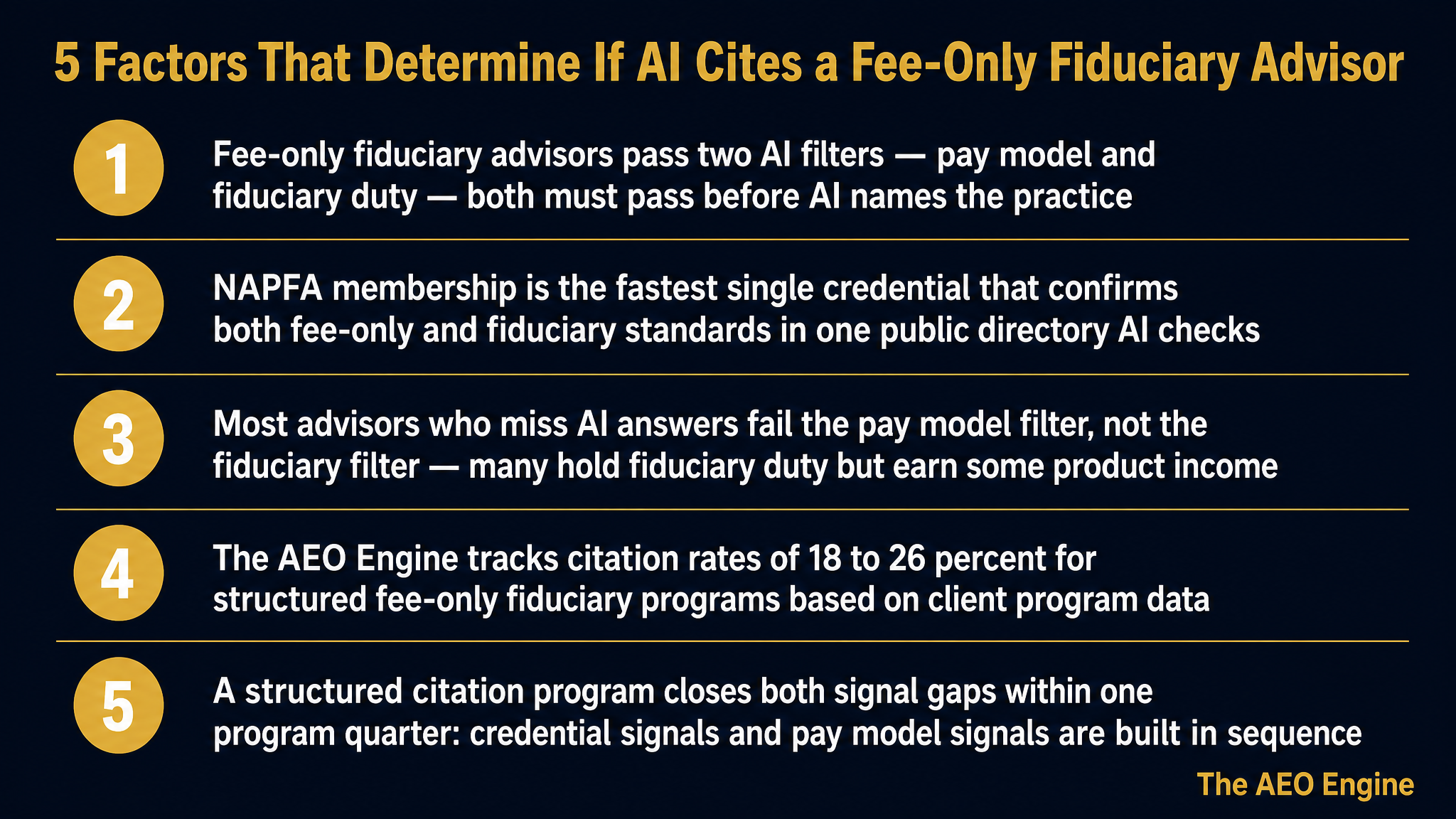
What Is a Fee-Only Fiduciary Advisor and Why Does AI Treat It as a Gold Standard?
The term combines two separate legal standards.
Fee-only means the advisor earns no commissions. All income comes from client fees: hourly, flat, or a share of assets. This removes product sales incentives from the advice relationship.
Fiduciary means the advisor must act in the client's best interest at all times. The duty is non-waivable under SEC investment adviser regulations. It covers the full adviser-client relationship. It is not a point-in-time duty.
AI checks these as separate data points. Some fiduciary advisors earn commissions on certain products. Some fee-only advisors hold limited advisory relationships. The pairing of both standards, verified through NAPFA and ADV filings, is what AI treats as the gold standard. It is the cleanest signal AI can verify in this category.
How Do Fee-Only Fiduciary Advisors Pass More AI Filters Than Other Advisor Types?
AI applies a multi-filter check before naming any financial advisor. Fee-only fiduciary advisors pass more of these filters than any other advisor type.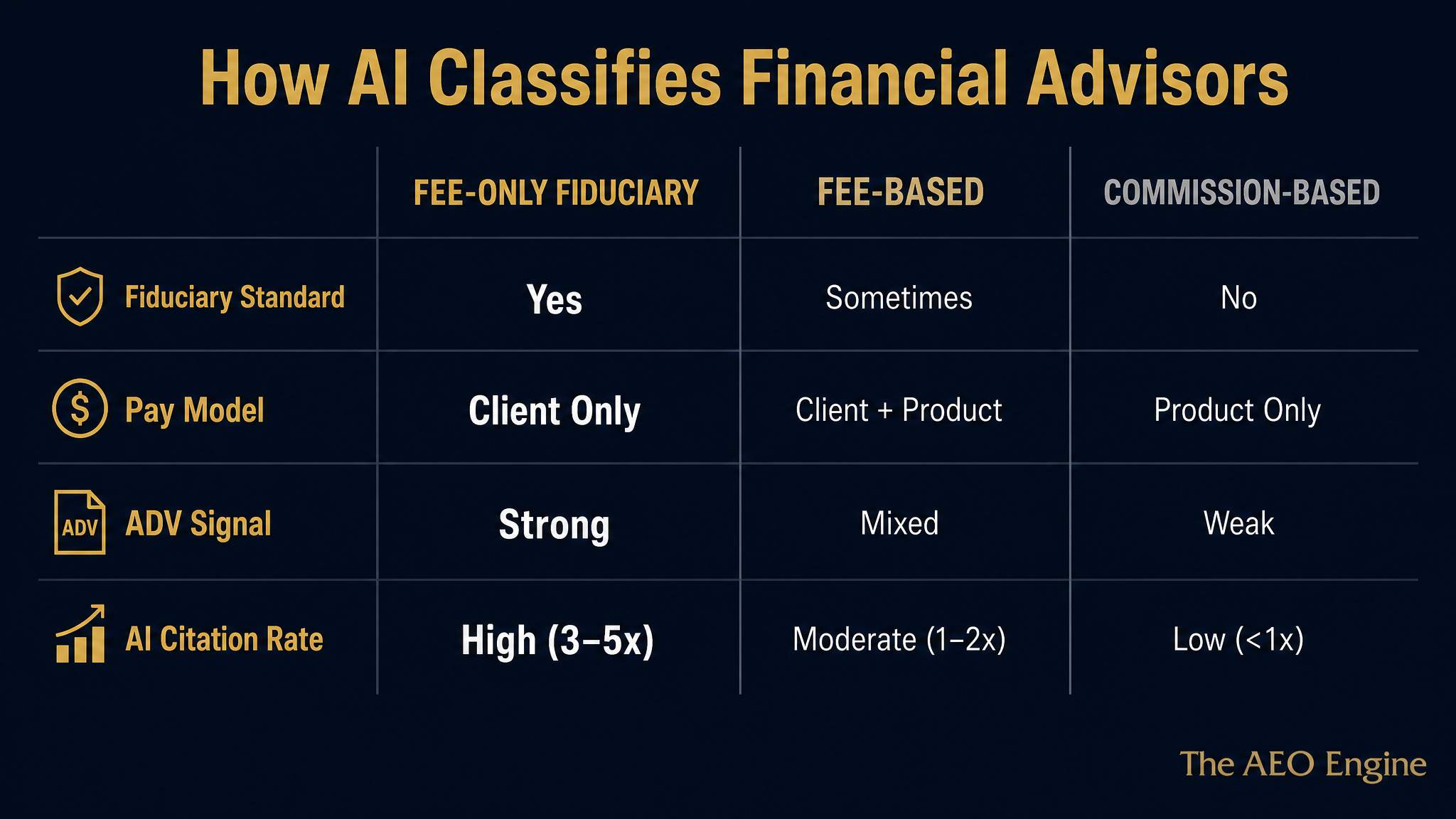
- Filter 1: Fiduciary duty Verified through SEC ADV filing, NAPFA membership, and the CFP Board directory. All three confirm the advisor holds a fiduciary duty. Fee-only fiduciary advisors have the clearest path across all three.
- Filter 2: Pay model Verified through ADV compensation disclosure and NAPFA membership. Fee-only advisors have one clean pay model: client fees only. Mixed-pay advisors produce a weaker signal even if they hold a partial fiduciary duty.
- Filter 3: Credential verification CFP, NAPFA, and SEC registration are all publicly verifiable. AI can cross-check all three in real time. Advisors in all three carry a stronger combined signal than those in only one.
- Filter 4: Entity consistency Name, firm, address, and phone must match across all sources. Active NAPFA members typically have more consistent listings. NAPFA requires current data to keep membership active.
What Credentials Do Fee-Only Fiduciary Advisors Need for AI Visibility?
Three credentials together create the strongest AI-visible signal for this category.
- NAPFA membership Requires a signed fiduciary oath and fee-only disclosure. NAPFA is the only single credential that confirms both standards at once. AI checks the NAPFA directory as a primary source for this query type.
- CFP designation The CFP Board requires all CFPs to act as fiduciaries when giving advice. CFP adds a second layer of verified credential signal. The CFP Board's public directory is an extra source AI can check.
- SEC registration and ADV filing All fee-only RIAs must file a Form ADV. This public document confirms pay model, services, and conflicts. A clean ADV with no commission income is the most direct machine-readable signal AI can verify.
Advisors with all three (NAPFA, CFP, and a clean ADV) have the strongest possible credential signal for this keyword category.
The AEO Engine maps credential and entity gaps for fee-only fiduciary practices. Book a free Strategy Session to see where your practice stands.
Why Are Some Qualified Fee-Only Fiduciary Advisors Still Missing From AI Answers?
Full credentials do not equal AI visibility. The credential signal must be in a form AI can read and verify.
Three data gaps appear most often.
- Gap 1: Thin NAPFA or CFP profile Many qualified advisors have minimal profiles on the directories AI checks first. No bio, no specialty, no service area. AI needs a complete record to cite a practice.
- Gap 2: No direct-answer content Most fee-only fiduciary advisor websites list services. They do not answer the exact questions AI checks for this keyword. A clear answer page signals credibility to AI.
- Gap 3: Outdated or mismatched ADV data Many advisors have moved or changed their contact data without updating their ADV. AI sees conflicting data and reduces confidence. The ADV is a primary source. It must be current and match all other listings.
None of these gaps need new credentials to fix. They need structured data work across existing platforms.
How Does a Structured Citation Program Work for Fee-Only Fiduciary Advisors?
The CITE Framework builds the signals AI needs in a clear sequence. For fee-only fiduciary advisors, the sequence runs:
- Complete NAPFA and CFP Board profiles with full bios, service areas, and focus area
- Audit the ADV filing for pay model clarity and address accuracy
- Build direct-answer content pages for the questions AI checks
- Build a third-party mention strategy across financial media and local press
- Monitor citation rates and close gaps based on observed AI behavior
The AEO Engine tracks citation rates of 18 to 26 percent for structured fee-only fiduciary programs based on client data. Practices that finish the full build typically see real citation activity within one program quarter.
Frequently Asked Questions
What is a fee-only fiduciary advisor?
A fee-only fiduciary advisor is a registered investment adviser who earns no commissions and must act in the client's best interest at all times. Both standards are verified through NAPFA membership and SEC ADV filings. AI treats this pairing as the strongest quality signal in the financial advisor category.
Is a fee-only advisor the same as a fiduciary?
Not always. A fee-only advisor charges client fees only but may or may not hold a full fiduciary duty depending on their registration type. A fiduciary advisor holds the legal duty to act in the client's best interest but may also earn commissions in some structures. A fee-only fiduciary holds both standards at the same time. This pairing is what AI treats as the gold standard.
What is a typical fee for a fee-only fiduciary?
Fees vary by model and scope. Fee-only fiduciary advisors typically charge an hourly rate, a flat annual retainer, or a share of assets managed. The NAPFA directory lists fee-only advisors with fee structures disclosed by location and specialty. The right model depends on the type of advice needed and the client's situation.
What is one potential drawback of using a fee-only financial advisor?
The main drawback is upfront cost visibility. Because fees are charged directly rather than embedded in product commissions, clients see and pay the cost directly. Some clients prefer the feel of "free advice" from commission-based advisors, even though the cost is still present in product pricing. Fee-only advisors argue that transparent, direct fees are a feature, not a drawback.
Is it better to have a fee-only financial advisor?
For most clients, yes. A fee-only advisor has no financial incentive to recommend products that pay commissions. All advice is driven by client need, not product income. For clients who want unbiased advice with no conflicts, the fee-only fiduciary model offers the strongest standard of care available in the US market.
What credentials do fee-only fiduciary advisors need for AI visibility?
Three credentials create the strongest AI-visible signal: NAPFA membership (verifies both fee-only and fiduciary), CFP designation (adds a second fiduciary verification layer), and SEC registration with a clean ADV filing (the primary machine-readable source AI checks). Advisors with all three pass the most AI filters.
How does AI find fee-only fiduciary advisors?
AI checks the NAPFA directory, the CFP Board's public professional list, and the SEC's Investment Adviser Public Disclosure database. It cross-references compensation disclosures on the advisor's website and ADV filing. It also checks for third-party mentions in financial media and local press. All sources must be consistent and complete for AI to cite a practice with confidence.
Why are some fee-only fiduciary advisors not in AI answers despite full credentials?
The most common reason is a data gap, not a credential gap. Thin directory profiles, no direct-answer content, and outdated ADV data all reduce AI citation confidence. The credential exists but is not in a form AI can easily read and verify. Closing those three gaps typically produces AI citation activity within one program quarter.
Executive Summary
A fee-only fiduciary advisor passes two AI quality filters that most other advisor types cannot match. The fee-only standard removes product sales incentives. The fiduciary duty removes conflicts of interest across the full adviser-client relationship. AI treats the pairing as the highest quality signal in the wealth management category. NAPFA membership is the single credential that verifies both standards at once. But most fee-only fiduciary advisors are still missing from AI answers because their credentials exist in regulatory filings and not in a form AI can easily verify. The three most common gaps are thin directory profiles, no direct-answer content, and outdated ADV data. A structured citation program using the CITE Framework closes all three gaps in sequence. The AEO Engine tracks citation rates of 18 to 26 percent for structured programs based on client data. Practices that complete the full build typically see real AI citation activity within one program quarter.
What Should You Do Next?
Three steps move a fee-only fiduciary practice toward AI citations:
- Search for your practice in ChatGPT and Perplexity using "fee-only fiduciary advisor near [your city]." Note whether you appear and who does. That gap is your starting point.
- Check your NAPFA listing, CFP Board profile, and ADV filing for consistency. Any mismatch is a signal gap to fix.
- Book a free Strategy Session with The AEO Engine. The session maps your credential and entity gaps and delivers a ranked fix plan.
Fee-only fiduciary advisors hold the highest standard in their field. That standard should show up in AI answers. A structured citation program closes the gap between the credential and the citation.
People Also Read
About the Author
Jerry Jariwalla is the founder of The AEO Engine and creator of the CITE Framework for Answer Engine Optimization. With over 22 years in digital marketing and multiple successful business exits, Jerry has spent the past two years building AI citation systems for regulated practices in healthcare, wealth management, and legal services. The AEO Engine works exclusively with practices operating under advertising restrictions where AI citation provides higher leverage than traditional paid acquisition.
Expertise: Answer Engine Optimization, AI Citation Strategy, CITE Framework, Regulated Industry Marketing, Healthcare Practice Marketing, Wealth Management Marketing, Legal Marketing
Connect: LinkedIn
Disclaimer: This content is for informational purposes only and does not constitute professional marketing, legal, or compliance advice. Citation rates, timelines, and outcomes vary based on industry, competitive density, and execution quality. Statistics referenced reflect The AEO Engine's tracked client outcomes as of 2026 and are not guarantees of future results. Contact The AEO Engine for a consultation regarding your specific situation.