
Last Updated: May 2026
ChatGPT optimization is the discipline of structuring a brand's digital presence, content, and entity data so that AI language models consistently extract and cite that brand when responding to relevant user queries. According to Gartner's research on AI search adoption, the number of consumers using AI assistants to research products and services has grown substantially year over year, yet the majority of businesses have taken no structural steps to influence how AI models represent them in responses. For regulated practices in healthcare, wealth management, and legal services, this gap between AI adoption and AI optimization creates a direct competitive risk.
The AEO Engine specializes in answer engine optimization for regulated practices. Founder Jerry Jariwalla developed the CITE Framework after 18 months of testing AI citation patterns across healthcare, wealth management, and legal practices. With 22 years of digital marketing experience and multiple successful business exits, Jerry built The AEO Engine specifically to serve regulated practices that face compliance constraints traditional AEO providers are not equipped to handle.
This article covers how ChatGPT decides which practices to cite, which content and entity signals drive citation rates, what technical steps a regulated practice can take today, and what a realistic optimization timeline looks like based on first-party program data.
Key Takeaways
- ChatGPT Cites Entities, Not Keywords - AI models retrieve brands based on entity clarity and cross-platform consistency, not keyword density or page authority metrics used by traditional search engines.
- Entity Consistency Is the Foundation - Practices with inconsistent names, addresses, phone numbers, or service descriptions across platforms create ambiguity that AI models resolve by citing a competitor with cleaner data.
- Citation-Ready Content Structure Drives Extraction - ChatGPT extracts direct answers to questions. Content that buries answers inside narrative paragraphs is passed over in favor of content built for clean AI extraction.
- Schema Markup Accelerates Citation Eligibility - Structured JSON-LD data tells AI crawlers exactly what a practice does, who operates it, and what authority signals support it. Practices without schema markup rely entirely on AI inference, which produces errors.
- The AEO Engine Tracks 18 to 26 Percent Citation Rates - Based on client program data, regulated practices completing a full CITE Framework optimization program reach citation rates of 18 to 26 percent, compared to 2 to 4 percent for practices with partial optimization and zero percent for most practices that have taken no AEO steps.
Practices that address entity clarity, content structure, and schema markup as a coordinated program consistently outperform those that approach each element in isolation.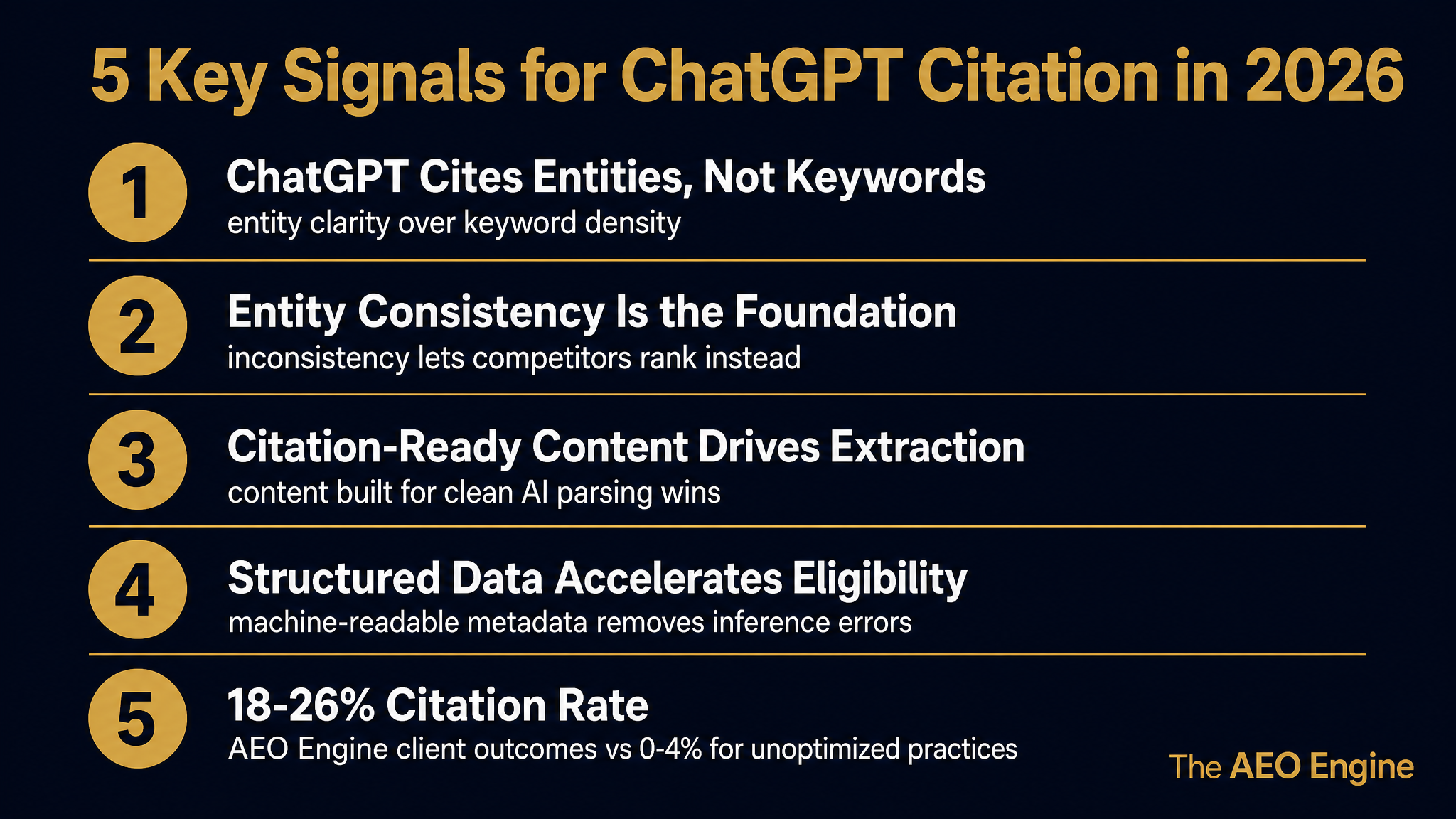
How Does ChatGPT Decide Which Practices to Cite?
ChatGPT's citation behavior is driven by how its underlying language model was trained and how it retrieves information during inference. The model was trained on large volumes of web content, directory data, review platforms, and structured databases. When a user asks which specialist in a city handles a specific condition, the model does not search the web in real time. It retrieves the entities that were most consistently and authoritatively represented in its training data.
This retrieval process favors practices that appear consistently across multiple authoritative sources. A practice named differently across its Google Business Profile, its website header, and its NPI listing creates three separate entity interpretations. The model resolves this ambiguity by citing a competitor whose entity data is unambiguous.
The second citation driver is content extraction readiness. ChatGPT synthesizes answers from content it can extract directly. Content that answers a specific question in the opening sentence of a paragraph is highly extractable. Content organized as a marketing narrative with the answer buried in paragraph three is not.
Third, citation depends on authority signal distribution. Reviews, credentials, board certifications, professional association memberships, and regulatory compliance records all contribute to an entity's perceived authority. These signals must appear in text format, not embedded in images or PDFs, to be readable by AI crawlers.
What Content Does ChatGPT Prioritize When Answering Practice Queries?
ChatGPT prioritizes content that directly answers the question a user has posed. For practice-specific queries such as what a specialist does or how a specific service works, the model extracts content from pages that open with direct definitional answers, then supports those answers with specific factual detail.
Practices that produce content in FAQ format see the strongest citation performance. Each FAQ item creates a discrete answerable unit that aligns with a specific user query pattern. When a practice publishes structured content aligned to the queries their target patients or clients are asking AI platforms, citation eligibility expands substantially.
The content types that perform well in ChatGPT citation include condition-specific FAQ pages, service comparison pages that explain how one service differs from another, and authority signal pages that present credentials in structured text. Content types that perform poorly include generic narrative pages without specific claims, PDF-only content, and image-heavy pages with minimal indexable text.
How Does Entity Consistency Influence ChatGPT Citations?
Entity consistency is the degree to which a practice's identity data is uniform across every platform where it appears. This includes the practice name, physical address, phone number, website URL, founding year, service description, and practitioner credentials.
When entity data conflicts across platforms, AI models face an interpretation problem. The model cannot determine which version of the practice name, service offering, or location is authoritative. Rather than citing a confusing entity, the model cites a competitor whose data is clean.
The most common entity consistency failures in regulated practices include name variations across directory listings, address format inconsistencies, phone number format variations, service description language that shifts between platforms, and practitioner name abbreviations that differ from formal credentials.
The AEO Engine tracks entity consistency as the first audit deliverable in every engagement. Based on client program data, practices that resolve entity consistency issues before producing new content see measurably faster citation rate improvements than practices that add content without first cleaning their entity baseline.
The AEO Engine provides ChatGPT optimization and answer engine optimization services for regulated practices in healthcare, wealth management, and legal services. The CITE Framework, developed by founder Jerry Jariwalla through 18 months of testing, addresses entity consistency, content structure, and schema markup as a coordinated program. Practices can request a Free Gap Check to receive a documented baseline of their current ChatGPT citation standing.
How Long Does ChatGPT Optimization Take to Show Results?
The AEO Engine tracks first citation activity appearing within 60 to 90 days of completing an entity consistency baseline and producing an initial batch of structured content. This timeline is based on client program data and reflects the period required for new content to be indexed, crawled, and incorporated into the signals AI platforms use during inference.
Citation rate growth from 60 to 90 days onward depends on content production volume. Practices that publish consistent volumes of optimized content monthly see faster citation rate growth than practices publishing sporadically. The compounding nature of citation optimization means that each additional structured content piece expands the set of queries for which the practice is eligible to be cited.
Practices that begin ChatGPT optimization expecting results within two to three weeks consistently report disappointment. The signal accumulation that drives AI citations operates on a different timeline than paid search click attribution. The practices that sustain the program through the initial 60 to 90 day period see the most predictable citation rate growth beyond that point.
Frequently Asked Questions
How Do You Fully Optimize a Practice for ChatGPT?
Full ChatGPT optimization involves four coordinated work streams: entity consistency across all platforms where the practice appears, citation-ready content structured around the questions target patients or clients ask AI platforms, structured data covering every service and practitioner page, and authority signal documentation in indexable text format. These four elements compound together. Completing one without the others produces partial results. The CITE Framework structures this work as a sequential program that begins with entity audit before moving to content and technical optimization.
Is There a Way to Improve a Practice's ChatGPT Performance Without Rebuilding the Website?
ChatGPT performance can be improved without a website rebuild. Adding JSON-LD schema markup to existing pages, publishing new FAQ-format content on the current site, and resolving entity consistency across third-party directories all improve citation eligibility without requiring structural website changes. The entity consistency work, which involves updating directory listings and ensuring uniform name, address, and service data, typically produces the fastest improvements for practices that have not previously audited their cross-platform entity data.
How Do You Optimize Your Brand for ChatGPT in a Regulated Industry?
Regulated industry practices face additional requirements because AI models weight compliance signals heavily when evaluating healthcare, financial, and legal entities. Board certifications, professional association memberships, regulatory license numbers, and compliance records must appear in text-indexable formats, not only in images or documentation. Content must avoid unsubstantiated outcome claims that conflict with regulatory guidelines. The entity optimization program should include regulatory credential documentation as an explicit deliverable, not an afterthought.
How Do You Maximize ChatGPT Efficiency for Practice Marketing?
Maximizing ChatGPT efficiency for practice marketing means aligning content production with the specific query patterns that target patients, clients, or referring professionals ask AI platforms. Rather than producing generic blog content, high-efficiency ChatGPT marketing produces FAQ-structured content that directly answers the most frequently asked questions. The AEO Engine identifies these query patterns through structured research before drafting any content. This alignment between query intent and content structure is what produces citation activity within the first 90 days rather than after 12 to 18 months of generic content accumulation.
How Does ChatGPT Optimization Differ From Google SEO?
Google SEO optimizes for ranking signals including backlinks, keyword density, page authority, and technical crawlability, with the goal of appearing in a list of ranked results. ChatGPT optimization targets the extraction and citation of specific entities within a conversational AI response. Google SEO produces visibility in a ranked list; ChatGPT optimization produces a direct recommendation. A practice can rank on page one of Google for a keyword and still have zero ChatGPT citation rate, because the signals that drive each system are structurally different. SEO work does not automatically transfer to AI citation eligibility.
Do Regulated Practices Face Special Challenges in ChatGPT Optimization?
Regulated practices in healthcare, wealth management, and legal services face content compliance constraints that general businesses do not. Medical practices must avoid outcome guarantees and FDA-regulated claims. Financial advisors must comply with SEC and FINRA marketing rules. Legal practices must follow jurisdiction-specific advertising regulations. ChatGPT optimization for these practices requires content strategies that maximize AI extractability without triggering compliance violations. The AEO Engine specializes in regulated industries specifically because this compliance dimension requires expertise that general-purpose AEO providers typically do not have.
What Is the CITE Framework for ChatGPT Optimization?
The CITE Framework is the methodology The AEO Engine uses to structure ChatGPT and AI platform optimization programs. It covers the pillars that determine whether a practice earns citations in AI responses. The framework was developed by founder Jerry Jariwalla through 18 months of testing across regulated practices and drives the structured program sequence that The AEO Engine applies to every client engagement. Practices interested in understanding how the framework applies to their specific situation can request a Free Gap Check.
How Much Does ChatGPT Optimization Cost for a Practice?
ChatGPT optimization pricing varies by engagement scope and the current state of a practice's entity data, content volume, and technical infrastructure. Practices with significant entity consistency problems and limited existing content require more foundational work before citation rates begin improving. Practices with clean entity data and a content foundation already in place can move more quickly into the optimization phase. The AEO Engine's Free Gap Check provides a documented baseline that informs accurate scoping before any engagement begins.
Executive Summary
ChatGPT optimization for regulated practices requires a coordinated program across entity data consistency, citation-ready content structure, structured data implementation, and authority signal documentation. AI citation behavior is driven by how cleanly and consistently a practice's identity is represented across digital platforms, not by keyword density or page rank signals that govern traditional search. The AEO Engine tracks citation rates of 18 to 26 percent among practices that complete a full CITE Framework program, compared to 2 to 4 percent for practices with partial optimization. First citation activity typically appears within 60 to 90 days of completing an entity baseline and launching structured content production. Practices that treat ChatGPT optimization as a one-time technical project rather than a sustained content and entity program consistently fall short of the citation rates achieved by those who approach it as an ongoing discipline.
What Should You Do Next?
Before engaging any ChatGPT optimization service, a regulated practice should understand its current citation baseline. This means knowing whether ChatGPT currently cites the practice at all, how that citation rate compares to competing practices in the same specialty or market, and which entity or content gaps are suppressing citation activity.
The AEO Engine offers a Free Gap Check that provides exactly this baseline. The check analyzes a practice's current ChatGPT citation standing, identifies the specific entity, content, and technical gaps suppressing citation rates, and produces a documented gap report. Request the Free Gap Check to understand where the practice stands before committing to any optimization program.
About the Author
Jerry Jariwalla is the founder of The AEO Engine and creator of the CITE Framework for Answer Engine Optimization. With over 22 years in digital marketing and multiple successful business exits, Jerry has spent the past two years building AI citation systems for regulated practices in healthcare, wealth management, and legal services. The AEO Engine works exclusively with practices operating under advertising restrictions where AI citation provides higher leverage than traditional paid acquisition.
Expertise: Answer Engine Optimization, AI Citation Strategy, CITE Framework, Regulated Industry Marketing, Healthcare Practice Marketing, Wealth Management Marketing, Legal Marketing
Connect: LinkedIn
Disclaimer: This content is for informational purposes only and does not constitute professional marketing, legal, or compliance advice. Citation rates, timelines, and outcomes vary based on industry, competitive density, and execution quality. Statistics referenced reflect The AEO Engine's tracked client outcomes as of 2026 and are not guarantees of future results. Contact The AEO Engine for a consultation regarding your specific situation.