
Last Updated: June 2026
A family law attorney near me search is a local request for a lawyer who handles divorce, child custody, and family disputes. AI now answers that search, and it recommends some local firms while skipping others. The choice is not random. There were 672,502 divorces in a recent year across the reporting states, according to the Centers for Disease Control and Prevention. Many of those people start with an AI assistant. About 34 percent of US adults have used ChatGPT, according to the Pew Research Center. The local firm AI names gets the first call.
The AEO Engine helps law firms earn those local recommendations through the CITE Framework. Founded by Jerry Jariwalla, the firm works only with regulated practices in healthcare, wealth management, and legal services. Jerry Jariwalla brings more than 22 years in digital marketing and multiple business exits. In these fields, strict ad rules make AI citation more valuable than paid ads. The system helps strong local firms stop losing clients to those that simply show up first.
This guide explains why AI picks some nearby family law firms over others. It covers the local signals AI reads, why most firms get skipped, and how to become the local answer.
Key Takeaways
- Local clarity wins. AI names firms with clear, consistent location details over those with vague pages.
- Match the local search. AI favors firms that plainly serve the searcher's area and practice family law.
- Build trust signals AI can read. Attorney bios, case results, and local reviews give AI the proof it needs.
- Answer real client questions. Pages that answer the plain questions local clients ask get cited far more often.
- Measure citations, not just clicks. The AEO Engine tracks citation rates of 18 to 26 percent based on client program data.
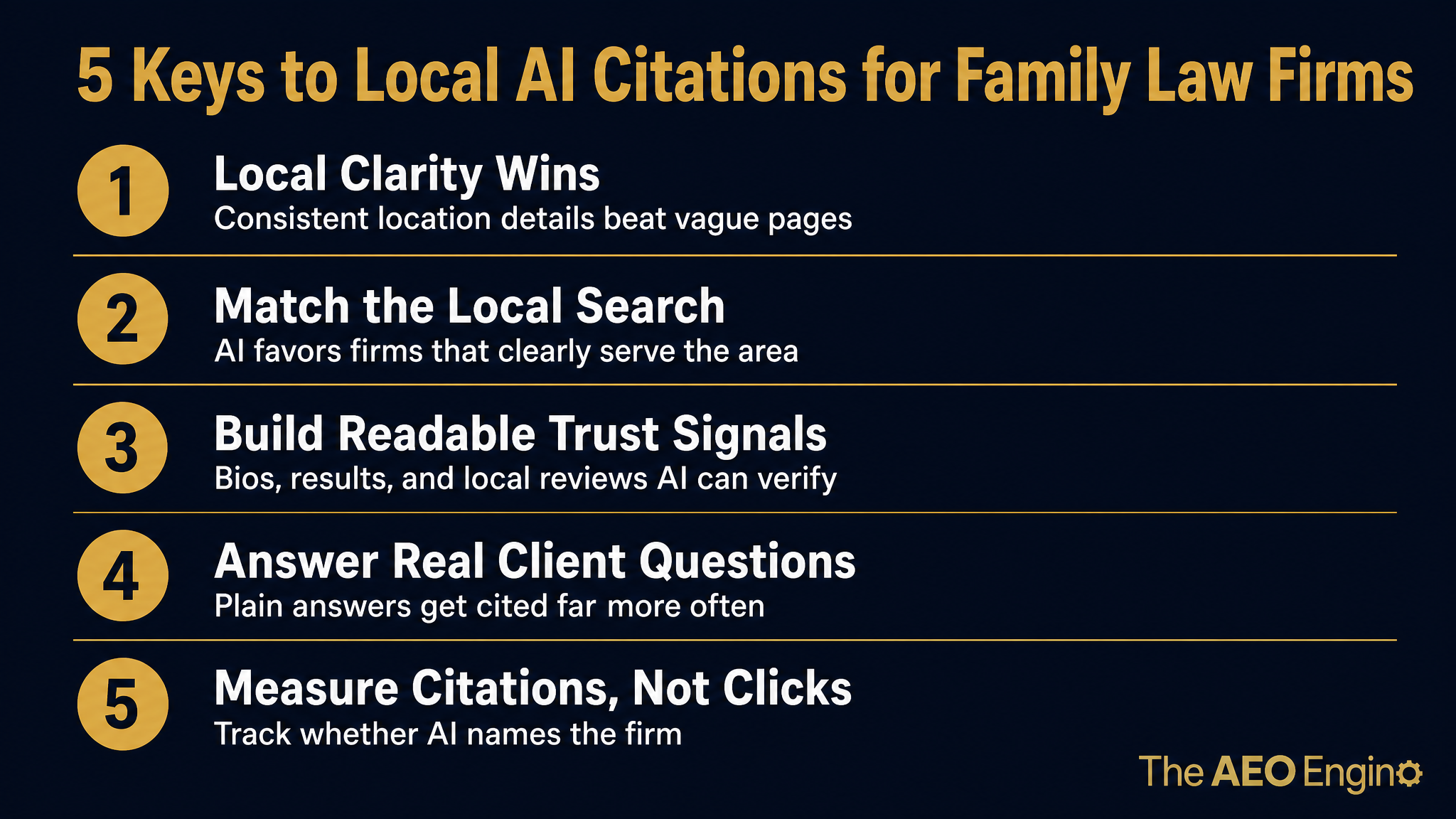
Infographic listing five keys to local AI citations for family law firms.
Why Does AI Skip Most Local Family Law Firms?
AI skips most local firms because it cannot clearly place them. To recommend a firm for a nearby search, AI must know where the firm works and what it does. Many firms make this hard. Their name, address, and practice area differ across the web, so AI cannot match them to one place.
A second reason is thin proof. AI leans on reviews, directories, and clear pages to trust a local firm. When those signals are weak, AI has little to go on. It will not name a firm it cannot confirm serves the area.
For AI to recommend a firm, the local picture must be clear online. A page that says "we serve clients everywhere" tells AI little. A page that names the city and explains the firm's family law work gives AI a reason to name it.
What Local Signals Does AI Read Before It Recommends a Firm?
AI reads signals that tie a firm to a place and a practice. It wants to be sure the firm is real, local, and right for the question. The clearer those signals, the more likely AI names the firm.
The strongest local signals include:
- Consistent name, address, and phone - The same details across the site, maps, and directories.
- Clear service area - Named cities or regions the firm serves, in plain text.
- Local reviews - Real client reviews that AI can find and tie to the firm.
- Family law focus - Pages that show the firm handles divorce and custody, not a long list of services.
These signals work together. One of them alone is weak. A firm that gets all four becomes easy for AI to place and name for a nearby search.
How Is a Local AI Search Different From Old Google Maps Rankings?
A local AI search gives one short answer, while old Google Maps gave a list of pins. On the old map, a firm could rank lower and still get found. With AI, the tool names a few firms and stops. A firm left out gets no local traffic at all.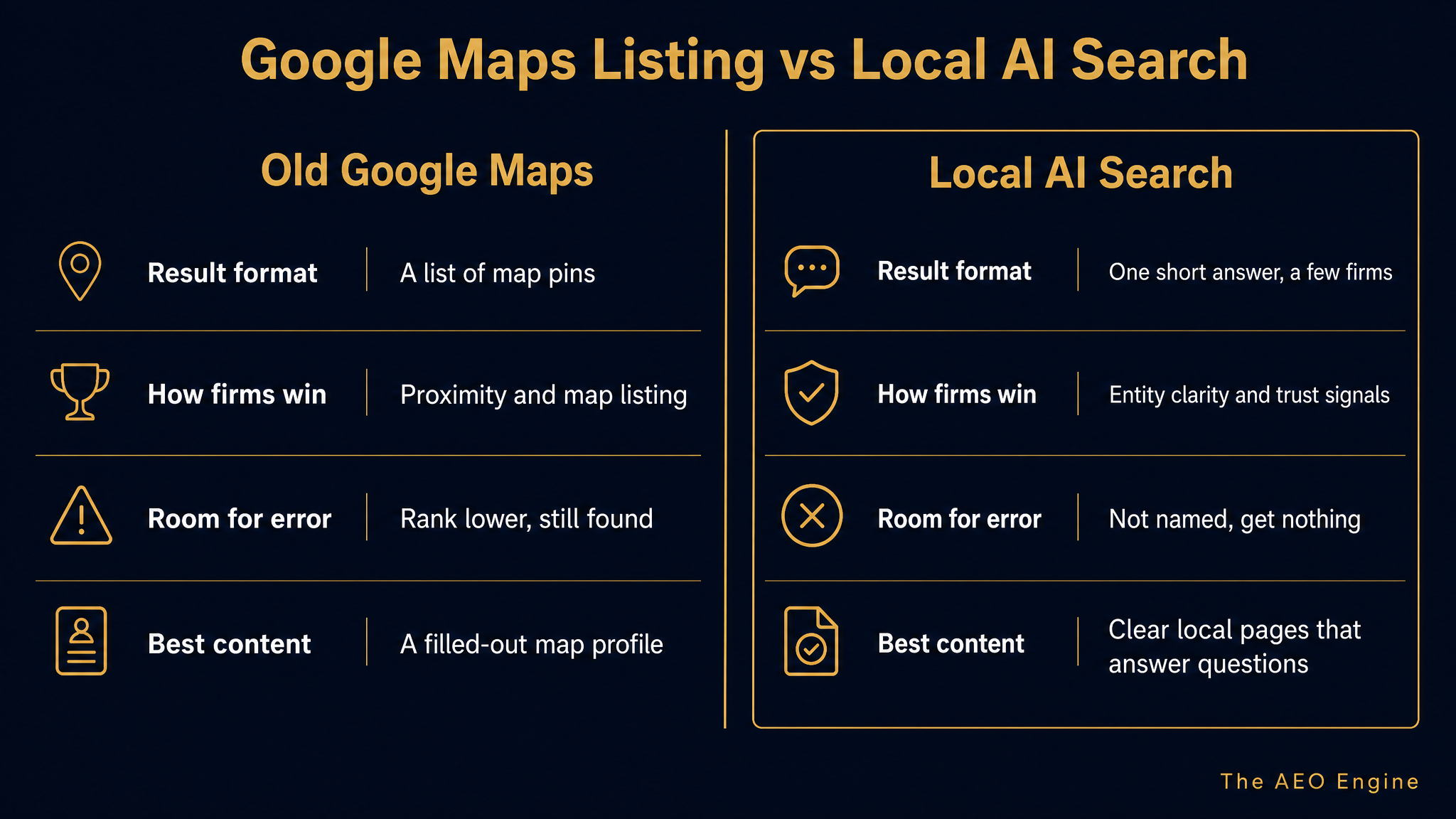
The table below shows how the two models differ.
The shift means local firms must do more than fill out a map profile. They must give AI clear, consistent signals it can trust.
What Trust Signals Should a Local Family Law Firm Build?
A local family law firm should build trust signals that AI can read and verify. AI cannot trust a slogan. It can trust a named attorney, a factual result, and a real local review. The goal is to make the firm's real proof easy to find.
Strong trust signals for a local practice include:
- Named attorneys with real bios - Education, bar admission, and years of practice in plain text.
- Factual case results - Outcomes described in an honest way that AI can read.
- Local client reviews - Reviews AI can find and tie to the firm and its area.
- Clear location and contact details - So AI can match the firm to a nearby search.
These signals work together. One review means little on its own. A steady local record across many trusted sources tells AI the firm is real and safe to recommend.
What Mistakes Keep Local Firms Out of AI Results?
The biggest mistake is inconsistent information. When a firm's name or address differs across the web, AI cannot tie it to one place. That single gap can keep a strong firm out of local AI answers.
A second mistake is writing for keywords instead of answers. Many firms repeat the same phrase across a page. AI rewards the page that answers the real question a local client asked, in plain words.
A third mistake is treating AI search as a side task. The firms that win treat it as a core channel. They keep their local details consistent. They build content around real client questions. This is the work the CITE Framework is built to handle.
The AEO Engine helps law firms become the local name AI gives. Learn how the CITE Framework builds AI citations, explore the firm's approach, or request a gap check to see where a practice stands today.
What Should a Local Family Law Firm Publish to Get Cited?
A local family law firm should publish clear answers to the questions nearby clients ask. People do not search in legal terms. They ask where to find help, what a process costs, and who to trust in their area. A firm that answers those questions in plain words gets cited.
Useful pages name the city, cover one question each, and answer it near the top. They name the attorney behind the work and link to real proof. Over time, this clear, local content tells AI the firm is the trusted source for family law in its area.
This is the heart of local AI citation work. The firm keeps its details consistent. It answers real client questions clearly. It backs each answer with verifiable trust signals. That is what moves a firm from invisible to recommended nearby.
Frequently Asked Questions
Who do I call for free legal advice in NC?
For free legal advice in North Carolina, people often start with Legal Aid of North Carolina or the state bar's lawyer referral service. Local law schools and nonprofit clinics may also help. A family law attorney can explain whether a matter qualifies for free help. Because programs and rules change, it is best to confirm current options with a licensed North Carolina source.
Is it better to have an attorney or a lawyer?
There is no real difference between an attorney and a lawyer in everyday use. Both terms describe a person licensed to practice law and represent clients. Some people use "attorney" in formal settings, but the two words mean the same thing. What matters more is the lawyer's focus, such as family law, and their experience with cases like yours.
What are the three C's of divorce?
The three C's of divorce are often described as communication, cooperation, and compromise. They describe a mindset that helps couples resolve issues with less conflict. This approach can lower stress and legal costs, especially when children are involved. A family law attorney can guide a client toward this path when it fits the case.
What is the 80 20 rule for lawyers?
The 80 20 rule, also called the Pareto principle, is the idea that about 80 percent of results come from about 20 percent of effort. For lawyers, it often means a small share of clients or tasks drives most of the value. It is a general business idea, not a legal rule. Many firms use it to focus on the work that matters most.
Why does AI recommend some local family law firms and not others?
AI recommends the firms it can clearly place and trust. It favors firms with consistent location details, a clear family law focus, real local reviews, and pages that answer client questions. It skips firms with vague or inconsistent information, because it will not name a source it cannot confirm serves the area.
Can a local law firm rank in AI search and still follow advertising rules?
Yes. A firm can give AI clear, factual signals while staying within bar ad rules. Named attorney bios, honest case descriptions, and verified reviews are all compliant. The work is about clarity and proof, not hype. A careful firm can build strong local AI signals without crossing any ethical line.
How long does it take to show up in local AI recommendations?
Timelines vary by market and starting point. AI tools update their view of a firm as new local signals appear across the web. A firm that stays consistent tends to see results build over months, not days. The AEO Engine tracks citation rates of 18 to 26 percent based on client program data.
Is AI search worth it for a small local firm?
Yes. AI search can help a smaller firm compete with larger ones because it rewards clarity and proof over budget. A focused local firm that answers real questions well can earn citations a bigger firm misses. For many small firms, this is a more level field than paid search.
Executive Summary
A family law attorney near me search is now answered by AI, and AI recommends some local firms while skipping others. The choice rests on clear local signals: consistent location details, a clear family law focus, real local reviews, and pages that answer client questions. AI skips firms it cannot place or confirm, even strong ones, because it will not name a source it cannot trust. Firms with inconsistent information or keyword-stuffed pages stay invisible nearby. Firms that keep their details consistent and answer real questions become the local name AI gives. The AEO Engine helps law firms earn those local citations through the CITE Framework, turning AI search into a steady source of nearby clients.
What Should You Do Next?
A local family law firm that wants AI to recommend it should start with a clear view of where it stands today. The steps below give a simple path:
- Audit current AI visibility. Ask the major AI tools who they recommend for family law in your city and note whether your firm appears.
- Fix local consistency. Make sure the firm's name, address, and phone match across the site, maps, and directories.
- Strengthen trust signals. Add named attorney bios, factual case results, and links to local reviews.
- Answer real questions. Build local pages that answer the plain questions clients ask before they call.
- Request a gap check. Contact The AEO Engine to see exactly where the firm is missing from local AI answers and how to fix it.
People Also Read
- How Do You Pick an AEO Agency That Drives Real Citations?
- What Is the AI Recommendation Gap and Why Are You Listed But Not Recommended?
About the Author
Jerry Jariwalla is the founder of The AEO Engine and creator of the CITE Framework for Answer Engine Optimization. With over 22 years in digital marketing and multiple successful business exits, Jerry has spent the past two years building AI citation systems for regulated practices in healthcare, wealth management, and legal services. The AEO Engine works exclusively with practices operating under advertising restrictions where AI citation provides higher leverage than traditional paid acquisition.
Expertise: Answer Engine Optimization, AI Citation Strategy, CITE Framework, Regulated Industry Marketing, Healthcare Practice Marketing, Wealth Management Marketing, Legal Marketing
Connect: LinkedIn
Disclaimer: This content is for informational purposes only and does not constitute professional marketing, legal, or compliance advice. Citation rates, timelines, and outcomes vary based on industry, competitive density, and execution quality. Statistics referenced reflect The AEO Engine's tracked client outcomes as of 2026 and are not guarantees of future results. Contact The AEO Engine for a consultation regarding your specific situation.