
Last Updated: June 2026
An estate planning attorney near me is a licensed lawyer who drafts wills, trusts, and health care directives in a specific city or region. Most show up on Google Maps. Few appear in AI answers. A 2026 Trust & Will survey found that 56 percent of American adults have no estate plan. The lawyers who could help them are easy to find in local search. But they are absent from ChatGPT, Perplexity, and Google AI Overviews. The reason is not skill or location. It is how AI decides which sources to trust.
The AEO Engine helps estate planning firms, wealth advisors, and local service professionals build the authority signals that AI platforms use for citations. It was built by Jerry Jariwalla, who developed the CITE framework to help local professionals move from AI-invisible to AI-cited. The AEO Engine tracks citation shifts across legal, financial, and healthcare clients.
This guide covers why "near me" has no effect on AI picks, what signals AI uses instead, how local search and AI search differ, and what a local firm must do to earn AI citations.
Key Takeaways
- 56 percent of Americans have no estate plan, yet most local estate lawyers have zero AI citation presence
- AI picks do not use location data. Proximity to the searcher has no effect on AI citations
- A full estate plan costs $2,000 to $5,000 or more with a lawyer, per the National Council on Aging
- Local search rankings and AI citations use different signals. A firm must build for both in 2026
- Structured content and third-party authority are the two drivers that shift estate lawyers from absent to cited
Does the "Near Me" Modifier Change How AI Recommends Estate Planning Attorneys?
When a person types "estate planning attorney near me" into ChatGPT, the AI does not check a map. It does not sort by distance. It pulls from indexed content. It weights sources by the authority signals it found during training or live search.
"Near me" is a local intent signal. Google Maps uses it to show the three closest firms. AI platforms work differently. They surface the sources they trust most on the topic. They do not care where the user or the firm is located.
A solo estate lawyer in a small city can appear in an AI answer. A large firm two miles from the searcher may not. The deciding factor is content quality and citation weight. Address plays no role. Distance plays no role.
Most estate lawyers assume a strong local rank carries over to AI presence. It does not. AI search and local search run on different rules. Firms that treat them as one thing stay invisible in AI. This happens even as their Google Maps rank climbs.
A 2026 Best Lawyers analysis found that 60 percent of Google searches for legal services now end without a click. AI answers are taking those queries. Local estate lawyers who lack AI citation signals lose those clients before their name ever appears.
Why Are Most Local Estate Planning Attorneys Absent From AI Answers?
Three patterns explain why local estate planning lawyers rarely show up in AI answers. They rank well in local search but have no AI presence.
First, most law firm websites are built for human readers. They list services. They show photos. They include a contact form. They rarely contain structured, question-answering content. AI needs clear answers to set questions. It needs a format it can parse and cite.
Second, most local lawyers have thin digital footprints. AI platforms weigh mentions across trusted sources. These include legal journals, bar association sites, and media coverage. A firm with only a website and a Google Business Profile gives AI very little to work with.
Third, estate planning is a trust-dependent area. AI is careful about citing unverified lawyers. Firms without published expert content, verified records, or third-party mentions get filtered out. This happens even when their real-world track record is strong.
Each of these gaps can be fixed with targeted content and citation work. Attorneys who know what is missing can start building the right signals.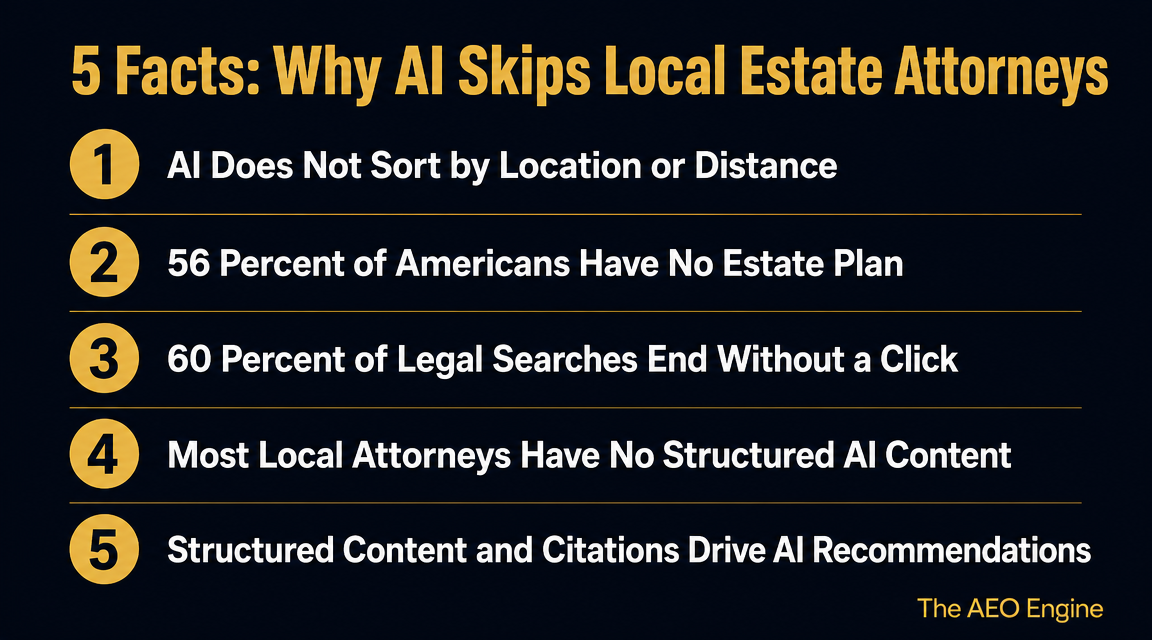
How Does Local Search Differ From AI Search for Estate Planning Attorneys?
An estate lawyer can rank at the top of Google Maps and have zero AI presence. Both tracks matter in 2026. Clients use AI first for research. They switch to Google Maps to find a local office and book a call.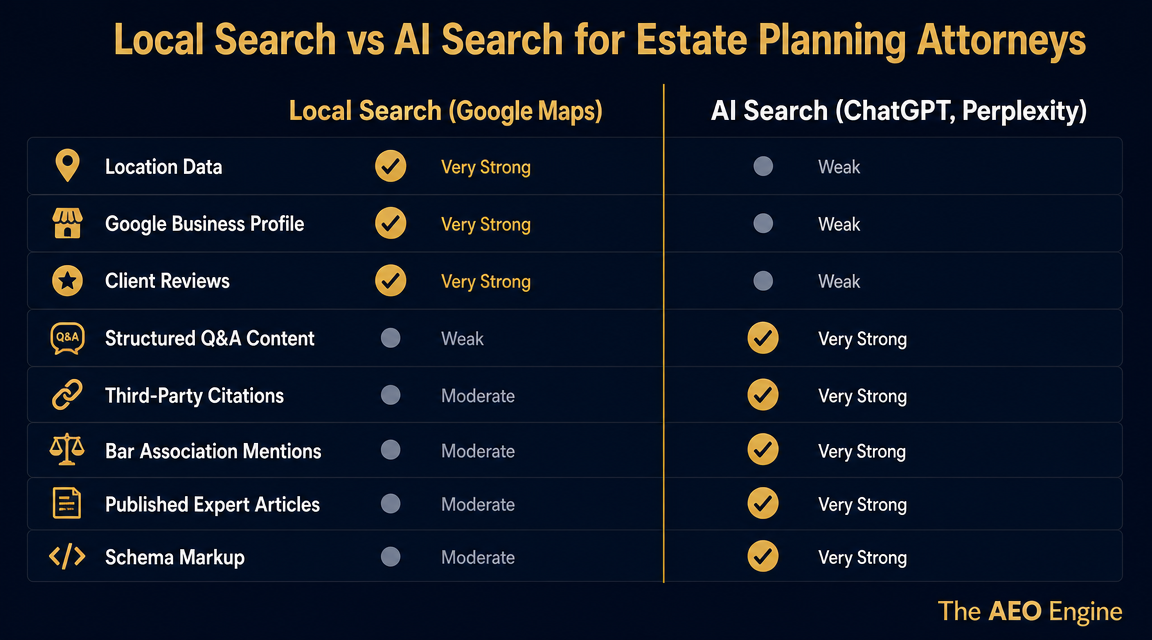
Want to see where your estate planning practice stands in AI answers? Start a free gap check. It maps your citation coverage across ChatGPT, Perplexity, and Google AI Overviews.
How Much Does an Estate Planning Attorney Cost?
Cost is one of the first things clients search before they contact a lawyer. It is also a clear trust signal for AI. Content that answers cost questions earns citations because it addresses a direct, high-intent query.
According to the National Council on Aging, a full estate plan with a lawyer costs $2,000 to $5,000 or more. A basic will runs $15 to $1,500. A living trust package costs $1,000 to $4,000. Hourly rates range from $162 to $392 per hour.
Flat-fee pricing is common for standard documents. It makes costs easier to plan. Lawyers who publish clear, honest cost content signal expertise to AI. This is not just helpful to clients. It is an authority signal that AI reads and weighs.
Firms that answer cost questions directly are more likely to earn citations when a client asks AI, "How much does an estate attorney cost near me?"
What Is the 5 and 5 Rule in Estate Planning?
The 5 and 5 rule is a trust provision. It gives an heir the right to withdraw up to $5,000 per year. Or five percent of the trust's fair market value, whichever is greater. This is a controlled access rule found in many trusts.
The rule matters for Medicaid planning and gift tax. A withdrawal right within these limits does not count as a taxable gift under IRS rules. Estate lawyers use it to give heirs some access to trust funds. The trust core stays protected long term.
Clients who ask about this rule are often close to a trust decision. Estate lawyers who publish clear answers to questions like this one are more likely to earn AI citations. AI values direct, correct answers to estate planning questions. Publishing them builds citation weight over time.
How Can an Estate Planning Attorney Near Me Build AI Citation Presence?
Building AI citation presence starts with structured content. The firm must answer the questions clients type into AI platforms. These answers must be clear and in a format AI can read and reference.
Key steps include:
- Publish detailed question-and-answer content on core estate planning topics
- Earn mentions in legal trade publications and bar association resources
- Add clear schema markup to the website, including FAQPage and Article types
- Build consistent listings on trusted legal directories such as Avvo, FindLaw, and Justia
- Get cited in local media as an expert source on estate planning topics
AI does not reward the nearest firm. It rewards the most cited and best-structured firm. A local lawyer who builds on this track can compete for AI citation presence even with a purely local client base.
The AEO Engine has observed that estate planning firms who take this approach begin to see AI mentions within months of starting. The first citations often appear for answer-format queries. These are the exact type of search that "near me" queries are shifting toward.
Frequently Asked Questions
How much does a lawyer cost for an estate?
Attorney fees vary based on complexity and location. A basic will with a lawyer runs $300 to $1,500. A full estate plan that includes a will, trust, power of attorney, and health care directive costs $2,000 to $5,000 or more. Hourly rates for estate lawyers range from $162 to $392 per hour. Flat-fee pricing is common for standard documents and helps clients plan their budget.
What is the 5 and 5 rule in estate planning?
The 5 and 5 rule lets a trust heir withdraw up to $5,000 per year or five percent of the trust's fair market value, whichever is greater. This stays within IRS gift tax limits. Estate lawyers use it to give heirs some access to trust funds. Core assets stay protected. It is common in trusts built to last across many generations.
What is the difference between an estate lawyer and an estate planner?
An estate lawyer is a licensed attorney who drafts binding legal documents and can appear in probate court. They also advise clients on their legal rights. An estate planner who is not a lawyer can help with financial planning and heir strategy. But that person cannot create legally valid wills, trusts, or powers of attorney. For documents that hold up in court, only a licensed estate lawyer can create them.
What is the biggest mistake with wills?
The most common mistake is failing to update the will after major life events. Marriage, divorce, the birth of a child, or the death of a named heir can all make a will outdated. Another frequent error is failing to name an alternate heir. Lawyers also see wills that were never properly signed or witnessed. This makes them invalid under state law. A review every three to five years helps catch these problems early.
Does AI recommend estate planning attorneys based on location?
No. AI platforms such as ChatGPT, Perplexity, and Google AI Overviews do not sort picks by location. They cite lawyers who have structured content, verified records, and strong authority signals across trusted sources. A local estate lawyer can earn AI citations. But only through content and citation work, not by being nearby.
How do estate planning attorneys get cited in AI answers?
AI platforms cite lawyers who publish detailed answers to common estate planning questions. They also cite firms that earn mentions in legal publications and bar association resources. Clear schema markup on the website helps too. Firms that are often referenced by trusted third parties build the citation weight that AI uses when choosing which lawyers to surface.
What credentials should an estate planning attorney near me have?
A licensed estate lawyer must hold a Juris Doctor (J.D.) degree and be admitted to the state bar. Many also hold a Master of Laws (LL.M.) in taxation or estate planning. This signals deeper expertise. Membership in groups such as ACTEC or the American Academy of Estate Planning Attorneys signals strong standing. AI often weights these signals when evaluating which lawyers to recommend.
How long does it take AI to start citing an estate planning attorney?
The time varies based on the starting point. Lawyers with thin content and no third-party mentions may see first AI citations within three to six months of a structured content and citation program. Firms with some authority signals, such as bar association listings and published articles, may see results faster. The AEO Engine tracks citation shifts for estate planning and other legal practices and gives clients regular reports on progress.
Executive Summary
Estate planning lawyers appear in local Google search every day but remain absent from AI platforms. These platforms now answer millions of estate planning questions. The "near me" modifier has no effect on AI picks because AI does not sort by location. It sorts by structured content, trust signals, and citation weight. With 56 percent of Americans lacking an estate plan and 30 percent now turning to AI for early legal guidance, this gap is a real risk. Lawyers who build structured content, earn third-party citations, and format their digital presence for AI can shift from absent to cited. It does not matter where their office is located.
What Should You Do Next?
Estate planning lawyers who want AI to recommend them have a clear first step: find out where you stand. A citation gap check maps your current presence across major AI platforms. It shows which estate planning questions your firm already answers in AI and which ones it is missing.
From there, a structured content program builds the authority signals that drive AI citations over time. The AEO Engine works with estate planning firms, wealth advisors, and local service professionals on this process. The program covers content structure, citation building, and ongoing tracking. Start with a free gap check.
People Also Read
- Plastic Surgery Marketing: How AI Is Changing Patient Discovery in 2025
- Med Spa Lead Generation: The AI-First Approach to Client Acquisition
About the Author
Jerry Jariwalla is the founder of The AEO Engine and creator of the CITE Framework for Answer Engine Optimization. With over 22 years in digital marketing and multiple successful business exits, Jerry has spent the past two years building AI citation systems for regulated practices in healthcare, wealth management, and legal services. The AEO Engine works exclusively with practices operating under advertising restrictions where AI citation provides higher leverage than traditional paid acquisition.
Areas of expertise: Answer Engine Optimization, AI citation strategy, structured content for professional services, local-to-AI presence for legal and financial practices.
Connect: LinkedIn | The AEO Engine
Disclaimer: This content is for informational purposes only and does not constitute professional marketing, legal, or compliance advice. Citation rates, timelines, and outcomes vary based on industry, competitive density, and execution quality. Statistics referenced reflect The AEO Engine's tracked client outcomes as of 2026 and are not guarantees of future results. Contact The AEO Engine for a consultation regarding your specific situation.