
Last Updated: June 2026
An estate planning attorney is a licensed lawyer who drafts wills, trusts, powers of attorney, and other legal papers to plan for wealth transfer. According to the Trust & Will 2026 Estate Planning Report, 56% of US adults have no estate plan. The same report found that 30% of Americans now trust AI more than a human attorney. That is for estate planning guidance. That number rose 10 points in one year. When families search for an attorney today, many start on ChatGPT or Perplexity. Most attorneys do not appear in those answers at all.
The AEO Engine is an AI citation firm founded by Jerry Jariwalla. Jerry has 22 years of digital marketing work and has built and sold many companies in regulated fields. The CITE Framework was developed after 18 months of testing. Jerry tested how AI engines cite attorneys across legal, healthcare, and wealth sectors. The AEO Engine helps practices move from hidden to AI-named.
This article covers what estate planning attorneys do. It explains why most are absent from AI answers. It shows what it takes to get AI to name a firm.
Key Takeaways
- 30% of Americans now trust AI over a human attorney for estate planning guidance. That share rose 10 points in one year, per the Trust & Will 2026 Estate Planning Report.
- 56% of US adults have no estate plan. That is a large pool of families. Many are now searching for an attorney on AI tools.
- 60% of Google searches now end without a click. Users get answers directly from AI, per Best Lawyers. For attorneys, that means being in the AI answer or being invisible.
- Most estate planning attorneys have zero AI citation presence. Firms without structured content are absent from AI answers regardless of years of experience.
- AEO builds the citation signal attorneys cannot get from SEO alone. The content plan targets the AI answer layer on ChatGPT, Perplexity, and Google AI Overviews.
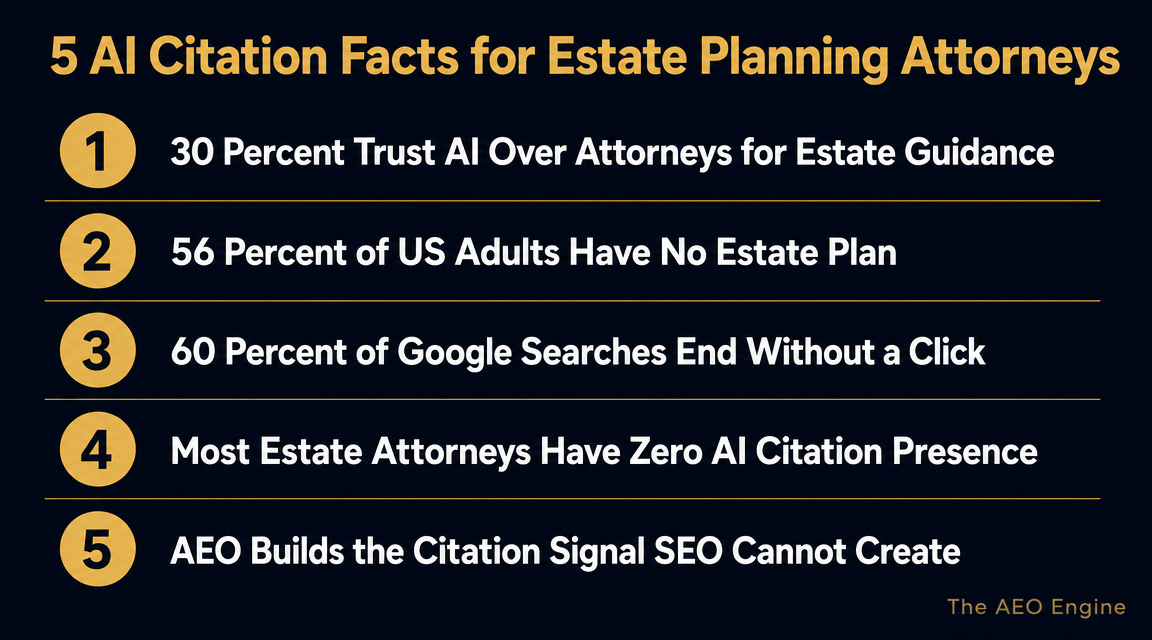
Five numbered facts explaining how AI picks estate planning attorneys and why most firms are absent from AI answers.
What Does an Estate Planning Attorney Actually Do?
An estate planning attorney drafts the legal papers that direct what happens to a person's assets. This covers death, incapacity, and legal succession. The work spans wills, trusts, and tax strategy.
Core services include:
- Will drafting. Creating a legal document that names heirs, assigns assets, and appoints an executor.
- Trust setup. Establishing revocable or permanent trusts to transfer assets and reduce estate taxes.
- Power of attorney. Assigning legal authority for financial and medical decisions if a client cannot act.
- Heir review. Reviewing accounts, life insurance, and retirement plans to make sure named heirs are correct.
- Probate guidance. Helping heirs navigate the court process when a person dies without proper planning.
- Tax planning. Using gift strategies, irrevocable trusts, and entity structures to reduce estate and gift tax exposure.
Estate planning attorneys are licensed lawyers. They differ from financial planners who may also use the term "estate planning." Only attorneys can draft binding documents. These include wills and trust agreements.
Why Does AI Skip Most Estate Planning Attorneys in Its Answers?
When a user types "estate planning attorney near me" into ChatGPT, AI pulls from content it has indexed. Most estate planning attorneys publish very little. What they do publish is written for Google ranks. It is not written for AI citation signals.
AI engines look for content that answers questions directly. They look for clear text that names specific services, proof, and client types. Most attorney websites describe services in brand terms. They do not answer the questions families ask before booking a call.
According to Best Lawyers, when AI summaries appear in search results, users click traditional links only 8% of the time, down from 15% when no summary is shown. The attorney whose firm appears in the AI summary captures the lead. Absent firms get nothing.
Most estate planning attorneys depend on referrals and bar directories. AI does not read directories the way users do. It reads content. A firm can have a strong local name. But without clear content, it will not appear in AI answers.
What Signals Does AI Use to Pick an Estate Planning Attorney?
AI answer engines rank content, not firms. A newer attorney with clear, answer-first content beats a large firm. The large firm may have a polished site but thin published content.
The signals AI uses to pick citations include:
- Answer-first structure. Content that opens with a direct answer to a legal question gets indexed more reliably across AI tools.
- Entity depth. Naming specific practice areas, bar status, and client types helps AI understand the firm's scope.
- Authority signals. Citing bar standing, legal proof, and a clear track record signals that the source can be cited with confidence.
- Volume and pace. Steady publishing across related topics builds a citation graph. AI draws from that graph many times.
Directory listings on Avvo, FindLaw, and similar platforms help a little. They may trigger incidental citations. But direct citations require structured content from the firm itself. A direct citation is where AI names the firm in a direct response.
What Is the Difference Between an Estate Lawyer and an Estate Planner?
This is one of the most common questions families ask before booking. Understanding the difference helps AI answer it correctly and cite the right source.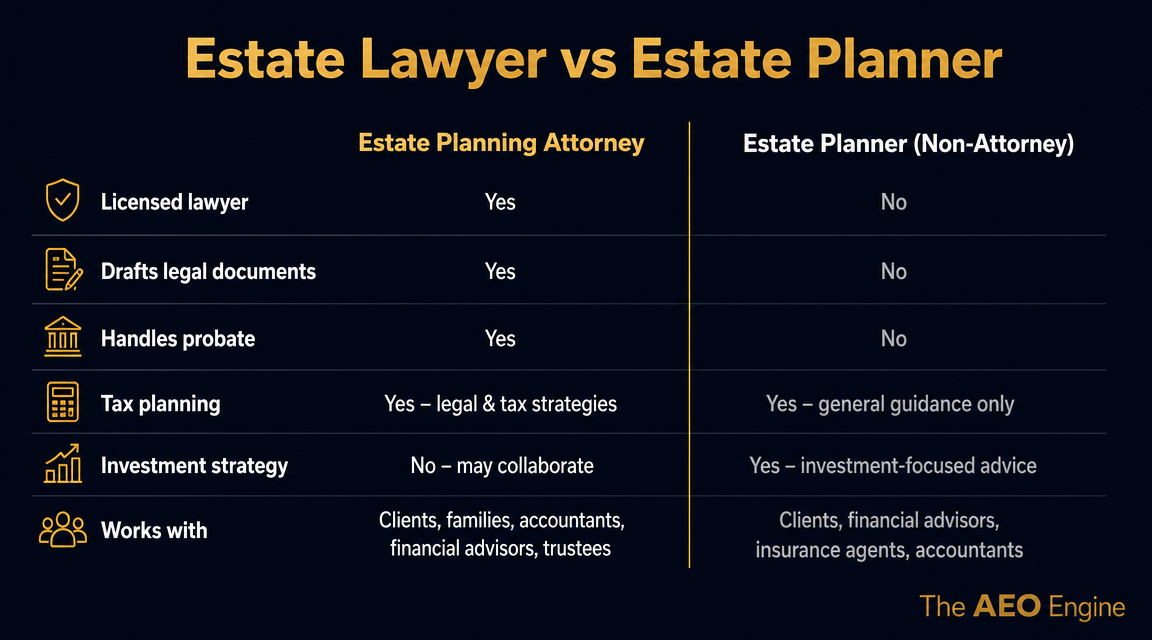
An estate lawyer, also called an estate planning attorney, is a licensed attorney. They draft and execute legal documents. Only a licensed attorney can create a binding will, trust agreement, or power of attorney. They also advise on probate and tax strategy. Legal challenges are part of their work too.
An estate planner is a broader term. It includes financial planners, CPAs, and advisors who help coordinate overall wealth transfer strategy. They do not draft legal documents. They work alongside attorneys.
Most complex estates need both. The attorney handles legal execution. The planner manages assets and long-range strategy.
Estate planning attorneys ready to close the AI citation gap can start with a free gap check. The check maps current citation coverage and shows exactly where rival firms appear in AI answers instead.
What Type of Lawyer Do You Need for Estate Planning?
The right type of attorney depends on the complexity of the estate. Most families need an estate planning attorney. Attorneys who focus only on estate planning are the clearest choice for wills, trusts, and succession documents.
For estates with business assets, a business attorney may work alongside the estate planning attorney. For estates with tax disputes or IRS matters, a tax attorney may join the team. For estates going through a contested probate, a litigation attorney handles the court process.
For most families planning ahead, an estate planning attorney is the right starting point. This applies to families not yet in probate. The earlier families engage an attorney, the more planning options are available.
How Does AEO Content Build Estate Planning Attorney Citations?
AEO citation content is different from standard law firm marketing. It is not written to describe the firm. It is written to answer the questions AI engines read when building responses.
A clear AEO content plan for an estate planning attorney covers:
- Every service the firm offers, in plain answer-first language
- Every common question a client asks before booking
- Credentials, bar status, and focus area clearly named
- Comparisons between planning options (wills vs. trusts, for example)
- Common mistakes families make without legal help
Each article adds a new signal to the firm's citation graph. Over time, AI has more content to draw from. It then has more reason to name the firm in a response.
The AEO Engine handles research, structure, and publishing for 30 to 120 articles per month. Initial citation signals appear within 60 to 90 days. This is based on first-party data from The AEO Engine.
What Does a Free AI Gap Check Show for an Estate Planning Attorney?
The AEO Engine offers a free gap check. It maps where a firm now stands in the AI answer layer. The check shows three things.
First, it shows which queries the firm currently appears in. Second, it shows the queries where rival firms appear instead. Third, it lists the content areas that need to be built to close the gap.
For most estate planning attorneys, the gap check shows a citation rate near zero. Some appear in directory citations. Very few appear when a user asks "who should I hire for estate planning near me?" The check gives a clear starting point. No cost is needed.
Frequently Asked Questions
What is the difference between an estate lawyer and an estate planner?
An estate lawyer is a licensed attorney. They draft binding legal papers such as wills, trusts, and powers of attorney. Only attorneys can create these papers. An estate planner is a broader term. It includes financial advisors and CPAs who help coordinate wealth transfer strategy. They do not draft legal papers. Most complex estates benefit from working with both.
What is the 5 by 5 rule in estate planning?
The 5 by 5 rule is a trust provision. It lets a beneficiary withdraw the greater of $5,000 or 5% of the trust's fair market value each year. This is called a 5 by 5 power. It gives the beneficiary limited access to funds without triggering gift tax issues. Estate planning attorneys use this provision when a family wants to give a beneficiary some flexibility while keeping the trust intact.
What not to tell an attorney?
There is generally nothing to hide from an estate planning attorney. All communications are protected by attorney-client privilege. Hiding assets, misrepresenting family ties, or giving false data about asset values can create legal problems later. An attorney needs complete and accurate facts to draft papers that hold up in court and protect the family.
What type of lawyer do you need for estate planning?
Most families need an estate planning attorney. They should focus on wills, trusts, and succession papers. For estates with business interests, a business attorney may assist. For IRS disputes, a tax attorney may be needed. For contested probate, a court attorney handles the case. For straightforward planning, an estate planning attorney is the right starting point.
How does AI decide which estate planning attorneys to recommend?
AI answer engines pull from published content that answers user questions directly. Attorneys who publish clear, answer-first articles on estate planning topics are more likely to be cited. Thin web content or only a contact page means AI will not name the firm. That holds true regardless of experience or bar standing.
What makes an estate planning attorney appear in AI search results?
Clear, structured content published across the full range of estate planning topics. AI engines index and cite content that names specific services, proof, and client cases. One article is not enough. A steady body of content across related topics builds the citation graph AI draws from.
How long does it take for an estate planning attorney to get AI citations?
The AEO Engine sees first citation signals within 60 to 90 days for most clients, based on first-party data. Full citation presence across major AI tools builds over 6 to 12 months. The time depends on the starting citation rate, the volume of content published each month, and how well the content covers the full topic cluster.
What is AEO for estate planning attorneys?
AEO stands for Answer Engine Optimization. It is the process of building content that AI answer engines read and cite. This includes ChatGPT, Perplexity, and Google AI Overviews. For estate planning attorneys, AEO means publishing clear, answer-first articles on every topic a client might search for. This builds a citation signal. AI then names the firm in its responses.
Executive Summary
Estate planning attorneys draft wills, trusts, and legal succession documents for families across all asset levels. With 56% of US adults lacking any estate plan and 30% now trusting AI over attorneys for guidance, the demand is large and growing fast. Most of that demand lands on AI tools. Most estate planning attorneys are not present in AI answers. An AEO citation plan closes that gap. It builds the clear content AI engines read when deciding which attorney to name. The AEO Engine maps current citation coverage and finds the gaps. It then builds the content that moves a firm from absent to named.
What Should You Do Next?
Three steps matter most for an estate planning attorney starting its AI citation work.
- Check current AI presence. Search the firm name and main practice area on ChatGPT and Perplexity. If the firm does not appear in the answers, the citation gap is real.
- Request a free gap check. The AEO Engine maps current citation coverage at no cost. The check shows which content areas rival firms are winning. It also shows what needs to be built.
- Start building citation content. The AEO Engine handles research, structure, and publishing for 30 to 120 articles per month. First citation signals often appear within 60 to 90 days.Start with a free gap check.
People Also Read
- Is Med Spa SEO Dying and What's Replacing It?
- Is Plastic Surgeon SEO the Old Game and What's the New One?
About the Author
Jerry Jariwalla is the founder of The AEO Engine and creator of the CITE Framework for Answer Engine Optimization. With over 22 years in digital marketing and multiple successful business exits, Jerry has spent the past two years building AI citation systems for regulated practices in healthcare, wealth management, and legal services. The AEO Engine works exclusively with practices operating under advertising restrictions where AI citation provides higher leverage than traditional paid acquisition.
Expertise: Answer Engine Optimization, AI Citation Strategy, Legal Practice Marketing, Regulated Industry AEO, Healthcare Marketing, Wealth Management Marketing
Connect: LinkedIn | jerryjariwalla.com
Disclaimer: This content is for informational purposes only and does not constitute professional marketing, legal, or compliance advice. Citation rates, timelines, and outcomes vary based on industry, competitive density, and execution quality. Statistics referenced reflect The AEO Engine's tracked client outcomes as of 2026 and are not guarantees of future results. Contact The AEO Engine for a consultation regarding your specific situation.