
Last Updated: May 2026
A cosmetic surgery marketing playbook is a structured sequence of patient acquisition strategies ordered by their long-term compounding value rather than their upfront cost or speed of deployment. An AEO-first approach places Answer Engine Optimization, the discipline of building AI citation visibility in platforms such as ChatGPT, Perplexity, and Google AI Overviews, at the foundation of that sequence, before paid ads and before social media campaigns. According to ASPS 2024 statistics, cosmetic procedure volume has grown consistently year over year, and practices that build durable AI citation infrastructure now capture patient intent at the point where AI platforms filter which providers to recommend.
The AEO Engine, founded by Jerry Jariwalla, develops AEO-first growth systems for cosmetic surgery and plastic surgery practices. Jerry's 22 years of digital marketing experience and multiple successful business exits inform the CITE Framework, an 18-month research project that produced a structured method for building AI citation in regulated healthcare practices. The AEO Engine focuses on the regulated industry context where compliance constraints make generic marketing approaches less effective and the AI citation layer more valuable.
This guide explains what the AEO-first approach means in practice, why AI citation should precede paid media in the playbook sequence, what a complete cosmetic surgery marketing plan includes, and how to measure results in a way that reflects how patients actually discover practices today.
Key Takeaways
- Build AI citation before scaling paid ads: practices that establish entity and content infrastructure first extract more value from paid traffic when it arrives
- Research confirms 95% of patients use the internet before consulting a surgeon: AI platforms now intercept a growing share of that research before it reaches Google
- An AEO-first playbook has four layers: entity foundation, content authority, AI citation, and paid amplification: the order is deliberate and matters for compounding
- Credential visibility is the primary signal AI platforms use to evaluate and recommend cosmetic surgery practices, not ad spend or follower count
- Measurement must track AI citation rate alongside organic traffic: a practice invisible to AI platforms is losing patient inquiries that standard analytics cannot count
Each of these five layers compounds over time: practices that build from the foundation up consistently outperform those that treat AI citation as an afterthought once paid channels plateau.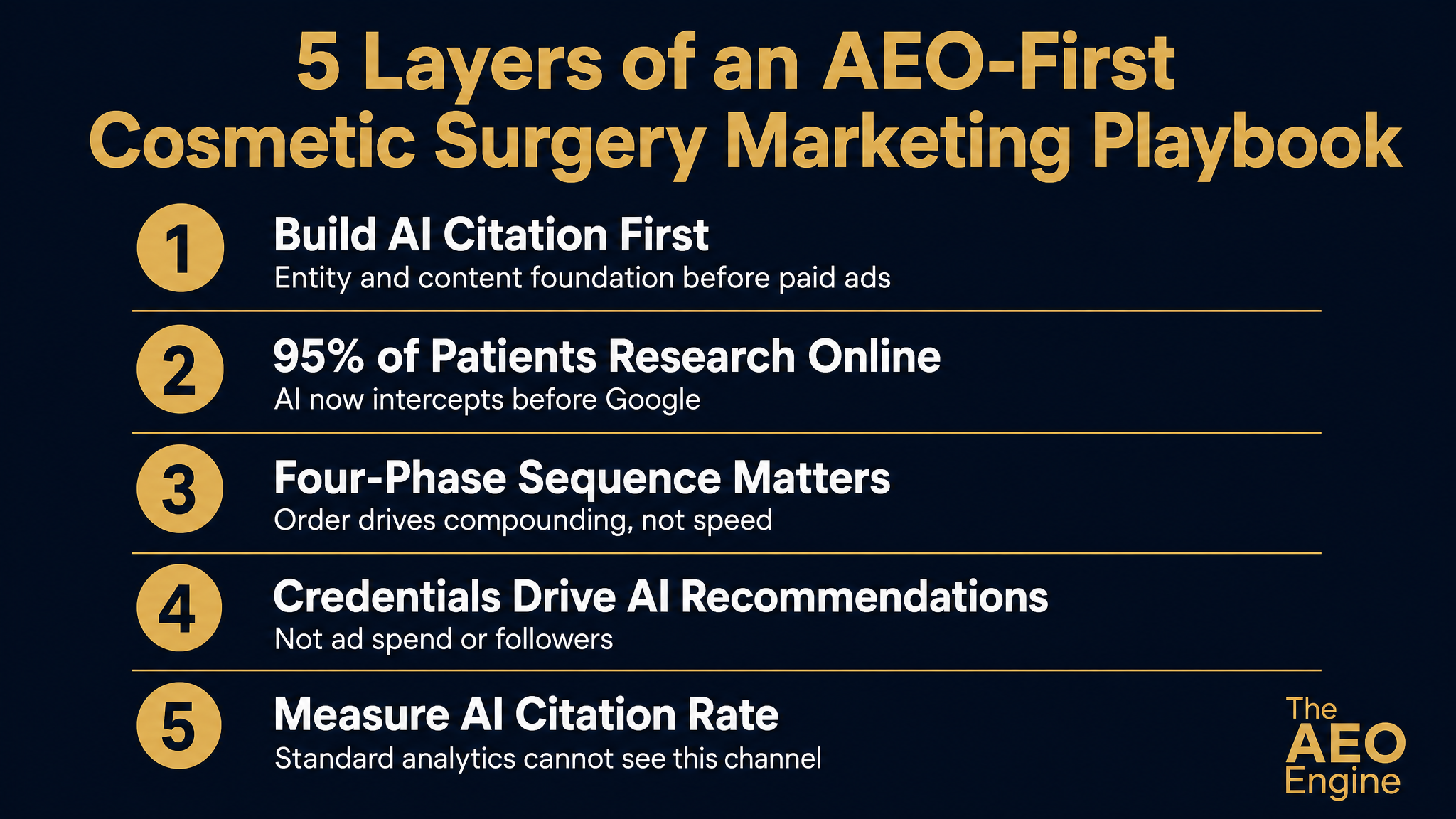
What Does "AEO-First" Mean for Cosmetic Surgery Marketing?
AEO-first is a sequencing principle, not a rejection of traditional marketing channels. It means that before a cosmetic surgery practice invests in Google Ads or Instagram campaigns, the foundational work that allows AI platforms to discover, evaluate, and recommend the practice is already in place.
The traditional marketing sequence runs: website, paid ads, SEO, and sometimes social media. AI citation is treated as optional or not addressed at all. This sequence made sense when Google captured the entire patient search journey. It no longer applies when ChatGPT, Perplexity, and AI Overviews now handle the early research queries that precede a Google search.
An AEO-first sequence runs differently: entity consistency first, then structured content, then AI citation building, then paid amplification on top of a practice the AI platforms already recognize. The result is that paid traffic arriving at an AEO-established practice converts at a higher rate because the practice was already recommended to the patient before the click occurred.
Why Is AI Citation the Missing Layer in Most Cosmetic Surgery Marketing Plans?
Most cosmetic surgery practices operate with a marketing plan that looks the same as it did three years ago: a website, Google Ads, and an Instagram account. That plan was built for a world where Google controlled patient discovery. That world has changed substantially.
Research on AI-generated information in plastic and cosmetic surgery documents that 95% of patients use the internet as a source of information before consulting a surgeon. AI platforms now intercept a portion of that research at the query stage. Patients ask ChatGPT or Perplexity which practices are recommended for rhinoplasty, abdominoplasty, or liposuction in their city before visiting any website.
The practices appearing in those AI responses are not the ones spending the most on ads. They are the ones that have built entity consistency, structured credential data, and procedure-specific content that AI systems can evaluate for authority. The majority of cosmetic surgery practices currently receive no AI-generated recommendations. Their ad spend, their SEO, and their social media presence are all invisible to the AI layer.
That invisibility is a solvable problem, not a permanent condition. The AEO-first approach addresses it directly by building the foundation that AI platforms require before they will cite any practice with confidence.
The AEO Engine builds AEO-first marketing infrastructure for cosmetic surgery practices navigating this shift. The AEO Engine offers a complimentary gap analysis showing your practice's current AI citation rate. Request it here.
What Should a Complete Cosmetic Surgery Marketing Playbook Include?
A complete AEO-first cosmetic surgery marketing playbook has four phases, each building on the last. No phase should be skipped, and the sequence is deliberate.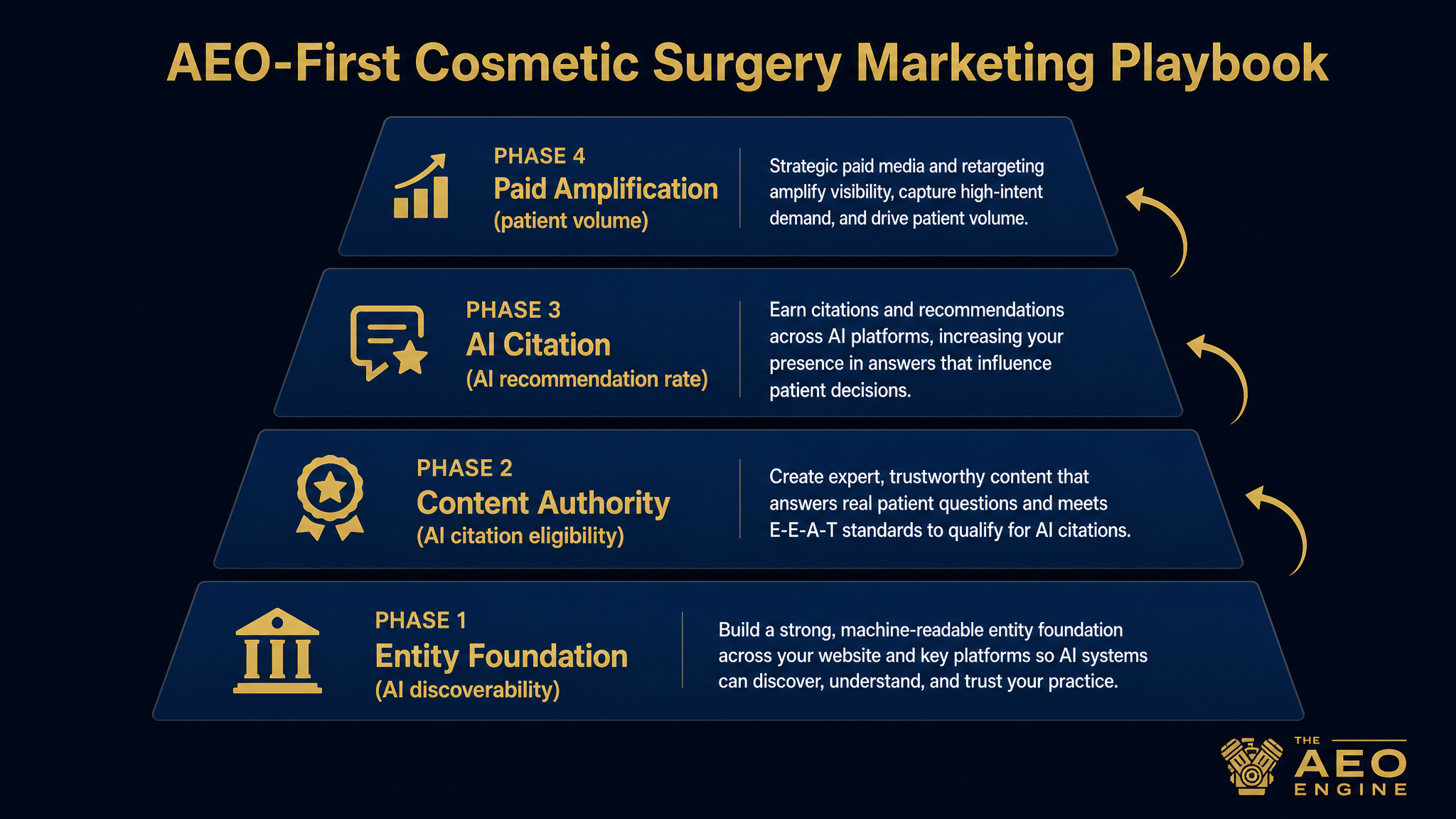
Phase 1 is entity foundation. The practice name, provider names, board certifications, affiliations, address, and contact details must be identical across the website, Google Business Profile, review platforms, and directory listings. AI systems use entity consistency to confirm a practice is real and credible. Inconsistent data across sources signals lower authority and reduces the likelihood of citation.
Phase 2 is content authority. The practice needs procedure-specific content: detailed, accurate guides to the specific procedures offered. Each piece addresses the questions patients ask before booking a consultation. Peer-reviewed research on plastic surgery digital marketing confirms that educational content consistently outperforms promotional content in both engagement and trust-building across patient demographics.
Phase 3 is AI citation building. This means applying structured data markup so AI systems can parse and evaluate the practice's information, publishing FAQ-format content aligned to the way patients query AI platforms, and ensuring credential visibility throughout the site architecture. The CITE Framework structures this phase with specific implementation steps for cosmetic surgery practices operating under healthcare advertising constraints.
Phase 4 is paid amplification. Once the first three phases are operational, paid ads (Google Search, Meta, Instagram) amplify a practice that AI platforms already recognize and recommend. Conversion rates are typically higher because patients arriving via paid channels have often already encountered the practice through an AI recommendation or organic search.
What Should Be Set Up Before a Cosmetic Surgery Practice Runs Paid Ads?
Paid advertising for cosmetic surgery practices performs best when the destination (the website, the landing page, the practice profile) carries authority that extends beyond the ad itself.
Before running paid ads, the practice should confirm four elements are in place. First, the Google Business Profile is complete, verified, and consistent with all other directory listings. Practices with incomplete or inconsistent GBP data underperform on both Google Ads and organic visibility, regardless of ad budget.
Second, the website has procedure-specific pages for every category being advertised. A Google Ad for rhinoplasty landing on a generic homepage with no rhinoplasty content wastes ad spend and lowers Quality Score, raising cost per click for all campaigns.
Third, board certification and credentials are prominently displayed on the website, on provider bios, and in structured data markup. AI platforms evaluate credentials when deciding whether to cite a practice. Patients reading landing pages evaluate credentials when deciding whether to book.
Fourth, at least the first phase of AI citation infrastructure, namely entity consistency, is established. Running paid ads to a practice that AI platforms do not recognize means every paid acquisition is isolated rather than reinforcing compounding authority.
Practices that skip these prerequisites can still generate leads from paid ads. They simply pay more per lead and see performance plateau earlier than practices with the foundation in place.
How Do You Measure Cosmetic Surgery Marketing Results in an AEO-First Approach?
The traditional measurement dashboard for cosmetic surgery marketing tracks website traffic, paid ad impressions, click-through rates, and form submissions. These metrics remain useful but are insufficient for an AEO-first approach because they cannot capture how many patients discovered the practice through an AI recommendation before clicking anything.
An AEO-first measurement framework adds three metrics. The first is AI citation rate: the percentage of relevant procedure-plus-location queries to AI platforms where the practice name appears in the response. This is measured by querying ChatGPT, Perplexity, and Google AI Overviews with the specific queries patients use in the target market.
The second metric is citation context quality: whether the practice is mentioned as a directly recommended option or cited only as a passing reference. A recommendation citation produces meaningfully different patient behavior than a list mention.
The third metric is consultation source tracking: asking new patients how they first heard about the practice, including whether they used an AI platform during their research. Practices that begin tracking this consistently find AI-referred patients present with higher intent and require fewer touchpoints before booking a consultation.
These three metrics, combined with traditional traffic and conversion data, give a complete picture of patient acquisition and allow budget decisions to be made based on where compounding value is actually accumulating.
Frequently Asked Questions
What is AEO-first cosmetic surgery marketing?
AEO-first cosmetic surgery marketing is an approach that prioritizes building Answer Engine Optimization infrastructure, AI citation visibility in platforms like ChatGPT, Perplexity, and Google AI Overviews, before investing in paid advertising or social media campaigns. The sequencing principle recognizes that AI platforms now intercept a growing share of patient research before it reaches Google, so the foundation that makes a practice discoverable by AI must be built first for subsequent marketing investments to perform at their full potential.
How is AEO different from SEO for cosmetic surgery practices?
SEO optimizes a practice's website to rank in Google search results through keyword targeting, backlinks, and on-page structure. AEO optimizes the practice's entity data, content, and credential visibility to be cited by AI platforms when patients ask those systems for procedure recommendations. Both disciplines matter, but they require different strategies. SEO focuses on keyword rankings and domain authority. AEO focuses on entity consistency, structured data, credential prominence, and educational content that AI systems can evaluate for authority.
What should be the first step in a cosmetic surgery marketing playbook?
The first step is entity foundation: ensuring the practice name, provider names, board certifications, affiliations, address, and contact information are identical across the website, Google Business Profile, review platforms, and directory listings. This consistency is the primary signal AI platforms use to confirm a practice is a real and credible entity before they will cite it in patient-facing responses. Without entity consistency, all subsequent marketing investments build on an unstable base.
How long does it take for an AEO-first cosmetic surgery marketing strategy to show results?
AI citation results typically begin appearing within 60 to 90 days of consistent entity and content work. Paid media results, added after the foundation is set, appear within the first two to four weeks of campaign launch when campaigns are structured correctly. Organic search improvements from content authority build over three to nine months as the practice's topical depth and domain authority grow. The compounding nature of the AEO-first approach means that results accelerate as each layer reinforces the others.
What does AI citation mean for cosmetic surgery marketing?
AI citation means that when a patient asks a platform like ChatGPT, Perplexity, or Google AI Overviews for a recommendation on cosmetic surgery providers in a specific city, the practice name appears in the AI's response as a recommended option. AI citation is driven by entity consistency, board certification visibility, structured content, and educational authority across the practice's digital properties. It is not driven by ad spend, follower count, or the number of reviews a practice has accumulated.
Do cosmetic surgery practices still need paid advertising in an AEO-first approach?
Yes. Paid advertising remains a high-value patient acquisition channel for cosmetic surgery practices. The AEO-first approach does not eliminate paid ads, it sequences them to follow the AI citation foundation rather than precede it. Practices running paid ads on top of established AI citation infrastructure extract better performance from their ad spend because patients arriving via paid channels have often already encountered the practice through an AI recommendation, arriving at the landing page with higher intent.
How do you measure the success of an AEO-first cosmetic surgery marketing playbook?
Success measurement in an AEO-first approach adds three metrics to the traditional dashboard: AI citation rate (how often the practice appears in AI platform responses to relevant queries), citation context quality (whether the practice is recommended or merely mentioned), and consultation source tracking (asking new patients whether they used an AI platform during their research). These metrics, combined with traffic and conversion data, give a complete picture of how patient acquisition is actually working across all discovery channels.
What makes a cosmetic surgery practice get cited by ChatGPT or Perplexity?
The primary factors AI platforms evaluate when deciding whether to cite a cosmetic surgery practice are: entity consistency across all digital properties, board certification and credential visibility, procedure-specific educational content, structured data markup that helps AI systems parse practice information, and geographic specificity in the content. Practices that address all five factors appear consistently in AI recommendations. Practices missing one or more of these foundations remain invisible to AI platforms regardless of their marketing budget.
Executive Summary
An AEO-first cosmetic surgery marketing playbook sequences patient acquisition strategy around the reality that AI platforms now intercept a growing share of patient research before it reaches Google. The playbook has four phases, entity foundation, content authority, AI citation, and paid amplification, and the order is deliberate. Practices that follow this sequence build durable, compounding visibility rather than traffic dependent on an ongoing ad budget. Measurement must track AI citation rate alongside traditional metrics to reflect the full patient discovery landscape. The majority of cosmetic surgery practices currently operate at a 0% AI citation rate, making this a genuine first-mover opportunity for practices willing to build the foundation now.
What Should You Do Next?
The first action for any cosmetic surgery practice evaluating an AEO-first approach is to measure the current AI citation baseline. Query ChatGPT, Perplexity, and Google AI Overviews with the procedure-plus-location queries patients use in the target market and record how many responses include the practice name. Most practices find the answer is zero across all three platforms.
The second action is an entity audit: compare the practice name, provider names, and contact details across the website, Google Business Profile, and the top five directory listings. Document any inconsistencies. These gaps are the first problem to resolve before any other marketing investment can compound properly.
The AEO Engine completes both steps as part of a complimentary gap analysis, showing the practice's current AI citation rate and the specific entity or content gaps explaining it. Request a free gap analysis here to get the current-state picture before deciding where to invest next.
People Also Read
- How Do AI Marketing Services Move You From Listed to Recommended?
- What Does an AI Visibility Audit Reveal About Your Citation Gap?
About the Author
Jerry Jariwalla is the founder of The AEO Engine and creator of the CITE Framework for Answer Engine Optimization. With over 22 years in digital marketing and multiple successful business exits, Jerry has spent the past two years building AI citation systems for regulated practices in healthcare, wealth management, and legal services. The AEO Engine works exclusively with practices operating under advertising restrictions where AI citation provides higher leverage than traditional paid acquisition.
Expertise: Answer Engine Optimization, AI Citation Strategy, CITE Framework, Regulated Industry Marketing, Healthcare Practice Marketing, Wealth Management Marketing, Legal Marketing
Connect: LinkedIn
Disclaimer: This content is for informational purposes only and does not constitute professional marketing, legal, or compliance advice. Citation rates, timelines, and outcomes vary based on industry, competitive density, and execution quality. Statistics referenced reflect The AEO Engine's tracked client outcomes as of 2026 and are not guarantees of future results. Contact The AEO Engine for a consultation regarding your specific situation.