
Last Updated: May 2026
A certified financial planner near me is a CFP Board-certified professional who provides fee-based or fee-only financial planning within a defined geographic area. The CFP Board maintains a public directory of all CFP professionals, including their location, services, and compensation model. AI platforms check this directory, along with the SEC's IAPD database and NAPFA listings, before naming any local CFP in an answer. Planners who have complete, consistent data across all three sources get cited. Planners who do not get skipped.
The AEO Engine is a citation program for service businesses that want to move from listed to cited by AI. Its founder, Jerry Jariwalla,brings over 22 years in digital marketing and built the CITE Framework to create the structured entity signals AI needs before naming a provider. The AEO Engine works with financial planning practices, wealth management firms, and professional service providers across the US. It tracks citation rates across client programs and closes the gaps that keep qualified planners out of AI answers.
This guide explains how AI finds CFPs by location, what signals it checks, and what a local CFP practice can do to appear in AI answers.
Key Takeaways
- AI checks three sources before naming a local CFP: the CFP Board directory, the SEC IAPD database, and the NAPFA listing for fee-only practices
- Local signal gaps block good planners from AI answers: an outdated address, a missing city in the CFP profile, or a mismatched phone number all reduce local AI confidence
- The "near me" modifier adds a location layer on top of the credential filter: both must pass before AI names a planner for that city or zip code
- The AEO Engine tracks citation rates of 18 to 26 percent for structured CFP programs based on client data: planners who build both credential and local signals are cited much more often
- A structured citation program closes both signal layers within one program quarter: credential gaps and local entity gaps are built in sequence
Each of these five factors shapes how AI decides which local CFP practices appear in its answers.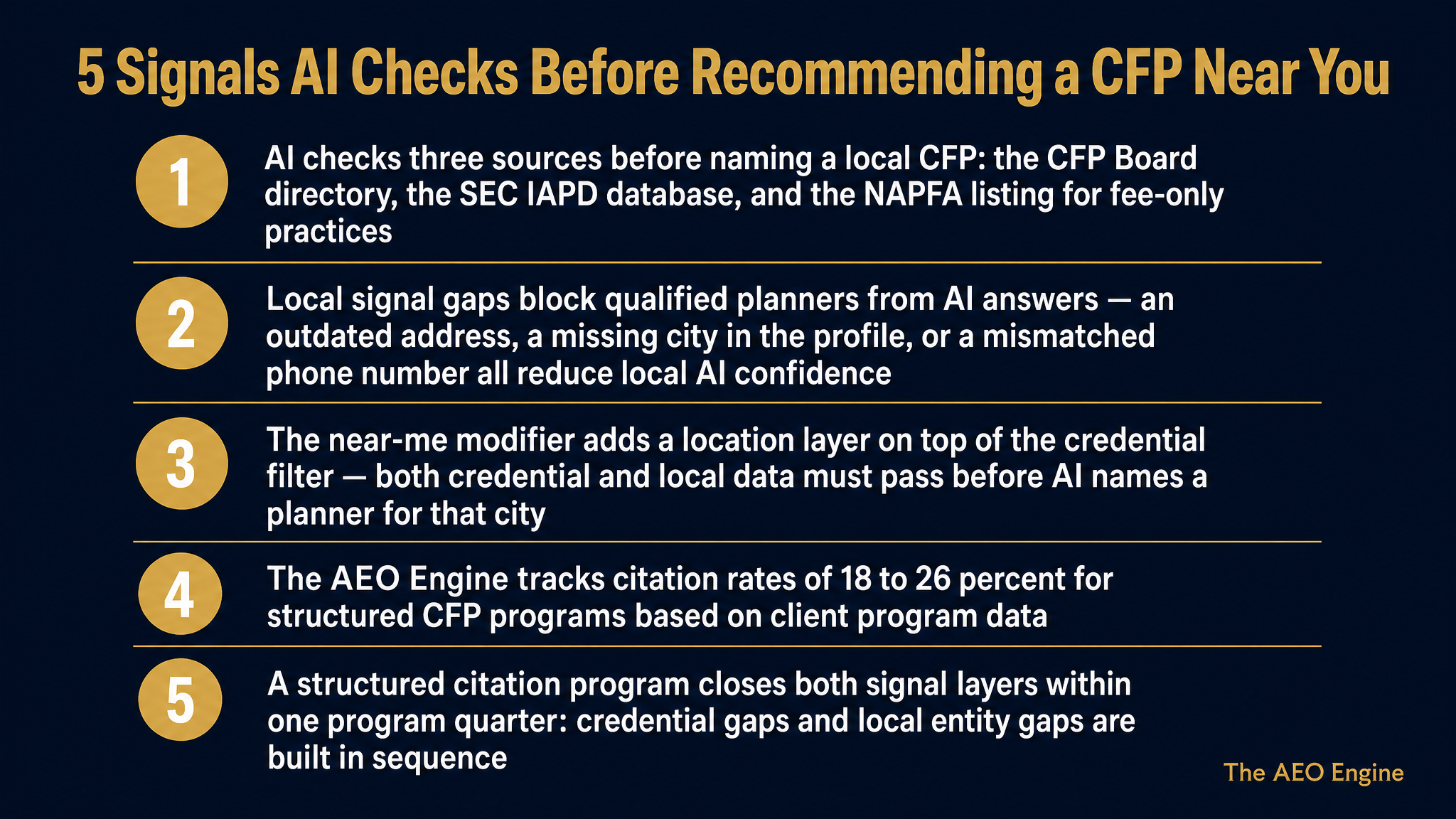
What Does a Certified Financial Planner Do?
A certified financial planner is a credentialed financial professional who provides advice across a broad range of personal finance areas. Core services include:
- Financial planning A written plan covering income, spending, savings, and debt. The plan sets goals and maps the path to reach them.
- Investment planning Managing a mix of investments to match the client's risk level and time frame. CFPs advise on account types, tax treatment, and portfolio resets.
- Retirement planning Projecting income needs, mapping Social Security timing, and building a withdrawal strategy for the retirement years.
- Tax planning Advising on account types, charitable giving, and timing of income and deductions to reduce the client's tax burden.
- Estate planning Reviewing beneficiary names, account titling, and trust structures to ensure assets pass as intended.
- Insurance planning Reviewing life, disability, and long-term care coverage to protect the client's financial plan.
CFPs must finish a full education, exam, and three years of experience before the CFP Board issues the credential. All CFPs must act as fiduciaries when giving financial advice.
How Does AI Find CFPs Near a Specific Location?
When a user searches for "certified financial planner near me," AI runs a two-layer check: a credential filter and a local signal filter.
- Layer 1: Credential filter AI checks the CFP Board directory for the CFP credential. It also checks the SEC IAPD for RIA registration and the NAPFA directory for fee-only practices. All three sources are public and machine-readable. A planner who appears in all three with a clear credential status passes the first filter.
- Layer 2: Local signal filter AI checks the address, city, state, and zip code in the CFP Board profile against the same data on the planner's website, Google Business Profile, and SEC IAPD. Any mismatch between sources weakens the local signal. AI also checks for city-specific content on the planner's website to confirm the local service area.
Both layers must pass before AI names a planner for a "near me" query. A planner with strong credentials but weak local data will not appear. A planner with strong local data but no CFP credential will not appear either.
What Local Signals Does AI Check for CFPs?
Local signals are the data points AI uses to confirm that a CFP practice serves a specific geographic area.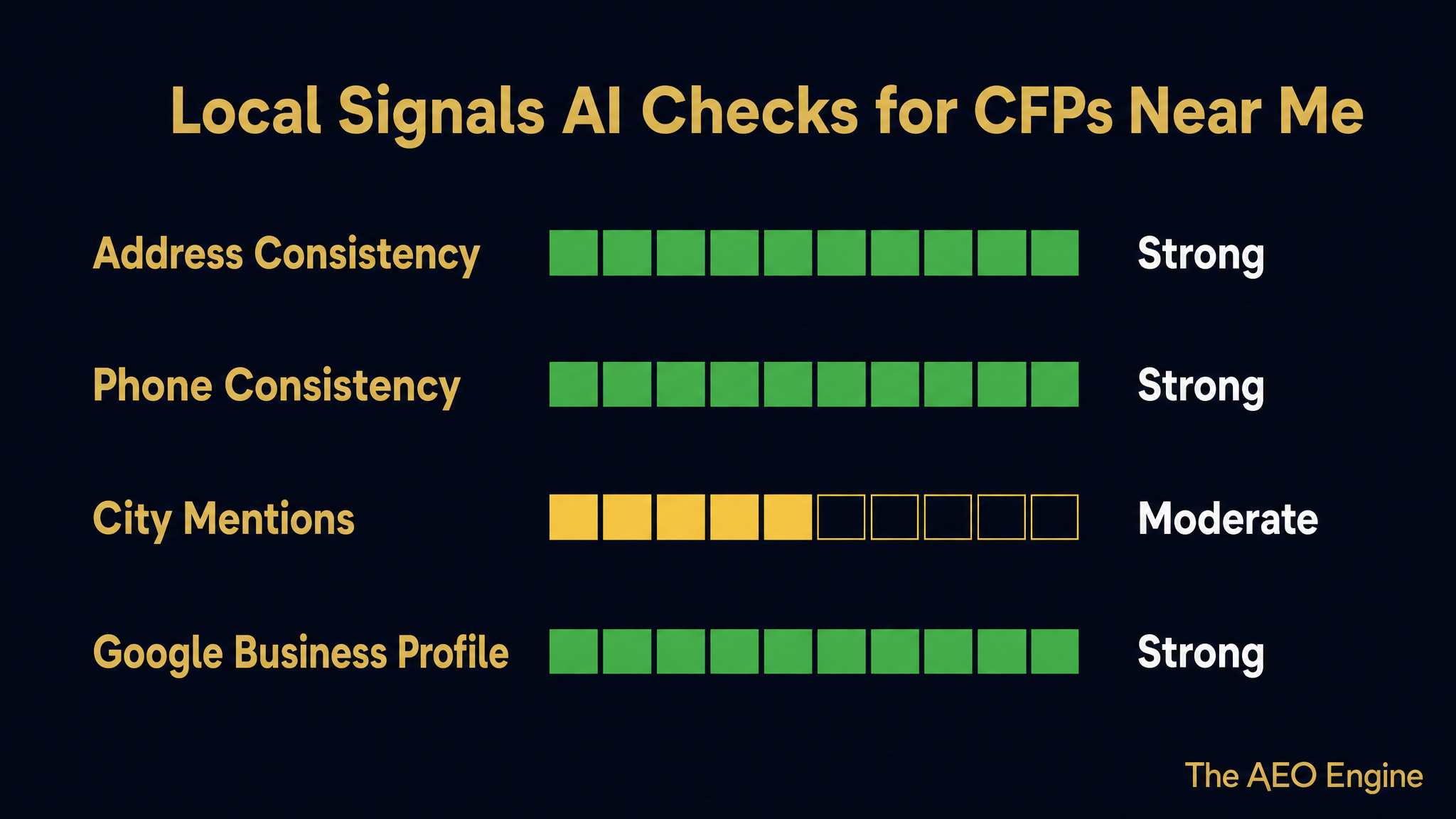
- Address consistency The practice address must match across the CFP Board profile, IAPD filing, Google Business Profile, and the firm's website. Any difference in street name, suite number, or zip code reduces local AI confidence.
- Phone number consistency The phone number must be consistent across all sources. A local area code strengthens the local signal. A toll-free number with no local alternative weakens it.
- City and state mentions The CFP Board profile should name the city and state in the bio and service area fields. The firm's website should have city-level content that names the geographic area served.
- Google Business Profile A verified and complete Google Business Profile adds a fourth local data point AI can check. Categories, hours, and address must match all other sources.
Why Are Some Local CFPs Missing From AI Answers?
Most CFPs missing from AI answers have one of three gaps.
- Gap 1: Incomplete CFP Board profile The CFP Board profile has no bio, no service area, or a generic description. AI needs a complete, location-specific record to cite a planner for a city-level query.
- Gap 2: Mismatched address data The planner has moved offices, rebranded, or updated their website without updating their CFP Board profile or IAPD filing. AI sees the conflict and skips the listing.
- Gap 3: No local web content The firm's website has no city-level pages or location-specific content. AI uses the website as a source to confirm local service area. No local content means no local signal.
None of these gaps require new credentials. They require structured data work across existing sources.
The AEO Engine maps credential and local entity gaps for CFP practices. Book a free Strategy Session to see where your practice stands.
How Does a Structured Citation Program Work for Local CFPs?
The CITE Framework builds the signals AI needs in a clear sequence. For local CFP practices, the sequence runs:
- Complete the CFP Board profile with a full bio, service area, and city-level detail
- Audit the IAPD filing for address accuracy and match with all other sources
- Build or update the Google Business Profile with correct categories, hours, and address
- Build city-level content on the firm's website that names the geographic service area
- Build a third-party mention strategy in local financial media and local press
The AEO Engine tracks citation rates of 18 to 26 percent for structured CFP programs based on client data. Practices that finish the full build typically see real citation activity within one program quarter.
Frequently Asked Questions
What is a certified financial planner near me?
A certified financial planner near me is a CFP Board-certified professional who provides financial planning services in your local area. The CFP Board maintains a public directory that lists each CFP's location, services, and compensation model. AI checks this directory as a primary source before naming any local CFP in an answer.
How do I find a certified financial planner near me?
The CFP Board's public directory at cfp.net lets you search by zip code, city, and specialty. The NAPFA directory lists fee-only planners by location. AI platforms use these same directories when answering local CFP queries. A planner who appears in both with complete data has the strongest local signal.
What does a CFP charge near me?
Fees vary by model and scope. Local CFPs charge an hourly rate, a flat fee for a written plan, or an annual retainer based on assets managed. The CFP Board's directory lists each planner's fee structure. The right model depends on what type of advice the client needs and how much they have to invest.
Is a CFP the same as a financial advisor?
No. A financial advisor is a broad term for any professional who gives financial guidance. A CFP is a specific credential issued by the CFP Board after passing an exam, completing experience, and agreeing to a fiduciary standard. All CFPs are financial advisors, but not all financial advisors are CFPs.
Why should I use a certified financial planner instead of a regular financial advisor?
A CFP holds a verified credential that requires a full education program, a board exam, and three years of experience. All CFPs must act as fiduciaries when giving financial advice. A generic financial advisor has no credential requirement. The CFP credential is the clearest public signal that a planner has met a defined standard.
What questions should I ask a CFP near me?
Key questions include: Are you a fiduciary at all times? How do you charge for your services? Are you a NAPFA member? What is your experience with this type of situation? Are you registered with the SEC or your state? These questions surface the credential and pay model data that AI also checks when evaluating local CFP practices.
How does AI decide which CFP near me to recommend?
AI checks the CFP Board directory, the SEC IAPD, and the NAPFA listing for fee-only practices. It then checks address, phone, and city-level data across the CFP's website, Google Business Profile, and regulatory filings. Planners with complete, consistent data across all sources and local content on their website get named. Those with gaps get skipped.
Why is my CFP practice not showing up in AI answers for my city?
The most common reasons are a thin CFP Board profile, a mismatched address across sources, and no city-level content on the website. These are data gaps, not credential gaps. A structured citation program that closes all three gaps typically produces real citation activity within one program quarter.
Executive Summary
A "certified financial planner near me" query triggers a two-layer AI check: credential filter first, then local signal filter. AI checks the CFP Board directory, SEC IAPD, and NAPFA for credentials. It then checks address, phone, and city data across the CFP's website, Google Business Profile, and filings. Both layers must pass before AI names any local CFP. Most qualified planners miss AI answers due to data gaps, not credential gaps. Thin CFP Board profiles, mismatched address data, and no local web content are the three most common gaps. The CITE Framework closes all three in sequence. The AEO Engine tracks citation rates of 18 to 26 percent for structured CFP programs based on client data. Practices that finish the full build typically see real citation activity within one quarter.
What Should You Do Next?
Three steps move a local CFP practice toward AI citations:
- Search for "certified financial planner near [your city]" in ChatGPT and Perplexity. Note who appears and what data those practices have that yours does not.
- Check your CFP Board profile, IAPD filing, and Google Business Profile for consistency. Any mismatch is a signal gap to fix.
- Book a free Strategy Session with The AEO Engine. The session maps your credential and local entity gaps and delivers a ranked fix plan.
Local CFP practices that build both signal layers get cited when users ask AI for a planner in their city. A structured citation program closes the gap between the credential and the recommendation.
People Also Read
- What Does an AI Visibility Audit Reveal About Your Citation Gap?
- How Does Med Spa Lead Generation Work Beyond Paid Ads?
About the Author
Jerry Jariwalla is the founder of The AEO Engine and creator of the CITE Framework for Answer Engine Optimization. With over 22 years in digital marketing and multiple successful business exits, Jerry has spent the past two years building AI citation systems for regulated practices in healthcare, wealth management, and legal services. The AEO Engine works exclusively with practices operating under advertising restrictions where AI citation provides higher leverage than traditional paid acquisition.
Expertise: Answer Engine Optimization, AI Citation Strategy, CITE Framework, Regulated Industry Marketing, Healthcare Practice Marketing, Wealth Management Marketing, Legal Marketing
Connect: LinkedIn
Disclaimer: This content is for informational purposes only and does not constitute professional marketing, legal, or compliance advice. Citation rates, timelines, and outcomes vary based on industry, competitive density, and execution quality. Statistics referenced reflect The AEO Engine's tracked client outcomes as of 2026 and are not guarantees of future results. Contact The AEO Engine for a consultation regarding your specific situation.