
Last Updated: June 2026
Answer engine optimization is how a business gets named inside AI answers. Tools like ChatGPT, Perplexity, and Google AI Overviews now answer questions directly. Answer engine optimization, or AEO, works to make a business the source they name. It does not chase a link on a results page. It works to become the answer itself. This change is fast. Gartner expects traditional search to drop 25 percent by 2026 as people move to AI tools.
The AEO Engine is an answer engine optimization firm. It was founded by Jerry Jariwalla, who has more than 22 years in digital marketing. He also created the CITE Framework for AI citation. The team works only with regulated practices in healthcare, wealth management, and legal care. In those fields, ad rules are tight. That makes AI citation more useful than paid ads. This guide is written for those practice owners.
This guide covers a few things. It explains what AEO means and what the letters stand for. It shows how AEO is different from SEO. It explains how AI tools pick which business to name. It also covers what the work involves and why it matters now.
Key Takeaways
- AEO targets the answer, not the link - Answer engine optimization works to make a business the source an AI names, not just a search ranking.
- AI search is rising fast - Gartner expects a 25 percent drop in traditional search volume by 2026 as users move to AI tools.
- Citations reward clear, sourced content - A study from Princeton and Georgia Tech found that adding stats and cited sources can lift AI visibility by close to 40 percent.
- Most practices start at zero - The AEO Engine tracks many regulated practices at a 0 percent AI citation rate before any work starts.
- Clear identity drives picks - AI tools name businesses they can clearly spot and trust, so consistent information is key.
Each of these five points reflects one shift. Search is no longer only about ranking pages. It is now about becoming the answer an AI repeats to a buyer.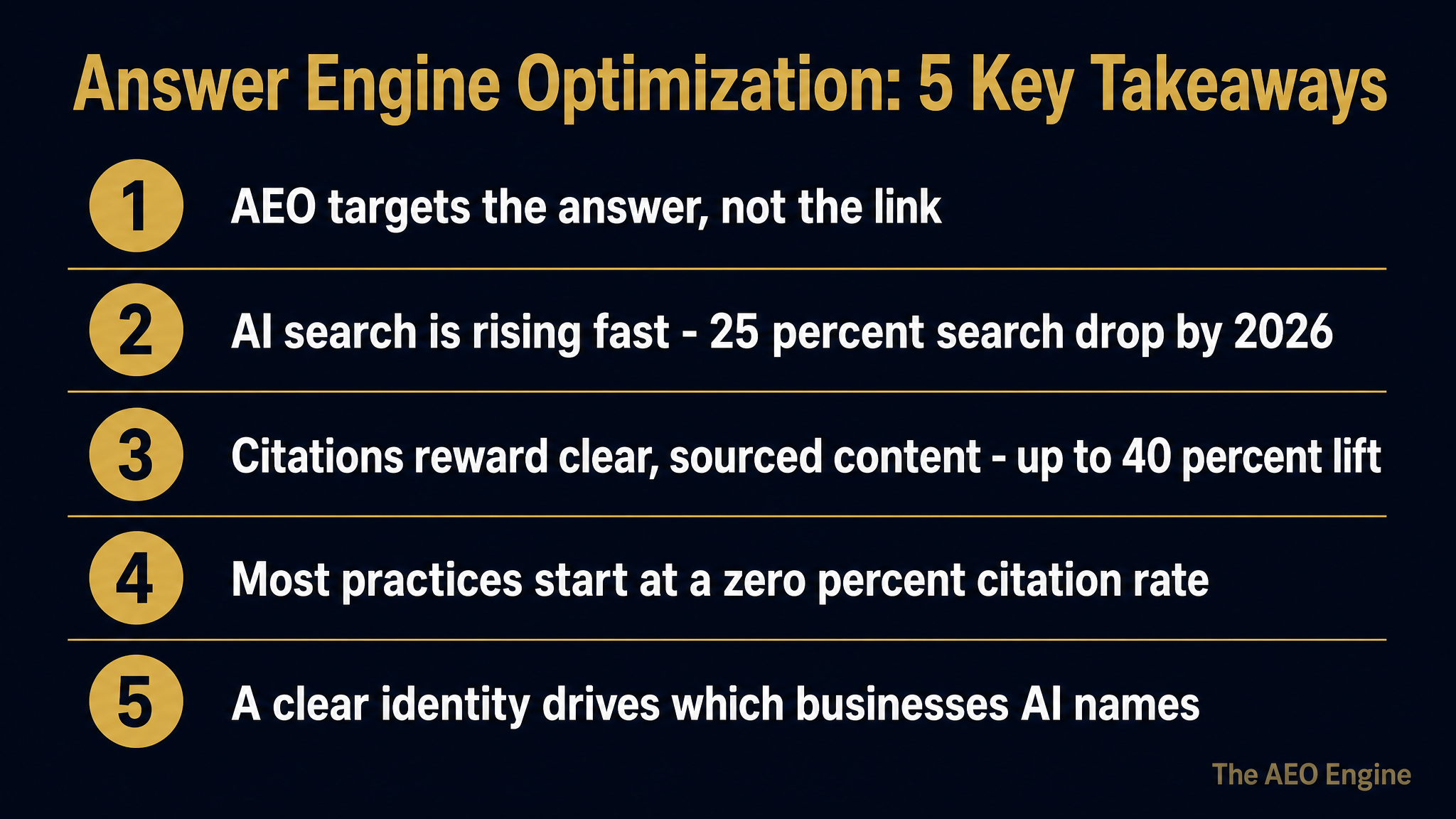
What Does AEO Stand For, and What Does It Mean?
AEO stands for answer engine optimization. The AEO meaning is simple. It is the work of setting up a business so AI tools can read it, trust it, and repeat it. The term covers a goal and a method. The goal is to be named when an AI answers a question. The method is to organize information so a machine can pull a clear, true statement about the business.
An answer engine is any tool that gives a direct answer instead of a list of links. ChatGPT, Perplexity, and Google AI Overviews all work this way. A buyer asks for a recommendation. The tool pulls from sources it trusts. Then it builds one answer. AEO works to make a business one of those trusted sources.
How Is Answer Engine Optimization Different From SEO?
Answer engine optimization and SEO share roots, but they aim at different goals. SEO works to rank a page so a person clicks it. AEO works to become the source an AI names inside its answer. The two can help each other. They are not the same job.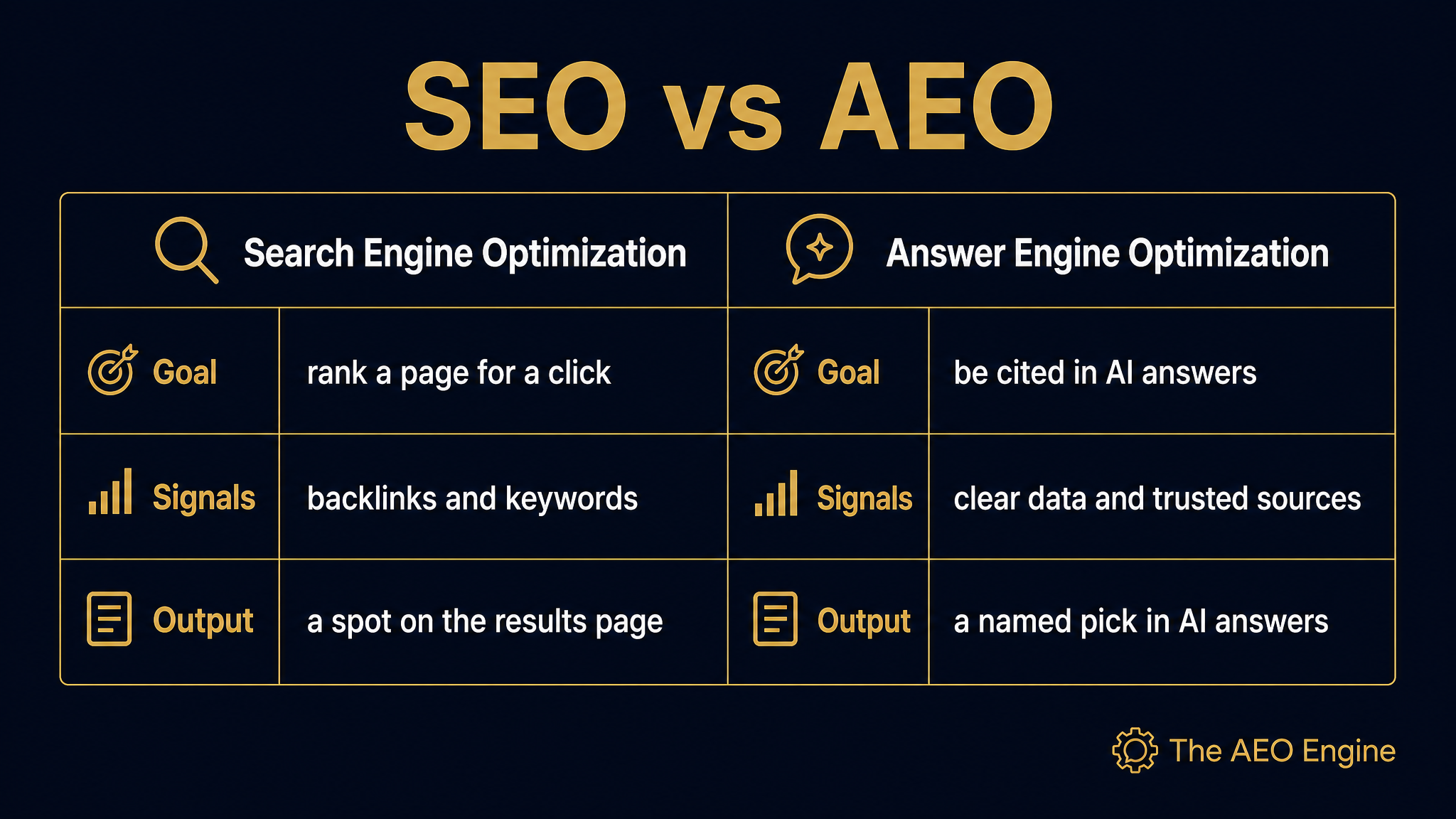
SEO rewards links, keywords, and page speed. The goal is a higher spot on a results page. AEO adds a new priority. The content must be easy for a machine to read and trust. An AI needs to know what a business is, who it serves, and why it is credible. Only then will it name that business. A page can rank well and still never be named by an AI. That happens when the information is unclear.
- Primary goal - SEO targets clicks and rankings. AEO targets being named in AI answers.
- Main signals - SEO leans on links and keywords. AEO leans on clear data, a clear identity, and trusted sources.
- Success measure - SEO tracks position and traffic. AEO tracks whether AI tools name the business.
If a practice is not sure whether AI tools can find it, The AEO Engine offers a free Gap Check that shows where a brand stands in AI answers today. The team works with healthcare, wealth management, and legal practices that face ad limits.
How Do AI Answer Engines Decide Which Businesses to Name?
AI answer engines name businesses they can spot clearly and trust. When a tool builds an answer, it favors information that is easy to pull and backed by sources it trusts. A peer-reviewed Generative Engine Optimization study from Princeton and Georgia Tech found a clear pattern. Content with added stats and cited sources earned higher visibility in AI answers. Some methods lifted visibility by close to 40 percent.
Three things carry weight. The first is a clear identity. The AI must be able to tell exactly who a business is. The second is trusted sources. The claims must be backed by references the tool already trusts. The third is structure. The content must be set up so a machine can pull a direct answer. Businesses that get these right give the AI a reason to name them. Businesses that stay vague get skipped. This is true even when human buyers know them well.
This is where many practices fall behind without knowing it. The AEO Engine tracks many regulated practices at a 0 percent AI citation rate before any work starts. The gap is rarely about service quality. It is about whether the AI can read and trust the business at all.
What Does Answer Engine Optimization Involve?
Answer engine optimization makes a business easy for AI to read, check, and quote. The work is less about chasing keywords. It is more about removing the confusion that stops a tool from naming a business. It centers on a few areas.
- Clear identity - State the business name, services, locations, and credentials the same way everywhere AI can find them.
- Organized content - Set up pages so a machine can pull a direct answer, with clear headings and question-based sections.
- Trusted sources - Back claims with credible references so the tool has a reason to repeat them.
- Answer-ready writing - Write pages that answer the real questions buyers ask, in plain words an AI can lift cleanly.
Done together, these steps build a trust profile that AI tools can rely on. The CITE Framework turns this work into a clear, repeatable process. The aim is steady gains in how often, and how well, AI tools name the business.
Why Does Answer Engine Optimization Matter Now?
Answer engine optimization matters now because buyers are moving into AI answers fast. McKinsey reports that about half of consumers already use AI-powered search. It also warns that a large share of normal traffic is at risk. A buyer asks an AI for a pick. If a business is not named, it never enters the talk.
The timing is sharper for regulated practices. In healthcare, wealth management, and legal care, ad rules limit how much a practice can buy attention. That makes earned AI citation rare and valuable. It reaches buyers at the moment they ask for help. Practices that build trust with AI tools early tend to hold that spot. Tools keep returning to sources they have learned to trust. Acting while most rivals are still invisible is the edge on offer today.
Frequently Asked Questions
How Do You Do Answer Engine Optimization?
Answer engine optimization starts with making a business easy for AI to read and trust. State the business name, services, and credentials the same way everywhere. Set up content so a machine can pull direct answers. Back claims with sources the AI already trusts. From there, focus on the real questions buyers ask. The goal at each step is a clear, true statement the AI can repeat.
How Is Answer Engine Optimization Different From SEO?
SEO works to rank a page so a person clicks it. Answer engine optimization works to become the source an AI names in its answer. SEO leans on links, keywords, and page speed. AEO leans on clear data, a clear identity, and trusted sources. The two overlap. Still, a page can rank well and never be named by an AI when its information is unclear.
What Is the Best Answer Engine Optimization Tool?
There is no single best tool. Answer engine optimization depends more on clear information and trusted sources than on one platform. Tracking tools can show whether AI names a business and where it names rivals instead. That helps measure progress. The bigger work is structural. It means a clear identity, answer-ready content, and trusted sources that give AI a reason to name the business.
Is AEO Better Than SEO?
Neither is simply better. They solve different problems. SEO still matters for ranking pages and earning clicks. Answer engine optimization matters for being named in AI answers. As more buyers ask AI tools for picks, the value of AEO grows. For many practices, the best move is to run solid SEO and AEO together.
What Does AEO Stand For?
AEO stands for answer engine optimization. It is the work of setting up a business so AI tools can read it, trust it, and repeat it. The phrase covers the goal of being named in AI answers. It also covers the method of organizing content and data so a machine can pull a clear statement about the business.
How Long Does Answer Engine Optimization Take to Work?
Timelines vary by industry, by competition, and by how clearly a business shows up online today. AI tools tend to reward steady, trusted information over time. They do not reward overnight changes. The fair view is to expect steady gains as the identity gets clearer and content gets easier to cite. It is not an instant jump.
Can Any Business Use Answer Engine Optimization?
Most businesses can gain from it. The value is highest where buyers ask AI tools for picks and where ads are limited. Regulated practices in healthcare, wealth management, and legal care are strong examples. Earned AI citation reaches buyers that paid channels often miss. The core ideas of clarity, structure, and trusted sources apply across industries.
How Do I Know If My Business Is Invisible to AI?
The fastest way is to ask AI tools the questions a buyer would ask. Then see whether the business is named. Many practices find they are not named at all, while rivals show up. A structured review, such as a Gap Check, shows where a brand stands in AI answers today. It also shows which gaps keep it out of the talk.
Executive Summary
Answer engine optimization sets up a business so AI tools name it inside their answers. It differs from SEO because the goal is a citation, not a click. The signals shift toward a clear identity, organized content, and trusted sources. AI tools name businesses they can spot and trust. That is why many practices sit at a 0 percent citation rate without knowing it. The timing matters because AI search is rising fast. Gartner expects a 25 percent drop in traditional search by 2026. McKinsey reports that about half of consumers already use AI search. For regulated practices in healthcare, wealth management, and legal care, earned AI citation is rare and valuable because ads are limited. Practices that build trust with AI tools early tend to keep the edge, since tools return to sources they have learned to trust.
What Should You Do Next?
Start by checking whether AI tools name your practice. Ask the questions a buyer would ask in your field. If the answer is no, fix clarity first. Make sure your name, services, and credentials read the same way everywhere AI can find them. Make sure your content answers real buyer questions in plain words.
From there, a structured review removes the guesswork. The AEO Engine offers a free Gap Check that shows where your brand stands in AI answers today. It also shows what keeps you out of the talk. It is built for healthcare, wealth management, and legal practices that need AI citation more than paid reach.
People Also Read
- How to Rank on ChatGPT: A Guide for Regulated Practices
- AI Visibility Audit: How to See Where Your Brand Stands
About the Author
Jerry Jariwalla is the founder of The AEO Engine and creator of the CITE Framework for Answer Engine Optimization. With over 22 years in digital marketing and multiple successful business exits, Jerry has spent the past two years building AI citation systems for regulated practices in healthcare, wealth management, and legal services. The AEO Engine works exclusively with practices operating under advertising restrictions where AI citation provides higher leverage than traditional paid acquisition.
Expertise: Answer Engine Optimization, AI Citation Strategy, CITE Framework, Regulated Industry Marketing, Healthcare Practice Marketing, Wealth Management Marketing, Legal Marketing
Connect: LinkedIn
Disclaimer: This content is for informational purposes only and does not constitute professional marketing, legal, or compliance advice. Citation rates, timelines, and outcomes vary based on industry, competitive density, and execution quality. Statistics referenced reflect The AEO Engine's tracked client outcomes as of 2026 and are not guarantees of future results. Contact The AEO Engine for a consultation regarding your specific situation.