
Last Updated: May 2026
A growing number of patients now use AI platforms such as ChatGPT, Perplexity, and Google AI Overviews as their first step when searching for a plastic surgeon, replacing traditional directory searches and referral calls with conversational AI queries that return direct practitioner recommendations. According to a 2024 study published in the National Library of Medicine, 95 percent of patients reported using the internet as a source of information before consulting a plastic surgeon, with AI-generated content now forming a significant share of those pre-consultation touchpoints.
The AEO Engine helps cosmetic surgery practices and healthcare businesses become the answer AI platforms deliver to patients. The firm was founded by Jerry Jariwalla and operates the CITE Framework, a structured methodology for building the entity authority that AI platforms require before citing a practice in patient-facing responses. Practices working with The AEO Engine build visibility in channels that standard analytics tools cannot measure.
This article explains how patients are using ChatGPT and other AI assistants to find plastic surgeons, why traditional SEO tactics are no longer sufficient to capture those patients, and what a practice must do to appear consistently in AI-generated recommendations.
Key Takeaways
- AI Platforms Intercept Patients Before Google: More than 40 million people ask ChatGPT health questions daily, according to a January 2026 OpenAI report via Healthcare Dive, making AI the first touchpoint for many prospective surgical patients.
- 95 Percent of Patients Research Digitally Before Consulting: Pre-consultation internet research is nearly universal, and AI platforms now route a growing share of that research traffic away from traditional directories.
- AI Citations Depend on Entity Authority, Not Ad Spend: Practices that appear in ChatGPT responses have built structured credentials, schema markup, and authoritative content that AI models use as citation signals.
- Credential Visibility Drives AI Recommendations: Board certification, procedural specializations, and published patient outcomes are the signals that AI platforms evaluate when selecting which surgeon to name.
- Standard Analytics Cannot Measure AI Citation Rate: Practices that do not actively track AI mentions have no visibility into how often patients are or are not receiving their name as a recommendation.
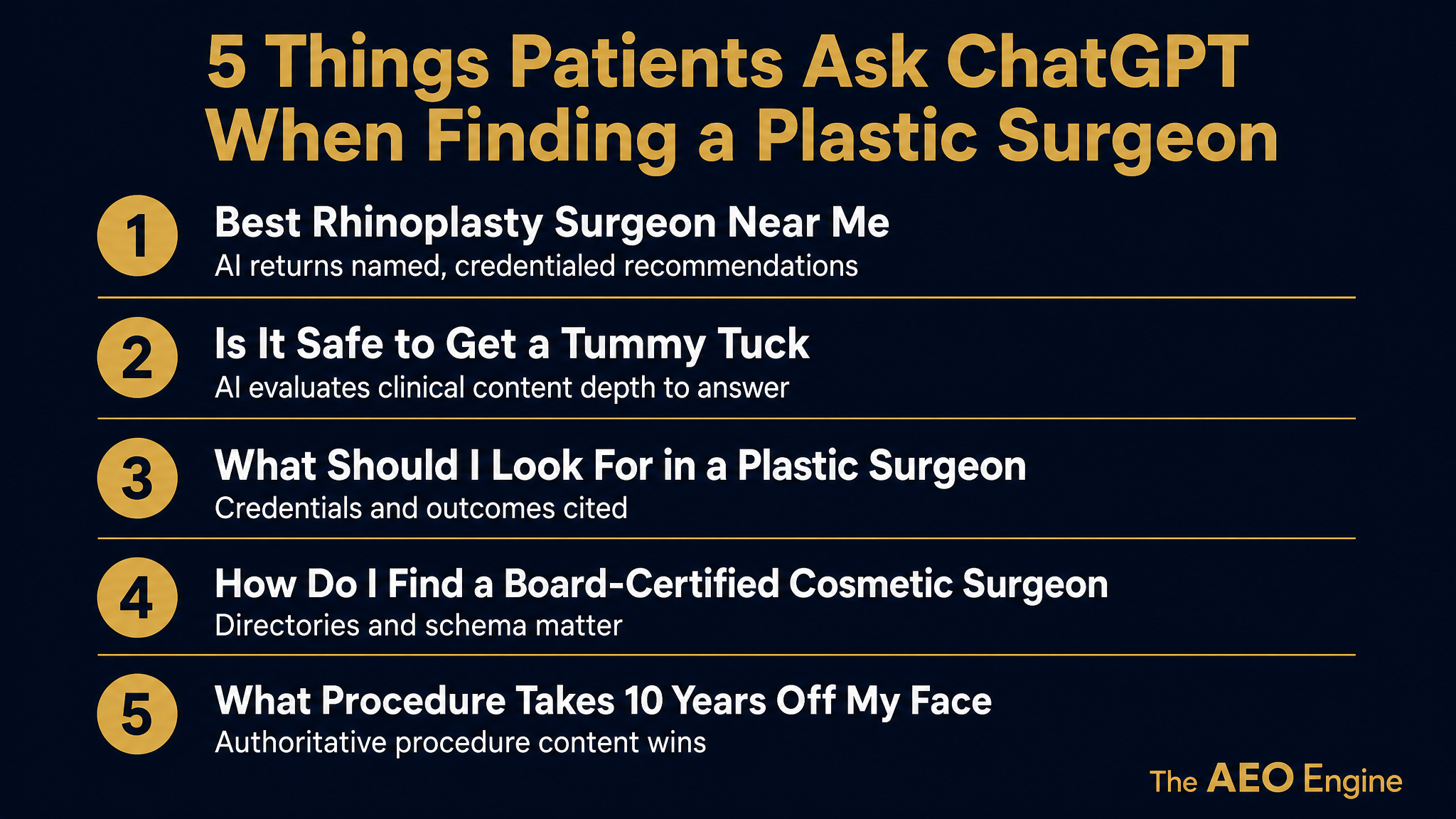
Infographic outlining common questions patients ask ChatGPT when finding a plastic surgeon.
Why Are Patients Turning to ChatGPT to Find a Plastic Surgeon?
Patients are turning to ChatGPT because it delivers a direct, conversational answer rather than a list of links that requires additional navigation and evaluation. When a patient types "find a plastic surgeon near me who specializes in rhinoplasty," an AI assistant can synthesize clinic credentials, procedure focus areas, and location data into a recommended shortlist, eliminating the multiple click-through steps that a Google search requires.
The behavior is particularly pronounced for high-consideration, high-anxiety decisions such as cosmetic surgery. Patients want to feel informed and confident before they contact a clinic. AI assistants provide a more accessible entry point than reading multiple competing websites, which explains why health-related queries have become one of the fastest-growing ChatGPT use cases.
Google Trends data shows that searches for "plastic surgery" more than doubled between December 2019 and January 2021, reflecting the broader acceleration of digital health research. That trend has continued with the rise of AI platforms, and patient behavior has shifted accordingly. Practices that built visibility in traditional search results are not automatically visible in AI-generated responses, because AI models select recommendations based on entity authority signals rather than keyword ranking positions.
What Does Patient AI Search Behavior Mean for Practice Visibility?
Patient AI search behavior creates a direct visibility gap for practices that have not built structured entity authority. A traditional SEO strategy optimizes a practice website to rank on page one of Google. AI citation optimization builds the underlying entity signals that cause an AI model to mention a practice by name when a patient asks a conversational question.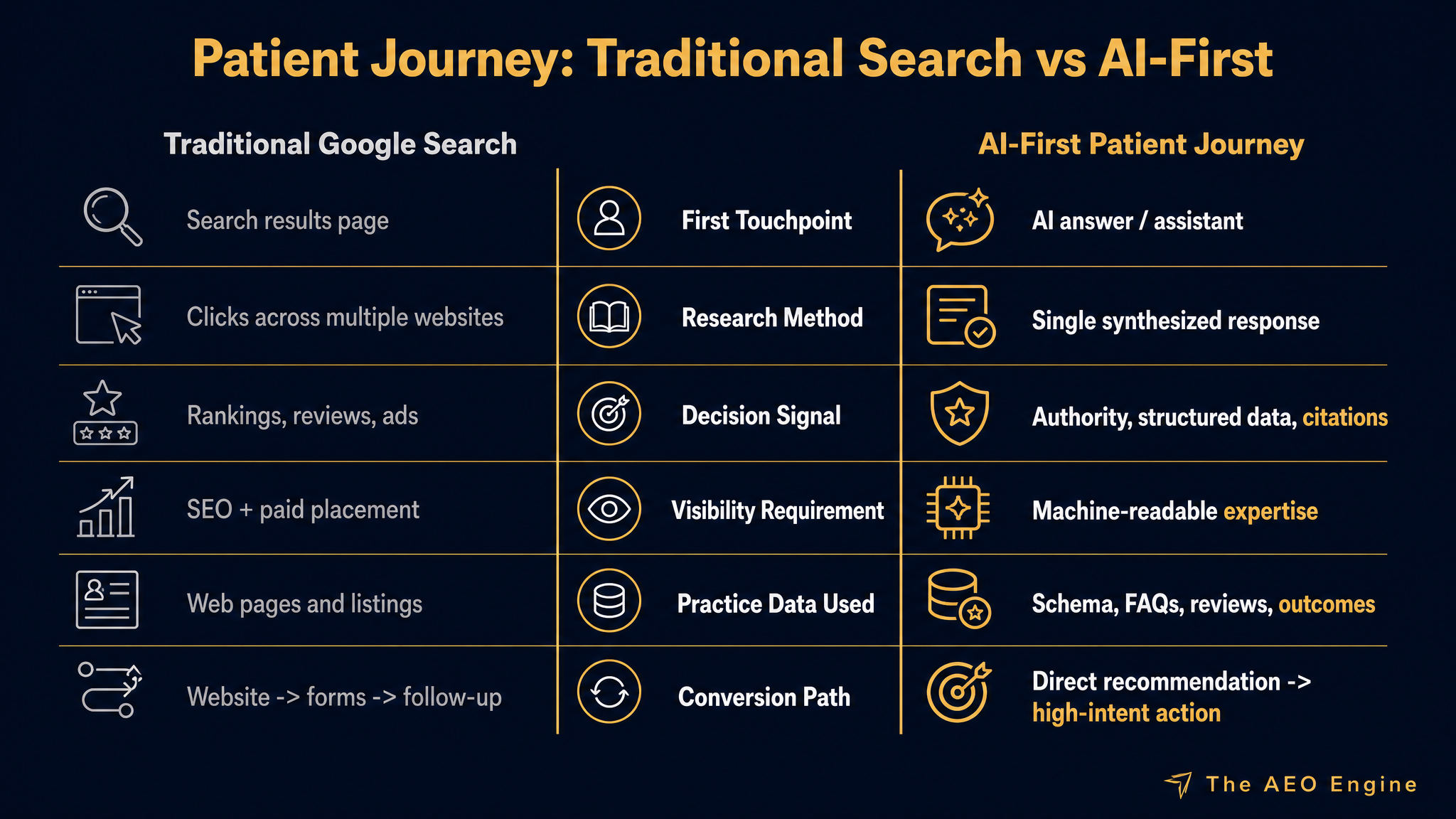
The difference is structural. Google ranks pages. AI platforms cite entities. An entity in this context is the full set of structured, verifiable information that describes a practice: its name, location, board-certified surgeons, procedural specializations, patient outcomes, credentials, and media mentions. When that entity data is consistent, comprehensive, and present across authoritative data sources, AI models have the confidence to include the practice in a recommendation.
The practical consequence is a two-tier visibility environment. Practices with high entity authority appear in AI responses and receive patient inquiries from a channel that competitors cannot see in their analytics. Practices without entity authority are invisible to AI platforms regardless of how much they spend on Google Ads or social media content. The patient journey has effectively bifurcated, and the AI citation channel represents the earlier, higher-intent stage of that journey.
The AEO Engine helps plastic surgery practices close this visibility gap through structured entity authority building, AI citation optimization, and ongoing citation rate tracking. Practices typically see measurable citation activity within the first 90 days of a structured program.
How Do AI Platforms Decide Which Plastic Surgeon to Recommend?
AI platforms select plastic surgeons to recommend based on a set of entity authority signals that indicate credibility, relevance, and verifiability. These signals are different from the ranking factors that determine Google search positions, which is why organic search performance does not reliably predict AI citation performance.
The primary signals that AI platforms evaluate include board certification and procedural credentials, the presence of structured schema markup on the practice website, mentions and citations from authoritative third-party sources such as medical journals and hospital affiliations, consistent name-address-phone data across major directories, and the depth and specificity of procedural content that demonstrates genuine clinical expertise.
Practices that invest in credentials are not doing so only for human patients who read their website. They are creating the factual foundation that AI models draw on when constructing a recommendation. A practice with an ABPS-certified surgeon, published case studies, and citations in credentialing directories is far more likely to receive AI mentions than a competitor with a polished brand but thin entity data.
The CITE Framework structures this entity-building process across four disciplines: credentials, information architecture, trust signals, and engagement indicators. Each discipline maps directly to the signals that AI platforms use to assess citation eligibility.
What Are the Most Common Queries Patients Use When Asking ChatGPT About Plastic Surgery?
Patients asking ChatGPT about plastic surgery tend to frame their queries conversationally, combining procedural intent with qualifier criteria such as location, specialization, and safety concerns. Common query patterns include "best rhinoplasty surgeon near me," "is it safe to get a tummy tuck," "what should I look for in a plastic surgeon," and "how do I find a board-certified cosmetic surgeon in [city]."
These queries share a key characteristic: they are evaluative rather than navigational. The patient is not looking for a homepage. They are asking an AI to perform the evaluation process on their behalf and return a recommended answer. This shifts the visibility requirement from ranking for keywords to being a credible, citable entity that the AI trusts to recommend.
Understanding query patterns also helps practices structure their content. FAQ-style pages that directly answer common patient concerns increase the probability that an AI model will extract and attribute that answer to the practice. Content that matches the natural language patterns patients use in AI queries is more likely to be selected as a citation source.
What Is the Best Way to Find a Good Plastic Surgeon?
The best way to find a good plastic surgeon is to verify board certification through the American Board of Plastic Surgery or the American Board of Cosmetic Surgery, review documented procedural outcomes relevant to the specific procedure, and confirm that the surgeon operates in an accredited facility. AI platforms and patient research platforms both increasingly surface these credential markers as primary recommendation criteria.
The most reliable credential verification pathway is the ABPS surgeon finder at the American Board of Plastic Surgery, which allows patients to confirm certification status directly rather than relying on self-reported claims. Hospital affiliation and facility accreditation provide additional safety indicators that AI platforms weight heavily in recommendation algorithms.
Beyond credentials, patients should evaluate the volume of procedures a surgeon performs annually in the specific area of interest. A high-volume rhinoplasty specialist will have documented outcomes that general cosmetic surgeons cannot match, and AI platforms are increasingly able to distinguish procedural concentration from generalist practice profiles.
Can Type 2 Diabetics Have Plastic Surgery?
Type 2 diabetics can have plastic surgery in many cases, but the decision requires careful medical evaluation of blood glucose control, healing risk, and anesthesia tolerance before any procedure is approved. Plastic surgeons typically require patients with type 2 diabetes to demonstrate stable HbA1c levels, usually below 7 to 8 percent, before scheduling elective procedures.
The primary concerns for diabetic patients considering cosmetic surgery are delayed wound healing, elevated infection risk, and cardiovascular considerations related to anesthesia. These risks are manageable with appropriate pre-surgical optimization, including glucose stabilization, medication review, and cardiac clearance where indicated.
Practices that publish detailed, medically accurate content addressing diabetes and cosmetic surgery eligibility demonstrate the clinical depth that AI platforms treat as an authority signal. When patients ask ChatGPT whether they qualify for a procedure given a health condition, the practices whose content directly answers that question are more likely to be cited as credible resources.
What Procedure Takes 10 Years Off Your Face?
The procedures most commonly associated with a decade or more of facial rejuvenation are the facelift (rhytidectomy), combined with upper or lower blepharoplasty, and fat transfer where volume loss is a primary aging factor. Research published in peer-reviewed plastic surgery journals indicates that patients who undergo comprehensive facial rejuvenation report perceiving themselves as appearing approximately 10 years younger following recovery.
AI platforms surface this type of comparative and outcome-focused content in response to patient questions because it reflects the genuine evaluation framework patients use. A practice that publishes procedure comparison content alongside documented outcomes gives AI models the citation-ready material needed to associate that practice with authoritative answers on facial surgery topics.
Brow lift, chemical peel, and laser resurfacing are frequently combined with surgical procedures to address surface texture in addition to structural changes, and the combination approach is what typically produces the most significant rejuvenation outcome. Practices that publish detailed combination-procedure content increase their citation surface across a broader set of patient queries.
What Is the 45-55 Breast Rule?
The 45-55 breast rule is a surgical principle in augmentation and breast lifting procedures that describes an ideal nipple-to-breast tissue distribution: 45 percent of breast volume above the nipple and 55 percent below. This ratio is used as a benchmark for natural-looking augmentation outcomes and for assessing the degree of ptosis correction required in a mastopexy procedure.
The rule serves as a planning tool rather than a strict anatomical requirement, and individual patient anatomy, implant selection, and aesthetic goals all influence how closely a surgeon targets this ratio. AI platforms that encounter this terminology in patient queries can cite practices that have published clear, accurate explanations of the principle as authoritative sources on breast augmentation planning.
Publishing accurate, procedure-specific educational content on topics like the 45-55 rule is a direct AI citation tactic. Patients ask AI platforms specific procedural questions because they want to arrive at consultations informed. Practices that answer those questions accurately and completely establish the pre-consultation authority relationship that converts to booked appointments.
How Does AI Citation Rate Differ From Traditional SEO Metrics?
AI citation rate measures how frequently a practice is named or recommended by AI platforms in response to relevant patient queries. Traditional SEO metrics such as keyword rankings, organic traffic, and domain authority measure performance in Google's algorithm. The two metric sets are distinct and do not reliably predict each other.
A practice can rank on page one for "rhinoplasty surgeon [city]" while having a near-zero AI citation rate if it lacks the entity authority signals that AI models use. Conversely, a practice with comprehensive entity data and credentialing documentation may generate AI citations that produce patient inquiries without those inquiries ever touching the Google search results that SEO tools monitor.
The practical consequence is that practices relying exclusively on traditional analytics have no visibility into a growing patient acquisition channel. The AEO Engine tracks AI citation rate as a primary performance indicator and provides clients with reporting on which AI platforms are citing them, how frequently, and in response to which query categories. This level of measurement is not available through standard marketing analytics platforms.
Frequently Asked Questions
What Is the Best Way to Find a Good Plastic Surgeon?
The best way to find a qualified plastic surgeon is to verify ABPS board certification through the official board website, review documented procedural outcomes specific to the procedure of interest, confirm facility accreditation, and request patient references for procedures of similar complexity. AI platforms that recommend specific surgeons are drawing on this same credential infrastructure, which means building comprehensive credentialing documentation serves both patient trust and AI citation eligibility simultaneously.
Can Type 2 Diabetics Have Plastic Surgery?
Type 2 diabetics can often have elective plastic surgery when blood glucose is well-controlled and a medical evaluation confirms acceptable healing and anesthesia risk. The standard pre-surgical requirement is an HbA1c below the threshold set by the treating surgeon, typically 7 to 8 percent, along with cardiovascular clearance for procedures requiring general anesthesia. Practices that publish medically accurate content on surgical eligibility for patients with common conditions increase their citation authority with AI platforms.
What Procedure Takes 10 Years Off Your Face?
A comprehensive facelift combined with blepharoplasty and fat transfer is the combination most consistently associated with a decade or more of perceived facial rejuvenation. Peer-reviewed research in plastic surgery journals supports this outcome range for appropriately selected patients. Laser resurfacing and brow lift are commonly added to address skin texture and brow position, producing a more complete rejuvenation outcome that surgical repositioning alone cannot achieve.
What Is the 45-55 Breast Rule?
The 45-55 breast rule describes the ideal upper-to-lower pole distribution for natural-looking breast augmentation outcomes: 45 percent above the nipple, 55 percent below. Surgeons use this ratio as a planning benchmark for augmentation and mastopexy procedures. It is a tool for communicating aesthetic goals with patients rather than a rigid anatomical target, and individual anatomy, implant profile, and patient preference all factor into how the ratio is applied in practice.
Why Do Patients Research Plastic Surgeons Online Before Consulting?
Research shows that 95 percent of patients use the internet to gather information before their first consultation with a plastic surgeon. Patients research to verify credentials, compare procedures, understand recovery timelines, and assess before-and-after outcomes before committing to an initial call. AI platforms have accelerated this behavior by allowing patients to receive synthesized, conversational answers rather than navigating multiple websites independently.
What Information Do AI Platforms Use to Recommend a Surgeon?
AI platforms draw on structured entity data including board certification records, schema markup, third-party citations, directory consistency, procedural content depth, and published outcomes. They do not use paid advertising, social media follower counts, or Google Ad spend as recommendation signals. This means the practices that appear in AI recommendations have invested in the credential and content infrastructure that AI models can verify and cite.
How Long Does It Take to Build AI Citation Visibility?
Building AI citation visibility is a structured process that typically requires 60 to 90 days of entity authority development before measurable citation activity appears. The timeline depends on the current state of the practice's entity infrastructure, the credentialing gaps that need to be addressed, and the authority of the content published during the program. The AEO Engine tracks citation rate throughout the program and provides reporting on progress at each phase.
Can a Plastic Surgery Practice Appear in ChatGPT Without Running Ads?
A plastic surgery practice can appear in ChatGPT recommendations entirely without paid advertising. AI citation is determined by entity authority, not ad spend. Practices that have invested in board certification documentation, consistent directory data, schema markup, and authoritative procedural content have the foundation that AI platforms use to generate recommendations. Paid advertising does not influence AI citation engines and should be viewed as a separate, complementary channel rather than a substitute for entity authority building.
Executive Summary
Patients are increasingly using ChatGPT and other AI platforms as their primary tool for finding and evaluating plastic surgeons before booking a consultation. With more than 40 million daily health-related queries on ChatGPT alone and 95 percent of plastic surgery patients conducting digital research before their first appointment, AI platforms have become the highest-intent patient acquisition channel in cosmetic surgery. Practices that appear in AI-generated recommendations have built structured entity authority through credential documentation, schema markup, and authoritative procedural content. Those that have not remain invisible to a growing share of patient demand regardless of their traditional SEO or paid advertising performance. The AEO Engine provides practices with the structured entity-building program and citation rate tracking needed to compete in this new visibility environment.
What Should You Do Next?
If your practice is not appearing in ChatGPT or Perplexity responses when patients search for your procedures, the first step is a citation audit that establishes your current AI visibility baseline across major platforms.
The AEO Engine recommends the following actions:
- Run an AI citation audit to determine how frequently your practice appears in AI responses for your primary procedure keywords and location
- Verify your entity completeness across board certification directories, schema markup, and major citation sources
- Publish procedure-specific content that directly answers the evaluative questions patients are asking AI platforms
- Establish credential documentation that AI models can verify and cite when constructing recommendations
- Implement citation rate tracking so you can measure AI visibility as a distinct marketing channel
Contact The AEO Engine to schedule a citation audit and receive a baseline report on your current AI visibility across ChatGPT, Perplexity, and Google AI Overviews.
People Also Read
About the Author
Jerry Jariwalla is the founder of The AEO Engine and creator of the CITE Framework for Answer Engine Optimization. With over 22 years in digital marketing and multiple successful business exits, Jerry has spent the past two years building AI citation systems for regulated practices in healthcare, wealth management, and legal services. The AEO Engine works exclusively with practices operating under advertising restrictions where AI citation provides higher leverage than traditional paid acquisition.
Expertise: Answer Engine Optimization, AI Citation Strategy, CITE Framework, Regulated Industry Marketing, Healthcare Practice Marketing, Wealth Management Marketing, Legal Marketing
Connect: LinkedIn
Disclaimer: This content is for informational purposes only and does not constitute professional marketing, legal, or compliance advice. Citation rates, timelines, and outcomes vary based on industry, competitive density, and execution quality. Statistics referenced reflect The AEO Engine's tracked client outcomes as of 2026 and are not guarantees of future results. Contact The AEO Engine for a consultation regarding your specific situation.