
Last Updated: May 2026
Defy Medical alternatives are testosterone replacement therapy providers that serve patients through a different care model than Defy Medical's hybrid telehealth and in-person clinic approach. Defy Medical is a hormone restoration and integrative medicine clinic based in Tampa, Florida, that has operated as a telemedicine provider for over a decade while also maintaining a physical clinic location. It serves most US states through virtual consultations, prescribes through a pharmacy network, and ships medications directly to patients — all on a cash-pay basis, with no insurance accepted. Patients searching for alternatives typically want providers that accept insurance, are located closer to home, follow different clinical protocols, or offer a different cost structure. According to Pew Research, 72 percent of internet users have searched for health information online, and three-quarters of those searches start at a search engine, meaning how TRT providers appear in AI-generated results directly determines whether patients can find them as alternatives to established national services like Defy Medical.
The AEO Engine helps regulated healthcare practices, including TRT clinics and men's health providers, become visible in AI-generated recommendations from ChatGPT, Perplexity, and Google AI Overviews. With over 22 years in digital marketing and multiple successful business exits, founder Jerry Jariwalla created the CITE Framework to help healthcare practices operating under advertising restrictions reach patients through AI citation rather than traditional paid acquisition. This article covers how Defy Medical works, why patients seek alternatives, what to evaluate in any TRT provider, and how AI recommendation systems determine which clinics appear when patients search for care options.
Patients evaluating Defy Medical alternatives will find that care models, insurance acceptance, protocol flexibility, geographic access, and cost structures vary significantly across provider types. This article breaks down the landscape and identifies the questions that separate credible providers from inadequate ones.
Key Takeaways
- Defy Medical operates as a hybrid clinic, not a platform: it employs its own physicians and clinicians, offering both telemedicine nationwide and in-person care at its Tampa, Florida facility, making it a more integrated clinical model than connector platforms
- Defy Medical does not accept insurance of any kind: patients pay directly for consultations, lab work, and medications, with the clinic estimating costs for a typical TRT patient at under $250 per month in the first year and under $200 per month thereafter
- Insurance-accepting alternatives require a different provider category: traditional urology practices, endocrinology clinics, and primary care physicians who manage TRT can often bill insurance for consultations and lab work under hypogonadism diagnosis codes
- Physician credentials and monitoring protocol transparency remain the primary quality signals: the Endocrine Society's clinical guidelines require lab-confirmed low testosterone, baseline cardiovascular evaluation, and regular monitoring of hematocrit, PSA, and serum testosterone before and during TRT
- AI recommendation systems prioritize TRT clinics with entity clarity, structured schema, review specificity, and clinical content depth: these signals determine which local and national providers appear when patients search for Defy Medical alternatives through AI platforms
Each of these five factors reflects a structural difference in how TRT providers serve patients and how clearly they communicate that service model to the AI systems patients increasingly use to navigate healthcare decisions.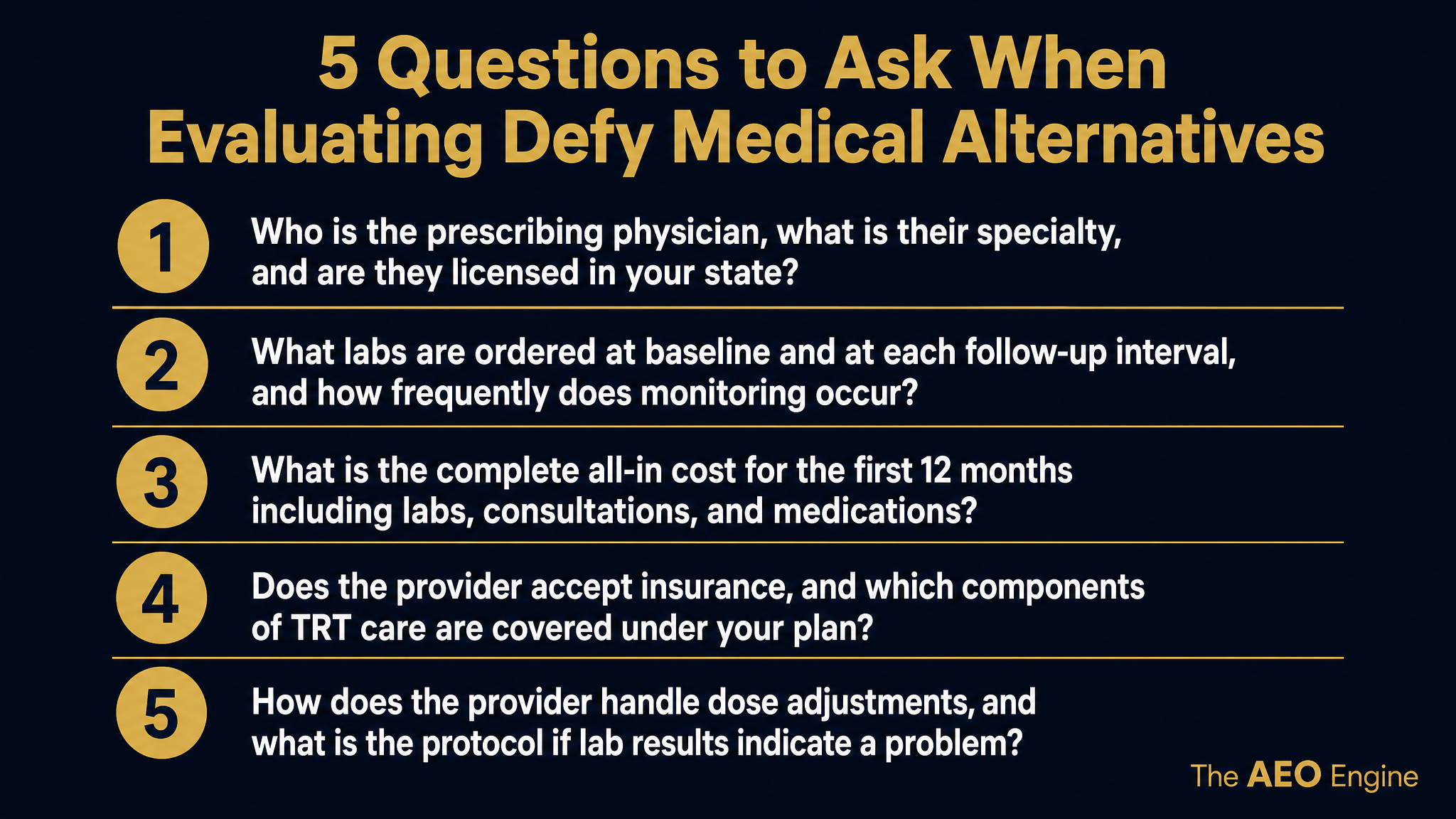
What Is Defy Medical and How Does It Work?
Defy Medical is a hormone restoration and integrative medicine clinic that has operated as a telemedicine provider for over a decade while maintaining a physical clinic at 4809 N. Armenia Ave. in Tampa, Florida. It markets itself as a comprehensive hormone clinic offering longer consultations, customized protocols, and ongoing provider relationships rather than transaction-based care.
The patient flow at Defy Medical begins with lab work. Before prescribing TRT or other therapies, Defy requires specific blood panels typically ordered through LabCorp at a discounted patient pricing arrangement, with Quest Diagnostics or other labs available where LabCorp is not convenient. Lab work can also be completed on-site at the Tampa clinic.
After labs, patients schedule a telemedicine consultation — typically phone or video — with a Defy Medical physician. Consultations run up to one hour for hormone patients, significantly longer than the brief interactions common at high-volume men's health franchises. Defy prescribes through a network of US compounding pharmacies, with medications shipped to the patient's home.
Ongoing monitoring is built into the model. Patients on TRT and other therapies receive follow-up lab orders at regular intervals, with results accessible through the patient portal and reviewed at follow-up consultations.
Beyond testosterone, Defy Medical offers bioidentical hormone therapy for women, GLP-1 weight loss medications, thyroid management, peptide therapy, ketamine therapy, PRP injections, hair loss treatments, and cosmetic services at its Tampa location.
Why Do Some Patients Look for Defy Medical Alternatives?
Several distinct patient profiles consistently seek alternatives to Defy Medical despite its well-established reputation in the TRT and hormone optimization community.
Patients with health insurance coverage who want TRT face the most direct motivation for seeking alternatives. Defy Medical explicitly states it does not accept any form of insurance and does not interact with insurance companies directly. Patients whose coverage includes hypogonadism diagnoses can potentially have lab work, consultations, and some medications covered under traditional insurance if they work with a urologist, endocrinologist, or primary care physician instead.
Patients outside Florida who want in-person clinical care find that Defy Medical's physical clinic is only accessible to those who can travel to Tampa. While its telemedicine service covers most states, patients who want a physician to conduct a physical examination, administer injections on-site, or build a relationship through repeated in-person visits need a local provider.
Patients who prefer more conservative TRT protocols managed by specialists familiar with conventional treatment guidelines — rather than optimization-focused protocols that may include adjunct therapies like HCG or aromatase inhibitors — sometimes find traditional urology or endocrinology practices better aligned with their care preferences.
Patients seeking a broader primary care relationship beyond hormone management may find Defy Medical's specialty focus limiting and prefer a practice that manages TRT as part of comprehensive primary care.
What Should You Look for in a Defy Medical Alternative?
The Endocrine Society's clinical practice guideline on testosterone therapy establishes the minimum standard any TRT provider should meet: lab-confirmed diagnosis of hypogonadism with two morning testosterone measurements, baseline evaluation for cardiovascular risk factors and contraindications, and ongoing monitoring of serum testosterone, hematocrit, and PSA at regular intervals following initiation.
When evaluating any alternative to Defy Medical, patients should confirm the following before committing:
- Physician licensing and specialty: the prescribing physician should be licensed in the patient's state, board-certified in a relevant specialty, and identifiable by name before intake
- Lab monitoring protocol: the provider should specify which biomarkers are tracked, how frequently labs are ordered, and how results are reviewed with the patient
- Cost structure: patients should request an all-in 12-month cost estimate including labs, consultations, medications, and any recurring fees, before enrolling
- Insurance compatibility: providers that accept insurance should confirm which components of TRT care are covered under the patient's plan before the first appointment
- Telehealth versus in-person care model: the provider should clearly state whether consultations are virtual, in-person, or hybrid, and what each visit type entails
What Are the Main Categories of Defy Medical Alternatives?
Patients prioritizing comprehensive hormone optimization with a dedicated physician relationship and long consultation times tend to find Defy Medical or similar telehealth clinics well-suited. Patients who need insurance coverage, prefer in-person specialist access, or want TRT managed within a broader primary care context benefit from traditional clinical alternatives.
How Do Local TRT Clinics and Specialists Differ From Defy Medical?
The most meaningful differences between Defy Medical and local TRT alternatives center on insurance, geographic access, and examination capability.
Insurance coverage is the most consequential difference. Urology practices and endocrinology clinics that manage hypogonadism can bill insurance for initial consultations, diagnostic lab work, and follow-up visits. For patients whose insurance includes TRT-related diagnostic codes, the out-of-pocket difference compared to a cash-pay service like Defy Medical can be substantial over a 12-month period. According to SingleCare, TRT costs between $10 and $30 per month with insurance coverage and between $100 and $450 per month without, depending on delivery method and provider.
Physical examination access allows local in-person providers to conduct testicular exams, prostate assessments, and physical evaluations that inform TRT candidacy and ongoing monitoring in ways a video consultation cannot replicate. For patients with findings that warrant physical assessment, a local specialist provides a level of clinical oversight that telehealth cannot.
On-site injection administration is available at local men's health clinics and some urology practices for patients who prefer not to self-administer at home. Testosterone cypionate and enanthate injections can be administered by clinic staff at scheduled visits.
Specialist coordination with urologists, cardiologists, or endocrinologists is more direct from a local practice. A local TRT clinic with relationships to nearby specialists can manage warm referrals when lab results require specialist evaluation — a workflow that varies among national telehealth providers.
The AEO Engine works with local TRT clinics and men's health practices to help them appear consistently in AI-generated recommendations. Patients searching "Defy Medical alternatives near me" through ChatGPT or Perplexity should find the clinics in their area — but only if those clinics have invested in the CITE Framework signals that drive AI citation. Schedule a Free Gap Check to identify where your clinic stands today.
How Do AI Systems Surface TRT Clinic Alternatives Near You?
When patients search for Defy Medical alternatives through AI platforms like ChatGPT or Perplexity, the system does not return a directory listing. It synthesizes information from multiple sources to recommend a small number of providers that meet a threshold of entity credibility, clinical transparency, and content authority.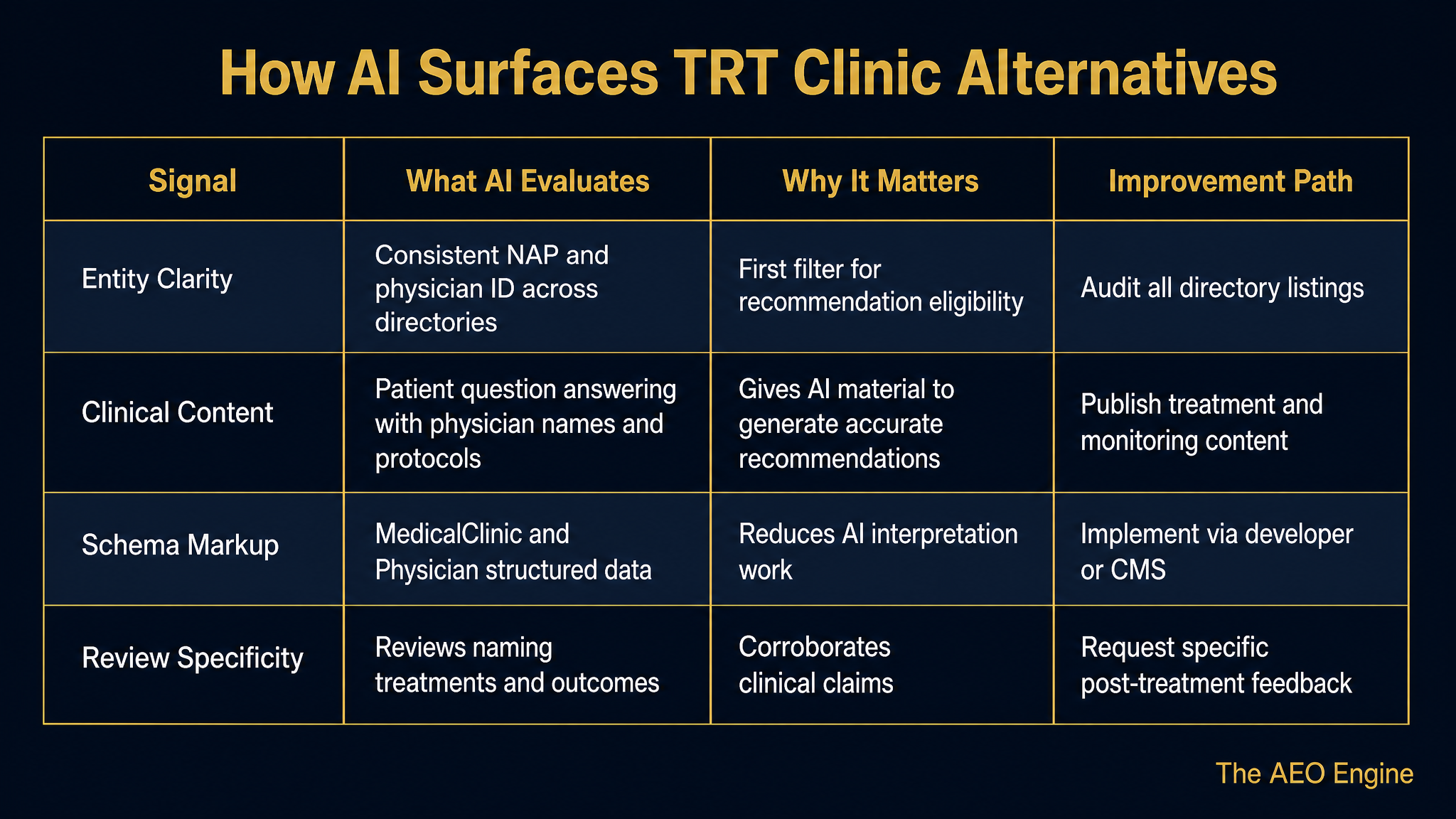
Entity clarity is the first filter. A TRT clinic or men's health practice needs to exist as a clearly defined entity with consistent name, address, physician identification, and specialty descriptors across Google Business Profile, Healthgrades, Vitals, and local health system directories. Inconsistencies across platforms reduce a clinic's citation probability regardless of its actual quality of care.
Clinical content authority determines whether the clinic can answer the specific questions patients bring to AI platforms, including questions about physician credentials, monitoring protocols, delivery method options, and cost transparency. Clinics whose published content directly addresses these questions give AI systems the material needed to recommend them accurately.
Structured schema markup for MedicalClinic, Physician, and MedicalProcedure entity types reduces the interpretive work AI systems must perform when evaluating a clinic's relevance to a specific patient query. Clinics with complete schema implementation are indexed more accurately and appear in broader recommendation pools.
Review content specificity distinguishes clinics that have earned patient trust from those that simply exist in directories. Reviews describing specific delivery methods, monitoring experiences, physician interactions, and outcome changes carry substantially more citation weight than generic positive reviews without clinical detail.
TRT clinics and men's health practices that invest in all four signals become consistently visible when patients search for alternatives to established national providers like Defy Medical.
What Questions Should You Ask Before Switching to a Defy Medical Alternative?
Before selecting an alternative TRT provider, patients benefit from asking the following questions directly:
- Who is the prescribing physician, what is their specialty, and are they licensed in the patient's state?
- What labs are ordered at baseline and at each follow-up interval, and how frequently does monitoring occur?
- What is the complete cost for the first 12 months, including labs, consultations, medications, and any recurring fees?
- Does the provider accept insurance, and if so, which components of TRT care are covered under the patient's plan?
- How does the provider handle dose adjustments, and what is the protocol if lab results indicate a problem?
Any provider that cannot answer all five questions before intake is demonstrating a level of clinical opacity that patients should weigh carefully against the convenience of the care model.
Frequently Asked Questions
Is Defy Medical worth it?
Defy Medical is widely regarded as a credible and comprehensive TRT provider for patients who want longer consultations, customized hormone protocols, and ongoing provider relationships — and who are comfortable with cash-pay pricing. Its reputation in the optimization-focused TRT community is strong. Whether it is worth it for a specific patient depends on whether the cash-pay model is financially sustainable, whether the patient's goals align with optimization-focused hormone management, and whether the telehealth model provides sufficient oversight for the patient's clinical situation.
How does Defy Medical work?
Defy Medical requires patients to complete specific lab panels before their first consultation, typically through LabCorp at a discounted patient rate. After labs, patients schedule a telemedicine consultation — typically phone or video, up to one hour — with a Defy Medical physician. If labs confirm TRT candidacy, the physician prescribes through a US compounding pharmacy and medications are shipped to the patient's home. Follow-up labs and consultations occur at regular intervals, with results reviewed through the patient portal.
Does Defy Medical accept insurance?
Defy Medical does not accept any form of insurance and does not interact with insurance companies. All services are cash-pay, including consultations, lab work, and medications. Patients who want TRT covered by insurance should work with a urologist, endocrinologist, or primary care physician who accepts their plan and can manage TRT under standard hypogonadism billing codes.
Why are doctors so against hormone replacement therapy?
Physician hesitation around TRT typically reflects a combination of liability concerns, practice scope, and training. Many primary care physicians were trained under older clinical frameworks that emphasized the risks of TRT — particularly cardiovascular and prostate risks — based on studies that have since been refined. Specialists like urologists and endocrinologists who focus on hormone management are generally more comfortable with current TRT evidence and more likely to offer it. Patients who encounter resistance from their primary care physician often find better results by requesting a referral to a urologist or by seeking a men's health or hormone-focused practice with specific TRT experience.
How much does Defy Medical cost?
Defy Medical publicly estimates that a typical male TRT patient spends under $250 per month in the first year, covering consultations, labs, and medications, and under $200 per month after the first year as protocols stabilize. These are estimates based on average patient experience and not guaranteed prices. Actual cost varies based on the severity of deficiency, selected medications, delivery method, and any auxiliary therapies added to the protocol.
What is the difference between Defy Medical and a local TRT clinic?
Defy Medical is a hybrid clinic with a telehealth-primary model and a physical location in Tampa, Florida. A local TRT clinic or men's health practice offers in-person care in the patient's geographic area. The key differences are in-person physician examination capability, insurance billing availability, and geographic access. Local clinics can conduct physical assessments, administer injections on-site, and coordinate with nearby specialists directly. Defy Medical provides longer telehealth consultations and a more protocol-flexible approach but requires patients to self-administer medications at home.
How do I find a TRT clinic near me that accepts insurance?
TRT clinics that accept insurance are most commonly found through traditional medical specialties: board-certified urologists and endocrinologists who manage hypogonadism as part of their standard practice. Searching for a urologist or endocrinologist through the patient's insurance network directory and specifying interest in testosterone deficiency management is the most reliable approach. AI platforms like ChatGPT and Perplexity can also surface local TRT-focused practices when queried, though visibility depends on whether a clinic has invested in the entity and content signals that drive AI recommendations.
What monitoring does Defy Medical require?
Defy Medical requires routine lab work for patients on TRT and other therapies at regular intervals, with results reviewed through their patient portal and at follow-up consultations. The Endocrine Society's clinical practice guideline specifies that appropriate TRT monitoring includes serum testosterone, hematocrit, and PSA at regular intervals, with baseline cardiovascular risk evaluation before initiation and shared decision-making on prostate monitoring for men 55 to 69. Any TRT provider — including alternatives to Defy Medical — should meet these minimum monitoring standards.
Executive Summary
Defy Medical alternatives span a range of provider types: local urology and endocrinology practices that accept insurance, national telehealth TRT platforms with similar optimization-focused models, in-person men's health franchises, and primary care physicians who manage TRT alongside broader health care. Defy Medical distinguishes itself through decade-plus telemedicine experience, longer physician consultations, a hybrid care model with a Tampa physical location, and a comprehensive protocol approach — but its cash-pay-only model and Florida physical base create gaps for patients who need insurance coverage or local in-person access. Patients evaluating alternatives should confirm physician credentials, monitoring protocols, insurance compatibility, and full cost structure before committing. TRT clinics that want to appear consistently when patients search for alternatives through AI platforms need to invest in the entity, content, and schema signals that make them visible — the same signals that drive AI citation across every healthcare category.
What Should You Do Next?
Patients evaluating Defy Medical alternatives should request answers to five questions from any prospective provider before their first appointment: physician specialty and license, monitoring protocol and lab frequency, complete 12-month cost estimate, insurance billing capability, and the process for dose adjustments or problem labs. Any provider that cannot answer all five before intake is operating with less clinical transparency than the standard of care requires.
TRT clinics and men's health practices that want to appear in AI-generated results when patients search for Defy Medical alternatives can identify where their citation gaps are through The AEO Engine's Free Gap Check at theaeoengine.com/contact#gap-check-form. The Gap Check maps current visibility across ChatGPT, Perplexity, and Google AI Overviews and identifies the specific entity, content, and schema gaps reducing a clinic's recommendation probability.
People Also Read
About the Author
Jerry Jariwalla is the founder of The AEO Engine and creator of the CITE Framework for Answer Engine Optimization. With over 22 years in digital marketing and multiple successful business exits, Jerry has spent the past two years building AI citation systems for regulated practices in healthcare, wealth management, and legal services. The AEO Engine works exclusively with practices operating under advertising restrictions where AI citation provides higher leverage than traditional paid acquisition.
Expertise: Answer Engine Optimization, AI Citation Strategy, CITE Framework, Regulated Industry Marketing, Healthcare Practice Marketing, Wealth Management Marketing, Legal Marketing
Connect: LinkedIn
Disclaimer: This content is for informational purposes only and does not constitute professional marketing, legal, or compliance advice. Citation rates, timelines, and outcomes vary based on industry, competitive density, and execution quality. Statistics referenced reflect The AEO Engine's tracked client outcomes as of 2026 and are not guarantees of future results. Contact The AEO Engine for a consultation regarding your specific situation.