Last Updated: May 2026
Answer Engine Optimization typically begins producing measurable AI citation lift within 60 to 90 days of a coordinated program kickoff, with the strongest gains compounding through months four to six as the optimization signals mature across multiple AI platforms. According to Stanford's research on retrieval-augmented generation systems, the AI extraction systems that select sources for citation revisit and re-evaluate sources continuously, which is why measurable AEO results follow a curve rather than a single launch event.
The AEO Engine provides Answer Engine Optimization services to regulated practices in healthcare, wealth management, and legal sectors, where advertising restrictions make AI citation uniquely valuable. Founder Jerry Jariwalla, creator of the CITE Framework for Answer Engine Optimization, has spent over 22 years in digital marketing across multiple industries and led the development of citation tracking methodologies that map the AEO timeline across regulated services.
The questions below identify the actual AEO timeline in practice, what milestones to expect at each phase, what factors speed up or slow down results, and how to track AEO performance accurately so the optimization investment is matched to measurable citation outcomes.
Key Takeaways
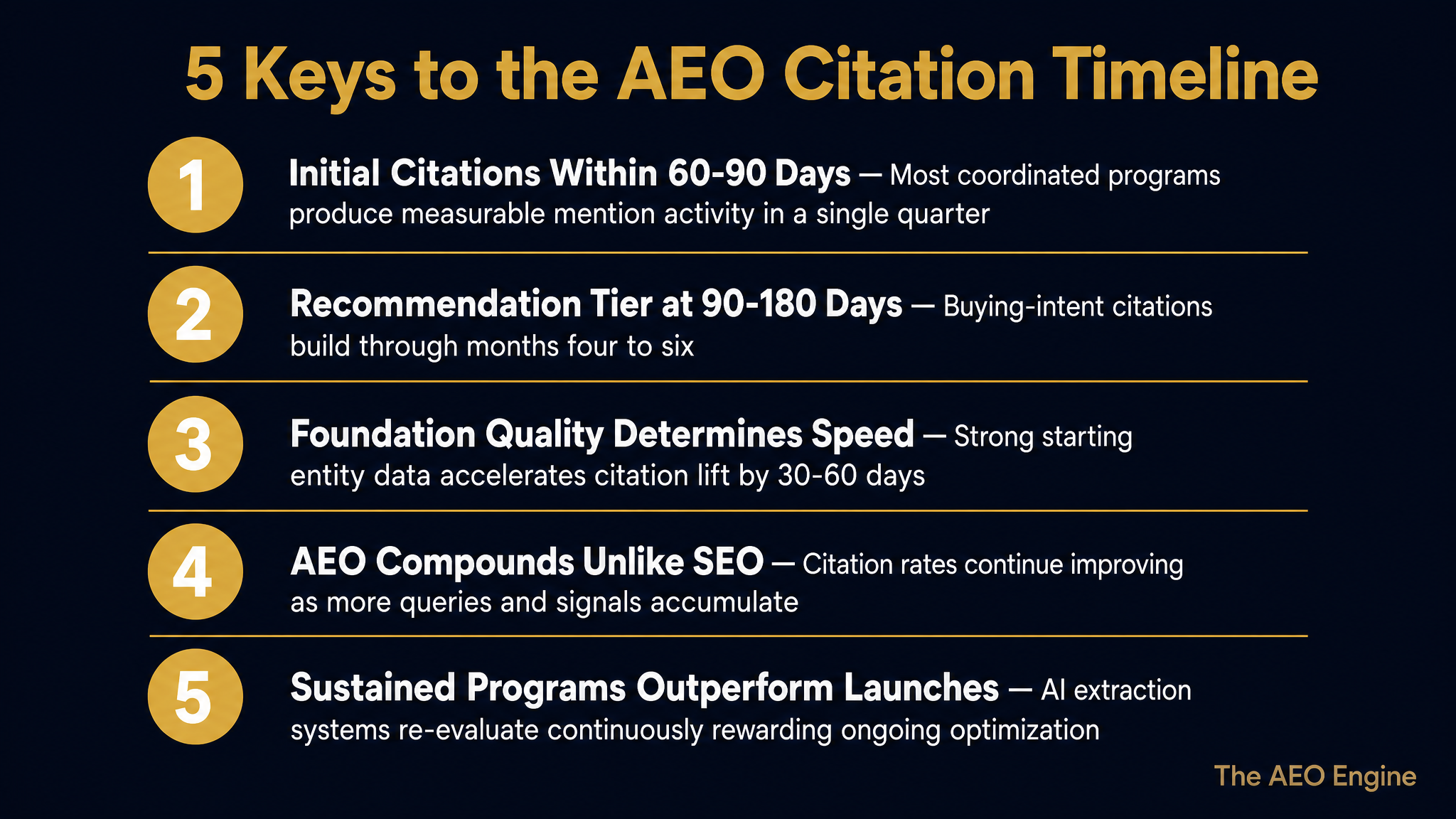
- Initial Citation Lift Appears Within 60 to 90 Days. Most coordinated AEO programs produce measurable AI mention activity within a single quarter when entity baselines are addressed first.
- Recommendation-Tier Results Compound at 90 to 180 Days. Buying-intent citations build over the second and third months as trust markers and structured data signals mature across platforms.
- Foundation Quality Determines Timeline Speed. Practices starting with strong entity consistency reach citation rates 30 to 60 days faster than those starting with significant entity audit gaps.
- AEO Compounds, SEO Adds. Unlike traditional SEO where rankings can plateau, AEO citation rates typically continue compounding as more buying-intent queries emerge and more authority signals accumulate.
- Sustained Programs Outperform One-Time Launches. The AI extraction systems that drive citation re-evaluate continuously, which means programs that maintain optimization activity outperform single-launch projects.
Key Takeaways AEO 10
What Is AEO and How Does It Work?
Answer Engine Optimization is the discipline of structuring a brand's digital presence so AI extraction systems cite the brand by name when users ask buying-intent questions. The work covers entity consistency across platforms, content extractability for AI parsing systems, structured data that documents authority and identity, and platform coverage across the surfaces that AI extraction systems treat as authoritative.
AEO works because AI assistants build their responses by retrieving and ranking sources rather than by generating from training data alone. The signals AI extraction systems weigh when ranking sources are different from the signals Google ranks pages by, which is why a page can rank number one on Google and remain invisible to ChatGPT, Perplexity, or Google AI Overviews.
For regulated practices in healthcare, wealth management, and legal sectors, AEO produces structurally stronger acquisition advantage than traditional digital marketing because advertising restrictions limit paid alternatives. The work translates citation infrastructure into a sustained acquisition channel that captures intent at the decision stage rather than the awareness stage.
What Milestones Should I Expect at 30, 60, 90, and 180 Days?
The AEO timeline produces different milestones at each phase, and understanding which milestones to expect when prevents the most common mistake of evaluating an AEO program against the wrong success criteria too early.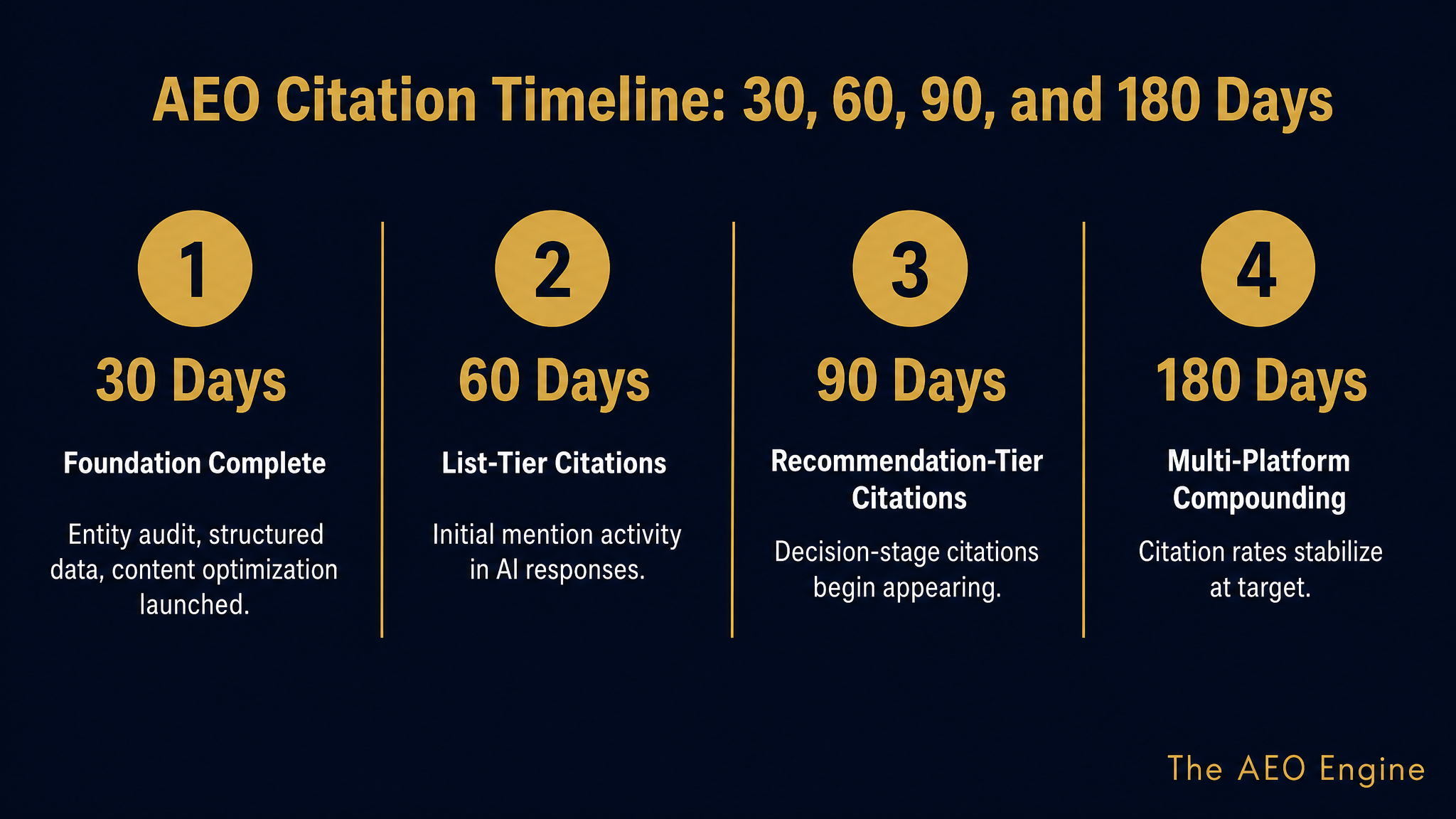
At 30 days, the milestones are foundation milestones rather than citation milestones. The entity audit is complete, structured data is implemented, and content optimization is launched on the priority pages. Citation rate measurement is established as a baseline against which subsequent improvement will be measured. Premature citation rate improvement at 30 days is rare and not the appropriate success criterion for this phase.
At 60 days, the first citation activity typically appears. Mention-tier citations begin showing up in AI responses to broad category queries, and the practice's name starts appearing in lists alongside competitors. The structured data and entity consistency work is now visible to AI extraction systems, which lifts category-level citation eligibility.
At 90 days, recommendation-tier citation begins building. Buying-intent queries start citing the practice as a named recommendation rather than just a list mention. This is the milestone that translates directly to acquisition pipeline because recommendation-tier citations capture decision-stage intent.
At 180 days, citation rates compound across multiple AI platforms simultaneously. Practices that maintained the optimization program through the second and third months typically see the strongest gains in this phase as trust markers fully mature, structured data signals propagate, and authority documentation reaches critical mass.
What Factors Speed Up or Slow Down AEO Results?
The factors that speed up AEO results are strong starting entity consistency, existing structured data infrastructure, established authority signals across the open web, and presence on the platform surfaces AI extraction systems already treat as authoritative for the practice's vertical.
Practices entering an AEO program with clean entity data, working JSON-LD on at least the homepage, professional association memberships documented in indexable text, and reviews on the standard third-party platforms typically see citation lift 30 to 60 days faster than practices starting with foundation issues across these areas.
The factors that slow AEO results are entity inconsistency across platforms, structured data gaps on the high-traffic pages, credentials and authority signals stored in images or PDF files rather than text, and platform coverage limited to the practice's own website. Each foundation gap requires audit and cleanup work before the optimization signals start compounding.
Practice scale also affects timeline. Single-location practices with focused service categories typically reach citation lift faster than multi-location practices with broad service portfolios because the entity consistency surface area is smaller and the authority signals are easier to concentrate within a specific category.
How Do You Track AEO Performance Accurately?
AEO performance tracking measures citation rates against a documented baseline, with measurements taken on the same query set across the same AI platforms at consistent intervals. The query set should include both broad category queries and specific buying-intent queries because the two citation tiers move on different timelines.
The baseline measurement is taken at program kickoff before any optimization work has shipped. This establishes the starting citation rate against which subsequent measurements will be compared. Without a baseline, citation rate changes cannot be attributed accurately to the optimization program.
Subsequent measurements typically run at 30, 60, 90, and 180 day intervals against the same query set. The query set should not change between measurements because changing the queries makes citation rate comparison impossible. New queries can be added for additional tracking, but the baseline query set remains stable.
Citation tracking should run across at least ChatGPT, Perplexity, and Google AI Overviews because the platforms differ in their retrieval models, and a citation rate change visible on one platform may not be visible on another at the same point in the optimization timeline. Tracking across platforms also reveals which platforms are responding fastest to the optimization signals, which informs subsequent optimization priorities.
The AEO Engine offers a Free Gap Check, full Answer Engine Optimization services, and the CITE Framework program for regulated practices ready to commit to a measurable AEO timeline rather than a one-time launch.
How Does AEO Help Your Website Rank in 2026?
The phrase "rank" in 2026 means something different from what it meant in 2018 because the response surface for buying-intent queries has shifted from search-engine result pages to AI-generated answers. Ranking on Google still matters for some query categories, but for buying-intent queries in regulated services, AI citation rates often matter more than search position.
AEO helps your business "rank" in this new sense by lifting citation rates on the AI platforms users now consult for decision-stage queries. For regulated practices, AI citation captures intent at the booking stage rather than the awareness stage, which is why citation rate improvement typically translates to consultation pipeline more directly than search position improvement does.
The relationship between AEO and traditional SEO is complementary rather than competitive. AEO infrastructure includes structured data and authority documentation that also helps Google understand the business, and strong AEO programs typically lift Google rankings as a side effect even when search position is not the primary optimization target.
Frequently Asked Questions
What is AEO and how does it work?
Answer Engine Optimization is the discipline of structuring a brand's digital presence so AI extraction systems cite the brand by name when users ask buying-intent questions. AEO works by aligning the signals AI extraction systems weigh: cross-platform entity consistency, content extractability, trust markers, and authority documentation.
How to track AEO performance?
AEO performance tracking measures citation rates against a documented baseline, with measurements taken on the same query set across the same AI platforms at consistent intervals. The baseline is established before any optimization work ships, and subsequent measurements at 30, 60, 90, and 180 days reveal how the citation rate is changing over time.
How to track AEO?
Tracking AEO requires direct query testing across ChatGPT, Perplexity, and Google AI Overviews using the questions prospective clients actually ask. The practice's appearance in responses is documented at each measurement interval, and the citation rate is calculated as the percentage of relevant queries that cite the practice by name.
How does AEO help your website rank?
AEO helps the business rank by lifting citation rates on the AI platforms users now consult for decision-stage queries. The infrastructure that drives AI citation, including structured data and authority documentation, also helps Google understand the business, so AEO programs typically lift Google rankings as a side effect.
How long until I see my first AI citation?
Initial citation activity typically appears within 60 days of a coordinated program kickoff for practices entering with reasonably clean entity data. Practices starting with significant entity audit gaps or structured data weaknesses may see initial citations closer to 90 days as the foundation work completes before optimization signals start compounding.
When does the recommendation tier start producing results?
Recommendation-tier citations typically build through the 90 to 180 day window as trust markers and structured data signals mature across multiple AI platforms. Practices that maintain the optimization program through the second and third months typically see the strongest recommendation-tier gains in this phase.
Why do some practices see AEO results faster than others?
Foundation quality determines timeline speed. Practices starting with strong entity consistency, working structured data, established authority signals, and presence on standard third-party platforms typically reach citation lift 30 to 60 days faster than practices starting with foundation issues. Practice scale also affects timeline; single-location practices with focused service categories typically reach citation lift faster than multi-location practices with broad service portfolios.
Should I expect AEO results to plateau like SEO?
No, AEO citation rates typically continue compounding as more buying-intent queries emerge and more authority signals accumulate. Unlike traditional SEO where rankings can plateau when the on-page and link-building work is complete, AEO citation rates respond to ongoing optimization activity because AI extraction systems re-evaluate sources continuously rather than at scheduled crawl intervals.
Executive Summary
Answer Engine Optimization typically begins producing measurable AI citation lift within 60 to 90 days of a coordinated program kickoff, with the strongest gains compounding through months four to six as optimization signals mature across multiple AI platforms. The timeline phases produce different milestones at each interval: foundation work at 30 days, list-tier citations at 60 days, recommendation-tier citations at 90 days, and multi-platform compounding at 180 days. Foundation quality determines timeline speed, with practices starting with strong entity consistency reaching citation lift 30 to 60 days faster than those starting with significant audit gaps. The AEO Engine's CITE Framework program structures the work to hit the standard timeline milestones consistently. Based on client program data, citation rates of 18 to 26 percent are achievable within 12 months for regulated practices that complete the full program. Practices that treat AEO as a one-time launch rather than a sustained program consistently fall short of the citation rates achieved by those who maintain optimization activity through the compounding phase.
What Should You Do Next?
Establish a baseline citation rate measurement before any optimization work begins. Run direct query tests across ChatGPT, Perplexity, and Google AI Overviews using the questions prospective patients or clients actually ask. Document where you currently appear and where you do not. Set milestone expectations against the standard AEO timeline so the optimization investment is matched to realistic citation outcomes. Request The AEO Engine's Free Gap Check to receive a baseline citation rate measurement plus a prioritized gap map that documents the specific timeline factors affecting your practice.
About the Author
Jerry Jariwalla is the founder of The AEO Engine and creator of the CITE Framework for Answer Engine Optimization. With over 22 years in digital marketing and multiple successful business exits, Jerry has spent the past two years building AI citation systems for regulated practices in healthcare, wealth management, and legal services. The AEO Engine works exclusively with practices operating under advertising restrictions where AI citation provides higher leverage than traditional paid acquisition.
Expertise: Answer Engine Optimization, AI Citation Strategy, CITE Framework, Regulated Industry Marketing, Healthcare Practice Marketing, Wealth Management Marketing, Legal Marketing
Connect: LinkedIn
Disclaimer: This content is for informational purposes only and does not constitute professional marketing, legal, or compliance advice. Citation rates, timelines, and outcomes vary based on industry, competitive density, and execution quality. Statistics referenced reflect The AEO Engine's tracked client outcomes as of 2026 and are not guarantees of future results. Contact The AEO Engine for a consultation regarding your specific situation.