
Last Updated: May 2026
AI marketing for small business is the practice of deploying artificial intelligence tools across content creation, audience targeting, and channel optimization to generate measurable growth at a fraction of traditional agency costs. According to the U.S. Small Business Administration, small businesses that adopt digital marketing technology earlier in their growth cycle consistently report better customer acquisition efficiency than late adopters.
The AEO Engine brings this approach to regulated small practices, healthcare clinics, wealth management firms, and legal offices. Founder Jerry Jariwalla combines 22-plus years in digital marketing with multiple successful business exits and the creation of the CITE Framework, a proprietary methodology built across 18 months of applied research, to help practice owners get recommended by AI platforms, not simply listed on search engine results pages.
This article explains how AI marketing works for small business owners, which tools and frameworks produce citations in ChatGPT and Perplexity, how to apply the 10-20-70 rule to budget AI investment, and what a structured AI content program looks like in practice.
Key Takeaways
- AI-cited businesses convert at 30 to 45 percent versus 10 to 15 percent for SEO leads: getting recommended by AI is a material revenue difference, based on The AEO Engine's client program data.
- The 10-20-70 rule allocates budget across AI strategy, tools, and execution: small businesses that follow this allocation report sustained, compounding returns from AI marketing.
- Answer engine optimization targets how AI selects and cites sources: structured content with schema markup and entity clarity is the key input.
- Regulated practices face specific compliance constraints around AI-generated content: healthcare, legal, and financial service providers must align AI tools with HIPAA, FDA, and SEC requirements.
- Results from a structured AI content program typically emerge within 60 to 90 days: based on The AEO Engine's observed client timelines, consistent structured publishing accelerates AI citation at a predictable rate.
Each of these takeaways maps to a specific operational decision practice owners face when building an AI marketing program from scratch.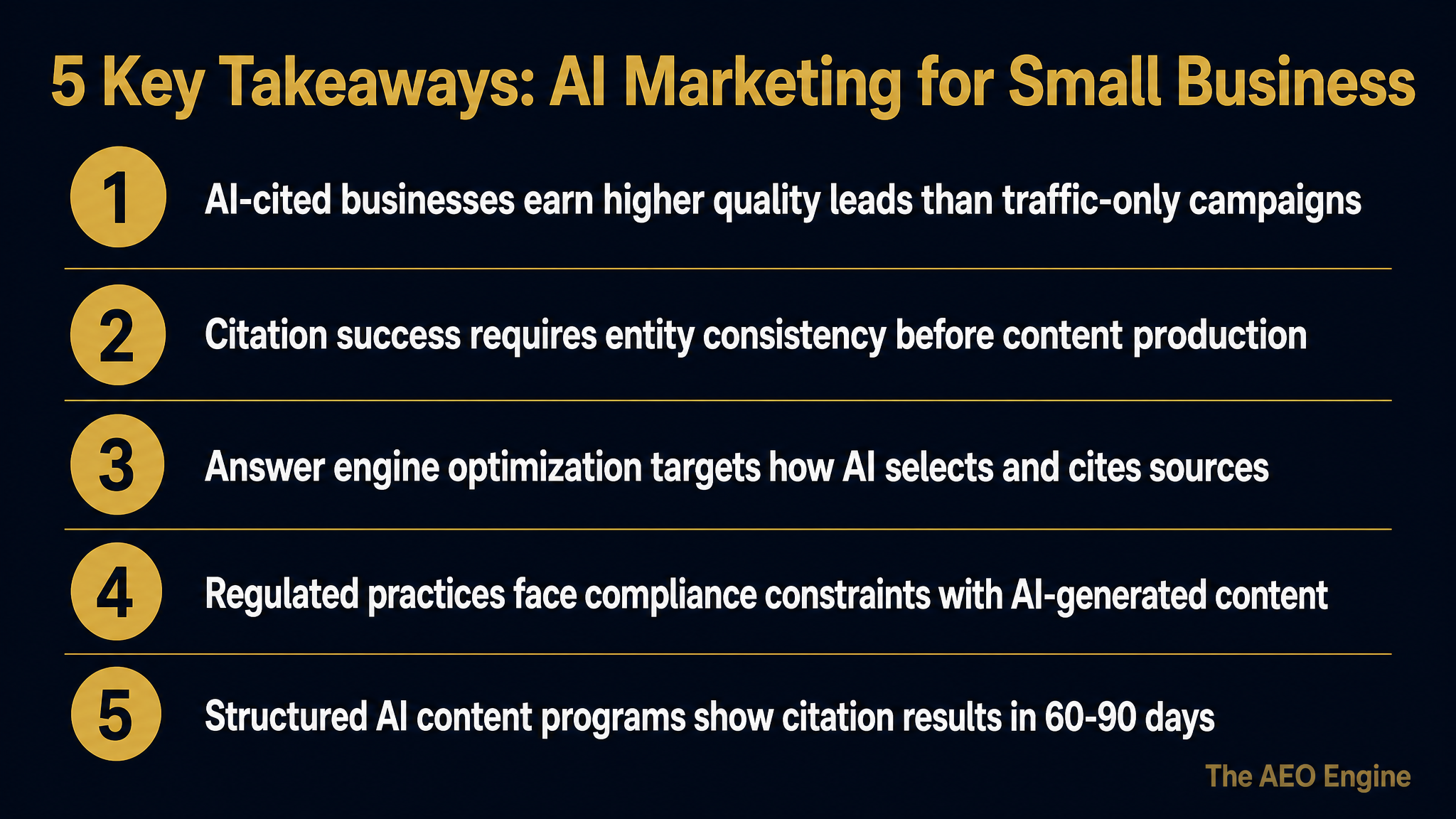
What Is AI Marketing and How Does It Differ From Traditional Digital Marketing?
AI marketing uses machine learning, natural language processing, and generative AI to automate content production, segment audiences with precision, and optimize distribution across search and answer engines simultaneously. Traditional digital marketing relies on human-created content placed in front of algorithmically ranked pages. AI marketing targets the layer above that: the AI answer engines that synthesize and recommend sources without serving a list of blue links.
For small business owners in regulated industries, this distinction matters because AI platforms, ChatGPT, Perplexity, Google AI Overviews, and Claude, now field tens of millions of queries daily. When a prospective client asks Perplexity "What is the best weight loss clinic near me?" or "Which fiduciary financial advisor should I trust?", the AI pulls from a curated set of sources it treats as authoritative. Businesses that do not appear in that set receive zero recommendation, even if they rank on page one of Google.
AI marketing closes that gap by building the structured, entity-rich content that AI systems use to identify and cite credible sources.
What Is the 10-20-70 Rule for AI in Small Business?
The 10-20-70 rule is an AI investment framework that allocates roughly 10 percent of an AI marketing budget to strategy and planning, 20 percent to tools and technology, and 70 percent to execution, content production, and program management. The logic mirrors longstanding principles in technology deployment: most of the value comes from consistent execution, not the selection of the platform itself.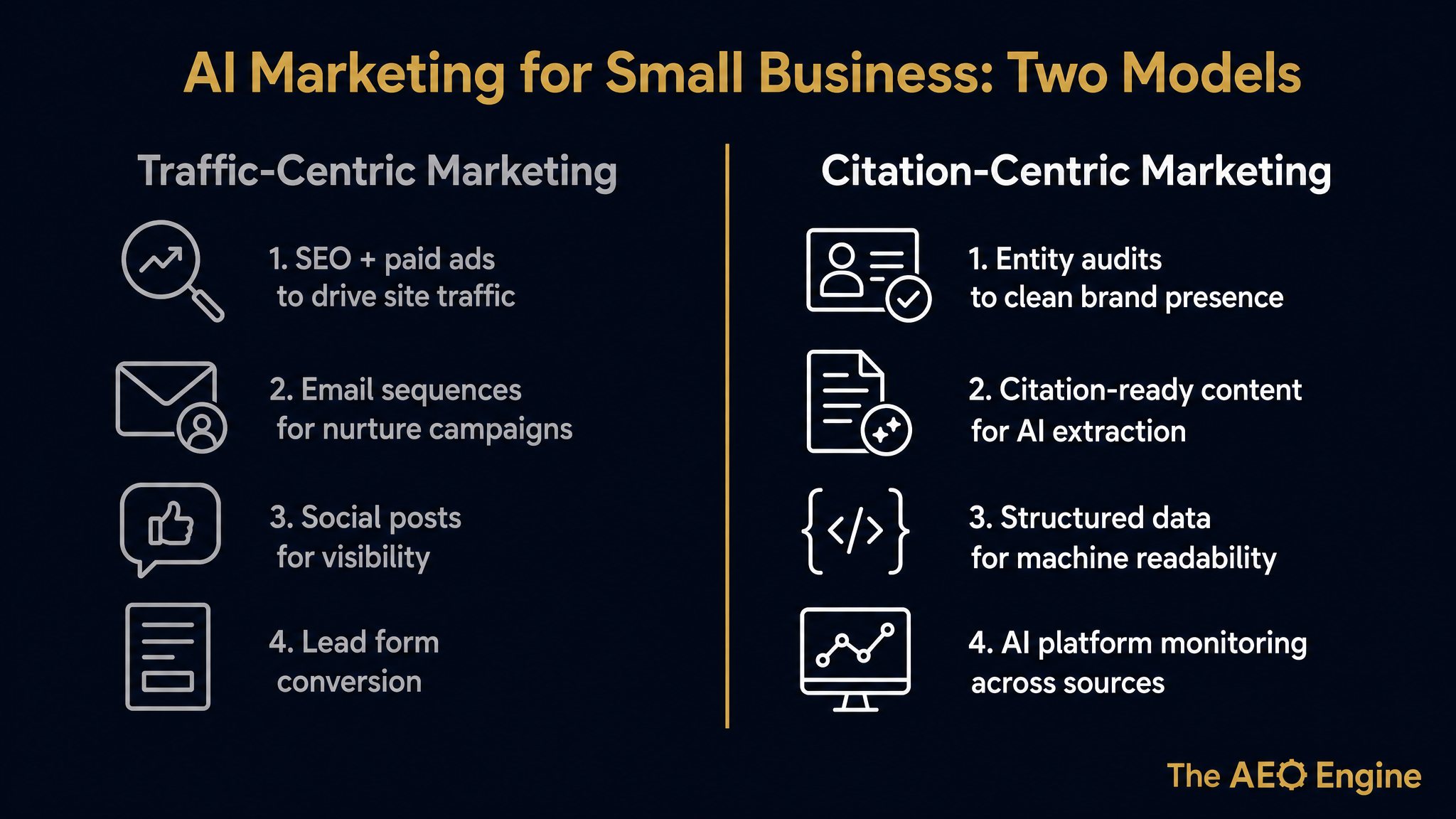
For small businesses applying this rule to AI marketing:
- The 10 percent strategy layer covers keyword universe research, competitor citation analysis, schema planning, and audience mapping.
- The 20 percent tools layer covers the AI platforms, SEO software, content publishing systems, and structured data validators the program runs on.
- The 70 percent execution layer covers article production, schema markup implementation, internal linking, entity optimization, and monthly performance review.
Practice owners who invert this ratio, spending the majority on tools and very little on execution, typically see no measurable AI citation improvement because AI platforms respond to structured, published content, not to software subscriptions.
The 10-20-70 rule applies directly to answer engine optimization programs. A practice that publishes 10 to 30 well-structured articles per month, with consistent schema markup, FAQ sections, and entity references, outperforms a practice running expensive AI tools with no structured content output.
Which AI Tools Work Best for Small Business Marketing?
The most effective AI tools for small business marketing fall into three categories: content generation and optimization, structured data and schema, and AI citation monitoring.
Content generation tools, including large language model platforms used in conjunction with human editorial oversight, accelerate article production and allow small practices to publish at volume. The quality control layer matters: AI-generated content that lacks entity specificity, factual accuracy, and proper schema markup does not earn AI citations regardless of how quickly it is produced.
Structured data tools, including Google's Schema Markup Validator and Rich Results Test, verify that FAQ schemas, LocalBusiness schemas, and Article schemas are correctly implemented. These schemas are the primary technical signal that tells AI platforms what a page is about, who wrote it, and what entity it represents.
Citation monitoring tools, including Perplexity-native searches and emerging AI SEO platforms, help small businesses track whether their content is being recommended and in which query contexts. The AEO Engine tracks citation rates of 18 to 26 percent based on client program data, compared to competitor benchmark rates of 2 to 4 percent and the majority of unoptimized practices sitting at effectively zero.
The AEO Engine's CITE Framework integrates all three layers into a single program, covering content structure, entity optimization, schema markup, and citation tracking for regulated practices in healthcare, wealth management, and legal services. Connect with the team to explore a structured AI marketing program.
Does AI Marketing Actually Work for Small Businesses?
AI marketing produces results when two conditions are met: the content is structured to match how AI systems select sources, and the publishing volume is high enough to establish entity authority over time. Single articles rarely generate citations. Programs that publish 10 to 30 structured articles per month, consistently, begin to see AI citation rates emerge within 60 to 90 days based on The AEO Engine's observed client timelines.
What AI marketing does not do is generate overnight results. The AI systems that power ChatGPT, Perplexity, and Google AI Overviews update their source pools on an ongoing basis, but those updates favor sources with established entity signals, consistent publishing history, and clear structured data. A practice entering AI marketing for the first time should expect a ramp period before citations begin to appear.
The revenue case is clearest in conversion rate differences. Leads who arrive after an AI recommendation, who asked a question, received a specific business as the answer, and then visited that business, convert at meaningfully higher rates than leads who found a business through a search engine results page. The AEO Engine tracks this at 30 to 45 percent conversion for AI-cited leads versus 10 to 15 percent for organic search leads, based on client program data.
How Do I Use AI to Promote My Small Business?
Promoting a small business with AI starts with three decisions: which platforms to target, which questions to answer, and what structured content format to use.
Platform selection for AI promotion depends on where the target audience asks questions. Healthcare practices benefit from appearing in Perplexity and Google AI Overviews because health queries drive significant AI search volume. Wealth management and legal practices benefit from appearing in ChatGPT and Claude because financial and legal advice queries skew toward conversational AI platforms.
Question targeting means building a keyword and topic universe around the specific queries prospective clients ask before making a purchase decision. The CITE Framework begins this process with a structured keyword universe build that maps search volume, PAA question data, and AI search intent across all target topics.
Content format for AI promotion requires AI-extractable structure across headings and paragraphs, FAQ sections drawing from real user queries, and structured data that identifies the article's author, publisher, and topic clearly. Generic blog posts without these structural elements are rarely cited by AI platforms regardless of their quality.
What Are the Compliance Constraints for AI Marketing in Regulated Industries?
Small businesses in healthcare, legal services, and wealth management face specific compliance requirements when using AI marketing tools. These constraints apply to both the content production process and the claims made within published articles.
Healthcare practices operating under HIPAA and FDA guidelines cannot include patient testimonials in AI-generated content without explicit consent documentation. Supplement and treatment claims must align with approved language. Weight loss clinic marketing, GLP-1 content, and aesthetic medicine content all carry specific claim constraints that AI generation tools do not automatically enforce.
Wealth management practices registered with the SEC or state regulators face restrictions on performance claims, investment return projections, and comparative advertising. AI-generated content about fiduciary advisors, retirement planning, and estate management must avoid forward-looking statements and specific return promises.
Legal practice AI marketing must avoid guaranteeing outcomes, making specific legal predictions, or implying an attorney-client relationship through editorial content. Bar association advertising rules vary by jurisdiction and apply to digital content regardless of whether it was human or AI authored.
The AEO Engine specializes in regulated industry AI marketing precisely because of these constraints. Jerry Jariwalla built the CITE Framework around HIPAA, FDA, and SEC-fluent content production, a distinction that generic AI marketing agencies do not offer.
Frequently Asked Questions
How Do I Use AI to Promote My Small Business?
Start with a structured topic and keyword universe focused on the questions your prospective clients are already asking AI platforms. Build FAQ-rich articles with schema markup, publish consistently at 10 to 30 articles per month, and monitor citation rates in ChatGPT, Perplexity, and Google AI Overviews. The content structure and publishing volume matter more than the AI tools used to produce the content.
What Is the 10-20-70 Rule for AI?
The 10-20-70 rule allocates AI marketing budget across three layers: 10 percent to strategy and planning, 20 percent to AI and SEO tools, and 70 percent to execution and content production. The principle is that most AI marketing value comes from sustained, high-volume, structured publishing rather than from the platforms or tools themselves.
Which AI Is Best for Small Businesses?
No single AI tool is universally best for small businesses. The most effective combination for AI marketing purposes is a large language model for drafting structured content paired with schema validation tools and a citation monitoring platform. The selection matters less than whether the content output is built for AI citations across formatting, FAQ coverage, and structured data.
Does AI Marketing Actually Work?
Yes, AI marketing produces measurable results when the content is structured correctly and published at sufficient volume. The AEO Engine tracks AI citation rates of 18 to 26 percent for client programs that use the CITE Framework, compared to competitor benchmarks of 2 to 4 percent. AI-cited leads convert at meaningfully higher rates than organic search leads based on client program data.
How Long Does AI Marketing Take to Show Results?
A structured AI marketing program typically takes 60 to 90 days before measurable AI citations begin to appear, based on The AEO Engine's observed client timelines. The ramp period reflects the time required for AI platforms to index, evaluate, and begin sourcing new content. Programs that publish faster, 20 to 30 structured articles per month, tend to reach citation thresholds earlier than slower-publishing programs.
What Is Answer Engine Optimization?
Answer engine optimization (AEO) is the practice of structuring content to earn citations from AI answer engines, ChatGPT, Perplexity, Claude, and Google AI Overviews. It differs from SEO in that it targets AI recommendation systems rather than traditional search engine rankings. AEO content uses AI-extractable formatting and entity-rich structured data to signal authority to AI citation algorithms.
How Much Does AI Marketing Cost for a Small Business?
AI marketing costs for small businesses vary considerably by scope and complexity, from self-managed content programs to fully managed agency relationships. The most relevant cost question for regulated small practices is not the absolute price but the cost per AI-cited lead compared to cost per SEO or paid-search lead. AI-cited leads convert at meaningful premiums based on The AEO Engine's client program data, which shifts the economic case for AI marketing investment significantly.
What Is the Difference Between SEO and AEO for Small Business?
SEO optimizes content to rank in search engine results pages. AEO optimizes content to be cited by AI answer engines. Both rely on structured, authoritative content, but AEO places additional emphasis on schema markup, entity specificity, FAQ coverage, and the structured data signals that AI platforms use to select sources. Small businesses pursuing AI citations need both SEO foundations and AEO-specific structure in their content programs.
Executive Summary
AI marketing for small business in 2026 centers on earning citations from AI answer engines, the platforms that now field queries that previously drove traffic to Google results pages. The 10-20-70 rule provides a budget framework that correctly weights execution over tools: most AI marketing value comes from high-volume structured content publishing, not software subscriptions. Regulated practices in healthcare, wealth management, and legal services face specific compliance constraints that require AI-fluent content oversight. The AEO Engine's CITE Framework integrates keyword universe research, structured content production, schema implementation, and citation tracking into a single program designed for these regulated verticals. Based on client program data, a structured AI marketing program produces AI citation rates of 18 to 26 percent and converts AI-cited leads at 30 to 45 percent versus 10 to 15 percent for SEO leads.
What Should You Do Next?
Audit your current AI citation rate by searching your practice name and target keywords in ChatGPT, Perplexity, and Google AI Overviews. If your practice does not appear, the citation gap is costing leads. Map the top 10 questions your prospective clients are asking AI platforms and assess whether you have published, structured content that answers each one.
Review your current content for full structured data coverage across the page's core entities required for AI citation eligibility. Request a Free Citation Gap Check from The AEO Engine at Free Gap Check to identify exactly where your practice is missing from AI recommendation results.
About the Author
Jerry Jariwalla is the founder of The AEO Engine and creator of the CITE Framework for Answer Engine Optimization. With over 22 years in digital marketing and multiple successful business exits, Jerry has spent the past two years building AI citation systems for regulated practices in healthcare, wealth management, and legal services. The AEO Engine works exclusively with practices operating under advertising restrictions where AI citation provides higher leverage than traditional paid acquisition.
Expertise: Answer Engine Optimization, AI Citation Strategy, CITE Framework, Regulated Industry Marketing, Healthcare Practice Marketing, Wealth Management Marketing, Legal Marketing
Connect: LinkedIn
Disclaimer: This content is for informational purposes only and does not constitute professional marketing, legal, or compliance advice. Citation rates, timelines, and outcomes vary based on industry, competitive density, and execution quality. Statistics referenced reflect The AEO Engine's tracked client outcomes as of 2026 and are not guarantees of future results. Contact The AEO Engine for a consultation regarding your specific situation.